
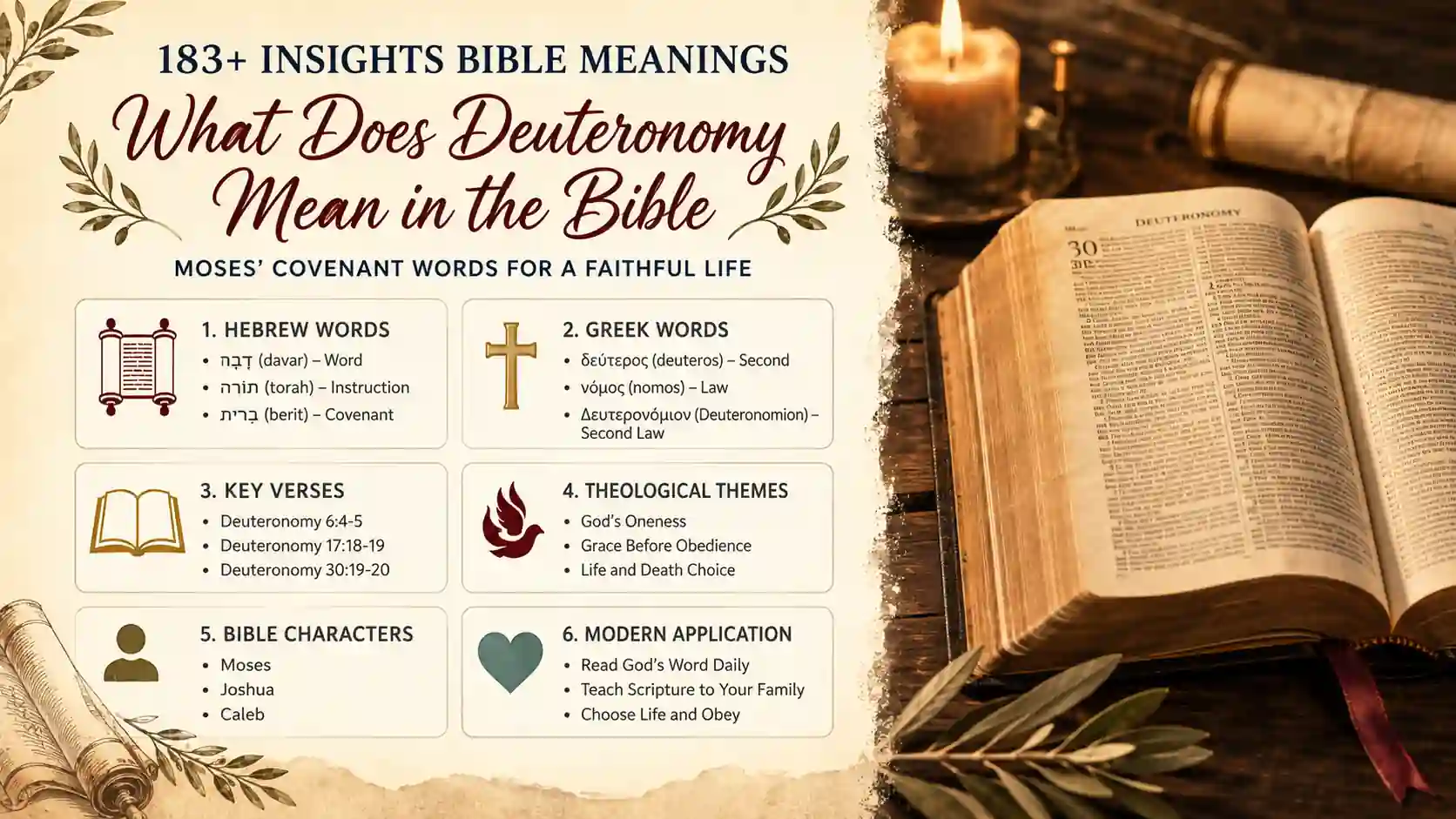
What does Deuteronomy mean in the Bible? The name comes from the Greek title Δευτερονόμιον, Deuteronomion, commonly understood as “second law” or “repeated law.” Yet the book is not a replacement for God’s earlier instruction. It is Moses’ covenantal restatement and application of that instruction to Israel’s new generation.
In Hebrew, the book is called דְּבָרִים, Devarim, meaning “words.” This title comes from its opening sentence and highlights the farewell words Moses spoke before Israel crossed the Jordan into Canaan.
Key Deuteronomy Scripture References
| Verse | Passage Snippet | Context |
|---|---|---|
| Deuteronomy 1:1 | “These are the words” | Moses begins his final addresses east of the Jordan |
| Deuteronomy 1:5 | Moses explained the law | The covenant teaching is clarified for a new generation |
| Deuteronomy 4:1 | Listen to the statutes | Israel must hear and obey before entering Canaan |
| Deuteronomy 5:1 | Hear the statutes and ordinances | Moses restates the covenant commandments |
| Deuteronomy 6:4-5 | The Lord is one | The Shema calls Israel to exclusive love and loyalty |
| Deuteronomy 17:18-19 | A copy of this law | Israel’s king must write, read, and obey the Torah |
| Deuteronomy 29:1 | Covenant in the land of Moab | Israel renews covenant commitment beyond Horeb |
| Deuteronomy 30:19-20 | Choose life | Moses places blessing and death before the people |
| Deuteronomy 31:9 | Moses wrote this law | The written Torah is entrusted to the priests |
| Deuteronomy 34:5 | Moses died there | The book closes with Moses’ death and Joshua’s succession |
Deuteronomy Bible Translation Comparison
| Verse | KJV | NIV | ESV | NASB |
|---|---|---|---|---|
| Deuteronomy 1:1 | “These be the words” | “These are the words” | “These are the words” | “These are the words” |
| Deuteronomy 1:5 | “declare this law” | “expound this law” | “explain this law” | “explain this Law” |
| Deuteronomy 4:1 | “hearken” | “hear” | “listen” | “listen” |
| Deuteronomy 6:4 | “The LORD our God is one LORD” | “The LORD is one” | “The LORD is one” | “The LORD is one” |
| Deuteronomy 6:5 | “all thy heart” | “all your heart” | “all your heart” | “all your heart” |
| Deuteronomy 17:18 | “a copy of this law” | “a copy of this law” | “a copy of this law” | “a copy of this Law” |
| Deuteronomy 29:1 | “beside the covenant” | “in addition to the covenant” | “besides the covenant” | “in addition to the covenant” |
| Deuteronomy 30:19 | “choose life” | “choose life” | “choose life” | “choose life” |
| Deuteronomy 31:9 | “Moses wrote this law” | “Moses wrote down this law” | “Moses wrote this law” | “Moses wrote this Law” |
| Deuteronomy 34:10 | “arose not a prophet” | “no prophet has risen” | “not arisen a prophet” | “no prophet has risen” |
People and Characters Associated with Deuteronomy
| Person | Role | Connection |
|---|---|---|
| Moses | Prophet and covenant mediator | Delivers the book’s major speeches and explains the Torah |
| Joshua | Moses’ successor | Commissioned to lead Israel across the Jordan |
| Aaron | High priest | His death recalls the passing wilderness generation |
| Eleazar | Priest | Represents the continuing priestly leadership |
| Caleb | Faithful spy | Receives a promise because he followed God wholeheartedly |
| Sihon | Amorite king | Defeated during Israel’s journey toward Moab |
| Og | King of Bashan | His defeat demonstrates God’s power and faithfulness |
| Levites | Priestly tribe | Guard, teach, read, and preserve the covenant law |
| Israel’s king | Future ruler | Commanded to write and study a personal copy of the Torah |
| The new generation | Covenant community | Hears Moses before entering the promised land |
Original Hebrew and Greek Words in Deuteronomy
| Original Word | Transliteration | Strong’s # | Literal Meaning |
|---|---|---|---|
| דָּבָר | davar | H1697 | Word, matter, speech |
| דְּבָרִים | devarim | H1697 | Words, the Hebrew book title |
| תּוֹרָה | torah | H8451 | Instruction, teaching, law |
| מִשְׁנֶה | mishneh | H4932 | Copy, repetition, double |
| בְּרִית | berit | H1285 | Covenant, binding agreement |
| שָׁמַע | shama | H8085 | Hear, listen, obey |
| אָהַב | ahav | H157 | Love, show covenant affection |
| δεύτερος | deuteros | G1208 | Second, next |
| νόμος | nomos | G3551 | Law, custom, instruction |
| Δευτερονόμιον | Deuteronomion | G1208 and G3551 | Second or repeated law |
The Greek name is connected with Deuteronomy 17:18, where the Hebrew expression מִשְׁנֵה הַתּוֹרָה, mishneh ha-torah, refers to a copy of the Torah for the king. The Greek tradition rendered the expression in a way that produced the familiar title “Deuteronomy.”
Related Biblical Concepts in Deuteronomy
| Concept | Connection | Supporting Verse |
|---|---|---|
| Torah | God’s instruction shapes Israel’s worship and public life | Deuteronomy 4:8 |
| Covenant | Israel belongs to God through a sworn relationship | Deuteronomy 29:1 |
| Shema | Hearing God includes faithful obedience | Deuteronomy 6:4 |
| Love of God | Covenant loyalty engages the whole person | Deuteronomy 6:5 |
| Remembrance | Israel must remember God’s saving acts | Deuteronomy 8:2 |
| Election | God chose Israel through grace rather than greatness | Deuteronomy 7:6-8 |
| Blessing and curse | Covenant choices carry real consequences | Deuteronomy 28:1-2 |
| Central worship | Sacrifice belongs at God’s chosen place | Deuteronomy 12:5-7 |
| Justice | Judges must decide cases impartially | Deuteronomy 16:18-20 |
| Teaching children | God’s words must pass to future generations | Deuteronomy 6:6-7 |
Historical and Cultural Context of Deuteronomy
| Aspect | Detail | Biblical Source |
|---|---|---|
| Location | Israel camps on the plains of Moab | Deuteronomy 1:5 |
| Time | Near the end of forty wilderness years | Deuteronomy 2:7 |
| Audience | Children of the exodus generation | Deuteronomy 1:35-39 |
| Speaker | Moses addresses the assembled nation | Deuteronomy 1:1 |
| Destination | Israel prepares to cross the Jordan | Deuteronomy 9:1 |
| Covenant setting | The Moab covenant renews Horeb obligations | Deuteronomy 29:1 |
| Political future | Laws anticipate judges, priests, prophets, and kings | Deuteronomy 16:18 through 18:22 |
| Public reading | Torah must be read during the Feast of Booths | Deuteronomy 31:10-13 |
| Written preservation | Levites place the law beside the ark | Deuteronomy 31:24-26 |
| Leadership transition | Joshua receives Moses’ commission | Deuteronomy 31:7-8 |
Deuteronomy’s speeches stand at the threshold between wilderness wandering and settled life in Canaan. Its covenant pattern includes historical review, commands, blessings, curses, witnesses, and provisions for preserving the text. Scholars often compare this shape with ancient Near Eastern treaty forms, while recognizing Deuteronomy’s distinct presentation of the Lord as Israel’s divine King.
Theological Themes of Deuteronomy
| Theme | Explanation | Scripture |
|---|---|---|
| God’s oneness | Israel must worship the Lord alone | Deuteronomy 6:4 |
| Covenant love | God’s election rests on faithful love and promise | Deuteronomy 7:7-9 |
| Grace before obedience | Redemption from Egypt precedes the commandments | Deuteronomy 5:6 |
| Wholehearted devotion | Love involves heart, soul, and strength | Deuteronomy 6:5 |
| Obedient hearing | True listening produces faithful action | Deuteronomy 5:1 |
| Human dignity | The poor, foreigner, orphan, and widow receive protection | Deuteronomy 24:17-22 |
| Holy community | Israel’s life should reflect God’s character | Deuteronomy 14:2 |
| Responsible leadership | Rulers remain under God’s written instruction | Deuteronomy 17:18-20 |
| Life and death | Covenant response leads toward blessing or judgment | Deuteronomy 30:15 |
| Future restoration | God promises mercy after repentance and return | Deuteronomy 30:1-6 |
Modern Application from Deuteronomy
| Area | Practice | Scripture |
|---|---|---|
| Scripture reading | Read God’s Word regularly rather than occasionally | Deuteronomy 17:19 |
| Worship | Give God undivided loyalty | Deuteronomy 6:13-14 |
| Family discipleship | Discuss Scripture throughout ordinary daily life | Deuteronomy 6:7 |
| Gratitude | Remember God when prosperity increases | Deuteronomy 8:10-14 |
| Leadership | Submit authority to God’s revealed standards | Deuteronomy 17:18-20 |
| Generosity | Open your hand to those in need | Deuteronomy 15:7-11 |
| Justice | Refuse partiality and dishonest judgment | Deuteronomy 16:19 |
| Work | Treat laborers fairly and pay them promptly | Deuteronomy 24:14-15 |
| Repentance | Return to God with your heart and soul | Deuteronomy 30:2 |
| Decision-making | Choose the path that nurtures covenant life | Deuteronomy 30:19-20 |
What Does Deuteronomy Mean in the Bible and Why Is It Called the Second Law?
The English title comes through Latin from the Greek Δευτερονόμιον, Deuteronomion. Its components are δεύτερος, deuteros, meaning “second,” and νόμος, nomos, meaning “law.” The title can therefore suggest “second law,” “repeated law,” or “restatement of the law.”
That wording should not lead you to imagine that Moses introduced a rival legal system. Deuteronomy renews, explains, and applies the covenant instruction already given. Moses speaks to people who must practice God’s teaching in homes, farms, courts, towns, worship gatherings, and national leadership.
דְּבָרִים Devarim Presents Moses’ Words as Covenant Preaching
The Hebrew title דְּבָרִים, Devarim, means “words” and comes from Deuteronomy 1:1. Much of the book consists of Moses speaking pastorally and prophetically. He recalls Israel’s history, explains God’s commands, warns against rebellion, and urges the people to trust the Lord.
This makes Deuteronomy more than a collection of regulations. Its laws appear inside passionate sermons. Moses addresses the conscience, memory, imagination, and affections of his hearers because covenant obedience cannot be reduced to outward conformity.
מִשְׁנֵה הַתּוֹרָה Mishneh Ha-Torah and the King’S Copy
The phrase מִשְׁנֵה הַתּוֹרָה, mishneh ha-torah, appears in Deuteronomy 17:18. In context, Israel’s future king must write a copy of this Torah under priestly supervision. He must keep it with him and read it throughout his life.
This command reveals the book’s view of authority. The king does not stand above God’s instruction. Scripture disciplines his fears, ambitions, wealth, military power, and treatment of fellow Israelites. Leadership is faithful only when the leader remains a learner under God’s Word.
The Moab Covenant Calls Israel to Love, Hear, and Choose Life
Deuteronomy presents the covenant in Moab as closely connected with the covenant at Horeb. The new generation receives the same divine claim upon its loyalty, yet Moses applies that claim to the circumstances awaiting Israel in the land.
The recurring commands to remember, hear, love, obey, and teach show that biblical faith involves the entire life. Deuteronomy 30 gathers these themes into a final appeal. God’s word is near, and Israel must choose life by loving, hearing, and holding fast to the Lord.
Questions Bible Students Ask About Deuteronomy
Does Δευτερονόμιον mean that God gave Israel a completely different law?
No. It describes a renewed and applied presentation of covenant instruction, not a competing law.
Why is Deuteronomy called דְּבָרִים, Devarim, in the Hebrew Bible?
The name means “words” and comes from the opening phrase identifying Moses’ speeches.
Does מִשְׁנֶה, mishneh, in Deuteronomy 17:18 mean “second” or “copy”?
In that verse it refers most directly to a copy or written duplicate of the Torah for the king.
Why do translations differ slightly in their wording of Deuteronomy 6:4?
The compact Hebrew confession can be rendered “the Lord is one” or with emphasis on the Lord alone, while both readings affirm exclusive covenant loyalty.
How should you apply Deuteronomy without placing yourself under ancient Israel’s national covenant?
You should read its laws within their covenant setting while receiving their enduring witness to God’s holiness, justice, grace, love, and concern for faithful obedience.