
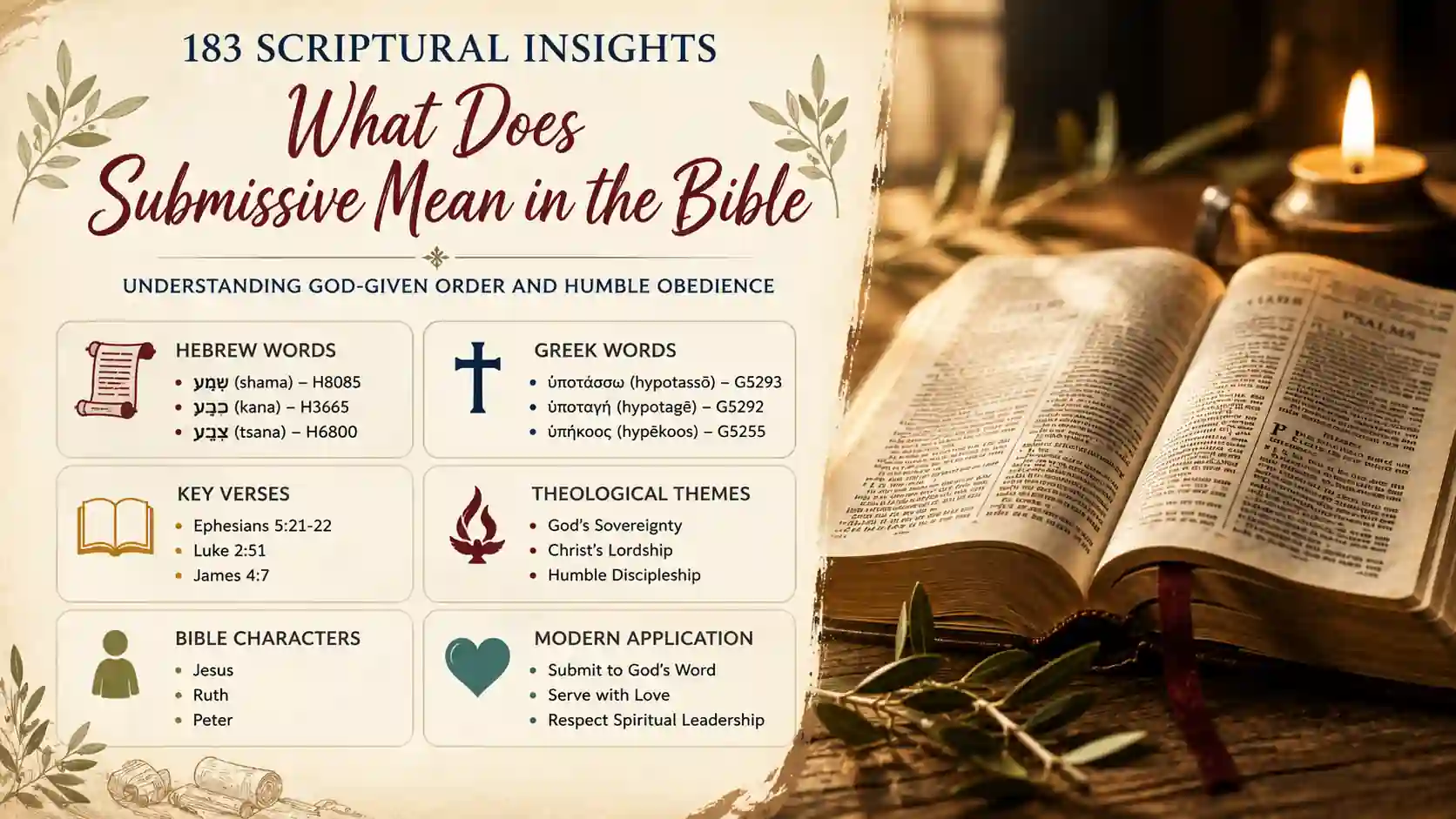
What does submissive mean in the Bible? Scripture presents submission as the willing recognition of God-given order, expressed through reverence, obedience, humility, and faithful service. It is not passive weakness, unquestioning compliance, or surrender to evil. Biblical submission begins with God and is shaped by loyalty to Christ.
The primary New Testament word, ὑποτάσσω, hypotassō, describes placing oneself under rightful order. Hebrew Scripture communicates related ideas through hearing obediently, humbling oneself, and walking modestly before God. Your study must therefore consider worship, discipleship, family, church, government, and Christ’s ultimate authority.
Submissive Key Scripture References
| Verse | Passage Snippet | Context |
|---|---|---|
| Luke 2:51 | Jesus was subject to them | Young Jesus honored Joseph and Mary |
| Romans 8:7 | Not subject to God’s law | The fleshly mind resists God |
| Romans 13:1 | Subject to governing authorities | Civil authority exists under God |
| 1 Corinthians 15:28 | The Son will be subjected | Christ’s kingdom reaches its appointed goal |
| Ephesians 5:21 | Submitting to one another | Spirit-filled Christian relationships |
| Colossians 3:18 | Wives, submit to your husbands | Household conduct in the Lord |
| James 4:7 | Submit yourselves to God | Resistance to the devil begins with God |
| 1 Peter 5:5 | Be subject to the elders | Humility within the church community |
Submissive Bible Translation Comparison
| Verse | KJV | NIV | ESV | NASB |
|---|---|---|---|---|
| Luke 2:51 | Subject unto them | Obedient to them | Submissive to them | Continued in subjection |
| Romans 13:1 | Subject unto higher powers | Subject to governing authorities | Subject to governing authorities | In subjection to authorities |
| Ephesians 5:21 | Submitting yourselves | Submit to one another | Submitting to one another | Subject to one another |
| Ephesians 5:22 | Submit yourselves | Submit yourselves | Submit to your own husbands | Subject to your own husbands |
| Colossians 3:18 | Submit yourselves | Submit yourselves | Submit to your husbands | Be subject to your husbands |
| Titus 2:5 | Obedient to husbands | Subject to husbands | Submissive to husbands | Subject to husbands |
| James 4:7 | Submit yourselves to God | Submit yourselves to God | Submit yourselves to God | Submit therefore to God |
| 1 Peter 5:5 | Submit yourselves unto elder | Submit yourselves to elders | Be subject to elders | Be subject to elders |
Submissive People and Bible Characters
| Person | Role | Connection |
|---|---|---|
| Jesus | Son of God and Messiah | Submitted to parents and the Father |
| Mary | Mother of Jesus | Accepted God’s calling in faith |
| Joseph | Legal father of Jesus | Obeyed divine instructions through dreams |
| Abraham | Covenant patriarch | Followed God into an unknown land |
| Sarah | Covenant matriarch | Remembered for hope and marital respect |
| Moses | Prophet and mediator | Learned humble dependence on God |
| David | King of Israel | Respected Saul’s anointed office |
| Ruth | Moabite believer | Loyally joined Naomi and Israel’s God |
| Esther | Persian queen | Received Mordecai’s counsel with courage |
| Peter | Apostle | Taught humility and proper submission |
Submissive Hebrew and Greek Words
| Original Word | Transliteration | Strong’s # | Literal Meaning |
|---|---|---|---|
| ὑποτάσσω | hypotassō | G5293 | Place or arrange under |
| ὑποταγή | hypotagē | G5292 | Subjection or submission |
| ὑπήκοος | hypēkoos | G5255 | Listening under, obedient |
| πείθω | peithō | G3982 | Persuade, trust, obey |
| εἴκω | eikō | G1502 | Yield or give way |
| שָׁמַע | shama | H8085 | Hear, listen, obey |
| כָּנַע | kana | H3665 | Humble or bring low |
| עָנָה | anah | H6031 | Humble or afflict |
| צָנַע | tsana | H6800 | Walk modestly or humbly |
| עָנָו | anav | H6035 | Humble, meek, lowly |
The verb ὑποτάσσω, hypotassō, combines the ideas of being “under” and being “arranged.” Its biblical uses include Christ’s submission to His earthly parents, believers’ submission to God, civic authorities, church leaders, and one another, and the final subjection of all things under Christ.
The Old Testament does not depend on one exact Hebrew equivalent. שָׁמַע, shama, connects genuine hearing with obedience, while כָּנַע, kana, emphasizes being humbled before God. צָנַע, tsana, describes the humble manner of walking with Him.
Submissive Related Biblical Concepts
| Concept | Connection | Supporting Verse |
|---|---|---|
| Obedience | Submission responds to God’s revealed will | 1 Samuel 15:22 |
| Humility | A submissive heart rejects self-exaltation | 1 Peter 5:5 |
| Reverence | Submission grows from honoring God | Hebrews 12:9 |
| Servanthood | Christ’s followers willingly serve others | Mark 10:45 |
| Self-denial | Disciples surrender self-rule to Christ | Luke 9:23 |
| Mutual care | Believers consider one another’s good | Ephesians 5:21 |
| Order | God appoints responsibilities within communities | 1 Corinthians 14:40 |
| Conscience | Submission recognizes accountability to God | Romans 13:5 |
| Trust | Faith yields to God’s wisdom | Proverbs 3:5-6 |
| Resistance | Submission to God enables resistance to evil | James 4:7 |
Submissive Historical and Cultural Context
| Aspect | Detail | Biblical Source |
|---|---|---|
| Roman government | Christians lived under imperial authority | Romans 13:1-7 |
| Household codes | Homes included spouses, children, and servants | Ephesians 5:22 to 6:9 |
| Patriarchal society | Men usually held public legal authority | 1 Peter 3:1-7 |
| Jewish family life | Children were expected to honor parents | Luke 2:51 |
| Patronage systems | Social rank shaped daily relationships | Philemon 8-21 |
| Church elders | Local congregations received pastoral oversight | 1 Peter 5:1-5 |
| Slavery | Apostles addressed believers within existing structures | Titus 2:9-10 |
| Imperial pressure | Loyalty to Christ could conflict with rulers | Acts 5:29 |
| Covenant worship | Israel submitted by hearing God’s commands | Deuteronomy 6:4-5 |
| Military imagery | Submission could describe ordered ranks | 1 Corinthians 15:27 |
Submissive Theological Themes
| Theme | Explanation | Scripture |
|---|---|---|
| God’s sovereignty | All rightful authority ultimately belongs to God | Psalm 103:19 |
| Christ’s lordship | Every power will be placed under Christ | 1 Corinthians 15:27 |
| The Son’s obedience | Jesus obeyed the Father without inferiority | Philippians 2:8 |
| Spirit-filled life | Submission accompanies worship and thanksgiving | Ephesians 5:18-21 |
| Created order | Distinct responsibilities serve God’s purposes | 1 Corinthians 11:3 |
| Christian freedom | Freedom serves God rather than selfish desire | 1 Peter 2:16 |
| Humble discipleship | Grace is given to the humble | James 4:6-7 |
| Kingdom witness | Honorable conduct displays allegiance to God | 1 Peter 2:12-17 |
| Mutual belonging | Christians serve as members of one body | Romans 12:4-5 |
| Final restoration | Creation will be ordered beneath Christ | Hebrews 2:8 |
Submissive Modern Application for Believers
| Area | Practice | Scripture |
|---|---|---|
| Relationship with God | Receive Scripture as final authority | James 4:7 |
| Prayer | Yield personal desires to God’s will | Matthew 6:10 |
| Marriage | Serve with love, honor, and faithfulness | Ephesians 5:21-33 |
| Church | Respect faithful spiritual oversight | Hebrews 13:17 |
| Government | Obey laws unless they require sin | Romans 13:1-7 |
| Workplace | Work sincerely as serving Christ | Colossians 3:22-24 |
| Family | Honor parents within obedience to God | Ephesians 6:1-3 |
| Conflict | Reject pride and pursue peace | Philippians 2:3-4 |
| Decision-making | Welcome wise and biblical counsel | Proverbs 12:15 |
| Spiritual warfare | Submit to God and resist the devil | James 4:7 |
What Does Submissive Mean in the Bible Through Ὑποτάσσω?
The central New Testament term is ὑποτάσσω, hypotassō, Strong’s G5293. It can describe placing something under another’s authority or voluntarily accepting an ordered relationship. Context determines whether the action is imposed, cosmic, civic, familial, ecclesial, or freely chosen. The word itself does not automatically imply inferiority, silence, or diminished worth.
This distinction becomes clear in Luke 2:51. Jesus was submissive to Mary and Joseph, yet He remained the eternal Son of God. His submission expressed righteousness within His earthly vocation, not lesser dignity. Biblical submission concerns ordered responsibility and faithful conduct rather than the value of one person compared with another.
שָׁמַע And כָּנַע in Israel’S Covenant Life
The Hebrew verb שָׁמַע, shama, Strong’s H8085, means to hear, listen, or obey. In Israel’s covenant setting, hearing God was never merely receiving sound or information. To hear the Lord truly was to take His words seriously and respond with covenant faithfulness. A person who ignored God’s command had not truly “heard,” regardless of physical perception.
The verb כָּנַע, kana, Strong’s H3665, adds the idea of humbling oneself or being brought low. Second Chronicles 7:14 joins humility with prayer, seeking God, and turning from wickedness. Submission in the Old Testament therefore involves a heart brought low before God, an attentive ear, repentance, and concrete obedience.
Christ’S Submission without Inferiority
Jesus reveals the purest form of submission. He came not to do His own will independently, but the will of the Father who sent Him. Philippians 2 presents His obedience unto death as the voluntary self-giving of the One who truly shares divine glory. His humility does not deny His deity. It displays the holy character of divine love.
First Corinthians 15:28 says that the Son will be subjected to the One who subjected all things to Him. This difficult text concerns the completion of Christ’s mediatorial kingdom, when every enemy has been defeated. It should not be read as teaching that the Son is a created being or possesses a lesser divine nature.
Submission Under Christ Has Moral Boundaries
Biblical submission is never permission for another person to command sin, excuse cruelty, or replace God’s authority. The apostles told believers to respect governing authorities, yet they also declared, “We must obey God rather than men” when rulers prohibited gospel witness. All human authority is delegated, limited, and accountable to the Lord.
This principle also protects the vulnerable in families and churches. Commands concerning submission stand beside commands requiring sacrificial love, gentleness, justice, and protection from harshness. A demand that contradicts God’s character is an abuse of authority, not a legitimate expression of biblical order.
Questions About Being Submissive in Scripture
Does ὑποτάσσω mean that one person is less valuable than another?
No. It describes ordered relationship or responsibility, not lesser human worth before God.
Why does Ephesians 5:21 speak of submitting to one another?
It introduces Spirit-filled relationships marked by reverence for Christ, humility, service, and concern for others.
Does שָׁמַע mean hearing or obeying?
It can mean both because biblical hearing often includes attentive acceptance and obedient response.
Must a Christian submit when an authority commands something sinful?
No. God remains the highest authority, so believers must refuse commands that directly require disobedience to Him.
How can you practice biblical submission without becoming passive?
You can yield to God’s Word, respect rightful authority, speak truth humbly, resist evil, and serve others with courage.