
When you ask what does heaven mean in the Bible, Scripture gives a richer answer than simply “the place believers go after death.” The biblical words translated “heaven” can describe the visible sky, the realm of the stars, or the transcendent dwelling associated with God’s throne and presence.
Your study also leads from Genesis to Revelation. Heaven belongs to the Bible’s larger story of creation, God’s kingship, Christ’s ascension, resurrection hope, and the promised new heaven and new earth. Understanding these contexts helps you read familiar passages with greater precision and hope.
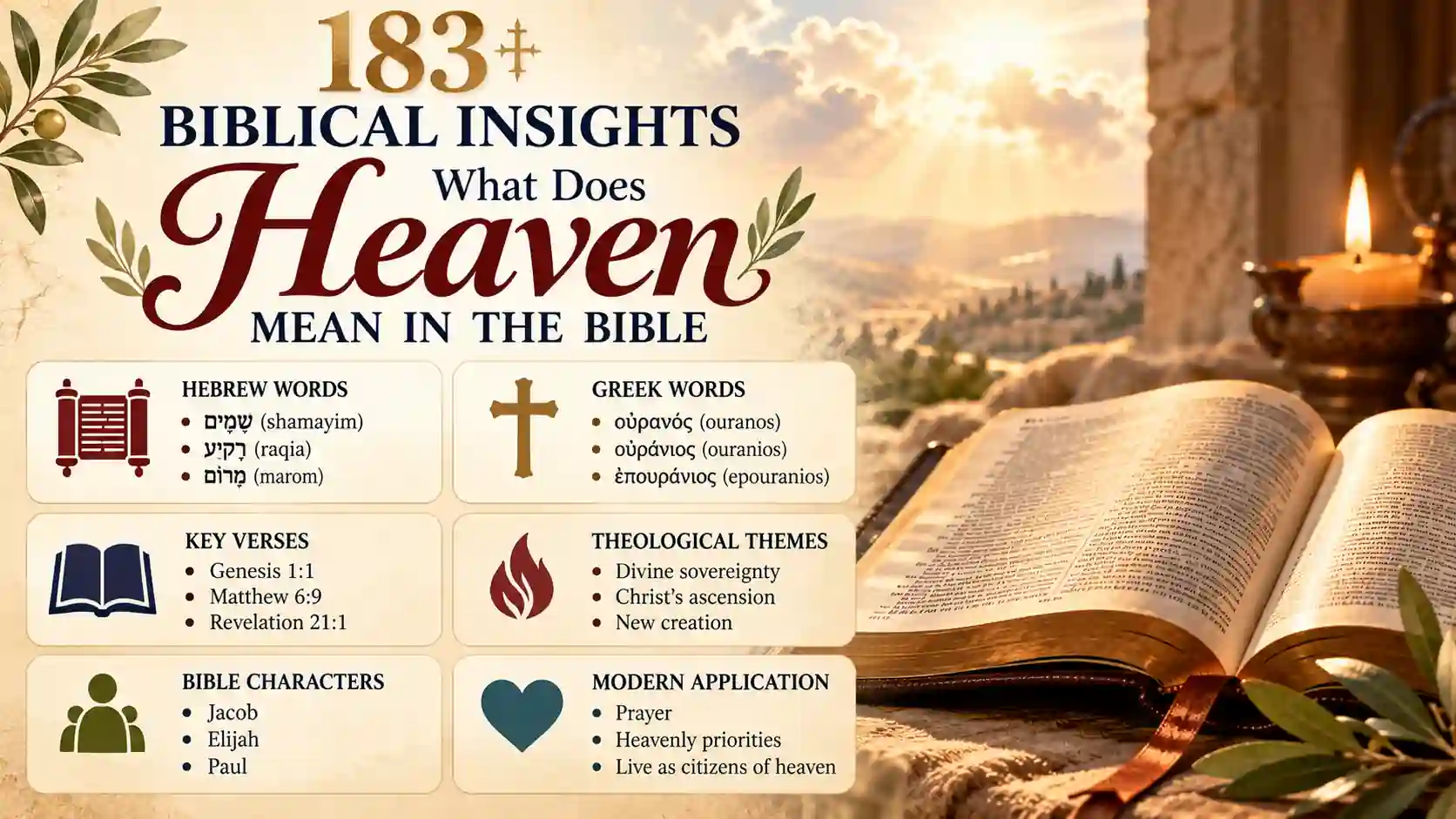
Heaven Key Scripture References
| Verse | Passage Snippet | Context |
|---|---|---|
| Genesis 1:1 | “the heaven and the earth” | God creates the total ordered creation. |
| Psalm 19:1 | “The heavens declare the glory of God” | The skies testify to their Creator. |
| Isaiah 66:1 | “Heaven is my throne” | God transcends temples made by human hands. |
| Matthew 6:9 | “Our Father which art in heaven” | Jesus teaches disciples to address the heavenly Father. |
| John 14:2 | “In my Father’s house are many mansions” | Jesus comforts disciples with promised fellowship. |
| Acts 1:11 | “taken up from you into heaven” | Jesus ascends after His resurrection. |
| Philippians 3:20 | “our conversation is in heaven” | Believers possess heavenly citizenship while awaiting Christ. |
| Revelation 21:1 | “a new heaven and a new earth” | John sees creation renewed after final judgment. |
Heaven Bible Translation Comparison
| Verse | KJV | NIV | ESV | NASB |
|---|---|---|---|---|
| Genesis 1:1 | “heaven” | “heavens” | “heavens” | “heavens” |
| Psalm 19:1 | “heavens” | “heavens” | “heavens” | “heavens” |
| Matthew 3:2 | “kingdom of heaven” | “kingdom of heaven” | “kingdom of heaven” | “kingdom of heaven” |
| Matthew 6:9 | “in heaven” | “in heaven” | “in heaven” | “in heaven” |
| Luke 15:18 | “against heaven” | “against heaven” | “against heaven” | “against heaven” |
| 2 Corinthians 12:2 | “third heaven” | “third heaven” | “third heaven” | “third heaven” |
| Philippians 3:20 | “conversation is in heaven” | “citizenship is in heaven” | “citizenship is in heaven” | “citizenship is in heaven” |
| Revelation 21:1 | “new heaven” | “new heaven” | “new heaven” | “new heaven” |
Heaven People and Characters Associated
| Person | Role | Connection |
|---|---|---|
| Jacob | Patriarch | Dreams of a stairway reaching heaven in Genesis 28. |
| Elijah | Prophet | Taken upward in a whirlwind in 2 Kings 2. |
| Isaiah | Prophet | Sees the Lord enthroned in a heavenly vision. |
| Daniel | Prophet | Sees the Son of Man approach the Ancient of Days. |
| Jesus | Messiah and Son of God | Comes from heaven, rises, and ascends to heaven. |
| Stephen | First Christian martyr | Sees heaven opened and Jesus standing by God. |
| Paul | Apostle | Describes being caught up to the third heaven. |
| John | Apostle and seer | Receives extensive heavenly visions in Revelation. |
Heaven Original Hebrew and Greek Words
| Original Word | Transliteration | Strong’s # | Literal Meaning |
|---|---|---|---|
| שָׁמַיִם | shamayim | H8064 | heavens, sky |
| שָׁמֶה | shameh | H8064 | heavenward, toward heaven |
| רָקִיעַ | raqia | H7549 | expanse, firmament |
| מָרוֹם | marom | H4791 | height, high place |
| οὐρανός | ouranos | G3772 | heaven, sky |
| οὐράνιος | ouranios | G3770 | heavenly, belonging to heaven |
| ἐπουράνιος | epouranios | G2032 | heavenly, celestial |
| μεσουράνημα | mesouranēma | G3321 | midheaven, midst of heaven |
The principal Old Testament term is שָׁמַיִם (shamayim), Strong’s H8064. Its form commonly appears as a plural or dual-like noun, and context determines whether it refers to the atmospheric sky, the celestial heavens, or the realm associated with God.
The New Testament’s principal word is οὐρανός (ouranos), Strong’s G3772. Like its Hebrew counterpart, it has a flexible range. You cannot assume that every occurrence refers specifically to the final dwelling of the redeemed.
Heaven Related Biblical Concepts
| Concept | Connection | Supporting Verse |
|---|---|---|
| Creation | Heaven and earth together describe God’s created order. | Genesis 1:1 |
| God’s throne | Heaven symbolizes God’s sovereign rule. | Isaiah 66:1 |
| Kingdom of heaven | Matthew emphasizes God’s reigning kingdom. | Matthew 4:17 |
| Prayer | God’s will is to be done on earth as in heaven. | Matthew 6:10 |
| Ascension | The risen Christ is received into heaven. | Acts 1:9-11 |
| Citizenship | Christians belong to a heavenly commonwealth. | Philippians 3:20 |
| Resurrection | Christ returns and transforms His people. | Philippians 3:20-21 |
| New creation | Heaven and earth reach their renewed consummation. | Revelation 21:1-5 |
Heaven Historical and Cultural Context
| Aspect | Detail | Biblical Source |
|---|---|---|
| Ancient creation language | Heaven and earth can express the whole created order. | Genesis 1:1 |
| Visible sky | Birds are described as flying across the heavens. | Genesis 1:20 |
| Celestial realm | Sun, moon, and stars occupy the heavenly expanse. | Genesis 1:14-17 |
| Divine kingship | God is portrayed as enthroned above creation. | Psalm 103:19 |
| Temple imagery | Earthly worship reflects God’s heavenly sovereignty. | Isaiah 6:1-4 |
| Jewish reverence | “Heaven” can function as a reverent reference to God. | Luke 15:18 |
| Roman citizenship | Paul uses citizenship language familiar to Philippi. | Philippians 3:20 |
| Apocalyptic vision | Heavenly scenes unveil realities beyond ordinary sight. | Revelation 4:1-11 |
The Bible arose within cultures that did not use modern astronomical categories. Biblical writers could speak phenomenologically about what human beings see above them while also confessing that God cannot be contained within the physical universe.
This matters when you encounter language such as “heavens opened.” Such expressions may introduce divine revelation rather than provide a geographical description of the universe. Genre and context should guide your interpretation.
Heaven Theological Themes
| Theme | Explanation | Scripture |
|---|---|---|
| Divine transcendence | God rules above and beyond created limitations. | 1 Kings 8:27 |
| Divine sovereignty | Heaven is pictured as the location of God’s throne. | Psalm 103:19 |
| Christ’s authority | The risen Jesus possesses authority in heaven and earth. | Matthew 28:18 |
| Christ’s ascension | Jesus enters heavenly glory after His resurrection. | Acts 1:9-11 |
| Mediation | Christ ministers for His people in God’s presence. | Hebrews 9:24 |
| Heavenly citizenship | Believers’ ultimate allegiance belongs to Christ. | Philippians 3:20 |
| Resurrection hope | Christian hope includes bodily transformation. | 1 Corinthians 15:42-49 |
| New creation | God finally renews heaven and earth. | Revelation 21:1-5 |
Heaven Modern Application for Believers
| Area | Practice | Scripture |
|---|---|---|
| Prayer | Seek God’s will on earth as in heaven. | Matthew 6:9-10 |
| Worship | Remember that God alone deserves ultimate allegiance. | Revelation 4:11 |
| Priorities | Store treasures in heaven rather than living for possessions. | Matthew 6:19-21 |
| Identity | Live consistently with heavenly citizenship. | Philippians 3:20 |
| Hope | Await Christ and resurrection with confidence. | 1 Thessalonians 4:16-18 |
| Suffering | Look toward God’s lasting unseen realities. | 2 Corinthians 4:17-18 |
| Holiness | Set your mind on realities associated with the risen Christ. | Colossians 3:1-4 |
| Mission | Serve the King who holds all authority. | Matthew 28:18-20 |
שָׁמַיִם Shamayim Shows Why Heaven Has More than One Biblical Sense
In Genesis 1:1, שָׁמַיִם (shamayim) appears immediately alongside “earth.” The expression presents God as Creator of everything. Yet Genesis also uses heavenly language for the expanse above the earth, where celestial lights appear and birds fly beneath the heavens.
This range teaches you to ask what “heaven” means in each passage rather than imposing one definition everywhere. Psalm 19 points toward the visible heavens declaring God’s glory, while 1 Kings 8:27 declares that even “heaven and heaven of heavens” cannot contain Him. Heaven belongs to God, but God is greater than heaven.
What Does Heaven Mean in the Bible When Jesus Says Kingdom of Heaven?
Matthew repeatedly uses βασιλεία τῶν οὐρανῶν (basileia tōn ouranōn), “kingdom of heaven.” The phrase does not primarily mean a place where people go after death. In Jesus’ proclamation, it concerns God’s royal reign breaking into history and demanding repentance, faith, and faithful discipleship.
This becomes especially clear when you compare Matthew with Mark and Luke, which frequently use “kingdom of God” in parallel contexts. Jesus teaches His disciples to pray for God’s kingdom to come and His will to be done “on earth as it is in heaven.” Heaven therefore represents the sphere where God’s authority is perfectly acknowledged, while His kingdom advances His purposes on earth.
Οὐρανός Ouranos and the Heavenly Ministry of the Risen Christ
The New Testament’s οὐρανός (ouranos) can mean the sky or heaven, depending on context. At Jesus’ baptism the heavens open, while Acts 1 describes the risen Christ ascending and being taken from the disciples’ sight. Hebrews develops the theological significance by presenting Christ as entering God’s presence on behalf of His people.
This means biblical teaching about heaven is deeply Christ-centered. Your hope is not merely relocation from earth to an invisible realm. Philippians 3:20 says believers have citizenship in heaven, but the same passage immediately directs attention toward Christ’s return and the transformation of their bodies. Heavenly hope and bodily resurrection belong together.
Paul’s unusual reference to the “third heaven” in 2 Corinthians 12:2 should also be read carefully. He describes an extraordinary revelation and shortly afterward uses the language of “Paradise.” His purpose is not to provide a detailed map of three heavenly levels, but to recount an indescribable experience while refusing to boast in himself.
Revelation 21 Brings Heaven and Earth Together in New Creation
Revelation does not end with redeemed humanity simply escaping the earth. John sees “a new heaven and a new earth” and then sees the holy city, New Jerusalem, coming down out of heaven from God. The movement in the vision is striking because God’s dwelling comes to humanity.
Revelation 21:3 announces the heart of this hope. God dwells with His people, death is defeated, tears are wiped away, and creation is made new. This completes themes stretching back to Genesis. The Bible begins with heaven and earth created by God and closes with creation renewed under His uncontested reign.
For your study, this guards against reducing Christian hope to disembodied existence. Passages about being with Christ after death, such as Philippians 1:23, are precious, yet the biblical story continues toward resurrection and renewal. The final Christian hope centers on God dwelling with a resurrected people in His restored creation.
Heaven Bible Study Faqs
Does שָׁמַיִם (shamayim) always mean God’s dwelling place?
No. Depending on context, שָׁמַיִם can describe the sky, celestial heavens, or heaven in relation to God’s sovereign presence.
Why does Matthew say “kingdom of heaven” while other Gospels often say “kingdom of God”?
The expressions substantially overlap, with Matthew characteristically using “kingdom of heaven” for the divine reign proclaimed and embodied in Jesus’ ministry.
What does Paul mean by the “third heaven” in 2 Corinthians 12:2?
Paul describes an extraordinary heavenly revelation associated with Paradise, but the passage does not attempt to give readers a complete geography of heaven.
Does Philippians 3:20 teach that believers will live in heaven forever?
It teaches that believers’ citizenship is in heaven while emphasizing that they await the returning Christ, who will transform their bodies.
Is the new heaven and new earth in Revelation 21 different from simply “going to heaven”?
Yes. Revelation’s final vision emphasizes renewed creation, resurrection hope, New Jerusalem descending from heaven, and God dwelling permanently with His people.