
What does sin mean in the Bible? Scripture gives a richer answer than simply “doing bad things.” Sin includes missing God’s righteous standard, violating his commands, rebelling against his authority, acting unjustly, and living in a condition of alienation from him. The biblical vocabulary develops these dimensions across both Testaments.
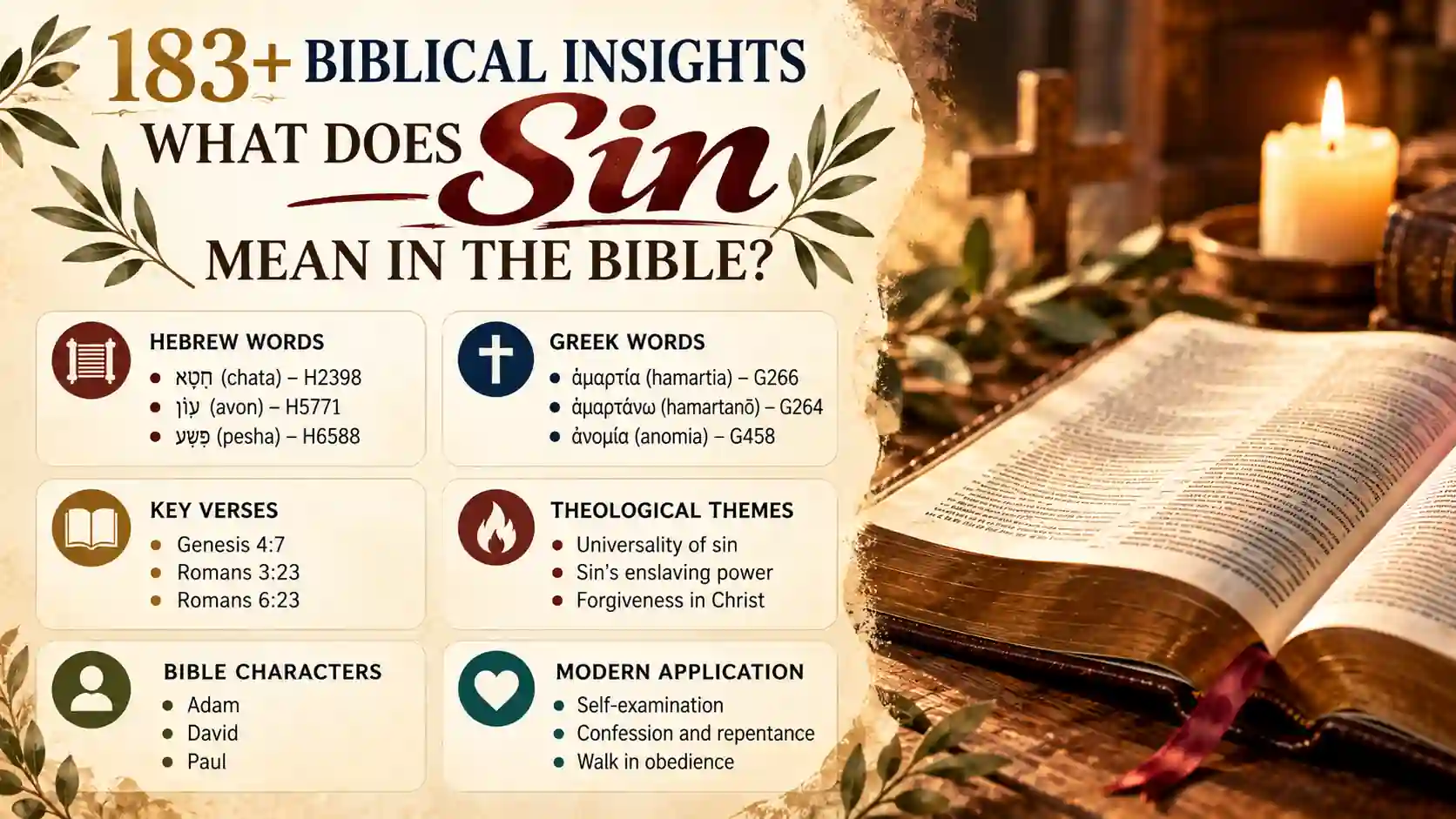
Your study becomes clearer when you examine words such as חָטָא (chata), פֶּשַׁע (pesha), עָוֹן (avon), ἁμαρτία (hamartia), and ἀνομία (anomia). Together, they show why sin is serious and why forgiveness, atonement, repentance, and grace stand at the heart of Scripture.
Key Sin Scripture References
| Verse | Passage Snippet | Context |
|---|---|---|
| Genesis 4:7 | “sin lieth at the door” | God warns Cain before Abel’s murder |
| Psalm 51:4 | “against thee…have I sinned” | David confesses after his sin involving Bathsheba |
| Isaiah 53:6 | “turned every one to his own way” | Human wandering and the Servant bearing iniquity |
| Ezekiel 18:20 | “the soul that sinneth” | Personal moral accountability before God |
| Matthew 1:21 | “save his people from their sins” | Jesus’ saving mission announced before his birth |
| John 1:29 | “taketh away the sin of the world” | John identifies Jesus as God’s Lamb |
| Romans 3:23 | “all have sinned” | Paul describes universal human guilt |
| Romans 6:23 | “wages of sin is death” | Sin’s consequence contrasted with God’s gift |
| 1 John 3:4 | “sin is…lawlessness” | John connects sinful practice with lawlessness |
| 1 John 1:9 | “confess our sins” | Confession is met by God’s faithful forgiveness |
Sin in Major Bible Translations
| Verse | KJV | NIV | ESV | NASB |
|---|---|---|---|---|
| Genesis 4:7 | “sin lieth at the door” | “sin is crouching at your door” | “sin is crouching at the door” | “sin is lurking at the door” |
| Psalm 51:4 | “have I sinned” | “have I sinned” | “have I sinned” | “I have sinned” |
| Isaiah 53:6 | “iniquity of us all” | “iniquity of us all” | “iniquity of us all” | “wrongdoing of us all” |
| Matthew 1:21 | “from their sins” | “from their sins” | “from their sins” | “from their sins” |
| John 1:29 | “sin of the world” | “sin of the world” | “sin of the world” | “sin of the world” |
| Romans 3:23 | “all have sinned” | “all have sinned” | “all have sinned” | “all have sinned” |
| Romans 6:23 | “wages of sin is death” | “wages of sin is death” | “wages of sin is death” | “wages of sin is death” |
| 1 John 3:4 | “transgresseth also the law” | “breaks the law” | “practices lawlessness” | “practices lawlessness” |
People and Characters Associated with Sin
| Person | Role | Connection |
|---|---|---|
| Adam | First man | His disobedience becomes central to Paul’s account of sin and death |
| Eve | First woman | Deceived by the serpent and ate the forbidden fruit |
| Cain | Son of Adam and Eve | Warned that sin was crouching at the door |
| Moses | Covenant mediator | Received laws defining Israel’s obligations and sacrifices |
| David | King of Israel | Confessed adultery, bloodguilt, and rebellion in Psalm 51 |
| Isaiah | Prophet | Confessed uncleanness when confronted by divine holiness |
| John the Baptist | Forerunner | Identified Jesus as the Lamb who takes away sin |
| Paul | Apostle | Explained sin’s universality, power, wages, and defeat in Christ |
| Jesus Christ | Messiah and Son | Sinless Savior who bears sins and brings forgiveness |
| John | Apostle | Connects sin with lawlessness, confession, cleansing, and advocacy |
Original Hebrew and Greek Words for Sin
| Original Word | Transliteration | Strong’s # | Literal Meaning |
|---|---|---|---|
| חָטָא | chata | H2398 | To sin, miss, go wrong |
| חֵטְא | chet | H2399 | Sin, offense, fault |
| חַטָּאת | chatta’t | H2403 | Sin, guilt, sin offering |
| עָוֹן | avon | H5771 | Iniquity, guilt, perversity |
| פָּשַׁע | pasha | H6586 | Rebel, transgress |
| פֶּשַׁע | pesha | H6588 | Rebellion, transgression |
| ἁμαρτάνω | hamartanō | G264 | To sin, err, miss |
| ἁμαρτία | hamartia | G266 | Sin, failure, offense |
| ἀνομία | anomia | G458 | Lawlessness, violation of law |
| ἀδικία | adikia | G93 | Unrighteousness, injustice |
Biblical Concepts Related to Sin
| Concept | Connection | Supporting Verse |
|---|---|---|
| Holiness | Sin contradicts God’s holy character | Leviticus 19:2 |
| Law | Law gives knowledge of sin | Romans 3:20 |
| Guilt | Sin creates genuine accountability | Leviticus 5:5 |
| Death | Death is described as sin’s wage | Romans 6:23 |
| Repentance | Sinners are called to turn to God | Acts 3:19 |
| Confession | Sin is acknowledged rather than concealed | 1 John 1:9 |
| Atonement | Sacrifice addresses guilt and impurity | Leviticus 17:11 |
| Forgiveness | God removes confessed guilt | Psalm 32:5 |
| Justification | God justifies through faith apart from works | Romans 3:28 |
| Sanctification | Grace leads believers away from sin’s dominion | Romans 6:14 |
Historical and Cultural Context of Sin
| Aspect | Detail | Biblical Source |
|---|---|---|
| Eden | Disobedience enters humanity’s story | Genesis 3 |
| Cain and Abel | Sin is pictured as crouching nearby | Genesis 4:7 |
| Sinai covenant | Commands define Israel’s covenant responsibilities | Exodus 20 |
| Sin offering | חַטָּאת could name both sin and its offering | Leviticus 4 |
| Unintentional sins | Sacrifices address offenses committed inadvertently | Leviticus 4:2 |
| Day of Atonement | Israel’s sins are ritually dealt with annually | Leviticus 16 |
| Prophetic preaching | Sin includes injustice and covenant rebellion | Isaiah 1 |
| Exile | Prophets connect persistent rebellion with judgment | 2 Kings 17 |
| Second Temple era | Sacrifice remained central to Jewish worship | Luke 2:22-24 |
| Early church | Christ’s death is proclaimed for sins | 1 Corinthians 15:3 |
Theological Themes of Sin
| Theme | Explanation | Scripture |
|---|---|---|
| Universality | Every person stands implicated in sin | Romans 3:23 |
| Rebellion | Sin can be deliberate revolt against God | Isaiah 1:2 |
| Missing the standard | Sin fails to conform to God’s will | Romans 3:23 |
| Inner corruption | Evil proceeds from the human heart | Mark 7:21-23 |
| Enslaving power | Sin can reign and exercise mastery | Romans 6:12 |
| Judgment | Sin produces guilt before divine justice | Romans 2:5-6 |
| Substitution | Christ bears sins on behalf of others | 1 Peter 2:24 |
| Forgiveness | God pardons those who confess | 1 John 1:9 |
| Reconciliation | Christ’s work restores relationship with God | 2 Corinthians 5:19 |
| New life | Believers are called to walk free from sin’s rule | Romans 6:4 |
Modern Application of Sin for Believers
| Area | Practice | Scripture |
|---|---|---|
| Self-examination | Ask God to expose harmful ways | Psalm 139:23-24 |
| Confession | Name sin truthfully before God | 1 John 1:9 |
| Repentance | Turn from sinful conduct toward God | Acts 3:19 |
| Temptation | Seek God’s provided way of escape | 1 Corinthians 10:13 |
| Scripture | Store God’s word in your heart | Psalm 119:11 |
| Relationships | Confess wrongdoing and pursue healing | James 5:16 |
| Forgiveness | Forgive as you have been forgiven | Colossians 3:13 |
| Accountability | Encourage fellow believers faithfully | Hebrews 3:13 |
| Obedience | Present yourself to God for righteousness | Romans 6:13 |
| Hope | Depend on Christ as advocate when you sin | 1 John 2:1 |
חָטָא And ἁμαρτία Show That Sin Is More than Missing a Target
The Hebrew verb חָטָא (chata, H2398) can carry the idea of missing, failing, or sinning. Its related noun חַטָּאת (chatta’t, H2403) is especially significant because it can refer to sin and, depending on context, the sacrifice offered because of sin. Leviticus therefore connects human failure with guilt, purification, sacrifice, and restored fellowship.
The Greek ἁμαρτία (hamartia, G266), related to ἁμαρτάνω (hamartanō, G264), likewise denotes sin, wrongdoing, or failure. “Missing the mark” can help illustrate the word’s background, but the New Testament idea should not be reduced to an innocent mistake. Sin can involve deliberate disobedience, unbelief, corrupt desire, injustice, and opposition to God.
What Does Sin Mean in the Bible from Eden to the Sinai Covenant?
Genesis 3 presents sin before Scripture gives Israel the detailed laws of Sinai. Adam and Eve distrust God’s word and take what he has forbidden. Genesis 4 then gives a vivid picture when God warns Cain that sin is “crouching at the door.” Sin is already portrayed as both a wrongful act and a threatening power seeking mastery.
At Sinai, Israel receives commands that express covenant responsibilities toward God and neighbor. Leviticus 4 is particularly instructive because even unintentional violations require attention. Biblical guilt is not determined solely by whether someone felt guilty. God’s holiness supplies the moral standard, while the sacrificial system provides a divinely appointed means for dealing with violated holiness.
פֶּשַׁע And עָוֹן Reveal Rebellion, Guilt, and Twistedness
Scripture does not rely on one Hebrew term to describe every dimension of evil. פֶּשַׁע (pesha, H6588) often emphasizes transgression or rebellion, while עָוֹן (avon, H5771) can describe iniquity and the guilt associated with it. These words prevent you from defining every sin merely as an accidental failure to achieve an ideal.
Psalm 51 gathers this vocabulary into a deeply personal confession. David does not excuse himself after his wrongdoing involving Bathsheba and Uriah. He speaks of transgression, iniquity, and sin, recognizing that wrongdoing against people is ultimately accountable to God. Biblical confession therefore involves agreeing with God about the moral reality of what has occurred.
Romans Presents ἁμαρτία as Guilt, Dominion, and a Problem Answered in Christ
Romans develops one of Scripture’s fullest theological treatments of ἁμαρτία. Romans 3:23 declares that all have sinned and fall short of God’s glory. Paul’s argument places humanity on common ground before God, removing any basis for claiming righteousness through personal moral achievement.
Romans 5 and 6 go further by speaking of sin almost as a ruling power. Through Adam, sin and death enter the human story, while Christ inaugurates righteousness and life. Grace does not make sin trivial. Because believers are united with Christ, Paul argues that they should no longer present themselves to sin as instruments of unrighteousness.
The New Testament’s answer to sin therefore reaches beyond moral improvement. Jesus saves his people “from their sins” in Matthew 1:21, John calls him the Lamb of God who takes away the world’s sin, and Paul says Christ died “for our sins.” Forgiveness rests finally on what God has accomplished in Christ rather than on your ability to repair your own guilt.
This gives Christian repentance both seriousness and hope. You are not encouraged to rename sin, hide it, or despair beneath it. You can confess it, turn from it, receive God’s forgiveness, and pursue obedience through grace. First John holds these truths together by warning against denying sin while assuring believers that Christ is their advocate.
Questions Bible Students Ask About Sin
Does חָטָא (chata) literally mean “to miss the mark”?
It can carry the sense of missing or failing, but biblical usage commonly gives it the specifically moral meaning of sinning against God or another person.
Why can חַטָּאת (chatta’t) mean both “sin” and “sin offering”?
Hebrew usage allows the same noun to describe the offense and, in sacrificial contexts such as Leviticus 4, the offering prescribed to deal with that offense.
Does Romans 3:23 mean every person commits exactly the same kinds of sins?
No. Paul’s point is universal accountability and failure before God, not that every person commits identical offenses or bears identical earthly consequences.
How can 1 John 1:8 say believers still have sin while 1 John 3 warns against practicing sin?
John distinguishes honest recognition of continuing sin from a settled pattern that treats sinful rebellion as compatible with belonging to God.
If Christ forgives sin, why should a believer still resist ἁμαρτία (hamartia)?
Because the grace that provides forgiveness also calls believers away from sin’s dominion and into obedient, righteous life with God.