
If you are asking what does Moses mean in the Bible, the answer begins with his name but quickly opens into the larger biblical story. Moses is the prophet whom God raised up to confront Pharaoh, lead Israel from Egypt, mediate the Sinai covenant, and guide the nation toward the Promised Land.
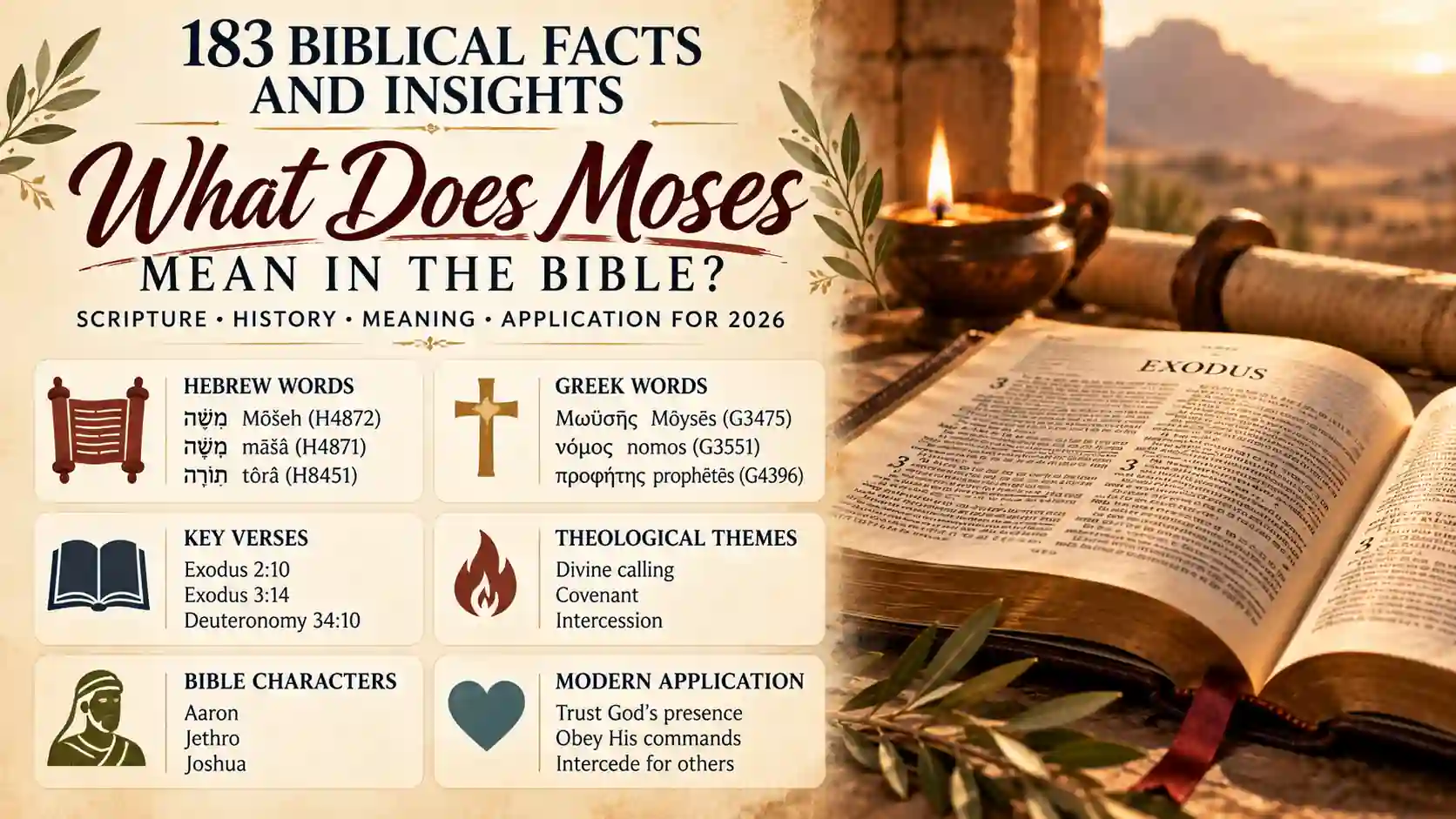
His Hebrew name is מֹשֶׁה, Mōšeh, traditionally connected in Exodus 2:10 with being “drawn out” of water. Yet Moses’ significance extends far beyond etymology. His life reveals God’s deliverance, holiness, covenant faithfulness, judgment, mercy, and promise of a greater Prophet.
Key Scripture References for Moses
| Verse | Passage Snippet | Context |
|---|---|---|
| Exodus 2:10 | “She called his name Moses” | Pharaoh’s daughter names the rescued child |
| Exodus 3:4 | “Moses, Moses” | God calls him from the burning bush |
| Exodus 3:10 | “I will send thee unto Pharaoh” | Moses receives his mission to Egypt |
| Exodus 12:31 | “Rise up, and get you forth” | Pharaoh finally releases Israel |
| Exodus 14:21 | “Moses stretched out his hand” | God parts the Red Sea |
| Exodus 19:20 | “Moses went up” | Moses approaches God at Sinai |
| Exodus 33:11 | “Face to face” | Moses enjoys extraordinary communion with God |
| Numbers 12:3 | “Very meek” | Scripture describes Moses’ humility |
| Deuteronomy 34:10 | “Whom the LORD knew face to face” | Moses receives a unique prophetic tribute |
| Hebrews 11:24 | “Moses…refused to be called” | His faith is remembered in the New Testament |
Moses Bible Translation Comparison
| Verse | KJV | NIV | ESV | NASB |
|---|---|---|---|---|
| Exodus 2:10 | “Moses” | “Moses” | “Moses” | “Moses” |
| Exodus 3:4 | “Moses, Moses” | “Moses! Moses!” | “Moses, Moses!” | “Moses, Moses!” |
| Exodus 3:14 | “I AM THAT I AM” | “I AM WHO I AM” | “I AM WHO I AM” | “I AM WHO I AM” |
| Exodus 4:10 | “slow of speech” | “slow of speech” | “slow of speech” | “slow of speech” |
| Exodus 14:13 | “Fear ye not” | “Do not be afraid” | “Fear not” | “Do not fear” |
| Exodus 33:11 | “face to face” | “face to face” | “face to face” | “face to face” |
| Numbers 12:3 | “very meek” | “very humble” | “very meek” | “very humble” |
| Deuteronomy 18:15 | “a Prophet” | “a prophet” | “a prophet” | “a prophet” |
| Deuteronomy 34:10 | “knew face to face” | “knew face to face” | “knew face to face” | “knew face to face” |
People and Characters Associated with Moses
| Person | Role | Connection |
|---|---|---|
| Amram | Father | Father of Moses, Aaron, and Miriam |
| Jochebed | Mother | Preserved Moses during Pharaoh’s decree |
| Miriam | Sister | Watched over the infant Moses |
| Aaron | Brother | Spokesman and high priest |
| Pharaoh’s daughter | Rescuer | Drew Moses from the Nile |
| Pharaoh | Egyptian ruler | Opposed Moses and Israel’s departure |
| Zipporah | Wife | Midianite wife of Moses |
| Jethro | Father-in-law | Counseled Moses about leadership |
| Joshua | Successor | Served Moses and later led Israel |
| Korah | Rebel | Challenged Moses’ God-given leadership |
Original Hebrew and Greek Words for Moses
| Original Word | Transliteration | Strong’s # | Literal Meaning |
|---|---|---|---|
| מֹשֶׁה | Mōšeh | H4872 | Moses, associated with drawing out |
| מָשָׁה | māšâ | H4871 | To draw out |
| נָבִיא | nāḇîʾ | H5030 | Prophet |
| תּוֹרָה | tôrâ | H8451 | Instruction, law |
| בְּרִית | berît | H1285 | Covenant |
| עֶבֶד | ʿeḇeḏ | H5650 | Servant |
| מֹשֶׁה | Mōšeh | H4872 | Hebrew personal name Moses |
| Μωϋσῆς | Mōysēs | G3475 | Moses |
| νόμος | nomos | G3551 | Law, principle |
Related Biblical Concepts for Moses
| Concept | Connection | Supporting Verse |
|---|---|---|
| Exodus | Moses leads Israel from Egypt | Exodus 12:31-42 |
| Passover | Moses communicates God’s instructions | Exodus 12:21-28 |
| Covenant | Moses mediates at Sinai | Exodus 24:3-8 |
| Law | Torah is given through Moses | Exodus 20:1-17 |
| Prophecy | Moses serves as God’s prophet | Deuteronomy 34:10 |
| Intercession | Moses pleads for sinful Israel | Exodus 32:11-14 |
| Tabernacle | Moses receives its instructions | Exodus 25:8-9 |
| Wilderness | Moses leads Israel for forty years | Deuteronomy 29:5 |
| Promised Prophet | Moses predicts a prophet like himself | Deuteronomy 18:15 |
Historical and Cultural Context of Moses
| Aspect | Detail | Biblical Source |
|---|---|---|
| Israel in Egypt | Israelites lived under forced labor | Exodus 1:11-14 |
| Birth crisis | Hebrew sons faced Pharaoh’s death decree | Exodus 1:22 |
| Nile rescue | Moses was placed in a papyrus basket | Exodus 2:3 |
| Egyptian court | Pharaoh’s daughter raised Moses | Exodus 2:10 |
| Midian | Moses fled there after killing an Egyptian | Exodus 2:15 |
| Shepherding | Moses tended Jethro’s flock | Exodus 3:1 |
| Sinai | God revealed covenant commands there | Exodus 19:1-6 |
| Wilderness | Israel journeyed under Moses’ leadership | Numbers 10:11-13 |
| Moab | Moses gave final covenant instruction | Deuteronomy 1:5 |
| Nebo | Moses viewed Canaan before dying | Deuteronomy 34:1-5 |
Theological Themes in the Life of Moses
| Theme | Explanation | Scripture |
|---|---|---|
| Divine calling | God chooses a reluctant shepherd | Exodus 3:10-12 |
| Redemption | God delivers Israel through Moses’ mission | Exodus 6:6 |
| Revelation | God reveals His name and character | Exodus 3:14-15 |
| Holiness | Moses encounters holy ground | Exodus 3:5 |
| Covenant | Moses mediates God’s covenant with Israel | Exodus 24:7-8 |
| Intercession | Moses pleads for rebellious people | Exodus 32:30-32 |
| Divine presence | Moses longs for God’s presence | Exodus 33:15 |
| Human failure | Moses sins at Meribah | Numbers 20:10-12 |
| Faithfulness | Moses serves faithfully in God’s house | Hebrews 3:5 |
| Christ fulfillment | Jesus surpasses Moses as Son | Hebrews 3:3-6 |
Modern Application from Moses for Believers
| Area | Practice | Scripture |
|---|---|---|
| Calling | Trust God’s presence when you feel inadequate | Exodus 3:11-12 |
| Obedience | Respond faithfully to God’s commands | Exodus 7:6 |
| Prayer | Intercede for others | Exodus 32:11-13 |
| Humility | Lead without self-exaltation | Numbers 12:3 |
| Worship | Treat God’s holiness seriously | Exodus 3:5 |
| Leadership | Share responsibilities wisely | Exodus 18:17-23 |
| Courage | Stand firm when circumstances seem impossible | Exodus 14:13 |
| Dependence | Seek God’s presence above mere success | Exodus 33:15 |
| Scripture | Receive God’s instruction reverently | Deuteronomy 6:1-2 |
| Faith | Choose God’s purposes over worldly status | Hebrews 11:24-26 |
מֹשֶׁה MōšEh and the Meaning of Moses’ Name
Exodus 2:10 provides the Bible’s own explanation of Moses’ name. Pharaoh’s daughter says she called him Moses because she “drew him out” of the water. The narrative creates a wordplay between מֹשֶׁה, Mōšeh, Strong’s H4872, and the Hebrew verb מָשָׁה, māšâ, Strong’s H4871, meaning “to draw out.”
Scholars also recognize that the name resembles an Egyptian naming element related to birth or being born, familiar from Egyptian names containing ms or mose. That historical observation need not erase Exodus’s Hebrew wordplay. Biblical narratives sometimes interpret names according to their theological significance within the story.
What Does Moses Mean in the Bible Beyond His Name?
Moses becomes a living picture of divine deliverance. The child drawn from the Nile eventually participates in God’s work of drawing an enslaved people out of Egypt. Yet Exodus carefully keeps God, not Moses, at the center. God hears Israel’s groaning, remembers His covenant, confronts Pharaoh, opens the sea, and brings His people to Himself.
This distinction matters for your study. Moses is neither Israel’s god nor an independent miracle worker. He is God’s עֶבֶד, ʿeḇeḏ, “servant,” and נָבִיא, nāḇîʾ, “prophet.” His greatness lies substantially in his unusual calling, his access to God’s revelation, and his faithful service within that calling.
Moses, Torah, and the Sinai Covenant
Moses is inseparable from תּוֹרָה, tôrâ, Strong’s H8451. Although commonly translated “law,” tôrâ can carry the broader sense of instruction or teaching. At Sinai, Moses receives God’s commandments and communicates covenant instruction to the people. Exodus 24 presents him as the mediator through whom Israel formally enters the covenant relationship established by God.
That role explains why later Scripture can speak of “Moses” almost as shorthand for the Mosaic Law. Jesus refers to what “Moses commanded” in passages such as Matthew 8:4, while Luke 24:27 speaks of “Moses and all the Prophets.” In such contexts, Moses is both the historical prophet and a conventional designation connected with Israel’s foundational Scriptures.
The Prophet Like Moses and the New Testament Witness
Deuteronomy 18:15 records Moses telling Israel that the Lord would raise up “a prophet like me.” Within Deuteronomy, Moses is presented as an extraordinary prophet whom the Lord knew “face to face.” His ministry therefore establishes a significant biblical pattern of prophetic revelation and covenant mediation.
The New Testament explicitly connects Deuteronomy’s promise with Jesus in Acts 3:20-23. Yet Hebrews 3 also establishes an important difference. Moses was faithful as a servant in God’s house, while Christ is faithful as the Son over God’s house. The comparison honors Moses while presenting Jesus as greater than the great covenant mediator.
Frequently Asked Questions About Moses
Does מֹשֶׁה, Mōšeh, literally mean “drawn out” in Hebrew?
Exodus 2:10 connects Moses’ name with מָשָׁה, māšâ, “to draw out,” although scholars also recognize a plausible Egyptian linguistic background to the name.
Why does Numbers 12:3 call Moses “meek” in the KJV but “humble” in some modern translations?
The Hebrew עָנָו, ʿānāw, can describe someone humble, meek, or lowly, so the translations emphasize closely related aspects of the same word.
Why is the Torah sometimes called the Law of Moses if God gave the commandments?
Moses is called the covenant mediator and teacher because God revealed His instruction through him, while Scripture consistently presents God as the ultimate source of that instruction.
Was Moses the prophet promised in Deuteronomy 18:15?
Moses speaks of a future prophet “like me,” and Acts 3:20-23 applies this passage specifically to Jesus Christ.
What should you learn from Moses’ failure at Meribah?
Numbers 20:7-12 shows that even a uniquely privileged servant of God remained accountable to God’s holiness, making Moses’ life a testimony to both extraordinary grace and serious obedience.