
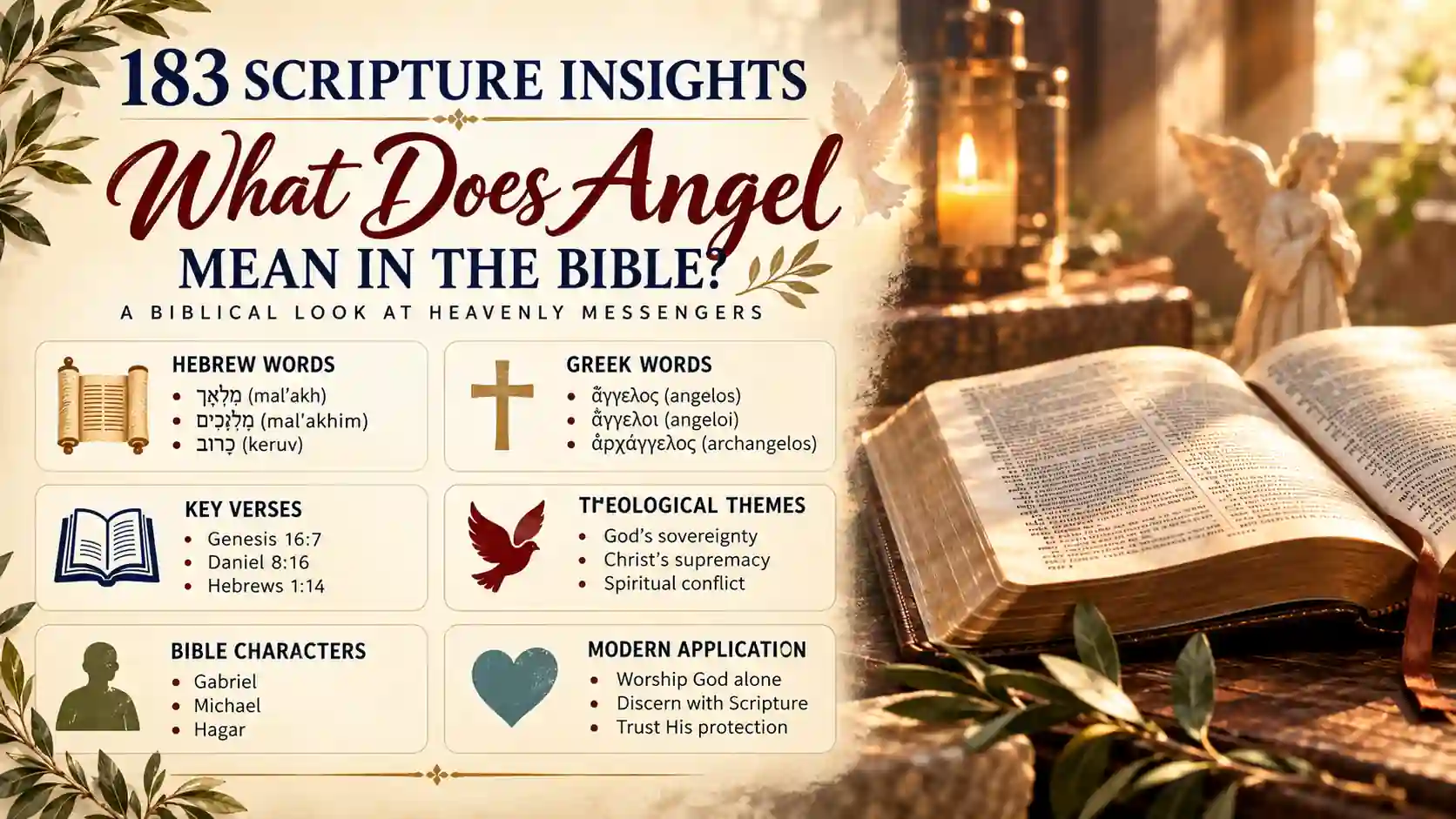
When you ask what does angel mean in the Bible, Scripture gives a richer answer than simply “a heavenly being.” The primary Hebrew and Greek words mean messenger, emphasizing the task of carrying a message rather than describing the messenger’s appearance. Depending on context, the Bible can use the same basic word for heavenly angels and human messengers.
Your study also encounters cherubim, seraphim, the archangel Michael, Gabriel, mysterious “watchers,” and the distinctive Angel of the LORD. Together, these passages reveal spiritual beings who worship God, serve His purposes, deliver His messages, and remain completely subordinate to Him.
Key Angel Scripture References
| Verse | Passage Snippet | Context |
|---|---|---|
| Genesis 16:7 | “angel of the LORD” | The Angel finds Hagar in the wilderness and speaks God’s promise. |
| Genesis 19:1 | “two angels” | Angels arrive in Sodom before divine judgment falls. |
| Exodus 3:2 | “angel of the LORD” | The Angel appears to Moses from the burning bush. |
| Psalm 34:7 | “angel of the LORD” | God’s angel encamps around those who fear Him. |
| Psalm 103:20 | “his angels” | Mighty angels obey God’s word and bless His name. |
| Daniel 8:16 | “Gabriel” | Gabriel is commanded to explain Daniel’s vision. |
| Matthew 1:20 | “angel of the Lord” | An angel instructs Joseph concerning Jesus’ birth. |
| Luke 1:19 | “I am Gabriel” | Gabriel identifies himself while speaking to Zechariah. |
| Hebrews 1:14 | “ministering spirits” | Angels serve God and minister for heirs of salvation. |
| Revelation 5:11 | “many angels” | Vast numbers of angels worship around God’s throne. |
Angel Bible Translation Comparison
| Verse | KJV | NIV | ESV | NASB |
|---|---|---|---|---|
| Genesis 16:7 | angel of the LORD | angel of the LORD | angel of the LORD | angel of the LORD |
| Genesis 19:1 | two angels | two angels | two angels | two angels |
| Psalm 8:5 | angels | angels | heavenly beings | God |
| Psalm 103:20 | his angels | his angels | his angels | His angels |
| Matthew 11:10 | messenger | messenger | messenger | messenger |
| Luke 7:24 | messengers | messengers | messengers | messengers |
| Hebrews 1:14 | ministering spirits | ministering spirits | ministering spirits | ministering spirits |
| Jude 9 | archangel | archangel | archangel | archangel |
| Revelation 12:7 | his angels | his angels | his angels | his angels |
Psalm 8:5 is especially instructive because the underlying Hebrew is אֱלֹהִים (ʾelohim), not מַלְאָךְ (malʾakh). Translation differences there arise from interpretation of the Hebrew text and its relationship to the Greek Old Testament and Hebrews 2:7.
People and Characters Associated with Angels
| Person | Role | Connection |
|---|---|---|
| Hagar | Abraham’s servant | The Angel of the LORD finds and addresses her. |
| Abraham | Patriarch | Receives heavenly visitors before Sodom’s judgment. |
| Jacob | Patriarch | Encounters angels and sees God’s heavenly host. |
| Moses | Covenant mediator | Encounters the Angel of the LORD at the burning bush. |
| Daniel | Prophet | Receives explanations involving Gabriel and Michael. |
| Gabriel | Heavenly messenger | Announces and interprets divine revelation. |
| Michael | Archangel | Contends with evil and leads heavenly forces. |
| Mary | Mother of Jesus | Receives Gabriel’s announcement of Jesus’ conception. |
| Joseph | Husband of Mary | Receives angelic guidance through dreams. |
| Peter | Apostle | An angel releases him from imprisonment. |
Original Hebrew and Greek Words for Angel
| Original Word | Transliteration | Strong’s # | Literal Meaning |
|---|---|---|---|
| מַלְאָךְ | malʾakh | H4397 | messenger, angel |
| מַלְאָכִים | malʾakhim | H4397 | messengers, angels |
| מַלְאֲכֵי | malʾakhe | H4397 | messengers of, angels of |
| כְּרוּב | keruv | H3742 | cherub |
| שָׂרָף | saraph | H8314 | fiery one, seraph |
| עִיר | ʿir | H5894 | watcher |
| ἄγγελος | angelos | G32 | messenger, angel |
| ἄγγελοι | angeloi | G32 | messengers, angels |
| ἀρχάγγελος | archangelos | G743 | chief angel, archangel |
| πνεῦμα | pneuma | G4151 | spirit |
The words in this table are not interchangeable titles for one class of being. מַלְאָךְ (malʾakh) and ἄγγελος (angelos) directly supply the biblical idea of a messenger, while terms such as cherub, seraph, watcher, archangel, and spirit describe related heavenly beings or categories in particular passages.
Related Biblical Concepts of Angels
| Concept | Connection | Supporting Verse |
|---|---|---|
| Messenger | The basic meaning of malʾakh and angelos | Luke 7:24 |
| Worship | Angels praise and glorify God | Revelation 5:11-12 |
| Obedience | Angels carry out God’s commands | Psalm 103:20 |
| Protection | God appoints angels according to His will | Psalm 91:11 |
| Judgment | Angels participate in divine judgments | Genesis 19:13 |
| Revelation | Angels communicate divine messages | Daniel 8:16 |
| Ministry | Angels serve according to God’s purposes | Hebrews 1:14 |
| Heavenly warfare | Michael and angels oppose the dragon | Revelation 12:7 |
| Christ’s return | Angels accompany the returning Christ | Matthew 25:31 |
| Hospitality | Strangers may unknowingly receive angels | Hebrews 13:2 |
Historical and Cultural Context of Angels
| Aspect | Detail | Biblical Source |
|---|---|---|
| Ancient messengers | Kings used authorized representatives | 1 Samuel 29:9 |
| Human malʾakh | Hebrew word can describe human messengers | Genesis 32:3 |
| Human angelos | Greek word can describe human messengers | Luke 7:24 |
| Divine court | Heavenly beings surround God’s throne | 1 Kings 22:19 |
| Cherubim | Associated with God’s holy presence | Exodus 25:18-22 |
| Seraphim | Worship around the exalted LORD | Isaiah 6:1-7 |
| Watchers | Appear in Nebuchadnezzar’s dream | Daniel 4:13 |
| Gabriel | Interprets revelation and delivers announcements | Daniel 8:16 |
| Michael | Described as a chief prince | Daniel 10:13 |
| First-century hope | Angels appear in Jewish apocalyptic imagery | Matthew 24:31 |
Theological Themes of Angels
| Theme | Explanation | Scripture |
|---|---|---|
| God’s sovereignty | Angels act under divine authority | Psalm 103:20 |
| Created worshipers | Angels worship rather than receive worship | Revelation 22:8-9 |
| Christ’s supremacy | The Son is greater than angels | Hebrews 1:4-14 |
| Divine holiness | Heavenly beings proclaim God’s holiness | Isaiah 6:3 |
| Providence | God can employ angels in caring for His people | Acts 12:7-11 |
| Revelation | Angels sometimes communicate God’s revealed purposes | Luke 1:26-38 |
| Judgment | Angels can execute divine commands of judgment | 2 Kings 19:35 |
| Spiritual conflict | Scripture depicts conflict among spiritual powers | Daniel 10:13 |
| Incarnation | Angels announce the birth of Christ | Luke 2:9-14 |
| Final gathering | Angels participate in end-time events | Matthew 13:41 |
Modern Application for Believers Studying Angels
| Area | Practice | Scripture |
|---|---|---|
| Worship | Direct worship to God alone | Revelation 22:8-9 |
| Christology | Keep Christ above every angelic being | Hebrews 1:4 |
| Discernment | Test supernatural claims by revealed truth | Galatians 1:8 |
| Prayer | Pray to God rather than seeking angelic mediation | Matthew 6:9 |
| Courage | Trust God’s sovereign protection | Psalm 34:7 |
| Hospitality | Receive strangers with generous care | Hebrews 13:2 |
| Humility | Avoid speculation beyond Scripture | Colossians 2:18 |
| Obedience | Learn from the angels’ readiness to serve | Psalm 103:20 |
| Hope | Remember the heavenly dimension of God’s kingdom | Hebrews 12:22 |
| Gospel focus | Treasure Christ above fascination with angels | Hebrews 1:1-14 |
מַלְאָךְ MalʾAkh Shows That Angel Means Messenger
The Hebrew noun מַלְאָךְ (malʾakh, H4397) fundamentally means a messenger or representative. Context determines whether that messenger is human or heavenly. Jacob sends malʾakhim to Esau in Genesis 32:3, while Psalm 103:20 uses the same word family for mighty heavenly servants who obey God.
This distinction matters because the English word “angel” can make you immediately imagine a particular kind of spiritual creature. Biblical Hebrew first emphasizes function. A malʾakh is one who is sent. When the context identifies that messenger as heavenly, “angel” is an appropriate English translation.
What Does Angel Mean in the Bible When Ἄγγελος Describes a Human?
The New Testament follows the same pattern. Greek ἄγγελος (angelos, G32) means messenger and can identify either a heavenly messenger or an ordinary human one. In Luke 7:24, the men John the Baptist sends to Jesus are called angeloi. English translations therefore appropriately render the word “messengers.”
The context changes dramatically in passages such as Luke 1:26, where Gabriel is sent from God to Mary. The underlying idea of being sent remains, but the messenger is heavenly. This helps you read Scripture carefully rather than assuming that every occurrence of angelos must mean a supernatural being.
The Angel of the Lord from Hagar to the Burning Bush
One of the deepest questions in your study concerns מַלְאַךְ יְהוָה (malʾakh YHWH), “the Angel of the LORD.” In Genesis 16, the Angel speaks to Hagar with divine authority. In Exodus 3:2, the Angel appears in the burning bush, yet the narrative soon says that God calls to Moses from the bush.
These passages have generated substantial theological discussion. Many Christian interpreters have understood certain appearances as manifestations of the preincarnate Son, while others understand the Angel as a heavenly representative who speaks fully with God’s delegated authority. The texts clearly establish an unusually close identification between the LORD and His messenger, but they do not explicitly use the later theological expression “preincarnate Christ.”
Hebrews 1 Places Jesus Above Every Angel
Hebrews provides one of Scripture’s clearest safeguards against making angels the center of Christian spirituality. Hebrews 1 describes angels as λειτουργικὰ πνεύματα, leitourgika pneumata, “ministering spirits,” sent to serve for the sake of those who will inherit salvation. Their ministry is real, but it remains commissioned ministry.
The Son occupies an entirely different position. Angels worship Him, while He reigns with divine authority. This distinction should shape your theology. Scripture encourages confidence in God’s heavenly servants without encouraging angel worship, attempts to contact angels, or spiritual fascination that pushes Jesus Christ away from the center.
Questions Bible Students Ask About Angels
Does מַלְאָךְ (malʾakh) always mean a supernatural angel?
No. H4397 means “messenger,” and context determines whether the messenger is human or heavenly.
Why can ἄγγελος (angelos) be translated “angel” in one verse and “messenger” in another?
G32 carries both senses, so translators identify the intended meaning from the person and setting described by the passage.
Is the Angel of the LORD in Exodus 3 definitely the preincarnate Christ?
The passage closely identifies the Angel with God, and many Christians interpret the appearance christologically, but Exodus itself does not explicitly identify the Angel as the Son.
Are cherubim and seraphim simply other biblical words for angels?
Not exactly. Scripture presents cherubim and seraphim as heavenly beings, but it gives them distinctive names, appearances, and functions rather than simply calling them malʾakhim.
Does Hebrews 1:14 teach that every Christian has a personal guardian angel?
Hebrews teaches that angels are ministering spirits serving God’s saving purposes, but that verse does not specify that each believer is permanently assigned one individual angel.