
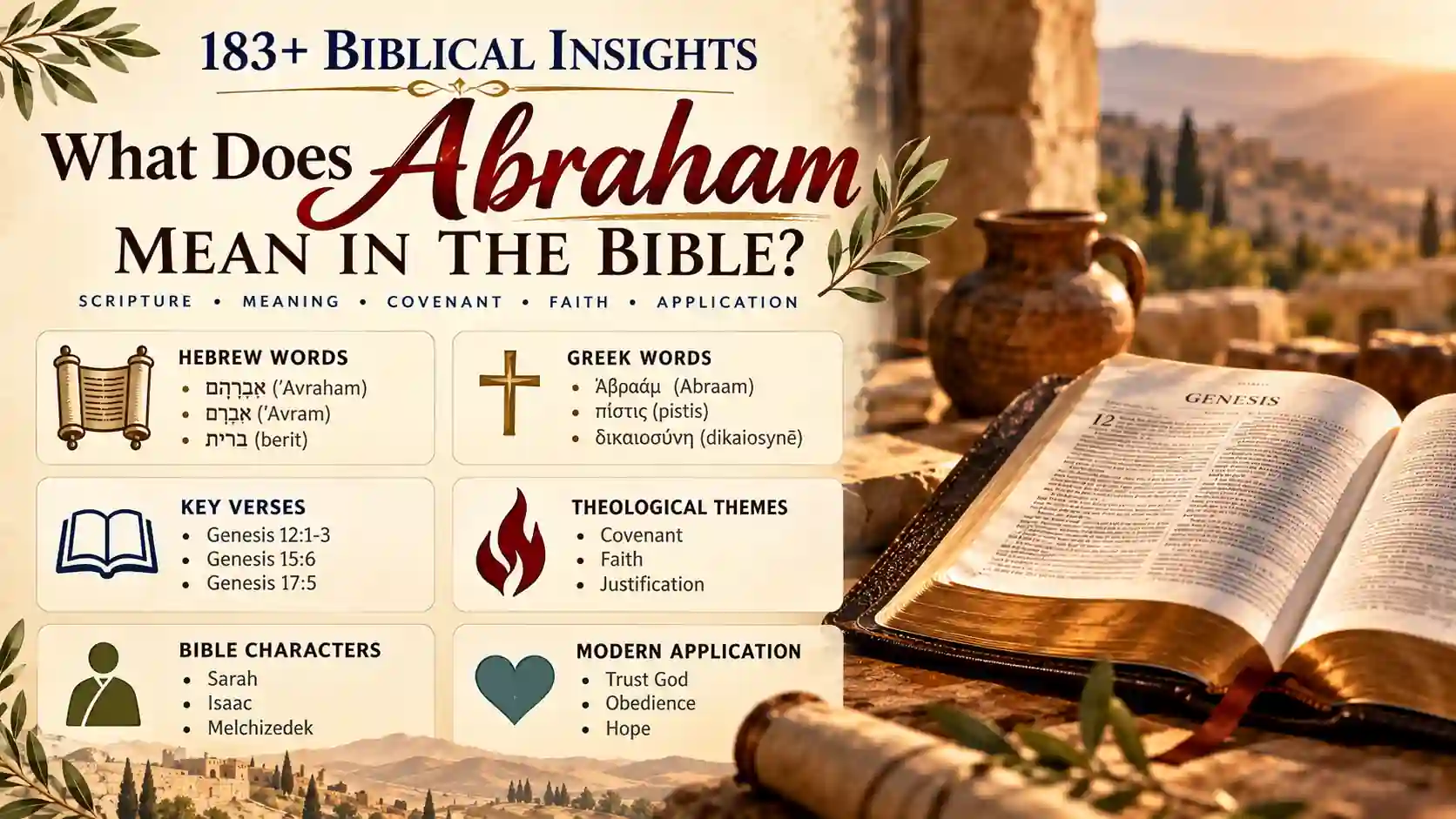
What does Abraham mean in the Bible? The name Abraham is far more than a personal label. In Genesis, God changes Abram’s name to Abraham as part of His covenant promise, declaring that the patriarch would become the father of many nations. The Hebrew name אַבְרָהָם (ʾAvraham) therefore carries covenant significance tied to descendants, nations, land, and blessing.
As you follow Abraham through Scripture, his name becomes associated with faith, righteousness, promise, testing, and God’s purpose to bless the nations. The New Testament then presents Abraham as a major example of justification by faith.
Abraham Key Scripture References
| Verse | Passage Snippet | Context |
|---|---|---|
| Genesis 12:1-3 | “I will make of thee a great nation” | God calls Abram and promises blessing |
| Genesis 13:14-17 | “all the land which thou seest” | God promises Canaan to Abram’s offspring |
| Genesis 15:5-6 | “he believed in the LORD” | Abram trusts God’s promise of descendants |
| Genesis 17:4-5 | “father of many nations” | Abram receives the name Abraham |
| Genesis 17:7 | “an everlasting covenant” | God establishes His covenant with Abraham |
| Genesis 21:1-3 | Sarah bears Isaac | The promised son is finally born |
| Genesis 22:1-18 | “God did tempt Abraham” | Abraham’s faith is tested through Isaac |
| Romans 4:1-3 | “Abraham believed God” | Paul explains justification by faith |
| Galatians 3:6-9 | “they which be of faith” | Abraham’s blessing is connected with faith |
| Hebrews 11:8-12 | “Abraham… obeyed” | Abraham appears among examples of faith |
Abraham Bible Translation Comparison
| Verse | KJV | NIV | ESV | NASB |
|---|---|---|---|---|
| Genesis 12:2 | “great nation” | “great nation” | “great nation” | “great nation” |
| Genesis 12:3 | “all families” | “all peoples” | “all families” | “all families” |
| Genesis 15:6 | “believed in the LORD” | “believed the LORD” | “believed the LORD” | “believed in the LORD” |
| Genesis 17:5 | “many nations” | “many nations” | “multitude of nations” | “multitude of nations” |
| Genesis 17:7 | “everlasting covenant” | “everlasting covenant” | “everlasting covenant” | “everlasting covenant” |
| Genesis 22:12 | “fearest God” | “fear God” | “fear God” | “fear God” |
| Romans 4:3 | “believed God” | “believed God” | “believed God” | “believed God” |
| Galatians 3:7 | “children of Abraham” | “children of Abraham” | “sons of Abraham” | “sons of Abraham” |
| Hebrews 11:8 | “Abraham… obeyed” | “Abraham… obeyed” | “Abraham obeyed” | “Abraham… obeyed” |
Abraham People and Characters Associated
| Person | Role | Connection |
|---|---|---|
| Terah | Abraham’s father | Took his family from Ur toward Canaan |
| Sarah | Abraham’s wife | Mother of Isaac and partner in the promise |
| Lot | Abraham’s nephew | Traveled with Abraham and later settled near Sodom |
| Melchizedek | King and priest | Blessed Abraham after his military victory |
| Hagar | Sarah’s servant | Bore Abraham’s son Ishmael |
| Ishmael | Abraham’s son | Received divine promises concerning descendants |
| Isaac | Promised son | Covenant line continued through him |
| Rebekah | Isaac’s wife | Joined the family through Abraham’s servant |
| Jacob | Abraham’s grandson | Inherited the patriarchal promises |
| Jesus Christ | Abraham’s descendant | Matthew and Galatians connect Him with Abraham’s line |
Abraham Original Hebrew and Greek Words
| Original Word | Transliteration | Strong’s # | Literal Meaning |
|---|---|---|---|
| אַבְרָהָם | ʾAvraham | H85 | Abraham, associated with “father of a multitude” |
| אַבְרָם | ʾAvram | H87 | Abram, commonly understood as “exalted father” |
| אָב | ʾav | H1 | father |
| הָמוֹן | hamon | H1995 | multitude, abundance, crowd |
| בְּרִית | berit | H1285 | covenant |
| זֶרַע | zeraʿ | H2233 | seed, offspring |
| אֱמוּנָה | ʾemunah | H530 | faithfulness, firmness |
| צְדָקָה | tsedaqah | H6666 | righteousness |
| Ἀβραάμ | Abraam | G11 | Abraham, the Hebrew patriarch |
| πίστις | pistis | G4102 | faith, trust, faithfulness |
Abraham Related Biblical Concepts
| Concept | Connection | Supporting Verse |
|---|---|---|
| Calling | God called Abram from his homeland | Genesis 12:1 |
| Promise | God promised nationhood and blessing | Genesis 12:2 |
| Blessing | Nations would be blessed through him | Genesis 12:3 |
| Faith | Abraham believed God’s promise | Genesis 15:6 |
| Righteousness | Faith was counted as righteousness | Genesis 15:6 |
| Covenant | God formally bound His promises to Abraham | Genesis 15:18 |
| Circumcision | Covenant sign given to Abraham’s household | Genesis 17:10-11 |
| Promised son | Isaac came according to God’s promise | Genesis 21:1-3 |
| Testing | Abraham was commanded to offer Isaac | Genesis 22:1-2 |
| Inheritance | Abraham looked toward God’s promised future | Hebrews 11:8-10 |
Abraham Historical and Cultural Context
| Aspect | Detail | Biblical Source |
|---|---|---|
| Family origin | Abraham belonged to Terah’s household | Genesis 11:27 |
| Ur | His family departed from Ur of the Chaldeans | Genesis 11:31 |
| Haran | Terah’s household settled there temporarily | Genesis 11:31 |
| Migration | Abraham entered Canaan after God’s call | Genesis 12:4-5 |
| Pastoral life | His wealth included livestock and servants | Genesis 13:2-6 |
| Altars | Abraham worshiped God at significant locations | Genesis 12:7-8 |
| Covenant ceremony | Divided animals accompanied Genesis 15 | Genesis 15:9-18 |
| Circumcision | Males received the covenant sign | Genesis 17:9-14 |
| Hospitality | Abraham welcomed three visitors | Genesis 18:1-8 |
| Burial property | He purchased Machpelah for Sarah | Genesis 23:16-20 |
Abraham Theological Themes
| Theme | Explanation | Scripture |
|---|---|---|
| Divine election | God graciously called Abraham | Genesis 12:1 |
| Covenant | God committed Himself through promises | Genesis 17:7 |
| Faith | Abraham trusted what God had spoken | Genesis 15:6 |
| Justification | Paul uses Abraham to explain righteousness by faith | Romans 4:1-5 |
| Grace | Promise precedes Abraham’s circumcision | Romans 4:9-12 |
| Promise | God pledged descendants despite human impossibility | Romans 4:18-21 |
| Blessing | God intended blessing to reach the nations | Genesis 12:3 |
| Obedience | Faith produced concrete obedience | Hebrews 11:8 |
| Testing | Genesis 22 reveals tested trust | Genesis 22:1-12 |
| Christ | Paul connects Abraham’s promise with Christ | Galatians 3:16 |
Abraham Modern Application for Believers
| Area | Practice | Scripture |
|---|---|---|
| Faith | Trust God when fulfillment is not yet visible | Romans 4:20-21 |
| Obedience | Respond when God’s revealed will requires action | Hebrews 11:8 |
| Patience | Wait for God rather than forcing outcomes | Hebrews 6:13-15 |
| Worship | Make devotion central to your journey | Genesis 12:7-8 |
| Prayer | Intercede seriously for other people | Genesis 18:22-33 |
| Hospitality | Receive others generously | Hebrews 13:2 |
| Stewardship | Hold possessions beneath God’s purposes | Genesis 14:21-23 |
| Family | Teach God’s ways within your household | Genesis 18:19 |
| Testing | Let trials expose and deepen genuine faith | Genesis 22:12 |
| Hope | Look beyond earthly security toward God’s promise | Hebrews 11:9-10 |
What Does Abraham Mean in the Bible Through אַבְרָהָם and Genesis 17?
Before Genesis 17, Scripture normally calls the patriarch אַבְרָם (ʾAvram), Abram. In Genesis 17:5, God declares that his name will now be אַבְרָהָם (ʾAvraham), Abraham, because God has appointed him as the “father of a multitude of nations.” The explanation is reinforced by the Hebrew הָמוֹן (hamon), meaning a multitude or abundance.
This makes the name theological as well as personal. Abraham’s new name continually reminds the reader of something God has promised to accomplish. He is an elderly man without the promised son when the name is given, so every use of “Abraham” points beyond present circumstances toward God’s covenant faithfulness.
Abraham’S Name Belongs to the Covenant Story of Genesis 12 Through 22
Abraham’s significance cannot be reduced to the translation of his name. Genesis 12 introduces God’s promises of land, nationhood, a great name, divine blessing, and blessing extending to the families of the earth. Genesis 15 develops the promises of offspring and land, while Genesis 17 establishes circumcision as the covenant sign and identifies Isaac as the promised son.
This covenant framework explains why Abraham remains prominent throughout the Bible. Israel repeatedly looks back to “Abraham, Isaac, and Jacob,” while the prophets recall God’s ancient promises. Abraham therefore represents a crucial stage in the biblical storyline where God’s purposes move through one chosen family toward blessing that ultimately reaches beyond that family.
Genesis 15 and Romans 4 Make Abraham a Witness to Faith and Righteousness
Genesis 15:6 says Abraham believed the LORD, and his faith was counted to him as righteousness. Paul builds extensively upon this passage in Romans 4. His argument emphasizes that Abraham was counted righteous before receiving circumcision, making the chronology of Genesis itself important to Paul’s teaching.
For your study, this guards against treating Abraham merely as a heroic man who earned God’s favor through exceptional conduct. Scripture records both his faith and his failures. Paul’s emphasis rests on Abraham trusting the God who makes promises, gives life, and accomplishes what human strength cannot achieve.
Galatians 3 and Hebrews 11 Carry Abraham’S Story into the New Testament
Galatians 3 returns to Abraham when explaining the relationship between faith, promise, and Christ. Paul recalls Genesis 15:6 and argues that those characterized by faith are connected with Abraham’s blessing. He also focuses on the promised “offspring” and identifies its climactic significance with Christ in Galatians 3:16.
Hebrews 11 approaches Abraham from another angle by emphasizing obedient faith. Abraham departed without possessing the complete destination, lived as a stranger in the promised land, and faced the extraordinary testing involving Isaac. Biblical faith, in Abraham’s life, is therefore neither passive optimism nor certainty that life will be easy. It is trust in the God who has spoken.
Frequently Asked Questions About Abraham
Does אַבְרָהָם (ʾAvraham) literally mean “father of many nations”?
Genesis 17:5 explicitly connects Abraham’s new name with God’s declaration that he would become the father of a multitude of nations.
What is the difference between אַבְרָם (ʾAvram) and אַבְרָהָם (ʾAvraham)?
Abram is Abraham’s earlier name, commonly understood as “exalted father,” while Abraham is the covenant name God gives him in Genesis 17:5 and associates with a multitude of nations.
Why are Strong’s H85 and G11 both connected with Abraham?
H85 identifies Hebrew אַבְרָהָם (ʾAvraham) in the Old Testament, while G11 identifies Greek Ἀβραάμ (Abraam), the New Testament form of the same patriarch’s name.
Why does Paul focus so strongly on Genesis 15:6 in Romans 4?
Paul emphasizes that Abraham was counted righteous through faith before circumcision, using the sequence of Abraham’s story to explain justification apart from works.
How can believers apply Abraham’s example without copying every action he took?
You can follow Scripture’s own emphasis by imitating his faith and obedience while recognizing that the Bible records his failures as well as his faithful responses.