
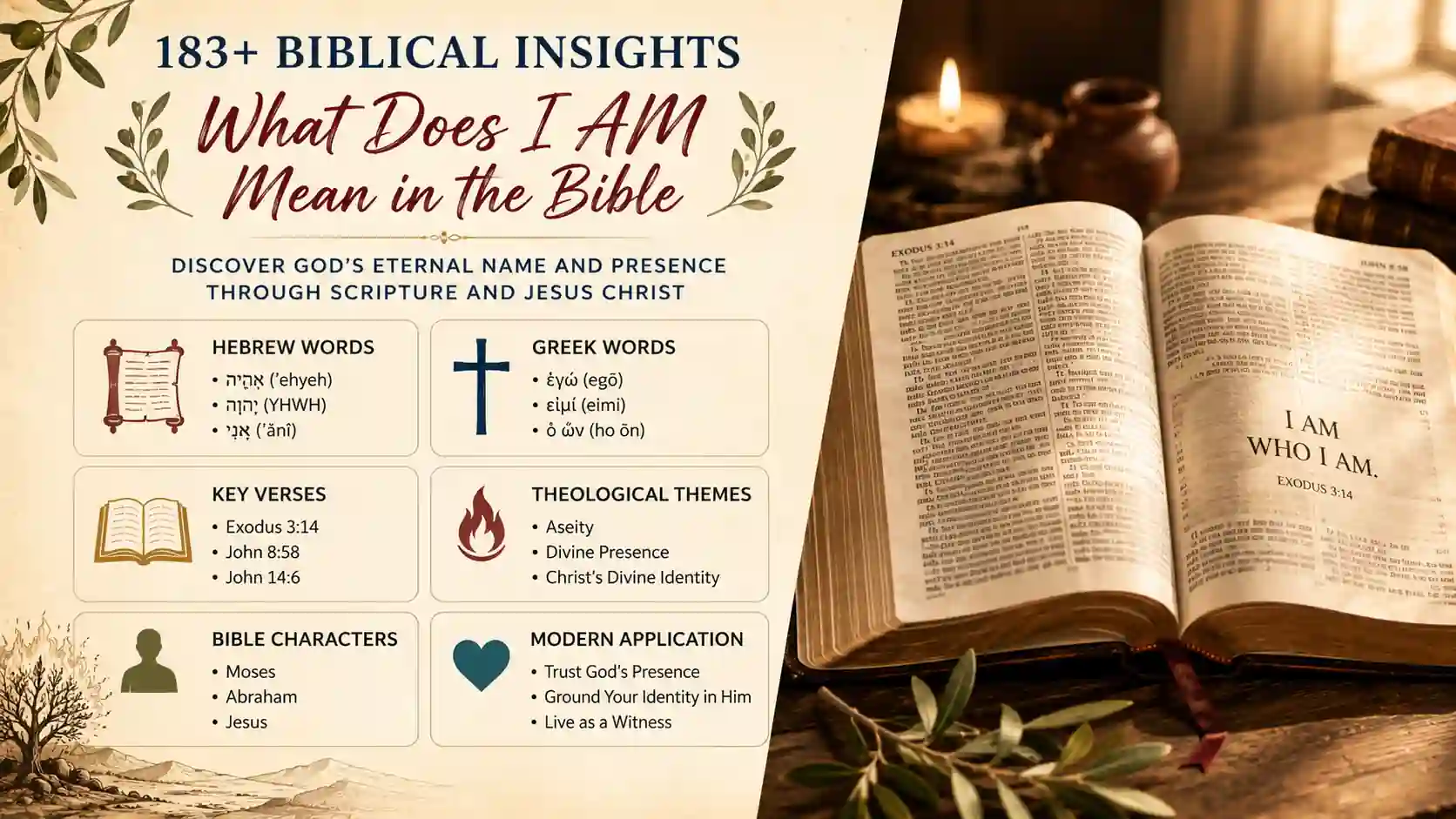
What does I AM mean in the Bible? This question leads you to the burning bush, where God revealed His covenant name to Moses, and to the Gospel of John, where Jesus used striking “I am” declarations. The phrase speaks of God’s existence, presence, faithfulness, and authority.
In your study, you will encounter the Hebrew אֶהְיֶה, ʾehyeh, and the Greek ἐγώ εἰμι, egō eimi. Their meanings depend on grammar and context, yet together they reveal the God who eternally is, remains with His people, and makes Himself known through Jesus Christ.
Key I AM Scripture References
| Verse | Passage Snippet | Context |
|---|---|---|
| Exodus 3:12 | “I will be with you” | God commissions Moses |
| Exodus 3:14 | “I AM WHO I AM” | God answers Moses |
| Exodus 3:15 | “The LORD” | Covenant name revealed |
| Deuteronomy 32:39 | “I, even I, am he” | God declares uniqueness |
| Isaiah 41:4 | “I, the LORD” | God rules generations |
| Isaiah 43:10 | “I am he” | Israel witnesses to God |
| Isaiah 46:4 | “I am he” | God promises sustaining care |
| John 8:24 | “I am he” | Jesus calls for faith |
| John 8:58 | “Before Abraham was, I am” | Jesus claims timeless identity |
| John 18:5–6 | “I am he” | Arresting party draws back |
I AM Bible Translation Comparison
| Verse | KJV | NIV | ESV | NASB |
|---|---|---|---|---|
| Exodus 3:12 | “I will be with thee” | “I will be with you” | “I will be with you” | “I will be with you” |
| Exodus 3:14 | “I AM THAT I AM” | “I AM WHO I AM” | “I AM WHO I AM” | “I AM WHO I AM” |
| Deuteronomy 32:39 | “I, even I, am he” | “I myself am he” | “I, even I, am he” | “I, I am He” |
| Isaiah 41:4 | “I the LORD” | “I, the LORD” | “I, the LORD” | “I, the LORD” |
| Isaiah 43:10 | “I am he” | “I am he” | “I am he” | “I am He” |
| John 6:35 | “I am the bread” | “I am the bread” | “I am the bread” | “I am the bread” |
| John 8:24 | “I am he” | “I am he” | “I am he” | “I am He” |
| John 8:58 | “Before Abraham was, I am” | “Before Abraham was born, I am” | “Before Abraham was, I am” | “Before Abraham was born, I am” |
| John 10:11 | “I am the good shepherd” | “I am the good shepherd” | “I am the good shepherd” | “I am the good shepherd” |
| John 14:6 | “I am the way” | “I am the way” | “I am the way” | “I am the way” |
People and Characters Associated with I AM
| Person | Role | Connection |
|---|---|---|
| God | Covenant Lord | Reveals אֶהְיֶה to Moses |
| Moses | Prophet and deliverer | Receives the divine revelation |
| Abraham | Patriarch | Named in John 8:58 |
| Isaac | Covenant son | God identifies with his family |
| Jacob | Patriarch of Israel | Included in Exodus 3:15 |
| Israelites | Enslaved covenant people | Hear that I AM sent Moses |
| Isaiah | Prophet | Records divine “I am he” sayings |
| Jesus | Son and Messiah | Uses ἐγώ εἰμι declarations |
| Samaritan woman | Witness in Samaria | Hears Jesus identify himself |
| John | Evangelist | Records the signs and sayings |
Original I AM Hebrew and Greek Words
| Original Word | Transliteration | Strong’s # | Literal Meaning |
|---|---|---|---|
| אֶהְיֶה | ʾehyeh | H1961 | I am or I will be |
| הָיָה | hāyâ | H1961 | To be, become, happen |
| אֲשֶׁר | ʾăšer | H834 | Who, which, that |
| יְהוָה | YHWH | H3068 | The LORD, divine name |
| אֱלֹהִים | ʾĕlōhîm | H430 | God |
| אֲנִי | ʾănî | H589 | I |
| ἐγώ | egō | G1473 | I |
| εἰμί | eimi | G1510 | I am, I exist |
| ὁ ὤν | ho ōn | G5607 | The one who is |
| γίνομαι | ginomai | G1096 | Become, come into being |
Related I AM Biblical Concepts
| Concept | Connection | Supporting Verse |
|---|---|---|
| Divine presence | God promises to accompany Moses | Exodus 3:12 |
| Covenant name | YHWH identifies Israel’s God | Exodus 3:15 |
| Self-existence | God depends on no creature | Exodus 3:14 |
| Eternality | God precedes Abraham | John 8:58 |
| Uniqueness | No rival deity compares with God | Deuteronomy 32:39 |
| Faithfulness | God remains through generations | Isaiah 41:4 |
| Revelation | God makes his identity known | Isaiah 43:10 |
| Salvation | Faith in Jesus concerns eternal life | John 8:24 |
| Incarnation | The eternal Word becomes flesh | John 1:1, 14 |
| Divine authority | Jesus speaks and acts sovereignly | John 18:5–6 |
Historical and Cultural Context of I AM
| Aspect | Detail | Biblical Source |
|---|---|---|
| Egyptian slavery | Israel suffers under Pharaoh | Exodus 1:8–14 |
| Midian exile | Moses lives as a shepherd | Exodus 2:15–22 |
| Burning bush | God appears without consuming it | Exodus 3:1–3 |
| Holy ground | Moses removes his sandals | Exodus 3:5 |
| Ancestral covenant | God remembers Abraham’s family | Exodus 3:6 |
| Divine commission | Moses is sent to Pharaoh | Exodus 3:10 |
| Name question | Moses anticipates Israel’s response | Exodus 3:13 |
| Greek Scriptures | Exodus was translated into Greek | Exodus 3:14 LXX |
| Second Temple debate | Jesus speaks amid identity disputes | John 8:48–59 |
| Roman arrest | Jesus is confronted in a garden | John 18:1–6 |
Theological Themes within I AM
| Theme | Explanation | Scripture |
|---|---|---|
| Aseity | God possesses life in himself | Exodus 3:14 |
| Immutability | God remains faithful and constant | Malachi 3:6 |
| Eternity | God is before all generations | Psalm 90:2 |
| Sovereignty | God directs history and deliverance | Exodus 6:1 |
| Presence | God stays with those he sends | Exodus 3:12 |
| Holiness | God’s presence makes ground holy | Exodus 3:5 |
| Covenant faithfulness | God remembers his promises | Exodus 2:24 |
| Christology | Jesus reveals divine identity | John 8:58 |
| Redemption | I AM delivers people from bondage | Exodus 3:7–8 |
| Revelation | God is known by his words and acts | Exodus 3:14–15 |
Modern I AM Application for Believers
| Area | Practice | Scripture |
|---|---|---|
| Worship | Honor God as eternally sufficient | Psalm 90:2 |
| Prayer | Approach God as present and faithful | Exodus 3:12 |
| Fear | Trust God when obedience feels costly | Exodus 4:11–12 |
| Identity | Ground your life in God, not status | Acts 17:28 |
| Suffering | Remember that God sees affliction | Exodus 3:7 |
| Calling | Depend on God’s presence, not ability | Exodus 3:11–12 |
| Scripture study | Read each “I am” in context | John 8:24–58 |
| Christ-centered faith | Receive Jesus as life and truth | John 14:6 |
| Perseverance | Trust the God of every generation | Isaiah 46:4 |
| Witness | Testify to who God has revealed himself to be | Isaiah 43:10 |
What Does I AM Mean in the Bible’S Burning Bush Account?
In Exodus 3, Moses asks what he should say when the Israelites request the name of the God who sent him. God answers, אֶהְיֶה אֲשֶׁר אֶהְיֶה, ʾehyeh ʾăšer ʾehyeh. English Bibles commonly render this statement “I AM WHO I AM,” though the Hebrew form can also carry a future sense, “I will be who I will be.”
That future shade is significant because God had just promised Moses, אֶהְיֶה עִמָּךְ, ʾehyeh ʿimmāk, “I will be with you.” God’s answer therefore communicates more than abstract existence. The God who is sends Moses, accompanies him, keeps covenant, overthrows oppression, and brings Israel out of Egypt.
אֶהְיֶה And Yhwh Reveal God’S Covenant Presence
The relationship between אֶהְיֶה, ʾehyeh, and יְהוָה, YHWH, stands at the heart of the passage. ʾEhyeh is the first-person form, “I am” or “I will be,” while YHWH is the covenant name Moses must announce to Israel. Exodus 3:15 connects that name with the God of Abraham, Isaac, and Jacob.
Scripture does not present the divine name as a formula that gives human beings control over God. The name reveals God while preserving his freedom and majesty. He cannot be defined by Pharaoh, localized like an Egyptian deity, or reduced to an idol. You know him because he graciously speaks, remembers his covenant, and acts.
Jesus and ἐγώ εἰμι in John’S Gospel
The ordinary Greek words ἐγώ εἰμι, egō eimi, mean “I am.” Context determines whether they function as simple self-identification or carry deeper theological force. In John 9:9, for example, the healed man uses the expression merely to say, “I am the man.” Not every occurrence is a claim to deity.
John 8:58 is different. Jesus contrasts Abraham’s coming into existence with his own continuing identity: “Before Abraham was, I am.” His hearers respond by taking up stones. Within John’s wider portrait of the eternal Word, the saying presents Jesus as more than an earthly teacher whose life began in Bethlehem.
The Seven Predicated I AM Sayings Reveal Jesus’ Saving Work
John also records seven well-known sayings in which Jesus joins “I am” to an image. He is the bread of life, the light of the world, the door, the good shepherd, the resurrection and the life, the way and the truth and the life, and the true vine. Each image explains how he gives life to his people.
These declarations are not disconnected slogans. They arise from signs, conversations, opposition, and covenant imagery. Bread recalls God’s provision, light announces revelation, the shepherd gathers the flock, and the vine describes living union. As you study them, ask what each saying reveals about Jesus and what response the surrounding passage requires.
Questions About I AM in the Bible
Does אֶהְיֶה, ʾehyeh, mean “I am” or “I will be”?
It can express either sense, and Exodus 3 emphasizes both God’s enduring existence and his promised presence with Israel.
Is “I AM” the exact pronunciation of God’s name?
No. “I AM” translates ʾehyeh, while the covenant name in Exodus 3:15 is יְהוָה, YHWH, commonly represented as Yahweh or LORD.
Why does the Greek Septuagint use ἐγώ εἰμι ὁ ὤν?
The wording means “I am the one who is,” presenting God as the existing one while interpreting the Hebrew expression for Greek readers.
Does every use of ἐγώ εἰμι prove that Jesus is claiming deity?
No. The phrase can be ordinary Greek, so you must examine the speaker, grammar, setting, reaction, and larger Gospel context.
How should the meaning of I AM affect your daily faith?
It calls you to trust God’s unchanging character, depend on his presence, obey his calling, and receive the life revealed in Christ.