
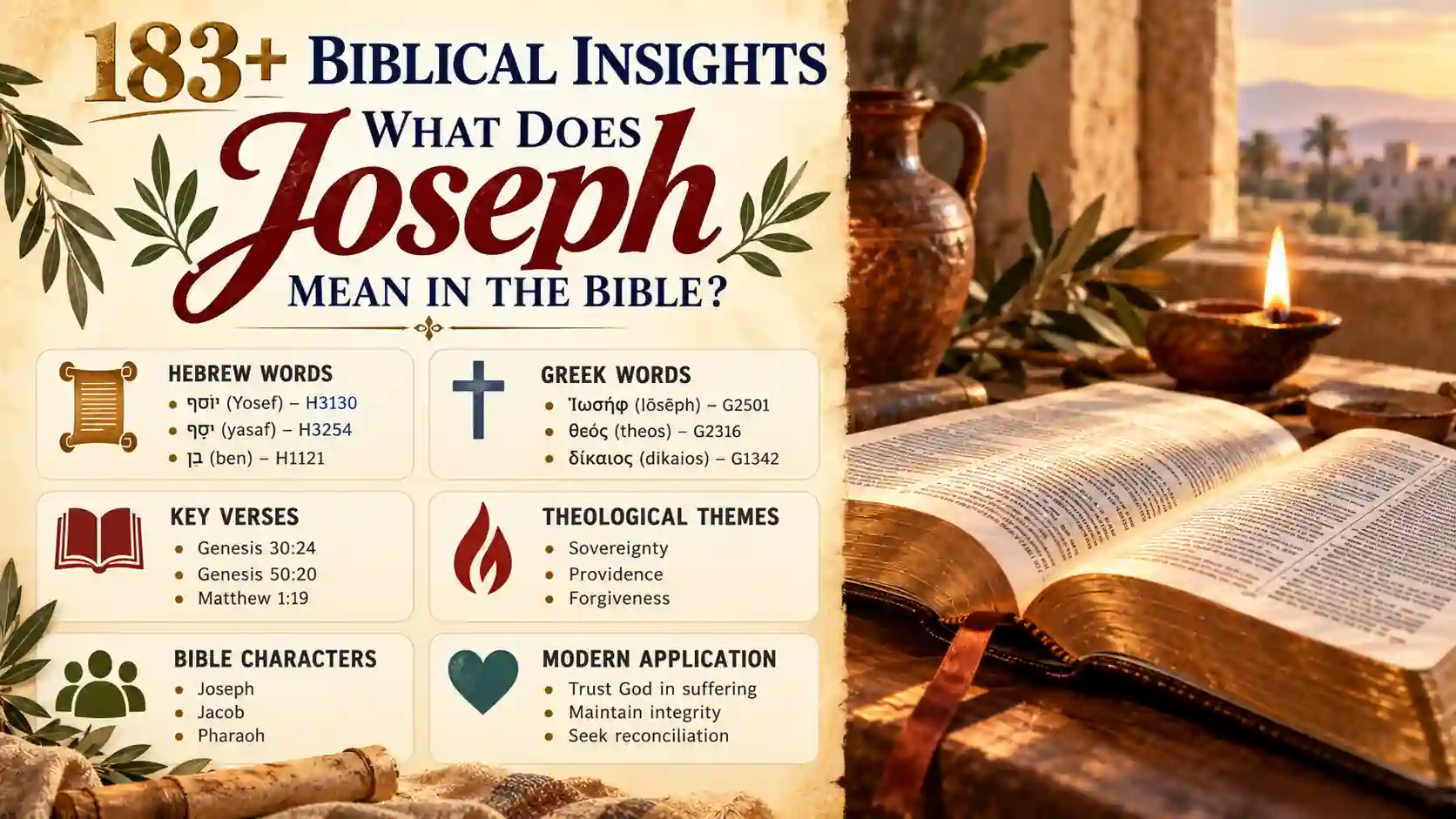
When you ask what does Joseph mean in the Bible, you are asking about more than the meaning of a personal name. Joseph comes from the Hebrew יוֹסֵף (Yosef), associated with the verb יָסַף (yasaf), meaning “to add,” “increase,” or “do again.” Genesis itself explains the name through Rachel’s hope that the LORD would “add” another son to her family.
The name belongs especially to Joseph son of Jacob, whose journey from slavery to authority displays divine providence, and to Joseph of Nazareth, the faithful guardian of Jesus.
Key Scripture References for Joseph
| Verse | Passage Snippet | Context |
|---|---|---|
| Genesis 30:22-24 | “The LORD shall add to me another son” | Rachel names Joseph after God opens her womb. |
| Genesis 37:3 | “Israel loved Joseph” | Jacob’s special affection contributes to family conflict. |
| Genesis 37:28 | “Sold Joseph to the Ishmeelites” | His brothers sell him toward Egypt. |
| Genesis 39:2 | “The LORD was with Joseph” | God blesses Joseph while he serves Potiphar. |
| Genesis 39:21 | “The LORD was with Joseph” | Divine favor continues during imprisonment. |
| Genesis 41:39-41 | “There is none so discreet and wise” | Pharaoh raises Joseph to authority. |
| Genesis 45:5 | “God did send me before you” | Joseph interprets his suffering providentially. |
| Genesis 50:20 | “God meant it unto good” | Joseph contrasts human evil with divine purpose. |
| Matthew 1:20-21 | “Joseph, thou son of David” | Joseph receives angelic instruction concerning Jesus. |
| Matthew 2:13-14 | “Take the young child” | Joseph protects Jesus by fleeing to Egypt. |
Bible Translation Comparison for Joseph
| Verse | KJV | NIV | ESV | NASB |
|---|---|---|---|---|
| Genesis 30:24 | “add to me” | “add to me” | “add to me” | “add to me” |
| Genesis 37:3 | “loved Joseph” | “loved Joseph” | “loved Joseph” | “loved Joseph” |
| Genesis 39:2 | “with Joseph” | “with Joseph” | “with Joseph” | “with Joseph” |
| Genesis 39:9 | “sin against God” | “sin against God” | “sin against God” | “sin against God” |
| Genesis 41:16 | “God shall give” | “God will give” | “God will give” | “God will give” |
| Genesis 45:5 | “God did send me” | “God sent me” | “God sent me” | “God sent me” |
| Genesis 50:19 | “am I in the place of God?” | “Am I in the place of God?” | “Am I in the place of God?” | “am I in God’s place?” |
| Genesis 50:20 | “meant it unto good” | “intended it for good” | “meant it for good” | “meant it for good” |
| Matthew 1:19 | “a just man” | “faithful to the law” | “a just man” | “a righteous man” |
| Matthew 1:24 | “did as the angel” | “did what the angel” | “did as the angel” | “did as the angel” |
People and Characters Associated with Joseph
| Person | Role | Connection |
|---|---|---|
| Jacob | Joseph’s father | Gives Joseph special affection and later settles in Egypt. |
| Rachel | Joseph’s mother | Names him Joseph after God enables conception. |
| Benjamin | Younger brother | Joseph’s full brother through Rachel. |
| Judah | Older brother | Helps prevent Joseph’s death and later pleads for Benjamin. |
| Potiphar | Egyptian official | Purchases Joseph as a slave. |
| Potiphar’s wife | Accuser | Falsely accuses Joseph after he rejects her advances. |
| Pharaoh | Egyptian king | Elevates Joseph after his interpretation of dreams. |
| Manasseh | Joseph’s son | Firstborn son born to Joseph in Egypt. |
| Ephraim | Joseph’s son | Receives Jacob’s greater patriarchal blessing. |
| Joseph of Nazareth | Jesus’ legal father | Davidic descendant entrusted with caring for Jesus. |
Original Hebrew and Greek Words Connected with Joseph
| Original Word | Transliteration | Strong’s # | Literal Meaning |
|---|---|---|---|
| יוֹסֵף | Yosef | H3130 | Joseph, “he adds” |
| יָסַף | yasaf | H3254 | add, increase, do again |
| בֵּן | ben | H1121 | son |
| אָח | ach | H251 | brother |
| חֵן | chen | H2580 | favor, grace |
| צַדִּיק | tsaddiq | H6662 | righteous, just |
| θεός | theos | G2316 | God |
| Ἰωσήφ | Iōsēph | G2501 | Joseph |
| δίκαιος | dikaios | G1342 | righteous, just |
| υἱός | huios | G5207 | son |
Related Biblical Concepts in the Joseph Narratives
| Concept | Connection | Supporting Verse |
|---|---|---|
| Providence | God works through Joseph’s suffering. | Genesis 50:20 |
| Divine presence | The LORD remains with Joseph in adversity. | Genesis 39:2 |
| Temptation | Joseph refuses sexual sin. | Genesis 39:7-9 |
| Wisdom | Joseph attributes interpretation to God. | Genesis 41:16 |
| Forgiveness | Joseph does not retaliate against his brothers. | Genesis 50:15-21 |
| Preservation | Joseph’s position saves many from famine. | Genesis 45:5-7 |
| Covenant family | Jacob’s household survives through Egypt. | Genesis 46:1-7 |
| Blessing | Joseph’s sons receive Jacob’s blessing. | Genesis 48:13-20 |
| Righteousness | Joseph of Nazareth is called righteous. | Matthew 1:19 |
| Obedience | Joseph obeys divine commands in dreams. | Matthew 1:24 |
Historical and Cultural Context for Joseph
| Aspect | Detail | Biblical Source |
|---|---|---|
| Patriarchal family | Joseph belongs to Jacob’s covenant household. | Genesis 30:22-24 |
| Special garment | Jacob marks Joseph for unusual favor. | Genesis 37:3 |
| Caravan trade | Merchants transport Joseph toward Egypt. | Genesis 37:25-28 |
| Egyptian slavery | Joseph serves in Potiphar’s household. | Genesis 39:1 |
| Imprisonment | Joseph is confined after false accusation. | Genesis 39:20 |
| Royal dreams | Pharaoh seeks meaning for troubling dreams. | Genesis 41:1-8 |
| Famine administration | Grain is stored during seven abundant years. | Genesis 41:47-49 |
| Egyptian authority | Joseph becomes Pharaoh’s chief administrator. | Genesis 41:40-44 |
| Davidic lineage | Joseph of Nazareth stands in Jesus’ legal genealogy. | Matthew 1:1-16 |
| Betrothal | Joseph and Mary are pledged before cohabitation. | Matthew 1:18-20 |
Theological Themes Revealed Through Joseph
| Theme | Explanation | Scripture |
|---|---|---|
| Sovereignty | God accomplishes purposes despite human wrongdoing. | Genesis 50:20 |
| Providence | Hidden circumstances serve God’s preserving work. | Genesis 45:5-8 |
| God’s presence | Joseph is not abandoned in slavery or prison. | Genesis 39:21 |
| Moral faithfulness | Joseph treats temptation as sin against God. | Genesis 39:9 |
| Divine wisdom | Joseph credits God for dream interpretation. | Genesis 40:8 |
| Reconciliation | Estranged brothers are restored. | Genesis 45:1-15 |
| Preservation | God preserves Jacob’s family during famine. | Genesis 45:7 |
| Blessing | Joseph becomes fruitful despite affliction. | Genesis 49:22 |
| Righteous obedience | Joseph of Nazareth obeys God at personal cost. | Matthew 1:19-24 |
| Messianic protection | Joseph safeguards the child Jesus. | Matthew 2:13-15 |
Modern Application from Joseph for Believers
| Area | Practice | Scripture |
|---|---|---|
| Suffering | Trust God without calling evil good. | Genesis 50:20 |
| Integrity | Resist temptation even when unseen. | Genesis 39:9 |
| Work | Serve faithfully under difficult conditions. | Genesis 39:4 |
| Success | Credit God rather than yourself. | Genesis 41:16 |
| Wisdom | Use responsibility to serve others. | Genesis 41:46-49 |
| Family conflict | Seek reconciliation without revenge. | Genesis 50:17-21 |
| Forgiveness | Refuse personal vengeance. | Genesis 50:19 |
| Uncertainty | Obey what God has clearly revealed. | Matthew 1:24 |
| Protection | Take responsible action for those entrusted to you. | Matthew 2:13-14 |
| Faith | Recognize God’s presence amid changing circumstances. | Genesis 39:21-23 |
יוֹסֵף Yosef and the Meaning Behind Joseph’S Name
The clearest explanation of Joseph’s name occurs at his birth. Rachel had endured painful infertility while her sister Leah bore children. Genesis 30:22 says that God remembered Rachel, listened to her, and opened her womb. After Joseph was born, she declared, “The LORD shall add to me another son” in Genesis 30:24.
That statement connects יוֹסֵף (Yosef, H3130) with יָסַף (yasaf, H3254), a common Hebrew verb meaning “to add,” “increase,” or “do again.” The name can therefore carry the sense “he adds” or “may he add.” Rachel’s words express hope that God would add another child, a hope eventually fulfilled in Benjamin.
What Does Joseph Mean in the Bible Through Genesis 37 to 50?
Joseph’s name has a lexical meaning, but Genesis gives his life a larger theological significance. His brothers hate him, strip him of his special garment, sell him, and allow Jacob to believe he is dead. In Egypt, Joseph experiences slavery, false accusation, and imprisonment before being unexpectedly elevated by Pharaoh.
The repeated statement that “the LORD was with Joseph” in Genesis 39 is central to interpreting these events. Scripture does not describe the brothers’ betrayal as morally acceptable. Instead, Genesis 50:20 holds human responsibility and divine providence together. The brothers intended evil, while God intended the same chain of events for a saving purpose, preserving many lives.
Joseph, Judah, and God’S Covenant Family in Genesis
Joseph’s story also belongs to the larger covenant narrative that begins with Abraham. The famine threatens Jacob’s household, the family through whom God’s promises are continuing. Joseph’s Egyptian position becomes the means by which that family receives food, protection, and a place to live.
Yet Genesis does not make Joseph the ancestor of Israel’s royal Messiah. That line develops through Judah, as Genesis 49:10 indicates. Joseph instead receives remarkable fruitfulness through Ephraim and Manasseh. His story shows how God preserves the covenant family while preparing for developments that extend far beyond Joseph’s own lifetime.
Ἰωσήφ IōSēPh and Joseph of Nazareth in Matthew
The Greek New Testament writes Joseph as Ἰωσήφ (Iōsēph, G2501), carrying the Hebrew name into Greek. Matthew introduces another major Joseph, the husband of Mary. Matthew 1:19 calls him δίκαιος (dikaios, G1342), meaning righteous or just, as he considers how to respond to Mary’s unexpected pregnancy.
After receiving divine instruction, Joseph repeatedly acts in obedience. He takes Mary as his wife, names the child Jesus, flees with the family to Egypt, and later returns when instructed. Matthew therefore portrays Joseph not through recorded speeches but through faithful action. His role places Jesus legally within a Davidic household and shows quiet obedience surrounding the Messiah’s early life.
Questions Bible Students Ask About Joseph
Does יוֹסֵף (Yosef) literally mean “God will increase”?
The name is related to יָסַף (yasaf), “to add” or “increase,” while Genesis 30:24 specifically connects Rachel’s naming of Joseph with her prayer that the LORD would add another son.
Why is Genesis 50:20 so important for understanding Joseph?
It shows that human evil remains evil while God can sovereignly direct events toward a good purpose, in this case preserving many people during famine.
Are Joseph son of Jacob and Joseph of Nazareth the same biblical person?
No. Joseph son of Jacob belongs to the patriarchal period in Genesis, while Joseph of Nazareth appears centuries later as Mary’s husband and Jesus’ legal father.
Why does Matthew call Joseph δίκαιος (dikaios) in Matthew 1:19?
The Greek term means “righteous” or “just,” describing Joseph’s character as he seeks a faithful and merciful response before receiving the angel’s fuller revelation.
What can you learn from Joseph when circumstances seem unfair?
Joseph’s story encourages faithful obedience, moral integrity, forgiveness, and confidence in God’s providence without minimizing the genuine evil or suffering people may cause.