
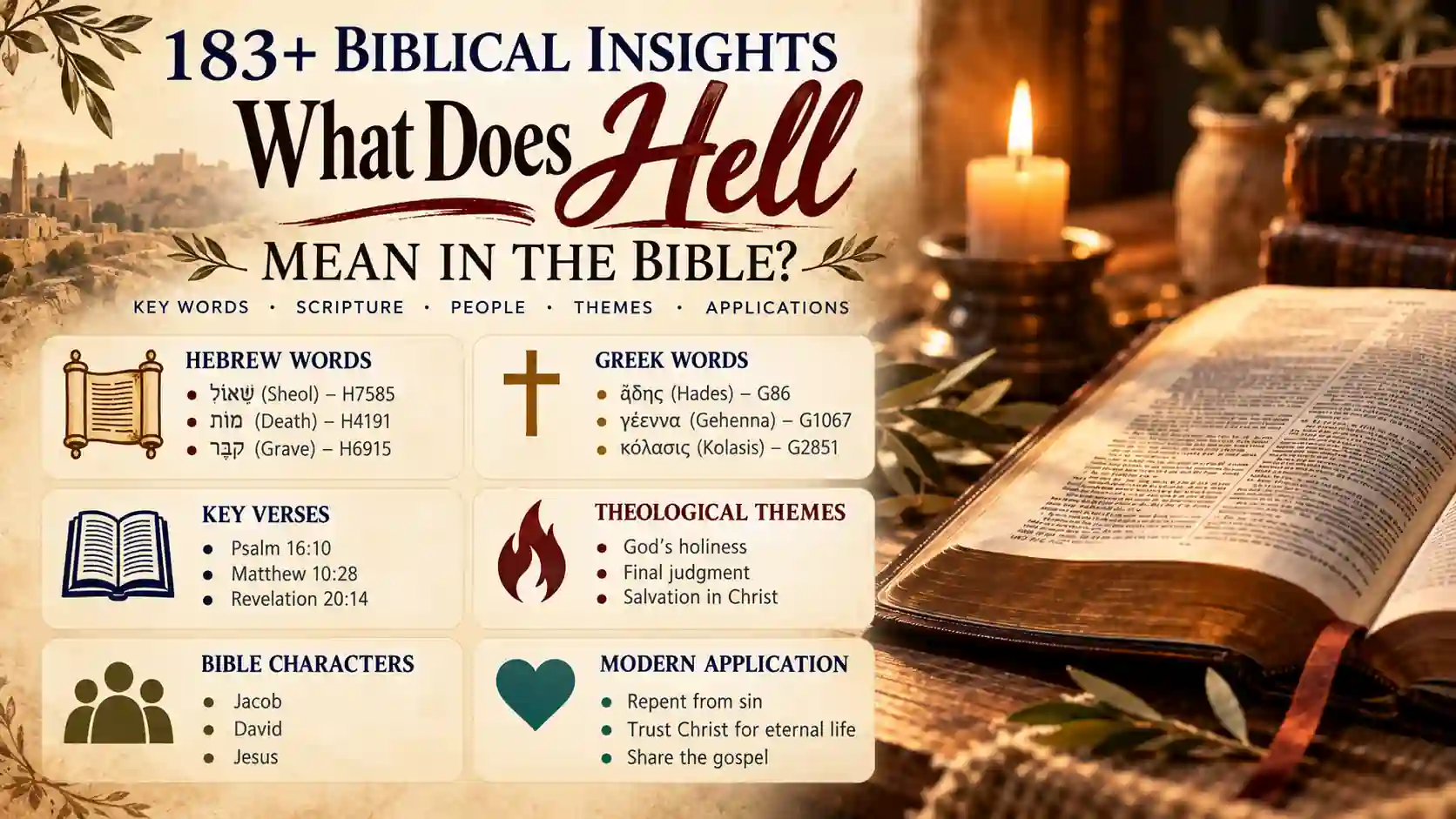
When you ask what does hell mean in the Bible, you are asking a question that reaches across the whole biblical story. English Bibles use the word “hell” for several Hebrew and Greek terms, but those terms do not always describe precisely the same reality.
Your study becomes clearer when you distinguish שְׁאוֹל (Sheol), ᾅδης (Hades), γέεννα (Gehenna), and ταρταρόω (tartaroō). Together with passages about final judgment, resurrection, the lake of fire, and eternal punishment, they reveal Scripture’s serious teaching about death, divine justice, and humanity’s need for salvation.
Hell Key Scripture References
| Verse | Passage Snippet | Context |
|---|---|---|
| Genesis 37:35 | Jacob expects to go to Sheol | Mourning and death |
| Psalm 16:10 | God’s holy one not abandoned to Sheol | Hope beyond death |
| Daniel 12:2 | Some rise to everlasting contempt | Final resurrection |
| Matthew 10:28 | God can destroy body and soul in Gehenna | Fear God |
| Matthew 25:46 | Eternal punishment and eternal life | Final judgment |
| Mark 9:43 | Jesus warns of Gehenna | Radical rejection of sin |
| Luke 16:23 | Rich man is in Hades | Reversal after death |
| 2 Peter 2:4 | Sinning angels cast into Tartarus | Angelic judgment |
| Revelation 20:14 | Death and Hades enter lake of fire | Final defeat of death |
Hell Bible Translation Comparison
| Verse | KJV | NIV | ESV | NASB |
|---|---|---|---|---|
| Psalm 16:10 | hell | realm of the dead | Sheol | Sheol |
| Psalm 9:17 | hell | realm of the dead | Sheol | Sheol |
| Proverbs 15:24 | hell | realm of the dead | Sheol | Sheol |
| Matthew 5:22 | hell fire | hell | hell | fiery hell |
| Matthew 10:28 | hell | hell | hell | hell |
| Matthew 16:18 | gates of hell | gates of Hades | gates of hell | gates of Hades |
| Luke 16:23 | hell | Hades | Hades | Hades |
| Acts 2:27 | hell | realm of the dead | Hades | Hades |
| 2 Peter 2:4 | hell | hell | hell | hell |
The differences show why word study matters. Older English usage often places “hell” where newer translations preserve Sheol or Hades, while translations commonly retain “hell” when γέεννα (Gehenna) describes eschatological judgment.
Hell People and Characters Associated
| Person | Role | Connection |
|---|---|---|
| Jacob | Patriarch | Speaks of descending to Sheol |
| David | King and psalmist | Prays for deliverance from Sheol |
| Korah | Israelite rebel | Judgment pictured as descent to Sheol |
| Isaiah | Prophet | Uses Sheol in judgment imagery |
| Jesus | Messiah and teacher | Gives major warnings about Gehenna |
| Rich man | Figure in Jesus’ account | Experiences anguish in Hades |
| Lazarus | Poor man in Jesus’ account | Receives comfort after death |
| Peter | Apostle | Uses tartaroō for sinful angels |
| John | Apostle and seer | Describes lake of fire and final judgment |
Jesus occupies the central place in the New Testament material because some of Scripture’s strongest warnings about final punishment occur in his teaching. His warnings are regularly joined to calls for repentance, faithfulness, and entry into life.
Hell Original Hebrew and Greek Words
| Original Word | Transliteration | Strong’s # | Literal Meaning |
|---|---|---|---|
| שְׁאוֹל | Sheol | H7585 | Realm of the dead |
| ᾅδης | Hadēs | G86 | Unseen realm, Hades |
| γέεννα | Gehenna | G1067 | Valley of Hinnom, judgment |
| ταρταρόω | tartaroō | G5020 | Cast into Tartarus |
| θάνατος | thanatos | G2288 | Death |
| ἀπώλεια | apōleia | G684 | Destruction, ruin |
| κόλασις | kolasis | G2851 | Punishment |
| κρίσις | krisis | G2920 | Judgment |
| πῦρ | pyr | G4442 | Fire |
שְׁאוֹל (Sheol, H7585) occurs throughout the Hebrew Scriptures as the realm or condition associated with the dead. ᾅδης (Hadēs, G86) performs a related function in New Testament Greek, while γέεννα (Gehenna, G1067) is especially associated with divine judgment. The verb ταρταρόω (tartaroō, G5020) occurs in 2 Peter 2:4 concerning sinful angels.
Hell Related Biblical Concepts
| Concept | Connection | Supporting Verse |
|---|---|---|
| Death | Sheol is associated with the dead | Psalm 89:48 |
| Judgment | God judges human evil | Hebrews 9:27 |
| Resurrection | Judgment follows resurrection | Daniel 12:2 |
| Gehenna | Jesus’ image of final judgment | Matthew 10:28 |
| Eternal punishment | Contrasted with eternal life | Matthew 25:46 |
| Second death | Final judgment imagery | Revelation 20:14 |
| Lake of fire | Final destination in Revelation | Revelation 20:15 |
| Salvation | Christ rescues from condemnation | John 3:16-18 |
| Repentance | Jesus calls sinners to turn | Luke 13:3 |
Biblical teaching about hell therefore cannot be separated from resurrection and judgment. Scripture does not merely ask where people go when they die. It moves toward God’s final judgment, the resurrection of the dead, and the ultimate distinction between life with God and condemnation.
Hell Historical and Cultural Context
| Aspect | Detail | Biblical Source |
|---|---|---|
| Sheol | Hebrew language of the dead | Genesis 37:35 |
| Descent | Death pictured as going downward | Numbers 16:30 |
| Hinnom Valley | Valley beside Jerusalem | Joshua 15:8 |
| Child sacrifice | Hinnom linked with pagan sacrifice | 2 Kings 23:10 |
| Topheth | Site condemned by prophets | Jeremiah 7:31 |
| Gehenna | Greek form tied to Hinnom | Matthew 5:22 |
| Hades | Greek term for realm of dead | Acts 2:27 |
| Tartarus | Imprisonment language for angels | 2 Peter 2:4 |
| Final judgment | Apocalyptic courtroom scene | Revelation 20:11-15 |
Gehenna has its geographical background in the Valley of Hinnom near Jerusalem. The Old Testament remembers this region particularly for abhorrent practices including child sacrifice, and Jeremiah turns the area into a powerful setting for divine judgment.
By the New Testament period, γέεννα (Gehenna) could serve as judgment language in Jesus’ teaching. It should therefore not simply be treated as another spelling of Sheol. The biblical terms overlap in their association with death and judgment, but they arise in different literary and historical contexts.
Hell Theological Themes
| Theme | Explanation | Scripture |
|---|---|---|
| God’s holiness | Evil cannot finally prevail before God | Habakkuk 1:13 |
| Divine justice | God judges impartially | Romans 2:5-6 |
| Human accountability | People answer to God | Hebrews 9:27 |
| Seriousness of sin | Sin leads to death | Romans 6:23 |
| Final judgment | Christ judges humanity | Matthew 25:31-46 |
| Resurrection | The dead are raised | John 5:28-29 |
| Defeat of death | Death itself is finally removed | Revelation 20:14 |
| Mercy | God calls sinners to repentance | Ezekiel 18:23 |
| Salvation in Christ | No condemnation for those in Christ | Romans 8:1 |
The Bible’s teaching on judgment is never merely an exercise in frightening imagery. It expresses convictions about God’s holiness, the moral seriousness of human actions, and God’s determination that evil and death will not have the final word.
At the same time, judgment belongs within the Bible’s message of salvation. The same Jesus who warns about Gehenna invites sinners to receive life, forgiveness, and reconciliation with God.
Hell Modern Application for Believers
| Area | Practice | Scripture |
|---|---|---|
| Worship | Honor God’s holiness | Revelation 15:4 |
| Repentance | Turn seriously from sin | Luke 13:3 |
| Faith | Trust Christ for eternal life | John 3:16 |
| Assurance | Rest in Christ rather than fear | Romans 8:1 |
| Evangelism | Share the gospel faithfully | 2 Corinthians 5:20 |
| Humility | Avoid self-righteous judgment | Romans 2:1 |
| Holiness | Resist habits that lead into sin | Mark 9:43 |
| Compassion | Desire repentance rather than ruin | Ezekiel 18:23 |
| Hope | Look toward resurrection life | John 11:25 |
Your practical response should therefore include both sobriety and hope. Biblical warnings encourage you to take sin seriously, but they are not invitations to speculate about the eternal destiny of particular people.
They also point you toward Christ. Christian hope rests not in escaping judgment through moral superiority, but in God’s saving work and the promised resurrection life revealed in the gospel.
What Does Hell Mean in the Bible When שְׁאוֹל Sheol Is in View?
The Hebrew שְׁאוֹל (Sheol) does not automatically mean the final place of punishment every time it appears. Jacob says that he will descend mourning to Sheol in Genesis 37:35, and poetic texts describe Sheol as the realm to which the dead descend. Strong’s H7585 identifies it as the underworld or place of the dead.
This explains why modern translations sometimes use “Sheol,” “grave,” or “realm of the dead” where the KJV uses “hell.” Context determines the emphasis. In your Old Testament study, you should resist reading every occurrence as though it already contains all the later imagery of final judgment.
Jesus’ γέεννα Gehenna Warnings Give Hell an Eschatological Weight
Jesus’ warnings about γέεννα (Gehenna, G1067) are particularly severe. In Matthew 10:28, he contrasts human persecutors who can kill the body with God, who holds ultimate authority over body and soul. In Mark 9, Gehenna appears within urgent warnings about the destructive seriousness of sin.
The background of the Valley of Hinnom gives this language prophetic depth. Yet Jesus is doing more than describing a Jerusalem landmark. He employs Gehenna as judgment language that directs your attention toward ultimate accountability before God.
ᾅδης Hades Is Not Identical to the Lake of Fire
The New Testament’s ᾅδης (Hadēs, G86) is closely related to the realm of the dead. Acts 2:27 uses the term while quoting Psalm 16, where the Hebrew text uses Sheol. This relationship helps explain why Sheol and Hades are often discussed together.
Revelation 20 supplies an important distinction. Death and Hades surrender the dead and are subsequently cast into the lake of fire. Whatever interpretive position you adopt regarding details of the intermediate state, Revelation’s imagery indicates that Hades and the final lake of fire should not simply be treated as interchangeable terms.
Final Judgment Holds Justice, Warning, and Gospel Hope Together
Matthew 25:46 places “eternal punishment” and “eternal life” within the same judgment scene. Revelation 20 portrays the judgment before the great white throne, while Daniel 12:2 anticipates resurrection leading either to everlasting life or to shame and everlasting contempt.
These texts explain why historic Christian theology has treated final judgment as a serious doctrine rather than a metaphor for ordinary earthly suffering alone. Yet Scripture’s purpose is pastoral as well as doctrinal. Judgment exposes the gravity of sin while directing you toward God’s mercy, repentance, resurrection, and salvation through Christ.
Frequently Asked Questions About Hell
Does שְׁאוֹל Sheol always mean hell as final punishment?
No. Sheol commonly describes the realm of the dead, so its meaning must be determined from each Old Testament context.
What is the difference between ᾅδης Hades and γέεννα Gehenna?
Hades usually concerns the realm of the dead, while Gehenna is used prominently by Jesus as language of divine and final judgment.
Why does the KJV sometimes say “hell” where newer translations say “Sheol” or “Hades”?
English translation conventions changed, and many modern versions preserve the underlying Hebrew or Greek term to make important distinctions clearer.
Does ταρταρόω tartaroō describe the ordinary destination of human beings?
Not in its only New Testament occurrence, because 2 Peter 2:4 uses tartaroō specifically for sinful angels held for judgment.
How should the Bible’s teaching about hell affect your Christian life?
It should deepen reverence for God’s justice, seriousness about repentance, compassion toward others, confidence in the gospel, and hope in resurrection life.