
When you ask what does exodus mean in the bible, you are asking about far more than a trip out of Egypt. The word points to God’s mighty departure story, where He heard the cries of enslaved Israel, judged Pharaoh, and led His people through the sea toward worship and covenant life.
In your study, exodus means a going out that God Himself brings about. Israel did not escape by its own strength. The Lord redeemed a people, claimed them as His own, and walked with them into a new future.
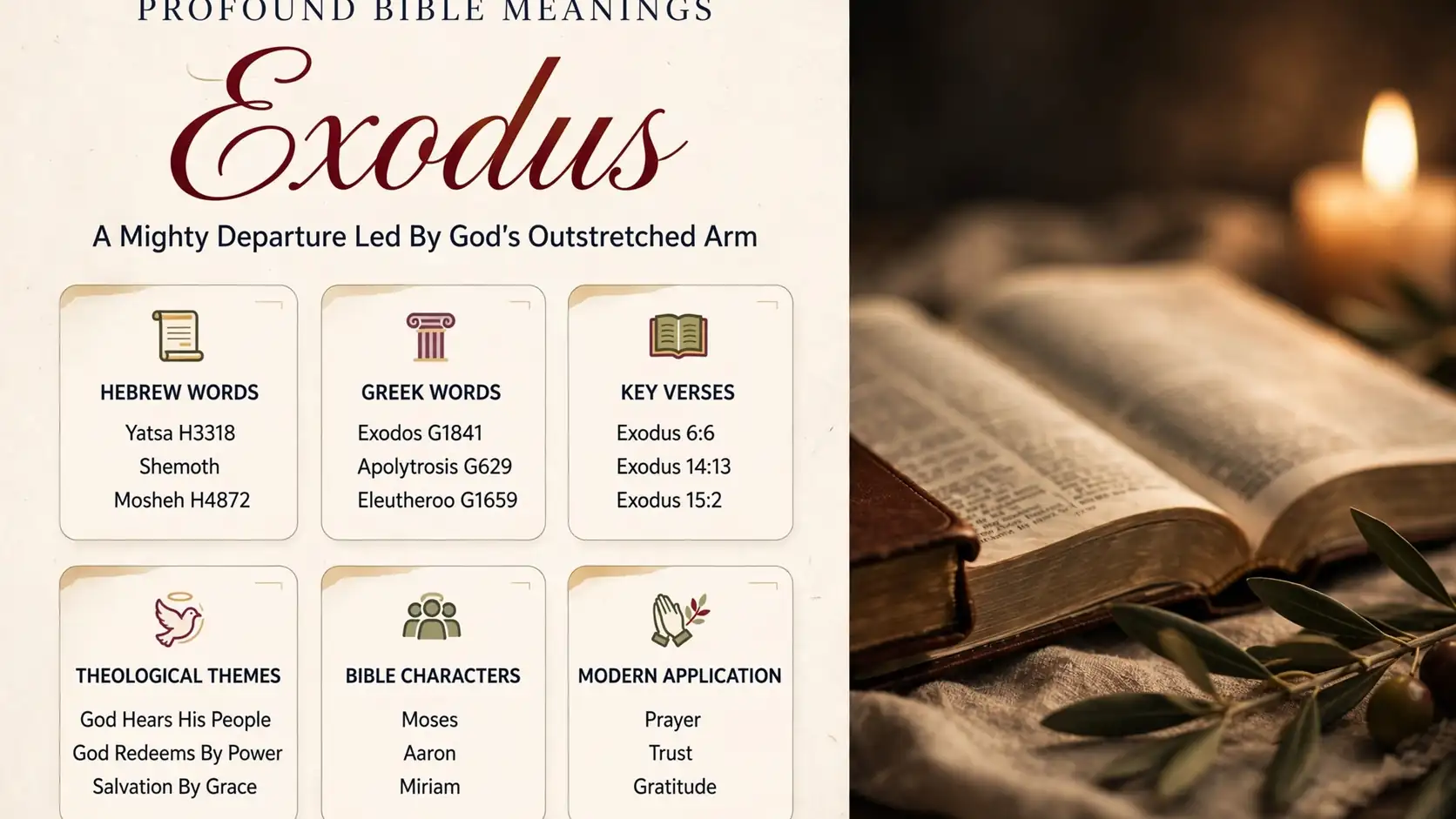
Exodus Key Scripture References
| Verse | Passage Snippet | Context |
|---|---|---|
| Exodus 3:7 | I have surely seen the affliction of my people | God speaks to Moses at the burning bush |
| Exodus 6:6 | I will redeem you with an outstretched arm | God promises deliverance from Egyptian bondage |
| Exodus 12:41 | All the hosts of the Lord went out from Egypt | Israel leaves after the first Passover night |
| Exodus 14:13 | Fear not, stand firm, and see God’s salvation | Moses speaks before the Red Sea crossing |
| Exodus 15:2 | The Lord is my strength and my song | Moses sings after the sea swallows Pharaoh’s army |
| Exodus 19:4 | I bore you on eagles’ wings and brought you to myself | God recalls the journey at Mount Sinai |
| Exodus 20:2 | I am the Lord who brought you out of Egypt | The Ten Commandments open with deliverance |
| Deuteronomy 26:8 | The Lord brought us out with a mighty hand | Israel confesses the exodus in worship |
| Luke 9:31 | They spoke of his departure which he would accomplish | Moses and Elijah speak with Jesus on the mountain |
Exodus Bible Translation Comparison
| Verse | KJV | NIV | ESV | NASB |
|---|---|---|---|---|
| Exodus 6:6 | Redeem you with stretched out arm | Redeem you with outstretched arm | Redeem you with outstretched arm | Redeem you with outstretched arm |
| Exodus 12:41 | Hosts of the Lord went out | The Lord’s divisions left Egypt | Hosts of the Lord went out | Armies of the Lord went out |
| Exodus 14:14 | The Lord shall fight for you | The Lord will fight for you | The Lord will fight for you | The Lord will fight for you |
| Exodus 15:2 | My strength and song | My strength and my defense | My strength and my song | My strength and song |
| Exodus 20:2 | Brought thee out of Egypt | Brought you out of Egypt | Brought you out of Egypt | Brought you out of Egypt |
| Deuteronomy 26:8 | Brought us forth out of Egypt | Brought us out of Egypt | Brought us out of Egypt | Brought us out of Egypt |
| Psalm 114:1 | Israel went out of Egypt | Israel came out of Egypt | Israel went out of Egypt | Israel went out from Egypt |
| Hebrews 11:22 | Spoke of Israel’s departing | Spoke about the exodus | Mentioned Israel’s exodus | Mentioned Israel’s exodus |
| Luke 9:31 | Spake of his decease | Spoke about his departure | Spoke of his departure | Speaking of His departure |
Exodus People & Characters Associated
| Person | Role | Connection |
|---|---|---|
| Moses | Prophet and leader | Called at the bush to lead Israel out |
| Aaron | Spokesman and high priest | Speaks for Moses before Pharaoh |
| Miriam | Prophetess and worship leader | Sings with the women after the sea |
| Pharaoh | King of Egypt | Hardens his heart and refuses release |
| Zipporah | Wife of Moses | Journeys back to Egypt beside Moses |
| Jethro | Priest of Midian | Advises Moses on judging the people |
| Joshua | Assistant to Moses | Fights Amalek after the exodus |
| Caleb | Faithful spy | Trusts God’s promise to this generation |
| Joseph | Patriarch remembered | Asked that his bones be carried up |
Exodus Original Hebrew & Greek Words
| Original Word | Transliteration | Strong’s # | Literal Meaning |
|---|---|---|---|
| יָצָא | Yatsa | H3318 | To go out or come forth |
| שְׁמוֹת | Shemoth | H8034 | Names, the Hebrew title of the book |
| מֹשֶׁה | Mosheh | H4872 | Moses, drawn out of the water |
| גָּאַל | Gaal | H1350 | To redeem or act as a kinsman redeemer |
| יְשׁוּעָה | Yeshuah | H3444 | Salvation, deliverance, and victory |
| זְרוֹעַ | Zeroa | H2220 | Arm, a picture of God’s mighty power |
| ἔξοδος | Exodos | G1841 | Departure, a going out |
| ἀπολύτρωσις | Apolytrosis | G629 | Redemption, a release secured by payment |
| ἐλευθερόω | Eleutheroo | G1659 | To set free or make someone free |
Exodus Related Biblical Concepts
| Concept | Connection | Supporting Verse |
|---|---|---|
| Redemption | God buys Israel back from slavery by His power | Exodus 6:6 |
| Passover | The lamb’s blood marks homes spared from judgment | Exodus 12:13 |
| Covenant | The rescued people receive God’s law at Sinai | Exodus 19:5 |
| Salvation | God saves Israel at the sea without their swords | Exodus 14:13 |
| Pilgrimage | The journey shapes Israel into a worshiping nation | Exodus 19:4 |
| Remembrance | Feasts keep the departure alive for each generation | Exodus 12:14 |
| Typology | The exodus pictures Christ leading a greater deliverance | Luke 9:31 |
| Providence | Joseph foresaw the departure centuries before it happened | Hebrews 11:22 |
| Worship | Freedom is given so Israel can serve the Lord | Exodus 7:16 |
Exodus Historical & Cultural Context
| Aspect | Detail | Biblical Source |
|---|---|---|
| Slavery in Egypt | Israel labors under harsh taskmasters building store cities | Exodus 1:11 |
| Royal power | Pharaoh is treated as a god within Egyptian religion | Exodus 7:1 |
| Pastoral roots | Israel settles in Goshen as shepherds under Joseph | Genesis 47:6 |
| Passover meal | Lamb, unleavened bread, and bitter herbs mark the night | Exodus 12:8 |
| Desert travel | The wilderness tests trust after the sea crossing | Exodus 16:2 |
| Covenant law | Sinai gives Israel a shared life under God’s rule | Exodus 20:1 |
| Tabernacle craft | Skilled workers build a dwelling for God’s presence | Exodus 35:30 |
| Ancient treaties | Covenant form matches suzerain patterns of the era | Exodus 19:5 |
| Song tradition | Victory songs celebrate great acts of deliverance | Exodus 15:1 |
Exodus Theological Themes
| Theme | Explanation | Scripture |
|---|---|---|
| God hears His people | The Lord sees affliction and remembers His covenant | Exodus 3:7 |
| God redeems by power | Deliverance rests on God’s outstretched arm | Exodus 6:6 |
| Judgment on false gods | The plagues expose Egypt’s deities as weak | Exodus 12:12 |
| Salvation by grace | Israel is rescued before receiving the law | Exodus 20:2 |
| God dwells with Israel | The tabernacle places God’s presence among Israel | Exodus 25:8 |
| Holiness and calling | The rescued nation becomes a kingdom of priests | Exodus 19:6 |
| Christ foreshadowed | Moses and the Passover lamb point to Jesus | Luke 9:31 |
| Faith in the journey | Believers trust God’s promise before its end | Hebrews 11:27 |
| Worship as freedom’s goal | Israel is freed to serve and praise God | Exodus 15:2 |
Exodus Modern Application for Believers
| Area | Practice | Scripture |
|---|---|---|
| Prayer | Bring your suffering to God who hears and remembers | Exodus 3:7 |
| Trust | Stand firm when fear rises and watch God work | Exodus 14:13 |
| Gratitude | Sing about past deliverances before new battles come | Exodus 15:2 |
| Obedience | Let rescued life shape daily choices and habits | Exodus 20:2 |
| Remembrance | Tell children how God has carried your family | Exodus 12:26 |
| Community | Share the journey with fellow believers in hardship | Exodus 19:4 |
| Hope | Trust that God finishes journeys He begins | Exodus 6:6 |
| Worship | Offer God praise as the goal of your freedom | Exodus 7:16 |
| Perseverance | Keep walking through wilderness seasons with faith | Hebrews 11:27 |
From Goshen to the Sea in What Does Exodus Mean in the Bible
Your reading starts in Goshen, where a favored family has become an enslaved people. Pharaoh fears Israel’s growth, crushes them with forced labor, and orders death for their sons. Yet God raises up Moses from the river meant to kill him. The burning bush turns a runaway shepherd into the messenger of a departure no human court could grant.
At the sea, the story reaches its turning point and Israel can only watch. The water parts, the people cross on dry ground, and the chasing army is swept away. That is why the exodus became Israel’s defining memory. Every later prophet and feast reaches back to this night when God made a way where no way existed.
The Exodus Pattern from Passover Blood to New Covenant Freedom
Notice the order God follows throughout this story of departure and covenant. He saves first and gives His law afterward, so obedience grows out of gratitude rather than fear. The blood of the Passover lamb marks Israel’s homes before a single command is given at Sinai. Grace comes first, and a holy life follows as the thankful response of a rescued people.
The New Testament reads this pattern with clear and grateful eyes. Luke uses the Greek word exodos for the departure Jesus would accomplish at Jerusalem, linking His death to the ancient deliverance. Paul calls Christ our Passover lamb. You see one faithful God telling one rescue story across both testaments, with Jesus completing what Moses could only begin.
Why the Exodus Still Shapes Your Worship and Obedience
The exodus gives your faith a memory longer than your own lifetime. Israel was commanded to retell the story at meals, festivals, and bedtime talks with their children. Remembering was never nostalgia for this people. It was fuel for trust, because a God who once opened the sea could be trusted with the next wilderness and the next generation.
That same memory steadies your walk with God today. When obedience feels costly, you recall that the Lord who commands you is first the Lord who rescued you. When a season feels like a desert, you remember that God fed a nation there. The exodus teaches you to worship a delivering God and obey Him as a grateful, freed person.
Exodus Questions Bible Students Ask Most
Does the Greek word exodos really appear for Jesus in Luke 9:31?
Yes, Luke uses exodos for the departure Jesus would accomplish at Jerusalem, linking His death to Israel’s deliverance from Egypt.
Why is the Hebrew book of Exodus called Shemoth instead?
Shemoth means names, taken from the book’s opening words listing the names of Jacob’s sons who came to Egypt.
What does yatsa add to your understanding of the exodus story?
Yatsa means to go out, and its use across Scripture shows God bringing His people out of Egypt, danger, and darkness.
Why do translations differ on Hebrews 11:22 about Joseph and the exodus?
Some versions use the word exodus directly while older ones say departing, yet all translate the same Greek word exodos.
How should the exodus shape the way you pray in hard seasons?
Pray like Israel groaned in Exodus 2, trusting that God hears, remembers His promises, and acts in His perfect time.