
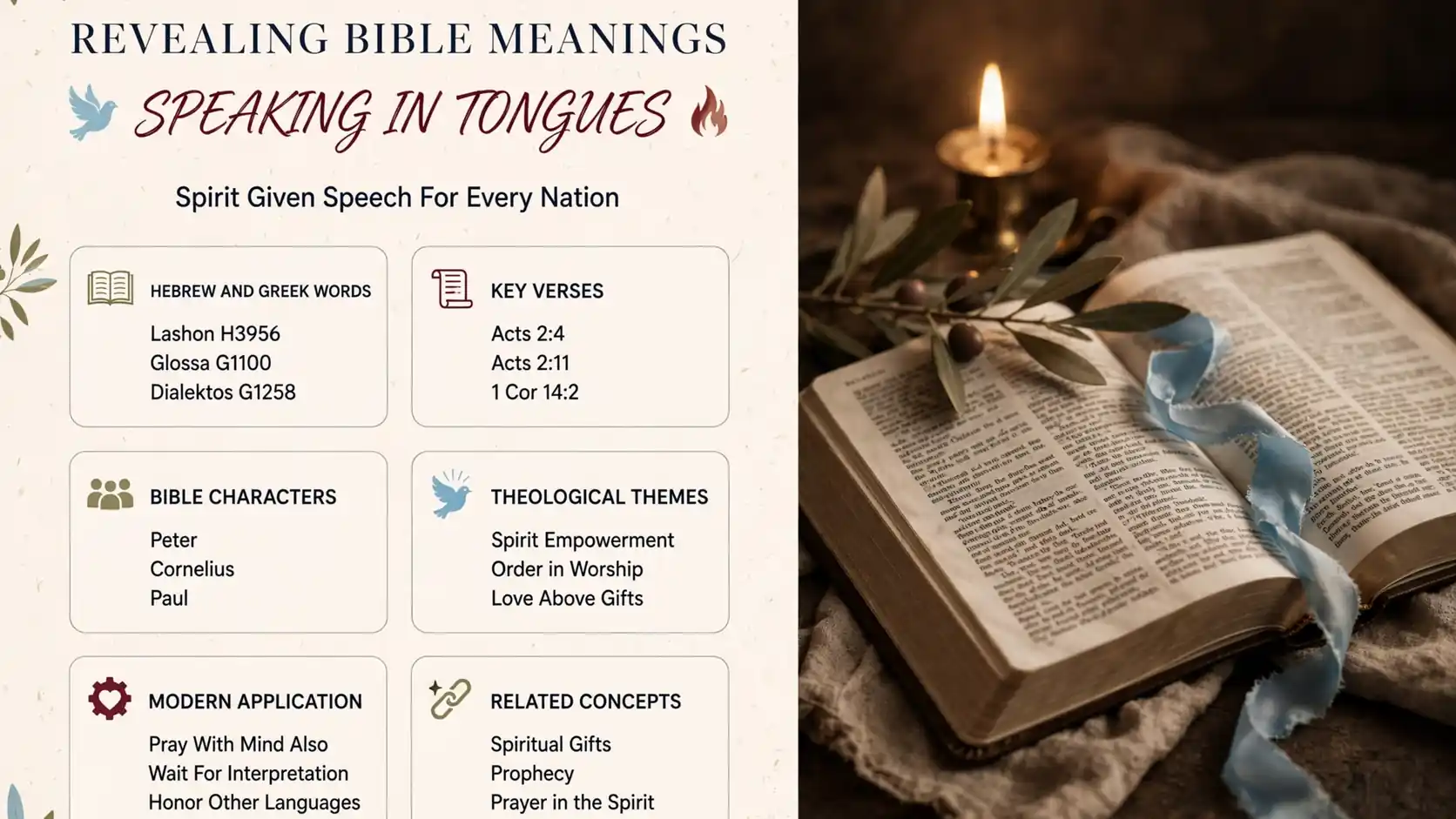
When you ask what does speaking in tongues mean in the bible, you step into Pentecost morning in Jerusalem and a crowded house church in Corinth. In Acts, believers spoke languages they had never learned as the Holy Spirit gave utterance. In Corinth, Paul taught that tongues need interpretation so the whole church is built up. This guide traces glossa through key verses, translations, people, and practice, so your study holds both the gift and its God given purpose together with reverence, order, and love for others in worship today.
Tongues Key Scripture References
| Verse | Passage Snippet | Context |
|---|---|---|
| Acts 2:4 | Filled with the Spirit, spoke in other tongues | Pentecost in Jerusalem |
| Acts 2:6 | Each one heard them in his own language | Crowds gather in amazement |
| Acts 2:11 | We hear the wonders of God in our tongues | Nations list at Pentecost |
| Acts 10:46 | Speaking in tongues and praising God | Cornelius household believes |
| Acts 19:6 | They spoke in tongues and prophesied | Disciples in Ephesus receive Spirit |
| 1 Corinthians 12:10 | Kinds of tongues and interpretation | Gifts list for the church body |
| 1 Corinthians 14:2 | In his spirit he speaks mysteries | Tongues addressed to God |
| 1 Corinthians 14:27 | Two or at most three, with interpretation | Order for public worship |
Tongues Bible Translation Comparison
| Verse | KJV | NIV | ESV | NASB |
|---|---|---|---|---|
| Acts 2:4 | Speak with other tongues | Speak in other tongues | Speak in other tongues | Speak with other tongues |
| Acts 2:11 | In our tongues the works of God | In our languages the wonders of God | In our own tongues the mighty works | In our own tongues the mighty deeds |
| Mark 16:17 | Speak with new tongues | Speak in new tongues | Speak in new tongues | Speak with new tongues |
| 1 Corinthians 12:10 | Divers kinds of tongues | Speaking in different kinds of tongues | Various kinds of tongues | Various kinds of tongues |
| 1 Corinthians 14:2 | Speaketh in an unknown tongue | Speaks in a tongue | Speaks in a tongue | Speaks in a tongue |
| 1 Corinthians 14:13 | Pray that he may interpret | Pray for the ability to interpret | Pray for power to interpret | Pray that he may interpret |
| 1 Corinthians 14:27 | By course, and one interpret | One at a time, someone must interpret | In turn, and let someone interpret | In turn, and one must interpret |
| 1 Corinthians 14:39 | Forbid not to speak with tongues | Do not forbid speaking in tongues | Do not forbid speaking in tongues | Do not forbid speaking in tongues |
Tongues People and Characters Associated
| Person | Role | Connection |
|---|---|---|
| Peter | Apostle and preacher | Explains Pentecost through Joel |
| Disciples in the upper room | First recipients at Pentecost | Speak as the Spirit gives utterance |
| Visiting Jews from many nations | Hearers at Pentecost | Hear Gods wonders in their own languages |
| Cornelius | God fearing centurion | His household speaks in tongues in Acts 10 |
| Gentile believers in Caesarea | New converts | Praise God in tongues before baptism |
| Paul | Apostle and teacher | Regulates tongues in Corinth, speaks in tongues |
| Disciples in Ephesus | Followers taught by Apollos circle | Speak in tongues after Paul lays on hands |
| Corinthian believers | Church members using gifts | Need order and interpretation in worship |
Tongues Original Hebrew and Greek Words
| Original Word | Transliteration | Strong’s # | Literal Meaning |
|---|---|---|---|
| לָשׁוֹן | lashon | H3956 | Tongue, language, speech |
| רוּחַ | ruach | H7307 | Spirit, wind, breath |
| γλῶσσα | glossa | G1100 | Tongue, language |
| λαλέω | laleo | G2980 | To speak, to talk, to utter |
| διάλεκτος | dialektos | G1258 | Language, dialect of a people |
| ἑρμηνεία | hermeneia | G2058 | Interpretation, explanation |
| πνεῦμα | pneuma | G4151 | Spirit, breath, wind |
| σημεῖον | semeion | G4592 | Sign, mark, token |
| λαλιά | lalia | G2981 | Speaking, talk, root of glossolalia |
| ξένος | xenos | G3581 | Foreign, strange, root of xenolalia |
Tongues Related Biblical Concepts
| Concept | Connection | Supporting Verse |
|---|---|---|
| Spiritual gifts | Tongues listed among gifts of the Spirit | 1 Corinthians 12:10 |
| Interpretation of tongues | Paired gift that makes tongues understood | 1 Corinthians 12:10 |
| Prophecy | Clear speech that builds the whole church | 1 Corinthians 14:3 |
| Baptism in the Holy Spirit | Tongues accompany the Spirit falling in Acts | Acts 10:44 |
| Pentecost | Birth of the church and tongues first appear | Acts 2:1 |
| Prayer in the Spirit | The spirit prays when words are tongues | 1 Corinthians 14:14 |
| Edification | Gifts are given to build others up | 1 Corinthians 14:12 |
| Sign for unbelievers | Paul calls tongues a sign in worship debate | 1 Corinthians 14:22 |
Tongues Historical and Cultural Context
| Aspect | Detail | Biblical Source |
|---|---|---|
| Feast of Pentecost | Harvest feast fifty days after Passover | Acts 2:1 |
| Pilgrims in Jerusalem | Diaspora Jews gathered from many nations | Acts 2:5 |
| Multilingual empire | Greek, Aramaic, Latin and local tongues in use | Acts 2:6 |
| Joel promise setting | Spirit poured out in the last days | Joel 2:28 |
| Isaiah sign background | Strange tongues as a sign to Israel | Isaiah 28:11 |
| Corinth as a port city | Travelers and many languages passed through daily | 1 Corinthians 1:2 |
| House church worship | Small gatherings needed clear order to be heard | 1 Corinthians 14:23 |
| Gentile inclusion debate | Tongues confirmed God welcomed non Jewish believers | Acts 11:18 |
Tongues Theological Themes
| Theme | Explanation | Scripture |
|---|---|---|
| Spirit empowerment | The Holy Spirit gives speech beyond natural learning | Acts 2:4 |
| Mission to the nations | Every language can carry the praise of God | Acts 2:11 |
| Edification of the church | Public gifts should build the gathered body | 1 Corinthians 14:12 |
| Order in worship | God is not a God of confusion but peace | 1 Corinthians 14:33 |
| Love above gifts | Gifts without love gain the speaker nothing | 1 Corinthians 13:1 |
| Understanding matters | Five clear words teach more than ten thousand | 1 Corinthians 14:19 |
| Sign and witness | Tongues point hearers toward Gods work | 1 Corinthians 14:22 |
| Unity in diversity | One Spirit gives different gifts to one body | 1 Corinthians 12:11 |
Tongues Modern Application for Believers
| Area | Practice | Scripture |
|---|---|---|
| Prayer | Pray with the spirit and with the mind also | 1 Corinthians 14:15 |
| Public worship | Wait for interpretation before speaking aloud | 1 Corinthians 14:27 |
| Humility | Refuse pride or shame over any single gift | 1 Corinthians 12:21 |
| Testing claims | Weigh what is said against Scripture carefully | 1 John 4:1 |
| Welcoming nations | Honor believers who praise God in other languages | Acts 2:11 |
| Seeking gifts | Desire gifts that build up the church most | 1 Corinthians 14:12 |
| Love for others | Let every gift serve people in front of you | 1 Corinthians 13:2 |
| Patience in debate | Hold convictions kindly across church traditions | Romans 14:19 |
Glossa and Dialektos on the Morning of Pentecost
Luke uses glossa for the tongues of fire and for the languages spoken in Acts 2, then he uses dialektos when the crowd hears the message in their own native speech. The double wording matters for your study. Luke stresses both the gift given to the speakers and the understanding granted to the hearers.
That hearing is the heart of the scene in Jerusalem. Parthians, Medes, Elamites and visitors from Rome each hear the mighty works of God without a translator between them. Pentecost presents tongues first as mission speech, a sign that the good news belongs to every people and language from the first day of the church.
What Does Speaking in Tongues Mean in the Bible When Paul Writes to Corinth
Corinth presents a different scene from Jerusalem. Believers there valued tongues highly, yet their gatherings could leave visitors confused because no one explained what was said. Paul never mocks the gift. He places it within the body, alongside prophecy, teaching and interpretation.
His rule is simple to state and hard to practice. Speech in the assembly must build the assembly. A tongue spoken aloud needs hermeneia, an interpretation, so minds are fed as well as spirits stirred. Without that pairing, Paul tells the speaker to pray quietly to God and keep the public moment clear for everyone present.
Laleo, Prayer and the Spirit in 1 Corinthians 14
Paul uses laleo again and again for ordinary speaking, which keeps tongues inside the wider world of speech to God and to people. He describes his own spirit praying while his mind stays unfruitful, then resolves to pray and sing both ways. The chapter holds devotion and understanding together rather than forcing a choice between them.
The same chapter quotes Isaiah 28 and calls tongues a semeion, a sign, echoing an older moment when foreign speech confronted Israel. Paul then turns the sign toward practical love. Five intelligible words that teach others outweigh a flood of uninterpreted sound, because the church grows when people can say amen with understanding.
Glossolalia and Xenolalia in Tongues Discussion Today
Modern writers often separate two ideas with compound labels drawn from Greek roots. Glossolalia joins glossa with lalia and describes Spirit prompted speech that may not be a known human language. Xenolalia joins xenos with glossa and describes speaking a real foreign language never learned, which matches the scene in Acts 2.
Churches read these passages with different emphases, and this study leaves room for that honest range while staying close to the text. What Scripture keeps in view is the character of the gift. Tongues point to the Spirit at work, praise directed to God, and a church that values both heartfelt prayer and clear understanding.
Frequently Asked Questions About Tongues
What is the difference between glossolalia and xenolalia in tongues teaching?
Glossolalia is Spirit prompted speech from glossa and lalia, while xenolalia is speaking a real foreign language never learned, from xenos and glossa.
Why does Paul require hermeneia for tongues in 1 Corinthians 14:27?
Paul requires hermeneia, interpretation, so the whole church understands and is built up rather than left confused by uninterpreted speech.
Were the tongues in Acts 2 heard as dialektos by the crowd?
Yes, Luke says each hearer listened in his own dialektos, his native language, and heard the mighty works of God declared clearly.
What does Paul mean by tongues of angels in 1 Corinthians 13:1?
Paul uses elevated speech about tongues of men and angels to teach that any gift without love is empty noise, however gifted it sounds.
Does the Bible tell churches to forbid speaking in tongues?
No, Paul ends his teaching in 1 Corinthians 14:39 by saying do not forbid speaking in tongues, while keeping worship decent and orderly.