
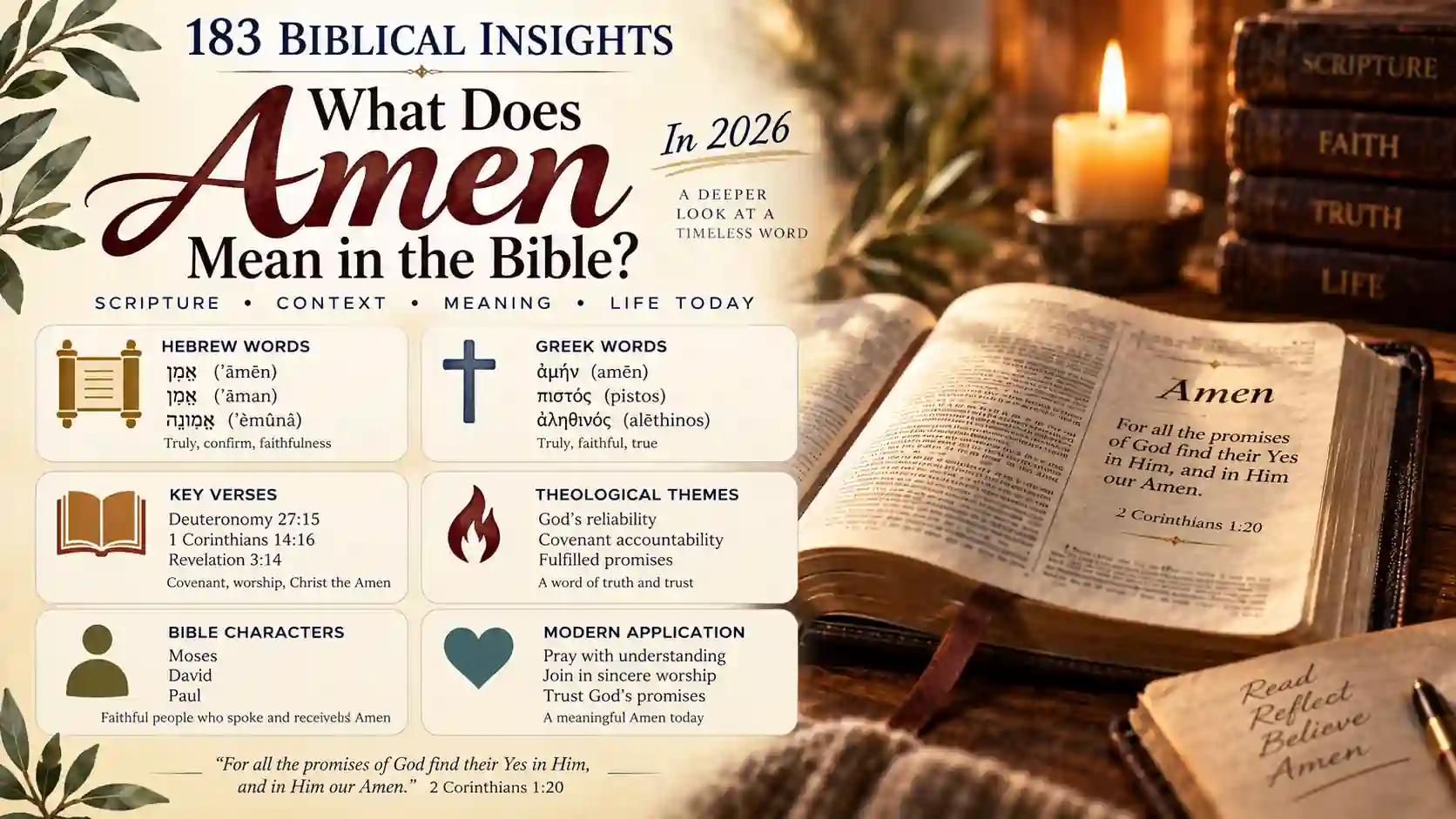
What does amen mean in the Bible? Far more than a traditional word used to finish a prayer. The biblical “amen” grows from Hebrew language about firmness, faithfulness, certainty, and truth. When worshipers say it, they affirm what has been spoken and identify themselves with it.
The New Testament carries the word directly into Greek, while Jesus gives it remarkable prominence in His teaching. From Israel’s covenant ceremonies to Christian worship and Revelation’s description of Christ as “the Amen,” Scripture presents this small word as a serious confession of trust.
Amen Key Scripture References
| Verse | Passage Snippet | Context |
|---|---|---|
| Numbers 5:22 | “Amen, amen” | Woman confirms the oath in the jealousy ritual |
| Deuteronomy 27:15 | “all the people shall…say, Amen” | Israel accepts covenant sanctions |
| 1 Chronicles 16:36 | “Amen, and praised the LORD” | Israel responds to David’s thanksgiving |
| Nehemiah 5:13 | “Amen, and praised the LORD” | Assembly accepts Nehemiah’s warning |
| Psalm 41:13 | “Amen, and Amen” | Doxology closing Book One of Psalms |
| Psalm 106:48 | “let all the people say, Amen” | Congregational agreement with praise |
| 1 Corinthians 14:16 | “say Amen at thy giving of thanks” | Paul expects understandable corporate worship |
| Revelation 3:14 | “the Amen” | Christ identifies Himself with faithfulness and truth |
Amen Bible Translation Comparison
| Verse | KJV | NIV | ESV | NASB |
|---|---|---|---|---|
| Deuteronomy 27:15 | Amen | Amen | Amen | Amen |
| 1 Chronicles 16:36 | Amen | Amen | Amen | Amen |
| Nehemiah 5:13 | Amen | Amen | Amen | Amen |
| Psalm 41:13 | Amen and Amen | Amen and Amen | Amen and Amen | Amen and Amen |
| Psalm 106:48 | say, Amen | say, Amen | say, Amen | say, Amen |
| Matthew 6:13 | Amen in traditional text | Omitted in main text | Omitted in main text | Omitted in main text |
| 1 Corinthians 14:16 | say Amen | say “Amen” | say “Amen” | say the “Amen” |
| Revelation 3:14 | the Amen | the Amen | the Amen | the Amen |
Amen People and Characters Associated
| Person | Role | Connection |
|---|---|---|
| Moses | Covenant mediator | Commands Israel’s responses in Deuteronomy 27 |
| Israelites | Covenant people | Publicly answer “Amen” to covenant declarations |
| David | King and psalmist | Leads thanksgiving answered with “Amen” |
| Nehemiah | Governor and reformer | Receives the assembly’s “Amen” after his warning |
| Ezra | Priest and scribe | People answer “Amen, Amen” during public worship |
| Jesus | Messiah and teacher | Repeatedly begins solemn declarations with ἀμήν |
| Paul | Apostle | Explains congregational “Amen” and Christ-centered fulfillment |
| John | Apostle and seer | Records “Amen” in worship and as a title of Christ |
Amen Original Hebrew and Greek Words
| Original Word | Transliteration | Strong’s # | Literal Meaning |
|---|---|---|---|
| אָמֵן | ʾāmēn | H543 | Truly, surely, so be it |
| אָמַן | ʾāman | H539 | To confirm, support, be faithful |
| אֱמוּנָה | ʾĕmûnâ | H530 | Firmness, faithfulness, fidelity |
| אֱמֶת | ʾĕmet | H571 | Truth, reliability, faithfulness |
| ἀμήν | amēn | G281 | Truly, surely, amen |
| πιστός | pistos | G4103 | Faithful, trustworthy |
| ἀληθινός | alēthinos | G228 | True, genuine |
| βέβαιος | bebaios | G949 | Firm, secure, established |
Amen Related Biblical Concepts
| Concept | Connection | Supporting Verse |
|---|---|---|
| Truth | Amen affirms something as reliable | Isaiah 65:16 |
| Faithfulness | Its Hebrew family concerns firmness | Deuteronomy 7:9 |
| Covenant | Israel says Amen to covenant sanctions | Deuteronomy 27:15 |
| Worship | Congregations voice agreement together | 1 Chronicles 16:36 |
| Prayer | Amen confirms petitions and praise | 1 Chronicles 29:20 |
| Understanding | Meaningful Amen requires comprehension | 1 Corinthians 14:16 |
| Fulfillment | God’s promises find their Yes in Christ | 2 Corinthians 1:20 |
| Witness | Jesus is called faithful and true | Revelation 3:14 |
Amen Historical and Cultural Context
| Aspect | Detail | Biblical Source |
|---|---|---|
| Covenant ceremony | Israel answers curses with Amen | Deuteronomy 27 |
| Oath response | Amen confirms acceptance of stated terms | Numbers 5:22 |
| Public worship | Assemblies answer leaders audibly | Nehemiah 8:6 |
| Temple praise | Amen accompanies blessing and thanksgiving | 1 Chronicles 16:36 |
| Psalter doxology | Amen marks major collection endings | Psalm 41:13 |
| Synagogue-era worship | Corporate responses continue after exile | Nehemiah 8:6 |
| Early church | Hearers answer Amen to thanksgiving | 1 Corinthians 14:16 |
| Heavenly worship | Amen accompanies praise before God | Revelation 7:12 |
Amen Theological Themes
| Theme | Explanation | Scripture |
|---|---|---|
| God’s reliability | Amen rests upon God’s trustworthy character | Isaiah 65:16 |
| Covenant accountability | Saying Amen can express solemn agreement | Deuteronomy 27:26 |
| Corporate unity | God’s people respond together in worship | Nehemiah 8:6 |
| Christ’s truthfulness | Jesus Himself is called “the Amen” | Revelation 3:14 |
| Fulfilled promises | Divine promises reach certainty in Christ | 2 Corinthians 1:20 |
| Confession | Amen personally embraces spoken truth | 1 Corinthians 14:16 |
| Doxology | Amen seals praise offered to God | Romans 11:36 |
| Eternal worship | Heaven answers God with Amen | Revelation 19:4 |
Amen Modern Application for Believers
| Area | Practice | Scripture |
|---|---|---|
| Prayer | Say Amen thoughtfully, not mechanically | 1 Corinthians 14:16 |
| Worship | Join sincerely in biblical praise | Psalm 106:48 |
| Scripture | Receive God’s truth with obedient faith | Nehemiah 8:6 |
| Community | Understand what you publicly affirm | 1 Corinthians 14:16 |
| Promises | Rest confidence in Christ | 2 Corinthians 1:20 |
| Speech | Let your words reflect truthfulness | Matthew 5:37 |
| Faith | Trust the God who remains faithful | Deuteronomy 7:9 |
| Hope | Join Scripture’s longing for Christ’s return | Revelation 22:20 |
אָמֵן ʾĀMēN Means More than “so Be It”
The Hebrew אָמֵן (ʾāmēn), Strong’s H543, belongs to a word family centered on firmness and reliability. Its related verb אָמַן (ʾāman), H539, can describe being established, trustworthy, or faithful. This background explains why “so be it” captures part of amen’s meaning but not all of it.
When an Israelite answered “Amen,” the response could mean something like “truly,” “certainly,” or “I affirm this as binding.” In Deuteronomy 27, the people repeatedly answer Amen after covenant declarations. Their response is therefore not merely a hopeful wish. They acknowledge the justice and authority of what God has declared.
What Does Amen Mean in the Bible When Jesus Says Ἀμήν?
Jesus uses ἀμήν (amēn), Strong’s G281, in an especially striking way. English translations frequently render His introductory formula as “truly” or “verily.” Instead of placing amen only after another person’s statement, Jesus places it before His own authoritative declarations.
In John’s Gospel, the expression is characteristically doubled, ἀμὴν ἀμήν, often translated “truly, truly.” Jesus uses it before weighty teachings such as the necessity of new birth in John 3:3 and His declaration about eternal life in John 5:24. The formula calls you to hear His words as certain and authoritative.
From Israel’S Covenant Amen to the Church’S Worship
Deuteronomy 27 shows how deeply amen belongs to covenant life. Israel gathers as God’s covenant people, and the repeated response makes each hearer personally involved. Numbers 5:22 likewise records the doubled response “Amen, amen” within a solemn oath setting. In both passages, the word carries moral seriousness.
By Nehemiah 8:6, you see another setting. Ezra blesses the LORD, and the gathered people answer, “Amen, Amen,” lifting their hands and bowing in worship. Paul later assumes that Christians also say Amen together. In 1 Corinthians 14:16, however, he insists that worship must be intelligible so another believer can knowingly affirm the thanksgiving.
Jesus as “the Amen” and the Certainty of God’S Promises
Revelation 3:14 takes the biblical theology of amen to an extraordinary point. Jesus does not merely say Amen. He is identified as “the Amen,” immediately described as “the faithful and true witness.” The title fits the word’s long association with truth, reliability, and faithfulness.
Second Corinthians 1:20 provides a closely related Christ-centered theme. God’s promises find their “Yes” in Christ, and through Christ believers utter their Amen to God’s glory. Your Amen, then, is strongest when it is grounded not in optimism or personal certainty but in the trustworthy God whose purposes are fulfilled in Christ.
Frequently Asked Questions About Amen
Does the Hebrew אָמֵן (ʾāmēn) simply mean “so be it”?
Not exactly. “So be it” is useful, but אָמֵן also conveys affirmation, certainty, truth, and confidence in what is reliable.
Why does Jesus sometimes say ἀμὴν ἀμήν, “Amen, amen”?
Especially in John, the doubled expression solemnly introduces an authoritative declaration and is commonly translated “truly, truly.”
Why do the Israelites repeatedly say Amen in Deuteronomy 27?
Their Amen publicly acknowledges the covenant declarations and expresses their acceptance of accountability before God.
What does Paul mean when he says another person should say Amen in 1 Corinthians 14:16?
He assumes a congregational response but argues that believers must understand what is being said before they can meaningfully affirm it.
Why is Jesus Himself called “the Amen” in Revelation 3:14?
The title presents Christ as the faithful and true witness, personally embodying the certainty and reliability associated with Amen throughout Scripture.