
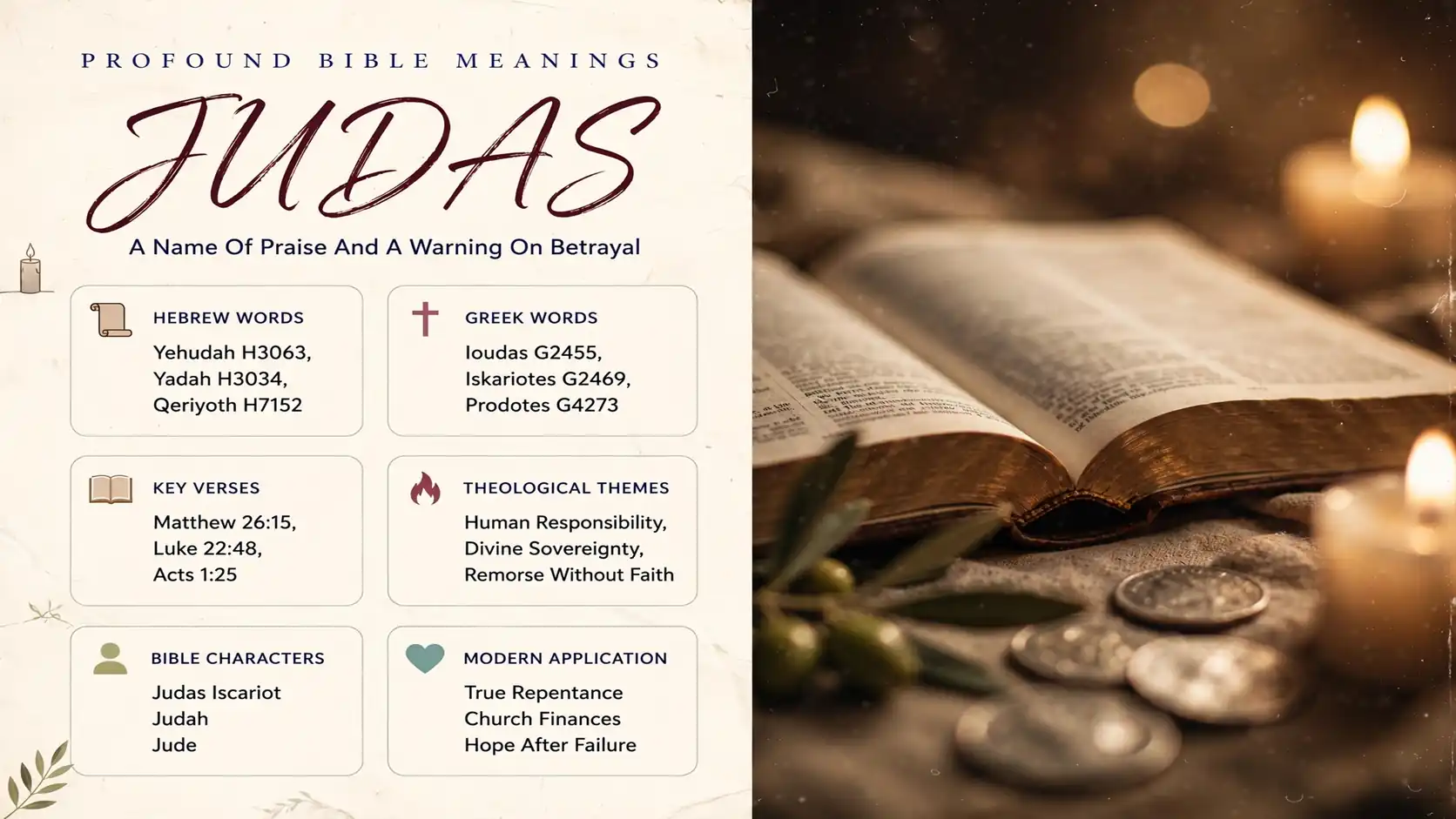
When you ask what does judas mean in the bible, you meet a name that means praise carried by a man remembered for betrayal. Judas is the Greek form of Judah, the tribe of kings and the line of Jesus himself. Yet Judas Iscariot sold Jesus for silver, greeted him with a kiss, and died in remorse. This study separates Judas Iscariot from Judah and Jude, traces the Hebrew and Greek words, follows the verses in order, and helps you read his sober story with care, humility, and hope in Christ for your study today.
Judas Key Scripture References
| Verse | Passage Snippet | Context |
|---|---|---|
| Matthew 10:4 | Judas Iscariot who also betrayed him | Named last among the twelve |
| Matthew 26:14 | Then one of the twelve called Judas | Judas goes to the chief priests |
| Matthew 26:15 | What will ye give me | Bargain set at thirty silver pieces |
| Matthew 26:49 | Hail master and he kissed him | Betrayal sign in Gethsemane garden |
| Matthew 27:3 | Judas brought again the thirty pieces | Remorse after Jesus is condemned |
| Luke 22:48 | Betrayest thou the Son of man | Jesus questions the betrayal kiss |
| John 12:6 | He was a thief and had the bag | Judas carries the apostles money bag |
| John 6:71 | Judas Iscariot the son of Simon | One of twelve called a devil |
| Acts 1:25 | From which Judas by transgression fell | Peter speaks of the lost office |
Judas Bible Translation Comparison
| Verse | KJV | NIV | ESV | NASB |
|---|---|---|---|---|
| Matthew 10:4 | Judas Iscariot who betrayed | Judas Iscariot who betrayed | Judas Iscariot who betrayed | Judas Iscariot who betrayed |
| Matthew 26:15 | thirty pieces of silver | thirty pieces of silver | thirty pieces of silver | thirty pieces of silver |
| Matthew 26:25 | Master is it I | Surely not I Lord | Is it I Rabbi | Surely not I Rabbi |
| Matthew 27:3 | repented himself | seized with remorse | changed his mind | felt remorse |
| Luke 22:48 | betrayest thou with a kiss | betraying with a kiss | betray with a kiss | betraying with a kiss |
| John 6:70 | one of you is a devil | one of you is a devil | one of you is a devil | one of you is a devil |
| John 13:27 | Satan entered into him | Satan entered into him | Satan entered into him | Satan entered into him |
| Acts 1:18 | purchased a field | bought a field | acquired a field | acquired a field |
Judas People and Characters Associated
| Person | Role | Connection |
|---|---|---|
| Judas Iscariot | Apostle who betrayed Jesus | Hands Jesus over for silver |
| Jesus Christ | Son of God and Messiah | Washes the feet of Judas |
| Simon Iscariot | Father of Judas | Named in John chapter 6 |
| Judah | Fourth son of Jacob | His name gives Judas its root |
| Jude | Apostle son of James | Different Judas who wrote Jude |
| Mary of Bethany | Woman who anointed Jesus | Her act draws protest from Judas |
| Chief Priests | Temple leaders in Jerusalem | Pay Judas and buy potter field |
| Matthias | Apostle chosen by lot | Takes the office Judas lost |
| Judas Barsabbas | Messenger of Jerusalem church | Sent to Antioch in Acts 15 |
Judas Original Hebrew and Greek Words
| Original Word | Transliteration | Strong’s # | Literal Meaning |
|---|---|---|---|
| יְהוּדָה | Yehudah | H3063 | Praise or the praised one |
| יָדָה | Yadah | H3034 | To give praise and thanks |
| קְרִיּוֹת | Qeriyoth | H7152 | Town in southern Judah |
| Ἰούδας | Ioudas | G2455 | Judas Greek form of Yehudah |
| Ἰσκαριώτης | Iskariotes | G2469 | Iscariot man of Kerioth |
| προδότης | Prodotes | G4273 | Betrayer who surrenders another |
| παραδίδωμι | Paradidomi | G3860 | To deliver or hand over |
| ἀργύριον | Argyrion | G694 | Silver coin or money |
| μεταμέλομαι | Metamelomai | G3338 | To feel remorse and regret |
| ἀπάγχω | Apancho | G519 | To hang oneself in despair |
Judas Related Biblical Concepts
| Concept | Connection | Supporting Verse |
|---|---|---|
| Betrayal | Trusted friend lifts his heel | Psalm 41:9 |
| Thirty Pieces of Silver | Price weighed out by Zechariah | Zechariah 11:12 |
| Kiss of Betrayal | Friendship sign turned arrest signal | Luke 22:48 |
| Son of Perdition | Jesus names Judas in prayer | John 17:12 |
| Field of Blood | Akeldama recalls the blood money | Acts 1:19 |
| Satan Entered | Satan enters before the plot | Luke 22:3 |
| Money Bag | Common purse entrusted to Judas | John 12:6 |
| Remorse | Regret that turns from Jesus | Matthew 27:3 |
| Prophecy Fulfilled | Betrayer Scripture comes to pass | Acts 1:16 |
| Lost Office | Empty place filled by another | Acts 1:20 |
Judas Historical and Cultural Context
| Aspect | Detail | Biblical Source |
|---|---|---|
| Kerioth Origin | Town in the south of Judah | Joshua 15:25 |
| Apostle Lists | Judas stands last in every list | Matthew 10:4 |
| Common Purse | Shared funds for food and alms | John 13:29 |
| Passover Crowds | Pilgrims fill Jerusalem at the feast | Luke 22:1 |
| Temple Treasury | Blood money barred from treasury | Matthew 27:6 |
| Potter Field | Field bought to bury strangers | Matthew 27:7 |
| Kiss of Greeting | Kiss marked respect and friendship | Luke 7:45 |
| Night Arrest | Guards came with torches and weapons | John 18:3 |
| Casting Lots | Lots decide between two men | Acts 1:26 |
Judas Theological Themes
| Theme | Explanation | Scripture |
|---|---|---|
| Praise Turned Bitter | Name of praise ends in shame | Matthew 27:5 |
| Human Responsibility | Judas answers for his own choice | Matthew 26:24 |
| Divine Sovereignty | God fulfills Scripture through betrayal | Acts 1:16 |
| Near Yet Lost | Hears Jesus daily without trust | John 6:64 |
| Love of Money | Greed grows inside trusted office | 1 Timothy 6:10 |
| Remorse Without Faith | Regret alone cannot restore life | 2 Corinthians 7:10 |
| Satanic Opposition | Satan works through willing heart | Luke 22:3 |
| Foot Washing Grace | Jesus serves his coming betrayer | John 13:11 |
| Warning to Disciples | Closeness cannot replace conversion | Matthew 7:22 |
| Restoration Pattern | Peter returns while Judas despairs | Luke 22:62 |
Judas Modern Application for Believers
| Area | Practice | Scripture |
|---|---|---|
| Personal Greed | Confess money loves early and honestly | Hebrews 13:5 |
| True Repentance | Bring regret to Jesus in faith | 1 John 1:9 |
| Church Finances | Handle shared funds with open oversight | 2 Corinthians 8:21 |
| Daily Closeness | Seek living trust not mere routine | John 15:5 |
| Betrayal Pain | Take wounds from friends to God | Psalm 55:22 |
| Self Examination | Ask God to search your heart | Psalm 139:23 |
| Guarding Influence | Refuse voices pulling you from Christ | Proverbs 1:10 |
| Hope After Failure | Return quickly like restored Peter | Luke 22:32 |
| Faithful Service | Serve unseen tasks with clean heart | Colossians 3:23 |
| Prayer Life | Pray for friends drifting toward sin | James 5:16 |
Yehudah and What Does Judas Mean in the Bible
Your study starts with a surprise because Yehudah H3063 means praise, from yadah H3034, the root Leah used when Judah was born in Genesis 29. Ioudas G2455 is the Greek form of that Hebrew name, carried into the New Testament. The name is good and royal, tied to the tribe that gave Israel its kings and gave Jesus his human line through David.
That royal link sharpens the tragedy, since Judas bore a kingly name while handing the true King to his enemies. Scripture never blames the name for the deed, and your reading should not either. The name points to praise, while the man chose silver and secrecy, and that contrast is the first lesson his story teaches careful readers today.
Ioudas in the Gospels and the Road to Gethsemane
The verb paradidomi G3860, to deliver over, follows Judas through every Gospel, from his naming among the twelve to the garden arrest. John adds that Judas was a thief who held the money bag and that Jesus knew who would betray him. Luke records that Satan entered Judas before he went to the priests to bargain away his master for silver.
None of this makes Judas a helpless puppet, because Jesus pronounces woe on the man by whom the Son of man is betrayed. Judas sought the priests, set his price, watched for a quiet moment, and chose the kiss as his signal. Your reading holds both truths together, the sovereign plan of God and the real guilt of a man who walked his road willingly.
Judas Iscariot Jude and Judah Are Not the Same Person
Many readers confuse three men because one Greek name covers them all, so keeping them apart protects your study from error. Judah is the Old Testament patriarch, son of Jacob, whose line produced David and Jesus. Jude is the apostle called Judas son of James in Luke 6, also known as Thaddaeus, who later wrote the short letter that bears his name.
Judas Iscariot stands apart from both in deed and in end, marked always by his surname and by the betrayal that follows it. Iskariotes G2469 most likely means man of Kerioth, a town in southern Judah, making him the lone Judean among Galilean apostles. When a verse names Judas, ask which Judas it means, and the surname, the father, or the deed will tell you clearly.
Remorse in Matthew 27 and the Hope Peter Found
Matthew uses metamelomai G3338 for Judas in chapter 27, a word of deep regret, and Judas truly feels the weight of innocent blood. He returns the argyrion G694 to the priests and confesses his sin, yet he goes out alone, and despair finishes what greed began. His sorrow looked backward at his deed, but it never turned him back toward the mercy of Jesus.
Peter shows you the other road, since he also failed Jesus that night, denying him three times in the courtyard. Peter wept bitterly, yet he stayed with the disciples, met the risen Jesus, and received a restored calling by the sea. The difference is not the size of the sin but the direction of the sorrow, so your failures can still run toward Christ.
Frequently Asked Questions About Judas
Is Judas the same name as Judah and Jude in the Bible?
Yes, Ioudas G2455 renders Yehudah H3063 for all three, so Judas Iscariot, the apostle Jude, and the patriarch Judah share one name.
Does Iskariotes G2469 mean man of Kerioth in southern Judah?
Most scholars read Iskariotes as man of Kerioth, the town in Joshua 15 verse 25, making Judas the likely lone Judean among Galilean apostles.
Why does Matthew 27:3 use metamelomai G3338 for the sorrow of Judas?
Metamelomai names regret over a deed, and Matthew shows remorse that returns the silver yet never returns to Jesus in repentant faith.
How do Luke 22:3 and John 13:27 explain Satan entering Judas?
Both verses show Satan entering a heart already set on betrayal, so Judas remains responsible while Satan works through his willing choice.
What happened to the office Judas lost in Acts 1:20 and 1:26?
Peter cited Psalm 109 verse 8, the apostles prayed, and the lot fell on Matthias, who was numbered with the eleven apostles.