
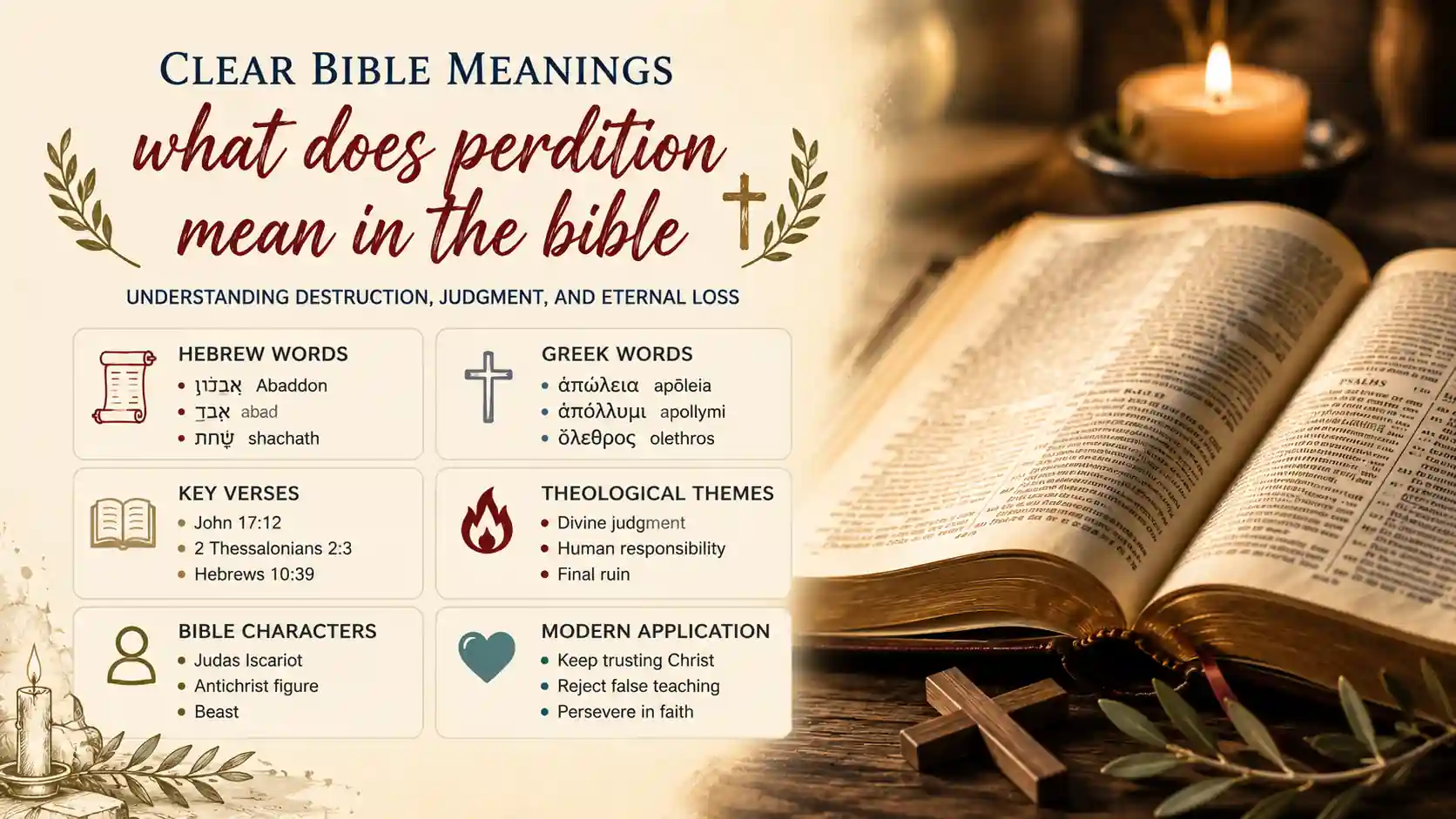
What does perdition mean in the Bible? In Scripture, “perdition” means ruin, destruction, or final loss under God’s judgment. It is not merely hardship, sadness, or death. It points to a fearful end for those who reject God’s truth, oppose Christ, or persist in unbelief.
Your study of perdition should begin with the Bible’s own vocabulary. The key Greek word is ἀπώλεια, apōleia, often translated “destruction,” “waste,” “ruin,” or “perdition.”
Perdition Key Scripture References
| Verse | Passage Snippet | Context |
|---|---|---|
| John 17:12 | “son of perdition” | Judas fulfills Scripture |
| 2 Thessalonians 2:3 | “son of perdition” | Lawless rebel revealed |
| Philippians 1:28 | “token of perdition” | Opponents face judgment |
| Hebrews 10:39 | “draw back unto perdition” | Warning against apostasy |
| 2 Peter 3:7 | “perdition of ungodly men” | Final judgment by fire |
| Revelation 17:8 | “go into perdition” | Beast’s doomed destiny |
| Revelation 17:11 | “goeth into perdition” | Beast judged by God |
| Matthew 7:13 | “leadeth to destruction” | Broad way contrasted |
Perdition Bible Translation Comparison
| Verse | KJV | NIV | ESV | NASB |
|---|---|---|---|---|
| John 17:12 | son of perdition | doomed to destruction | son of destruction | son of destruction |
| 2 Thessalonians 2:3 | son of perdition | doomed to destruction | son of destruction | son of destruction |
| Philippians 1:28 | perdition | destroyed | destruction | destruction |
| Hebrews 10:39 | perdition | destruction | destruction | destruction |
| 2 Peter 3:7 | perdition | destruction | destruction | destruction |
| Revelation 17:8 | perdition | destruction | destruction | destruction |
| Revelation 17:11 | perdition | destruction | destruction | destruction |
| Matthew 7:13 | destruction | destruction | destruction | destruction |
Perdition People and Characters Associated
| Person | Role | Connection |
|---|---|---|
| Judas Iscariot | Betrayer | Called son of perdition |
| Jesus Christ | Intercessor | Preserved His own |
| Antichrist figure | Rebel | Called son of perdition |
| Paul | Apostle | Warned of destruction |
| Peter | Apostle | Spoke of ungodly perdition |
| Beast | Apocalyptic ruler | Goes into perdition |
| Ungodly men | Judgment objects | Destined for destruction |
| False teachers | Deceivers | Bring swift destruction |
Perdition Original Hebrew and Greek Words
| Original Word | Transliteration | Strong’s # | Literal Meaning |
|---|---|---|---|
| ἀπώλεια | apōleia | G684 | destruction, ruin |
| ἀπόλλυμι | apollymi | G622 | destroy, perish, lose |
| ὄλεθρος | olethros | G3639 | ruin, destruction |
| φθορά | phthora | G5356 | corruption, decay |
| אֲבַדּוֹן | Abaddon | H11 | destruction, ruin |
| אָבַד | abad | H6 | perish, be lost |
| שַׁחַת | shachath | H7845 | pit, corruption |
| כָּלָה | kalah | H3615 | consume, finish |
Perdition Related Biblical Concepts
| Concept | Connection | Supporting Verse |
|---|---|---|
| Apostasy | Drawing back | Hebrews 10:39 |
| Judgment | God’s verdict | 2 Peter 3:7 |
| Betrayal | Judas’ path | John 17:12 |
| Lawlessness | Man of sin | 2 Thessalonians 2:3 |
| Broad way | Road to ruin | Matthew 7:13 |
| False teaching | Destructive heresies | 2 Peter 2:1 |
| Eternal punishment | Final consequence | Matthew 25:46 |
| Salvation | Opposite destiny | Philippians 1:28 |
Perdition Historical and Cultural Context
| Aspect | Detail | Biblical Source |
|---|---|---|
| Jewish prayer | Jesus prays for disciples | John 17 |
| Betrayal setting | Judas leaves the Twelve | John 13 |
| Temple language | Lawless one exalts himself | 2 Thessalonians 2 |
| Roman pressure | Philippi faced opposition | Philippians 1 |
| Covenant warning | Apostasy is fearful | Hebrews 10 |
| Prophetic fire | Judgment imagery | 2 Peter 3 |
| Apocalyptic empire | Beast imagery | Revelation 17 |
| Wisdom tradition | Destruction before God | Proverbs 15:11 |
Perdition Theological Themes
| Theme | Explanation | Scripture |
|---|---|---|
| Divine judgment | God judges evil | 2 Peter 3:7 |
| Human responsibility | People reject truth | Hebrews 10:39 |
| Scripture fulfilled | Judas’ fall foretold | John 17:12 |
| Christ’s keeping power | Jesus preserves His own | John 17:12 |
| Final ruin | Evil ends in destruction | Revelation 17:11 |
| False worship | Beast opposes God | Revelation 17:8 |
| Perseverance | Faith does not shrink back | Hebrews 10:39 |
| Salvation contrast | Believers are delivered | Philippians 1:28 |
Perdition Modern Application for Believers
| Area | Practice | Scripture |
|---|---|---|
| Faith | Keep trusting Christ | Hebrews 10:39 |
| Discernment | Reject false teaching | 2 Peter 2:1 |
| Worship | Refuse beastly allegiance | Revelation 17:8 |
| Repentance | Turn from ruin | Matthew 7:13 |
| Assurance | Rest in Christ’s keeping | John 17:12 |
| Witness | Warn with humility | 2 Peter 3:7 |
| Holiness | Resist lawlessness | 2 Thessalonians 2:3 |
| Courage | Do not fear opponents | Philippians 1:28 |
ἀπώλεια ApōLeia and the Bible’S Serious Meaning of Perdition
The central New Testament word behind perdition is ἀπώλεια, apōleia. It describes destruction, ruin, or loss. Sometimes it can mean waste, as when costly ointment is viewed as “waste.” In passages about judgment, however, it carries a much heavier meaning.
Perdition is not annihilation as a casual metaphor, nor is it ordinary trouble. It is the end of a path set against God. The word gathers together moral rebellion, divine judgment, and the tragic loss of what should have been preserved under God’s mercy.
What Does Perdition Mean in the Bible When Judas Is Called the Son of Perdition
In John 17:12, Jesus says He kept the disciples, and “none of them is lost, but the son of perdition.” The phrase points to Judas Iscariot, not as a helpless victim of fate, but as the betrayer whose chosen treachery fulfilled Scripture.
This verse holds together two truths your study should not separate. Jesus truly preserved His own, and Judas truly acted wickedly. Perdition here is personal, historical, and covenantal. A man who walked near holy light loved darkness instead.
The Man of Sin and the Apocalyptic Road into Perdition
Second Thessalonians 2:3 uses the same solemn phrase for the “man of sin” or “man of lawlessness.” He is called the son of perdition because his identity is bound to rebellion and his destiny is destruction. He exalts himself against God.
Revelation 17 says the beast “goes into perdition.” The language is apocalyptic, but the meaning is clear. Evil may appear powerful for a season, yet its future is already judged. Perdition is the appointed collapse of arrogant opposition to the Lamb.
Perdition as a Warning and a Contrast to Salvation
Philippians 1:28 says the courage of believers is a sign of salvation for them and perdition for their opponents. Hebrews 10:39 contrasts those who shrink back to perdition with those who believe to the saving of the soul.
This contrast matters pastorally. Perdition is never given to satisfy curiosity about judgment. It warns the careless, sobers the proud, and strengthens the faithful. Scripture uses the word so you will cling more closely to Christ, not speculate coldly about others.
Frequently Asked Questions About Perdition
Does ἀπώλεια, apōleia, always mean eternal damnation?
No. It can mean waste or ruin, but in judgment texts it refers to final destruction under God’s verdict.
Why is Judas called the son of perdition in John 17:12?
Because his betrayal revealed a life moving toward ruin while also fulfilling Scripture.
Are the “son of perdition” in John 17:12 and 2 Thessalonians 2:3 the same person?
No. Judas is the betrayer of Jesus, while 2 Thessalonians speaks of the lawless end-time rebel.
How does אֲבַדּוֹן, Abaddon, relate to perdition?
It is a Hebrew term for destruction or ruin, often linked with the realm of death and judgment.
What should believers do with the Bible’s teaching on perdition?
Receive it as a sober warning, trust Christ’s salvation, and persevere in faithful obedience.