
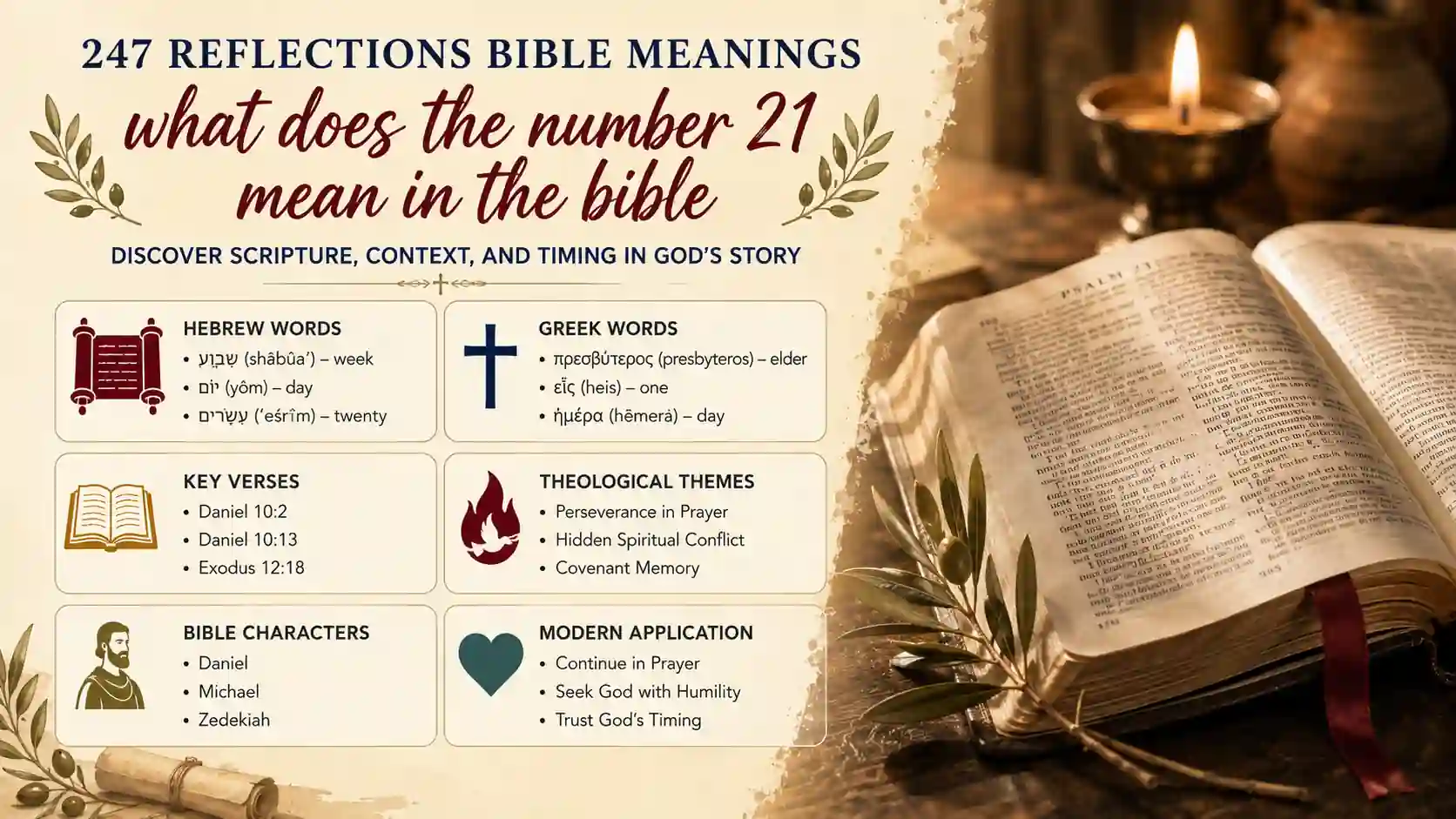
What does the number 21 mean in the Bible? Your study should begin with caution and reverence. Scripture uses numbers meaningfully, but it does not assign every number a hidden code. The number 21 appears in contexts of waiting, appointed worship, royal judgment, and spiritual conflict.
Most clearly, 21 is tied to “three weeks” in Daniel 10 and to the “twenty-first day” in Israel’s calendar. It can suggest a completed season of testing, prayer, or sacred observance, but its meaning depends on the passage.
Number 21 Key Scripture References
| Verse | Passage Snippet | Context |
|---|---|---|
| Daniel 10:2 | “three full weeks” | Daniel mourns and fasts |
| Daniel 10:3 | “till three whole weeks” | Abstinence before vision |
| Daniel 10:13 | “one and twenty days” | Angelic delay |
| Exodus 12:18 | “one and twentieth day” | Unleavened Bread ends |
| Leviticus 23:34 | “fifteenth day” | Feast of Tabernacles begins |
| Leviticus 23:36 | “seven days” | Festival reaches day 21 |
| Haggai 2:1 | “one and twentieth day” | Prophetic temple word |
| 2 Kings 24:18 | “twenty and one years old” | Zedekiah begins reign |
| 2 Chronicles 36:11 | “one and twenty years old” | Judah’s last king |
| Jeremiah 52:1 | “one and twenty years old” | Fall of Jerusalem setting |
Number 21 Bible Translation Comparison
| Verse | KJV | NIV | ESV | NASB |
|---|---|---|---|---|
| Daniel 10:2 | three full weeks | three weeks | three weeks | three entire weeks |
| Daniel 10:3 | three whole weeks | three weeks | three weeks | three weeks |
| Daniel 10:13 | one and twenty days | twenty-one days | twenty-one days | twenty-one days |
| Exodus 12:18 | one and twentieth day | twenty-first day | twenty-first day | twenty-first day |
| Haggai 2:1 | one and twentieth day | twenty-first day | twenty-first day | twenty-first day |
| 2 Kings 24:18 | twenty and one years old | twenty-one years old | twenty-one years old | twenty-one years old |
| 2 Chronicles 36:11 | one and twenty years old | twenty-one years old | twenty-one years old | twenty-one years old |
| Jeremiah 52:1 | one and twenty years old | twenty-one years old | twenty-one years old | twenty-one years old |
Number 21 People & Characters Associated
| Person | Role | Connection |
|---|---|---|
| Daniel | Prophet in exile | Prays through three weeks |
| Michael | Chief prince | Helps after 21 days |
| Gabriel-like messenger | Heavenly envoy | Delayed 21 days |
| Prince of Persia | Spiritual opponent | Resists the messenger |
| Moses | Covenant mediator | Receives Passover law |
| Israel | Redeemed people | Keeps Unleavened Bread |
| Haggai | Postexilic prophet | Speaks on day 21 |
| Zerubbabel | Davidic governor | Hears temple promise |
| Joshua son of Jehozadak | High priest | Encouraged with people |
| Zedekiah | Judah’s last king | Begins reign at 21 |
Number 21 Original Hebrew & Greek Words
| Original Word | Transliteration | Strong’s # | Literal Meaning |
|---|---|---|---|
| עֶשְׂרִים | ʿeśrîm | H6242 | twenty |
| אֶחָד | ʾeḥād | H259 | one |
| שְׁלֹשָׁה | šĕlōšâ | H7969 | three |
| שָׁבוּעַ | šābûaʿ | H7620 | week, seven |
| יוֹם | yôm | H3117 | day |
| חֹדֶשׁ | ḥōdeš | H2320 | month, new moon |
| חַג | ḥag | H2282 | feast, festival |
| מַצָּה | maṣṣâ | H4682 | unleavened bread |
| πρεσβύτερος | presbyteros | G4245 | elder, older |
| εἷς | heis | G1520 | one |
Number 21 Related Biblical Concepts
| Concept | Connection | Supporting Verse |
|---|---|---|
| Waiting prayer | Daniel waits three weeks | Daniel 10:2 |
| Fasting | Daniel abstains | Daniel 10:3 |
| Spiritual conflict | Messenger delayed | Daniel 10:13 |
| Deliverance memory | Unleavened Bread | Exodus 12:18 |
| Pilgrimage worship | Tabernacles week | Leviticus 23:34 |
| Temple renewal | Haggai’s prophecy | Haggai 2:1 |
| Covenant judgment | Zedekiah reigns | 2 Kings 24:18 |
| Exile | Jerusalem falls | Jeremiah 52:1 |
| Completion of feast | Seven-day observance | Leviticus 23:36 |
| Hope after shaking | Glory promised | Haggai 2:6-9 |
Number 21 Historical & Cultural Context
| Aspect | Detail | Biblical Source |
|---|---|---|
| Passover month | Abib or Nisan | Exodus 12:18 |
| Unleavened Bread | Days 15 through 21 | Exodus 12:18 |
| Tabernacles | Seventh month festival | Leviticus 23:34 |
| Sacred assembly | Festival closing day | Leviticus 23:36 |
| Persian period | Daniel under empire | Daniel 10:1 |
| Angelic princes | Nations in conflict | Daniel 10:13 |
| Postexilic temple | Rebuilding encouraged | Haggai 2:1 |
| Davidic collapse | Zedekiah’s weak reign | 2 Kings 24:18 |
| Babylonian exile | Jerusalem destroyed | Jeremiah 52:1 |
| Hebrew counting | “Twenty and one” | Daniel 10:13 |
Number 21 Theological Themes
| Theme | Explanation | Scripture |
|---|---|---|
| Perseverance | Prayer may wait | Daniel 10:2 |
| Hidden conflict | Earthly events have spiritual depth | Daniel 10:13 |
| Covenant memory | Redemption shapes worship | Exodus 12:18 |
| Holiness | Leaven removed from homes | Exodus 12:19 |
| Pilgrim joy | Israel rejoices before God | Leviticus 23:40 |
| Temple hope | God promises greater glory | Haggai 2:9 |
| Judgment | Rebellion brings exile | Jeremiah 52:1 |
| Mercy | God still sends prophets | Haggai 2:1 |
| Divine timing | Days matter to God | Daniel 10:14 |
| Faithful endurance | Waiting does not mean silence | Daniel 10:12 |
Number 21 Modern Application for Believers
| Area | Practice | Scripture |
|---|---|---|
| Prayer | Continue when answers delay | Daniel 10:12 |
| Fasting | Seek God with humility | Daniel 10:3 |
| Discernment | Do not fear hidden battles | Daniel 10:13 |
| Worship | Remember redemption | Exodus 12:18 |
| Repentance | Remove corrupting leaven | Exodus 12:19 |
| Community | Gather for holy worship | Leviticus 23:36 |
| Hope | Trust God’s future glory | Haggai 2:9 |
| Leadership | Learn from Zedekiah | Jeremiah 52:1 |
| Patience | Let God define timing | Daniel 10:14 |
| Scripture study | Read numbers in context | Exodus 12:18 |
The Hebrew שָׁבוּעַ Shows 21 as Three Completed Weeks
In Daniel 10, the phrase “three full weeks” uses the Hebrew idea of a שָׁבוּעַ, šābûaʿ, a unit of seven. Three such weeks give the 21-day period that frames Daniel’s mourning, fasting, and waiting before God.
This is not casual arithmetic. Daniel is not experimenting with a mystical number. He is a faithful exile seeking understanding after a troubling revelation, and the 21 days reveal that heaven was active even while Daniel felt unanswered.
What Does the Number 21 Mean in the Bible During Daniel’S Angelic Conflict?
Daniel 10:13 gives the strongest symbolic weight to 21. The heavenly messenger says the “prince of the kingdom of Persia” resisted him for 21 days until Michael came to help. The number marks a real period of delay within a larger vision of kingdoms.
For your study, this means 21 can point to persevering prayer amid unseen resistance. Yet the emphasis rests on God’s sovereignty, not on the number itself. Daniel’s answer was delayed, but it was not denied, forgotten, or outside divine rule.
The Twenty-First Day in Exodus and Haggai Belongs to Worship and Hope
Exodus 12:18 places the twenty-first day at the close of Unleavened Bread, when Israel remembered deliverance from Egypt. The number stands inside a calendar of redemption, holiness, and covenant identity.
Haggai 2:1 also dates a prophetic word to the twenty-first day of the seventh month, during the season of Tabernacles. Into a discouraged rebuilding community, God promised that the latter glory of the house would be greater than the former.
Zedekiah at 21 Warns Against Covenant Unfaithfulness
Zedekiah was 21 years old when he began to reign, according to 2 Kings 24:18, 2 Chronicles 36:11, and Jeremiah 52:1. His age does not make 21 evil, but his reign shows the tragic setting of Judah’s final collapse.
This reminds you that biblical numbers must be read within narrative context. The same number can appear in prayer, worship, prophecy, and judgment. Scripture teaches theology through the passage, not through isolated numerology.
FAQ About the Number 21 in the Bible
Does שָׁבוּעַ, šābûaʿ, prove that 21 means spiritual warfare?
No. Daniel 10 connects 21 days with spiritual conflict, but the word itself simply means a week or unit of seven.
Why do translations differ between “one and twenty” and “twenty-one”?
The KJV often preserves older English order, while modern versions express the same Hebrew number in current English.
Is Daniel’s 21-day fast a command for Christians today?
No. It is a descriptive account, though believers may learn perseverance, humility, and prayerful dependence from it.
Does Zedekiah being 21 make the number a symbol of rebellion?
No. Zedekiah’s reign warns against covenant unfaithfulness, but Scripture does not define 21 as rebellion.
Should I build doctrine on the number 21?
No. Let clear biblical teaching govern your interpretation, and treat 21 as meaningful only where the passage itself gives context.