
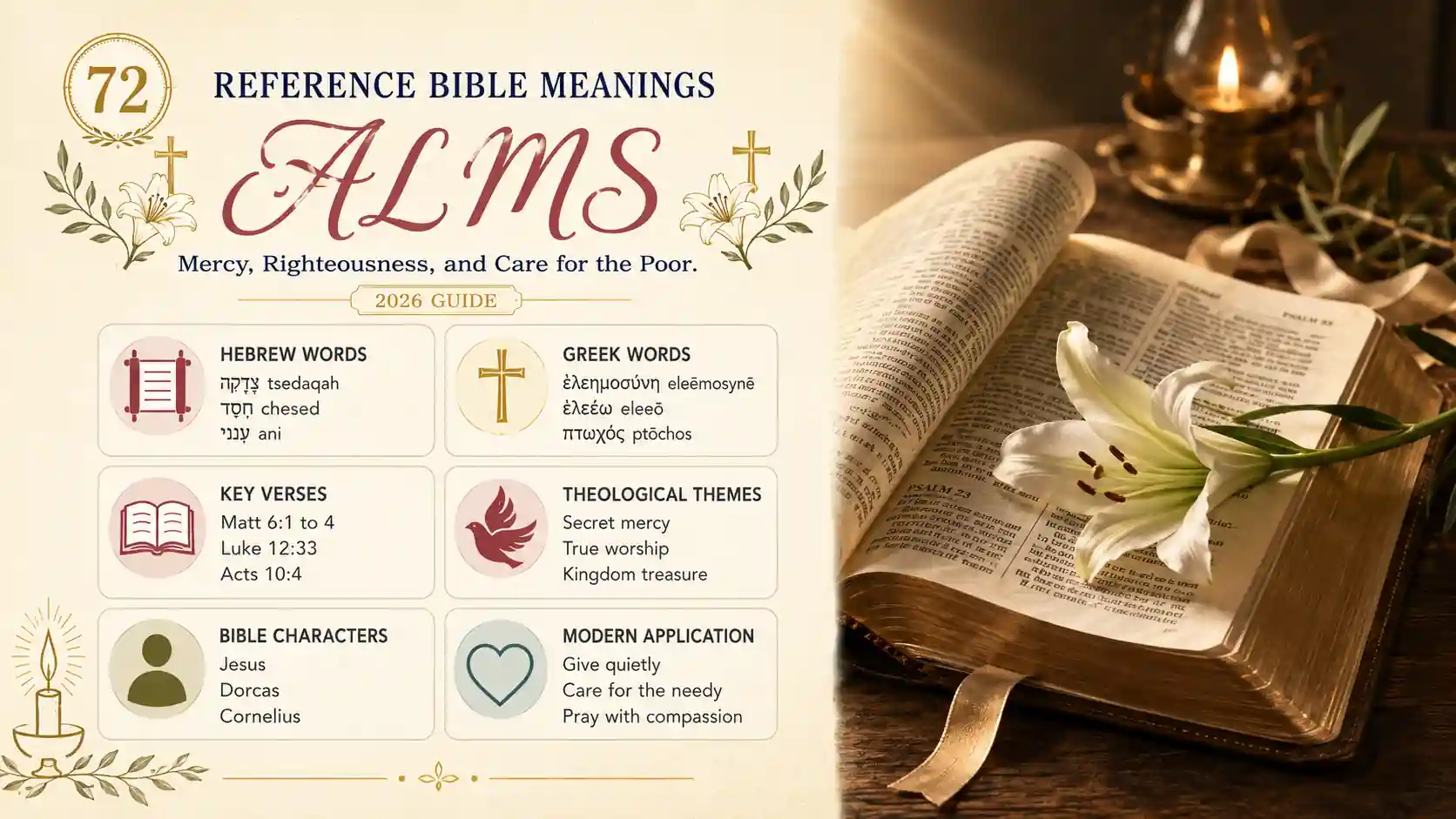
What does alms mean in the Bible? In Scripture, alms are merciful gifts given to the poor, the needy, or the vulnerable as an act of righteousness before God. The word is not merely about money. It belongs to a wider biblical vision of compassion, covenant faithfulness, justice, humility, and worship.
When you study alms, you are looking at how God’s people are taught to love neighbors in practical ways, without pride, hypocrisy, or spiritual showmanship.
Alms Key Scripture References
| Verse | Passage Snippet | Context |
|---|---|---|
| Deuteronomy 15:7-8 | Open your hand | Care for poor Israelites |
| Proverbs 19:17 | Lends to the Lord | Mercy to the poor |
| Isaiah 58:7 | Share bread with the hungry | True fasting |
| Matthew 6:1-4 | Give in secret | Sermon on the Mount |
| Luke 11:41 | Give alms from within | Inner purity |
| Luke 12:33 | Sell possessions and give alms | Kingdom treasure |
| Acts 3:2-3 | Asked alms at the gate | Lame man at temple |
| Acts 9:36 | Full of good works and alms | Dorcas in Joppa |
| Acts 10:4 | Your alms have ascended | Cornelius before God |
Alms Bible Translation Comparison
| Verse | KJV | NIV | ESV | NASB |
|---|---|---|---|---|
| Matthew 6:1 | alms | righteousness | righteousness | righteousness |
| Matthew 6:2 | doest thine alms | give to the needy | give to the needy | give to the poor |
| Matthew 6:3 | doest alms | give to the needy | give to the needy | give to the poor |
| Matthew 6:4 | thine alms | your giving | your giving | your charitable giving |
| Luke 11:41 | give alms | be generous to the poor | give as alms | give that which is within |
| Luke 12:33 | give alms | give to the poor | give to the needy | give to charity |
| Acts 3:2 | ask alms | beg | ask for money | beg alms |
| Acts 9:36 | almsdeeds | helping the poor | acts of charity | charity |
| Acts 10:2 | gave much alms | gave generously | gave alms generously | gave many charitable gifts |
Alms People & Characters Associated
| Person | Role | Connection |
|---|---|---|
| Jesus | Messiah and Teacher | Taught secret giving |
| The poor | Needy recipients | Central concern of alms |
| Hypocrites | Public religious actors | Warned against display |
| Widow of Mark 12 | Poor worshiper | Gave sacrificially |
| Lame man | Temple beggar | Asked for alms |
| Peter | Apostle | Gave healing, not silver |
| John | Apostle | Present at temple gate |
| Dorcas | Disciple in Joppa | Known for mercy |
| Cornelius | Gentile centurion | His alms were remembered |
Alms Original Hebrew & Greek Words
| Original Word | Transliteration | Strong’s # | Literal Meaning |
|---|---|---|---|
| צְדָקָה | tsedaqah | H6666 | righteousness, justice |
| חֶסֶד | chesed | H2617 | covenant mercy |
| חָנַן | chanan | H2603 | show favor, be gracious |
| דַּל | dal | H1800 | poor, weak |
| אֶבְיוֹן | evyon | H34 | needy one |
| עָנִי | ani | H6041 | afflicted, poor |
| ἐλεημοσύνη | eleēmosynē | G1654 | mercy, almsgiving |
| ἐλεέω | eleeō | G1653 | show mercy |
| πτωχός | ptōchos | G4434 | poor, destitute |
Alms Related Biblical Concepts
| Concept | Connection | Supporting Verse |
|---|---|---|
| Mercy | Alms express compassion | Proverbs 14:31 |
| Righteousness | Giving reflects covenant life | Matthew 6:1 |
| Justice | The poor must not be ignored | Isaiah 1:17 |
| Fasting | Mercy validates worship | Isaiah 58:6-7 |
| Prayer | Cornelius joined prayer and alms | Acts 10:2 |
| Humility | Secret giving rejects praise | Matthew 6:3 |
| Stewardship | Possessions serve God’s kingdom | Luke 12:33 |
| Neighbor love | Need becomes personal duty | Luke 10:33-35 |
| Worship | Giving can rise before God | Acts 10:4 |
Alms Historical & Cultural Context
| Aspect | Detail | Biblical Source |
|---|---|---|
| Covenant law | Israel must aid the poor | Deuteronomy 15:7-11 |
| Harvest gleaning | Fields left for the needy | Leviticus 19:9-10 |
| Temple gates | Beggars gathered near worship | Acts 3:2 |
| Synagogue piety | Giving was public virtue | Matthew 6:2 |
| Roman Judea | Poverty was highly visible | Luke 16:20 |
| Jewish prayer hours | Mercy joined devotion | Acts 3:1 |
| Early church care | Widows received daily help | Acts 6:1 |
| Diaspora generosity | Joppa knew Dorcas’s works | Acts 9:36 |
| Gentile God-fearers | Cornelius practiced alms | Acts 10:2 |
Alms Theological Themes
| Theme | Explanation | Scripture |
|---|---|---|
| God sees secret mercy | Hidden giving is not forgotten | Matthew 6:4 |
| Mercy reflects God’s heart | Kindness honors the Maker | Proverbs 14:31 |
| Reward belongs to God | Human applause is shallow | Matthew 6:2 |
| Faith works through love | True devotion becomes action | James 2:15-17 |
| Wealth is entrusted | Possessions can serve eternity | Luke 12:33 |
| Worship needs justice | Ritual without mercy is empty | Isaiah 58:3-7 |
| Grace forms generosity | Received mercy becomes mercy | Luke 6:36 |
| Prayer and giving meet | Cornelius’s devotion was noticed | Acts 10:4 |
| Christ purifies motives | The heart matters in giving | Matthew 6:1 |
Alms Modern Application for Believers
| Area | Practice | Scripture |
|---|---|---|
| Personal giving | Give quietly and wisely | Matthew 6:3 |
| Church mercy | Support care for the needy | Acts 6:1-4 |
| Local poverty | Open your hand nearby | Deuteronomy 15:7 |
| Hospitality | Share food and shelter | Isaiah 58:7 |
| Financial planning | Set aside mercy funds | 1 Corinthians 16:2 |
| Motives | Refuse spiritual performance | Matthew 6:1 |
| Prayer life | Let compassion accompany prayer | Acts 10:2 |
| Discipleship | Teach children generosity | Proverbs 19:17 |
| Kingdom priorities | Treasure God over possessions | Luke 12:33 |
ἐλεημοσύνη And the Mercy Shaped Meaning of Alms
The main Greek word behind alms is ἐλεημοσύνη, eleēmosynē, which comes from the language of mercy. In the New Testament, alms are not cold charity or religious dues. They are mercy made visible through material help.
This matters for your study because Jesus does not criticize almsgiving itself. He corrects the motive. In Matthew 6, the issue is not whether disciples should give, but whether they give before the Father or before an audience.
צְדָקָה And the Old Testament Roots of Almsgiving
Although the English word “alms” appears most clearly in the New Testament, its roots reach deeply into the Old Testament. The Hebrew word צְדָקָה, tsedaqah, often means righteousness, but biblical righteousness includes fair dealing, covenant loyalty, and care for the weak.
Israel’s law trained God’s people to see poverty as a covenant concern. Gleaning laws, debt release, openhanded lending, and protection for widows and orphans all prepared the moral world in which almsgiving later became a recognized act of piety.
What Does Alms Mean in the Bible When Jesus Warns Against Hypocrisy
In Matthew 6, Jesus says not to practice righteousness in order to be seen by others. Some translations use “alms,” while others say “righteousness,” because the Greek textual and translation issue centers on the wider category of righteous acts and the specific example of giving.
Jesus pictures people sounding a trumpet in synagogues and streets. Whether literal or figurative, the warning is plain. A gift given to purchase admiration has already received its reward. The Father’s reward belongs to mercy offered in reverent secrecy.
Dorcas, Cornelius, and Alms in the Book of Acts
Acts gives you two memorable portraits of almsgiving. Dorcas, also called Tabitha, is remembered for good works and alms, especially among widows who grieved her death. Her mercy had a name, a face, and garments held in grateful hands.
Cornelius, a Gentile centurion, gave many alms and prayed continually. His alms did not replace the gospel, but Acts says they came up as a memorial before God. The story shows that God noticed his reverent seeking and sent Peter to proclaim Christ.
Alms as Worship without Performance
Biblical alms are never a way to buy salvation. Scripture consistently teaches that mercy flows from a heart being formed by God. The poor are not props for religious self-display, and giving is not a stage on which the giver becomes great.
For the believer, alms remain a searching test of love. They ask whether your worship reaches your wallet, your schedule, your table, and your neighborhood. True almsgiving is humble, practical, prayerful, and shaped by the mercy you have received from the Lord.
Frequently Asked Questions About Alms
Does ἐλεημοσύνη mean only money?
No. It often includes material giving, but its root idea is mercy shown in practical help.
Why do some translations say “righteousness” instead of “alms” in Matthew 6:1?
Because the passage introduces righteous practice broadly, then immediately applies it to giving to the poor.
Is צְדָקָה the same thing as alms?
Not exactly, but צְדָקָה includes the righteous covenant concern that stands behind biblical giving.
Did Cornelius’s alms save him in Acts 10?
No. His alms were remembered by God, but Peter still preached Christ and the gospel to him.
How should a Christian practice alms today?
Give quietly, generously, and wisely, seeking the Father’s approval rather than public praise.