
When you ask what does lent mean in the bible, you may be surprised that the word Lent itself never appears in Scripture. Lent comes from an old English word for spring, yet its practices grow from deep biblical roots.
Fasting, repentance, prayer, ashes and humble self denial fill the pages you love, from Joel calling people to return to God to Jesus fasting forty days in the wilderness before His public ministry began for the sake of others with love and patience for His people.
Key Scripture References for Lent
| Verse | Passage Snippet | Context |
|---|---|---|
| Matthew 4 verse 2 | He fasted forty days and forty nights | Jesus in the wilderness |
| Joel 2 verse 12 | Return to me with fasting and weeping | Call to national repentance |
| Jonah 3 verse 5 | People proclaimed a fast in sackcloth | Nineveh repents at preaching |
| Daniel 9 verse 3 | I turned to prayer with sackcloth and ashes | Daniel intercedes for Israel |
| Isaiah 58 verse 6 | Loose the bonds of wickedness | True fasting serves justice |
| Matthew 6 verse 16 | When you fast do not look gloomy | Jesus teaches sincere fasting |
| Esther 4 verse 16 | Fast for me for three days | Esther seeks courage and favor |
| Nehemiah 9 verse 1 | Israel assembled with fasting and sackcloth | Confession after exile return |
| Psalm 35 verse 13 | I humbled myself with fasting | David prays for others |
| Luke 5 verse 35 | Then they will fast in those days | Jesus speaks of future fasting |
Bible Translation Comparison for Lent
| Verse | KJV | NIV | ESV | NASB |
|---|---|---|---|---|
| Joel 2 verse 12 | Rend your heart and not garments | Rend your heart not your garments | Rend your hearts not garments | Rend your heart not garments |
| Matthew 4 verse 2 | He had fasted forty days | After fasting forty days | After fasting forty days | After He had fasted forty days |
| Matthew 6 verse 17 | Anoint thine head and wash face | Put oil on your head | Anoint your head and wash face | Put oil on your head |
| Isaiah 58 verse 6 | Loose the bands of wickedness | Loose the chains of injustice | Loose the bonds of wickedness | Loose the bonds of wickedness |
| Daniel 9 verse 3 | With fasting sackcloth and ashes | In fasting sackcloth and ashes | With fasting sackcloth and ashes | With fasting sackcloth and ashes |
| Jonah 3 verse 5 | Proclaimed a fast in sackcloth | Called for a fast in sackcloth | Called for a fast in sackcloth | Proclaimed a fast in sackcloth |
| Luke 5 verse 35 | Then shall they fast | Then they will fast | Then they will fast | Then they will fast then |
| Psalm 35 verse 13 | My clothing was sackcloth | I put on sackcloth | I wore sackcloth | My clothing was sackcloth |
People and Characters Associated with Lent
| Person | Role | Connection |
|---|---|---|
| Jesus | Son of God and teacher | Fasted forty days in wilderness |
| Moses | Prophet and lawgiver | Fasted forty days on Sinai |
| Elijah | Prophet to Israel | Fasted forty days to Horeb |
| Daniel | Prophet in exile | Prayed in sackcloth and ashes |
| Esther | Queen of Persia | Called a three day fast |
| David | King of Israel | Humbled himself with fasting |
| King of Nineveh | Ruler of Nineveh | Led citywide fast and repentance |
| Nehemiah | Governor of Judah | Led confession with fasting |
| Anna | Prophetess in temple | Worshiped with fasting and prayer |
| John the Baptist | Forerunner of Jesus | Lived simply and called repentance |
Original Hebrew and Greek Words for Lent
| Original Word | Transliteration | Strong’s # | Literal Meaning |
|---|---|---|---|
| צוֹם | tsom | H6685 | Fasting or a fast |
| צוּם | tsum | H6684 | To fast or abstain |
| עָנָה | anah | H6031 | To humble or afflict self |
| שַׂק | saq | H8242 | Sackcloth for mourning |
| אֵפֶר | epher | H665 | Ashes showing grief |
| νηστεία | nesteia | G3521 | Fasting or abstinence |
| νηστεύω | nesteuo | G3522 | To fast or go without food |
| μετάνοια | metanoia | G3341 | Repentance and change of mind |
| μετανοέω | metanoeo | G3340 | To repent and turn |
| σποδός | spodos | G4700 | Ashes used in mourning |
Related Biblical Concepts for Lent
| Concept | Connection | Supporting Verse |
|---|---|---|
| Fasting | Voluntary denial that focuses prayer | Matthew 6 verse 16 |
| Repentance | Turning from sin toward God | Joel 2 verse 13 |
| Mourning | Grief over sin and loss | Joel 2 verse 12 |
| Prayer | Seeking God in dependence | Daniel 9 verse 3 |
| Self Denial | Taking up the cross daily | Luke 9 verse 23 |
| Temptation | Testing faced by Jesus fasting | Matthew 4 verse 3 |
| Almsgiving | Generosity paired with devotion | Matthew 6 verse 3 |
| Humility | Lowering self before God | Psalm 35 verse 13 |
| Renewal | New heart promised by God | Ezekiel 36 verse 26 |
| Resurrection Hope | Sorrow moving toward Easter joy | Luke 24 verse 6 |
Historical and Cultural Context for Lent
| Aspect | Detail | Biblical Source |
|---|---|---|
| Lent Name Origin | From Old English lencten for spring | No direct Bible verse |
| Forty Day Pattern | Repeated seasons of testing and prayer | Matthew 4 verse 2 |
| Sackcloth Clothing | Coarse cloth worn in grief | Jonah 3 verse 5 |
| Ashes Practice | Dust on head showed repentance | Daniel 9 verse 3 |
| Early Church Fast | Believers fasted before Easter feast | Luke 5 verse 35 pattern |
| Ash Wednesday | Later church tradition marking season start | Joel 2 verse 12 roots |
| Holy Week | Final week remembering Jesus passion | Matthew 26 verse 2 |
| Wilderness Setting | Dry place of testing and trust | Matthew 4 verse 1 |
| Spring Season | Time linked with renewal and growth | Song of Songs 2 verse 11 |
| Communal Repentance | Whole towns fasted together publicly | Nehemiah 9 verse 1 |
Theological Themes for Lent
| Theme | Explanation | Scripture |
|---|---|---|
| Repentance | God welcomes a broken contrite heart | Psalm 51 verse 17 |
| Dependence | Fasting declares need for God | Matthew 4 verse 4 |
| Victory Over Temptation | Jesus resists Satan with Scripture | Matthew 4 verse 10 |
| True Worship | Fasting must include mercy and justice | Isaiah 58 verse 7 |
| Humility | God lifts those who bow low | James 4 verse 10 |
| Intercession | Believers pray for others in need | Daniel 9 verse 19 |
| Mortification of Sin | Putting selfish desires to death | Romans 8 verse 13 |
| Hope Beyond Sorrow | Grief leads toward resurrection life | John 16 verse 20 |
| Covenant Return | God calls His people back home | Joel 2 verse 13 |
| Sincerity | God sees the heart not display | Matthew 6 verse 18 |
Modern Application for Believers and Lent
| Area | Practice | Scripture |
|---|---|---|
| Prayer | Set a daily quiet prayer time | Daniel 6 verse 10 |
| Fasting | Skip a meal to seek God | Matthew 6 verse 17 |
| Repentance | Confess sin quickly and honestly | 1 John 1 verse 9 |
| Giving | Share food money and time | Isaiah 58 verse 7 |
| Scripture | Read a Gospel passage daily | Psalm 119 verse 105 |
| Simplicity | Limit screens and extra spending | Luke 9 verse 23 |
| Forgiveness | Release grudges and seek peace | Matthew 6 verse 14 |
| Service | Visit lonely or sick neighbors | Matthew 25 verse 36 |
| Gratitude | Thank God before each meal | 1 Thessalonians 5 verse 18 |
| Community | Share the season with your church | Hebrews 10 verse 25 |
Nesteia and Metanoia at the Heart of Lent
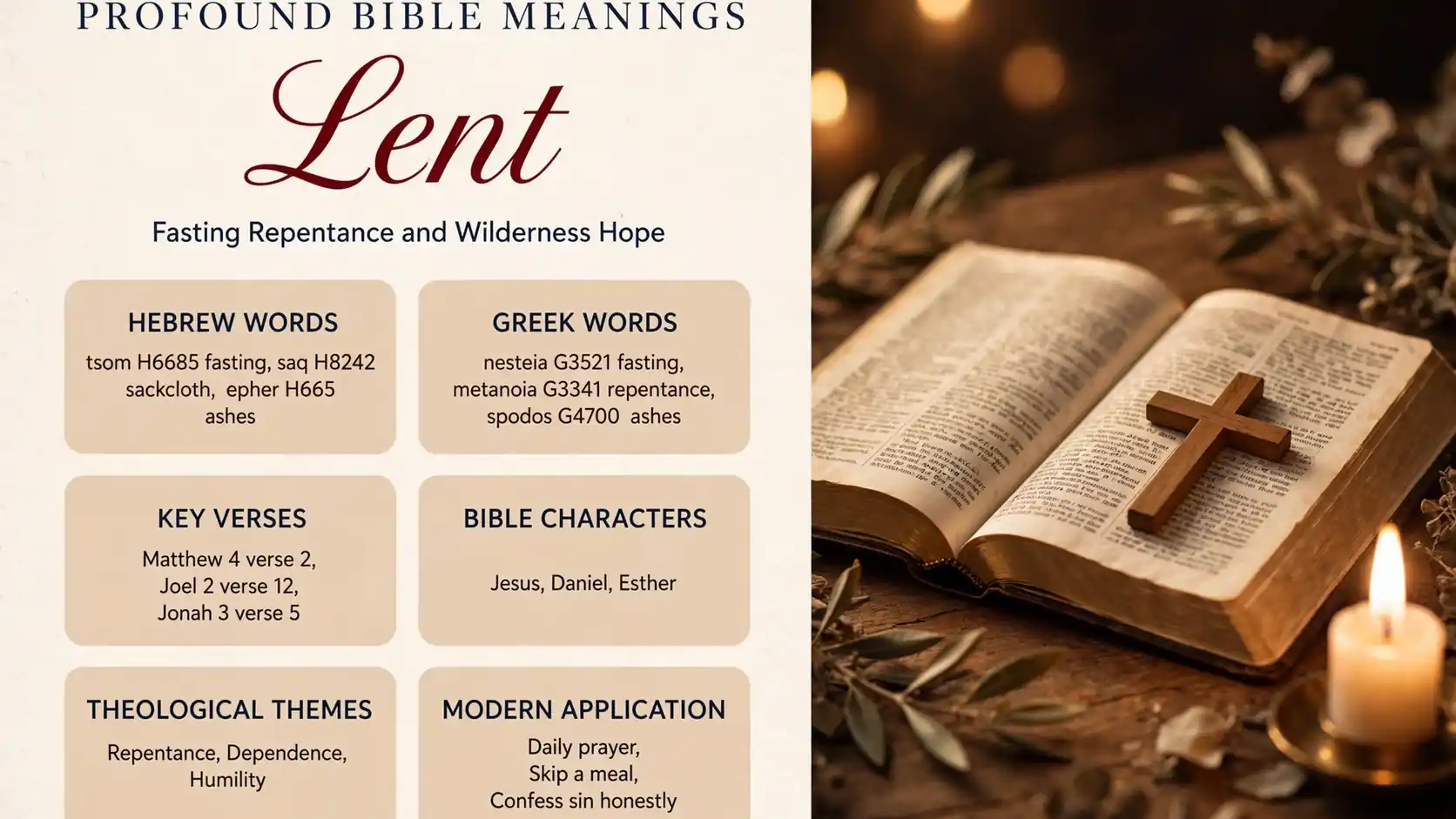
The Greek word nesteia G3521 means fasting, and metanoia G3341 means repentance with a changed mind and changed direction. Together they describe the inner movement behind the season, less food for the body and more room for God in your heart and habits.
When Jesus fasted in Matthew 4, He answered temptation with Scripture and trust in His Father. Your observance can follow that pattern in a simple way, pairing each act of denial with prayer and a verse you carry through the day.
Ashes Sackcloth and Sincere Return in Lent
Joel urged the people to rend their hearts and not only their garments, a warning against outward show without inward change. Ashes and sackcloth in Daniel and Jonah were visible signs, but God always looked deeper for humility, confession and a real return to His mercy.
That honesty still protects your practice today. A small honest fast with secret prayer honors God more than a public display, because the Father who sees in secret values sincerity over performance and rewards a heart that truly seeks Him.
From Wilderness Fasting to What Does Lent Mean in the Bible Today
Many churches observe Lent for forty days before Easter, echoing the forty days of Jesus and the forty years of Israel in the wilderness. Not every believer observes it the same way, and Scripture leaves room for conscience, gratitude and sincere devotion rather than compulsion or pride.
Seen in that light, what does lent mean in the bible becomes a question about roots rather than rules. The roots are strong and clear in fasting, repentance and hope, and they can enrich your walk whether your church marks the season formally or simply calls you to renewed prayer.
Frequently Asked Questions About Lent
Is Lent commanded in the Bible?
No direct command names Lent, but its roots in fasting nesteia G3521 and repentance metanoia G3341 are taught throughout Scripture.
Why does Lent last forty days?
The forty days echo Jesus fasting forty days in Matthew 4 and other forty day seasons of prayer and testing in Scripture.
What does the Hebrew word tsom H6685 mean?
Tsom means fasting or a fast, describing voluntary abstinence paired with prayer, humility and seeking God in times of need.
Why do people receive ashes during Lent?
Ashes recall epher H665 and spodos G4700 in mourning and repentance, reminding believers of mortality and Gods mercy in Joel 2.
Should every Christian observe Lent?
Scripture does not require it for every believer, so you can observe it freely as a helpful season of prayer without judging others.