
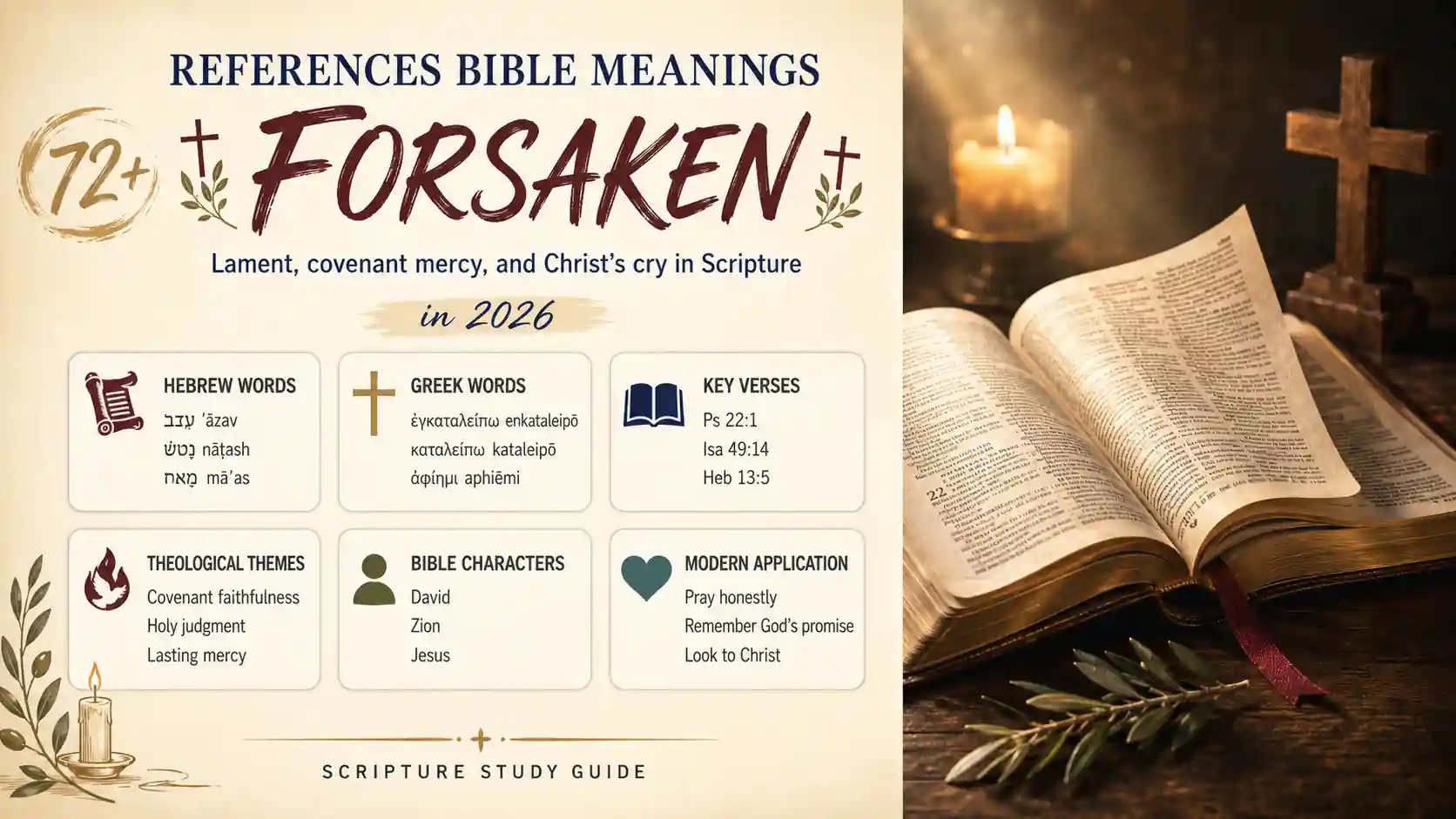
What does forsaken mean in the bible is a question that reaches into covenant loyalty, human suffering, divine judgment, and the deepest cry of Christ on the cross. In Scripture, “forsaken” can mean abandoned, left behind, rejected, neglected, or handed over.
Yet the word is not always hopeless. The Bible also shows that God may discipline, hide His face for a moment, or allow His people to feel deserted, while still keeping His covenant mercy and calling them back to trust.
Forsaken Key Scripture References
| Verse | Passage Snippet | Context |
|---|---|---|
| Deuteronomy 31:6 | He will not leave you nor forsake you | Moses encourages Israel |
| Joshua 1:5 | I will not leave thee, nor forsake thee | Joshua receives leadership |
| Psalm 22:1 | My God, why hast thou forsaken me | David’s lament, Christ’s cry |
| Psalm 37:25 | Nor his seed begging bread | The righteous are not abandoned |
| Psalm 94:14 | The Lord will not cast off his people | Covenant assurance |
| Isaiah 49:14 | The Lord hath forsaken me | Zion feels forgotten |
| Isaiah 54:7 | For a small moment have I forsaken thee | Exile and restoration |
| Matthew 27:46 | Why hast thou forsaken me | Jesus quotes Psalm 22 |
| Hebrews 13:5 | I will never leave thee | Christian contentment |
Forsaken Bible Translation Comparison
| Verse | KJV | NIV | ESV | NASB |
|---|---|---|---|---|
| Psalm 22:1 | forsaken me | forsaken me | forsaken me | forsaken me |
| Deuteronomy 31:6 | nor forsake thee | nor forsake you | or forsake you | or forsake you |
| Joshua 1:5 | nor forsake thee | nor forsake you | or forsake you | or forsake you |
| Isaiah 49:14 | hath forsaken me | has forsaken me | has forsaken me | has abandoned me |
| Isaiah 54:7 | have I forsaken thee | I abandoned you | I deserted you | I abandoned you |
| 2 Timothy 4:10 | hath forsaken me | has deserted me | has deserted me | has deserted me |
| Hebrews 13:5 | nor forsake thee | never will I forsake you | nor forsake you | nor will I ever desert you |
| Mark 15:34 | why hast thou forsaken me | why have you forsaken me | why have you forsaken me | why have You forsaken Me |
| Psalm 27:10 | take me up | receive me | take me in | take me up |
Forsaken People and Characters Associated
| Person | Role | Connection |
|---|---|---|
| David | King and psalmist | Felt abandoned in lament |
| Moses | Prophet and leader | Taught God would not forsake |
| Joshua | Israel’s commander | Strengthened by God’s promise |
| Zion | Personified city | Said the Lord had forsaken her |
| Job | Suffering righteous man | Felt God distant and hostile |
| Jesus | Messiah and Son | Bore the forsaken cry |
| Paul | Apostle | Deserted by coworkers |
| Demas | Former companion | Forsook Paul for the world |
| Israel | Covenant people | Forsook the Lord repeatedly |
Forsaken Original Hebrew and Greek Words
| Original Word | Transliteration | Strong’s # | Literal Meaning |
|---|---|---|---|
| עָזַב | ʿāzav | H5800 | leave, abandon |
| נָטַשׁ | nāṭash | H5203 | thrust away, desert |
| שָׁכַח | shāḵaḥ | H7911 | forget, ignore |
| מָאַס | māʾas | H3988 | reject, despise |
| רָפָה | rāphāh | H7503 | let go, slacken |
| ἐγκαταλείπω | enkataleipō | G1459 | leave behind |
| καταλείπω | kataleipō | G2641 | leave, forsake |
| ἀφίημι | aphiēmi | G863 | leave, release |
| ἀπολείπω | apoleipō | G620 | leave remaining |
Forsaken Related Biblical Concepts
| Concept | Connection | Supporting Verse |
|---|---|---|
| Covenant faithfulness | God promises not to abandon | Deuteronomy 31:6 |
| Apostasy | Israel forsakes the Lord | Jeremiah 2:13 |
| Lament | Faith speaks from pain | Psalm 22:1 |
| Exile | Forsakenness felt as judgment | Isaiah 54:7 |
| Restoration | Mercy follows discipline | Isaiah 54:8 |
| Divine presence | God remains with His people | Joshua 1:9 |
| Human desertion | Friends may abandon | 2 Timothy 4:16 |
| Perseverance | Christ sustains believers | Hebrews 13:5 |
| Substitution | Christ bears judgment | Matthew 27:46 |
Forsaken Historical and Cultural Context
| Aspect | Detail | Biblical Source |
|---|---|---|
| Covenant oath | Loyalty framed by promise | Deuteronomy 31 |
| Wilderness memory | Israel learns dependence | Deuteronomy 8 |
| Royal lament | Kings prayed amid enemies | Psalm 22 |
| Temple grief | Zion mourns loss | Lamentations 1 |
| Exile language | Abandonment describes judgment | Isaiah 54 |
| Family duty | Parents should not abandon | Psalm 27:10 |
| Patron loyalty | Companions expected support | 2 Timothy 4 |
| Crucifixion shame | Public death felt cursed | Matthew 27 |
| Church endurance | Believers cling to promise | Hebrews 13 |
Forsaken Theological Themes
| Theme | Explanation | Scripture |
|---|---|---|
| God’s faithfulness | He does not break covenant | Psalm 94:14 |
| Human unfaithfulness | People forsake living water | Jeremiah 2:13 |
| Holy judgment | Sin brings relational rupture | Isaiah 59:2 |
| Temporary discipline | God may hide His face | Isaiah 54:7 |
| Lasting mercy | Compassion outlasts wrath | Isaiah 54:8 |
| Christ’s suffering | Jesus enters forsakenness | Mark 15:34 |
| Honest prayer | Lament is faithful speech | Psalm 22:1 |
| Divine nearness | The Lord receives the forsaken | Psalm 27:10 |
| Christian assurance | God remains present | Hebrews 13:5 |
Forsaken Modern Application for Believers
| Area | Practice | Scripture |
|---|---|---|
| Fear | Remember God’s promise | Deuteronomy 31:6 |
| Loneliness | Pray lament honestly | Psalm 22:1 |
| Shame | Look to the crucified Christ | Matthew 27:46 |
| Grief | Trust God’s receiving love | Psalm 27:10 |
| Temptation | Do not forsake the Lord | Jeremiah 2:13 |
| Church life | Stay faithful in trial | 2 Timothy 4:10 |
| Contentment | Rest in God’s presence | Hebrews 13:5 |
| Repentance | Return after wandering | Isaiah 55:7 |
| Hope | Expect mercy beyond discipline | Isaiah 54:8 |
עָזַב And the Covenant Weight Behind Forsaken
The main Hebrew word behind “forsaken” is עָזַב, ʿāzav, which means to leave, abandon, loose, or depart from. It can describe ordinary leaving, but in covenant passages it becomes morally and spiritually serious. To forsake the Lord is not mere absence. It is betrayal of the One who redeemed, called, and sustained His people.
This is why Jeremiah 2:13 is so piercing. Israel has forsaken the fountain of living waters and chosen broken cisterns. The image is not cold doctrine. It is the grief of God over a people who traded living fellowship for things that cannot hold water.
What Does Forsaken Mean in the Bible When David Cries Psalm 22?
Psalm 22 opens with a question every suffering believer recognizes. “My God, my God, why have you forsaken me?” David does not stop believing while he suffers. He still says “my God,” even when he cannot feel rescue. Biblical forsakenness often names the felt distance between God’s promise and present pain.
The psalm moves from agony to trust, then to praise among the congregation. That movement matters for your study. Forsaken language in the Bible is not always final abandonment. Sometimes it is the vocabulary of faith under pressure, praying while darkness still feels near.
Isaiah’S Forsaken Zion and the Mercy After Exile
In Isaiah 49:14, Zion says, “The Lord has forsaken me.” The historical wound behind that sentence is exile, defeat, shame, and the apparent collapse of God’s promises to Jerusalem. Zion speaks like a bereaved woman who believes she has been forgotten.
Yet Isaiah answers with maternal tenderness and covenant hope. In Isaiah 54:7, God says He forsook her “for a small moment,” but with great mercies He will gather her. The language holds discipline and compassion together. God’s judgment is real, but His covenant mercy is deeper than the wound.
ἐγκαταλείπω And the Forsaken Cry of Jesus
In Matthew 27:46 and Mark 15:34, Jesus cries the words of Psalm 22 using the Greek verb ἐγκαταλείπω, enkataleipō, meaning to leave behind or abandon. This is not a random cry of despair. Jesus is praying Scripture at the moment He bears sin, shame, and judgment as the crucified Messiah.
Christ’s forsakenness is unique. Believers may feel abandoned, David may lament, Paul may be deserted, and Zion may mourn, but Jesus enters the deepest place as the righteous sufferer. Because He was forsaken in this saving sense, Hebrews 13:5 can tell believers that God will never leave or forsake them.
Forsaken in the Life of the Church
The New Testament also uses forsaken language for human failure. Demas forsook Paul because he loved this present world. At Paul’s first defense, no one stood with him, yet the Lord stood by him. That contrast teaches you to distinguish painful human desertion from divine abandonment.
Christians should never treat forsakenness as a shallow slogan. Some wounds are real, some loneliness is heavy, and some prayers begin with tears. Yet Scripture trains you to bring that ache to God, to refuse apostasy, and to anchor your hope in the Lord who receives His people.
FAQ
Does עָזַב mean God completely abandons His covenant people?
Not usually. עָזַב can mean abandon, but covenant texts often pair temporary discipline with lasting mercy.
Why does Jesus quote Psalm 22:1 if the psalm later turns to praise?
He enters the psalm’s suffering as the righteous Messiah, while also fulfilling its movement toward vindication.
Why does NASB sometimes say “abandoned” where KJV says “forsaken”?
“Abandoned” often brings out the relational force of עָזַב or ἐγκαταλείπω in modern English.
Is feeling forsaken a sin for a believer?
No. Psalm 22 shows that honest lament can still be faithful prayer when addressed to “my God.”
How should I respond when I feel forsaken by God?
Pray honestly, remember Hebrews 13:5, and look to Christ who bore forsakenness so you would not be finally abandoned.