
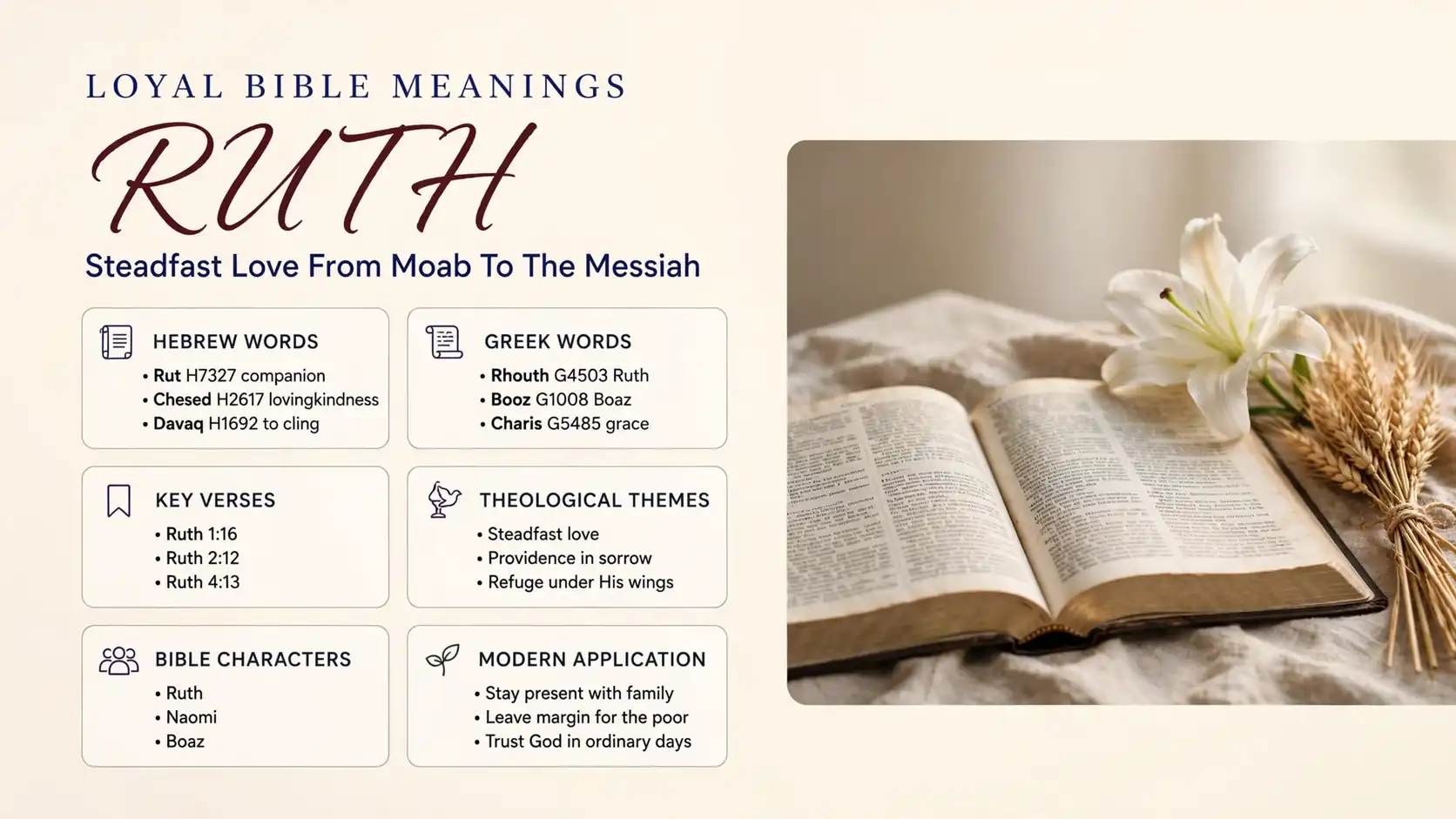
When you ask what does ruth mean in the bible, you meet a Moabite widow whose name became a picture of loyal love. Her story fills only four chapters, yet it carries you from a famine road in Moab to the royal line of David and the family tree of Jesus.
Ruth means companion or friend, and her life proves the name true in every scene. She clings to Naomi, gleans in the fields of Boaz, and trusts the God of Israel when her future looks empty. This study follows her name, her words, and her Redeemer through Scripture.
Key Scripture References About Ruth
| Verse | Passage Snippet | Context |
|---|---|---|
| Ruth 1:16 | Where you go I will go | Ruth pledges herself to Naomi and her God |
| Ruth 1:17 | Where you lodge I will lodge | Ruth seals her vow with an oath |
| Ruth 2:2 | Let me go to the field and glean | Ruth asks leave to gather leftover grain |
| Ruth 2:10 | Why have I found favor in your eyes | Ruth bows before Boaz in wonder |
| Ruth 2:11 | You left your father and your mother | Boaz honors all Ruth did for Naomi |
| Ruth 2:12 | A full reward be given you by the LORD | Boaz blesses Ruth under the wings of God |
| Ruth 3:10 | You have made this last kindness greater | Boaz praises Ruth at the threshing floor |
| Ruth 3:11 | All my fellow townsmen know you are worthy | Boaz names Ruth a woman of excellence |
| Ruth 4:13 | The LORD gave her conception, and she bore a son | Ruth marries Boaz and bears Obed |
Bible Translation Comparison for Ruth Verses
| Verse | KJV | NIV | ESV | NASB |
|---|---|---|---|---|
| Ruth 1:16 | Whither thou goest, I will go | Where you go I will go | Where you go I will go | Where you go, I will go |
| Ruth 1:16 | Thy people shall be my people | Your people will be my people | Your people shall be my people | Your people shall be my people |
| Ruth 1:17 | Where thou diest, will I die | Where you die I will die | Where you die I will die | Where you die, I will die |
| Ruth 2:12 | The LORD recompense thy work | May the LORD repay you | The LORD repay you | May the LORD reward your work |
| Ruth 3:10 | Blessed be thou of the LORD | The LORD bless you, my daughter | May you be blessed by the LORD | May you be blessed of the LORD |
| Ruth 3:11 | Thou art a virtuous woman | A woman of noble character | You are a worthy woman | You are a woman of excellence |
| Ruth 4:14 | Blessed be the LORD | Praise be to the LORD | Blessed be the LORD | Blessed is the LORD |
| Ruth 4:17 | There is a son born to Naomi | He has a son | A son has been born to Naomi | A son has been born to Naomi |
| Matthew 1:5 | Booz begat Obed of Ruth | Boaz was the father of Obed by Ruth | Boaz fathered Obed by Ruth | Boaz was the father of Obed by Ruth |
People and Characters Around Ruth
| Person | Role | Connection |
|---|---|---|
| Ruth | Moabite widow and gleaner | Heroine who clings to Naomi and God |
| Naomi | Widowed mother in law | Ruth follows her back to Bethlehem |
| Boaz | Wealthy landowner of Bethlehem | Kinsman redeemer who marries Ruth |
| Orpah | Sister in law of Ruth | Kisses Naomi and returns to Moab |
| Elimelech | Husband of Naomi | His death in Moab begins the story |
| Mahlon | First husband of Ruth | His early death leaves Ruth a widow |
| Obed | Son of Ruth and Boaz | Child given as restorer of life to Naomi |
| Jesse | Son of Obed | Grandson of Ruth, father of David |
| David | King of Israel | Great grandson of Ruth in the royal line |
Original Hebrew and Greek Words Behind Ruth
| Original Word | Transliteration | Strong’s # | Literal Meaning |
|---|---|---|---|
| רוּת | Rut | H7327 | Companion or friend, the name Ruth |
| רְעוּת | re’ut | H7474 | Friendship or companionship, likely root of Rut |
| חֶסֶד | chesed | H2617 | Lovingkindness or steadfast covenant love |
| גָּאַל | ga’al | H1350 | To redeem or act as kinsman redeemer |
| דָּבַק | davaq | H1692 | To cling, cleave, or hold fast |
| חֵן | chen | H2580 | Favor or grace in the eyes of another |
| לָקַט | laqat | H3950 | To glean or gather what is left |
| Ῥούθ | Rhouth | G4503 | Ruth in Greek form, named in Matthew 1 |
| Βοόζ | Booz | G1008 | Boaz in Greek form, husband of Ruth |
| χάρις | charis | G5485 | Grace or favor, the Greek echo of chen |
Related Biblical Concepts in the Story of Ruth
| Concept | Connection | Supporting Verse |
|---|---|---|
| Chesed loyalty | Ruth shows steadfast love to Naomi and Boaz | Ruth 1:8 |
| Kinsman redemption | Boaz buys back land and marries the widow | Ruth 4:9 |
| Gleaning mercy | Law leaves grain for the poor and sojourner | Leviticus 19:9 |
| Care for widows | God guards widows and Ruth is protected | Psalm 68:5 |
| Welcome of foreigners | A Moabite finds refuge in Israel | Ruth 2:12 |
| Hidden providence | God works through ordinary days and choices | Ruth 2:3 |
| Refuge under wings | Boaz blesses Ruth for trusting God | Ruth 2:12 |
| Restoration of the empty | Naomi returns empty and is filled again | Ruth 1:21 |
| Lineage of David | Obed leads to Jesse and King David | Ruth 4:17 |
Historical and Cultural Context of Ruth
| Aspect | Detail | Biblical Source |
|---|---|---|
| Days of the judges | Story unfolds while judges ruled Israel | Ruth 1:1 |
| Famine in Bethlehem | The house of bread suffers hunger and loss | Ruth 1:1 |
| Widowhood | Widows faced poverty with no male provider | Ruth 1:5 |
| Gleaning custom | Harvesters leave edges and fallen grain behind | Leviticus 19:10 |
| Harvest season | Ruth gleans through barley and wheat harvests | Ruth 2:23 |
| Threshing floor | Boaz winnows barley there at night | Ruth 3:2 |
| City gate court | Elders witness legal redemption at the gate | Ruth 4:1 |
| Sandal custom | A removed sandal seals the transfer of rights | Ruth 4:7 |
Theological Themes in the Book of Ruth
| Theme | Explanation | Scripture |
|---|---|---|
| Steadfast love | Human chesed mirrors the covenant love of God | Ruth 3:10 |
| Providence in sorrow | God guides famine, travel, and a chance field | Ruth 2:3 |
| Redemption by a kinsman | Boaz pays the cost Ruth cannot pay | Ruth 4:10 |
| Grace for the outsider | A foreign widow is gathered into Israel | Ruth 2:10 |
| Faith that clings | Ruth holds fast when return looks easier | Ruth 1:14 |
| Refuge under His wings | God shelters those who trust in Him | Ruth 2:12 |
| Fruitfulness after loss | A grave in Moab gives way to a cradle | Ruth 4:13 |
| Blessing through a child | Obed becomes a restorer of life | Ruth 4:15 |
| Road to the Messiah | The story ends pointing toward David and Christ | Matthew 1:5 |
Modern Application for Believers from Ruth
| Area | Practice | Scripture |
|---|---|---|
| Loyalty in family | Stay present with aging parents and in laws | Ruth 1:16 |
| Grief and loss | Bring honest sorrow to God like Naomi | Ruth 1:20 |
| Daily work | Work diligently where God has placed you | Ruth 2:7 |
| Generosity | Leave margin in your resources for the poor | Leviticus 19:9 |
| Welcoming outsiders | Honor believers who arrive from far away | Ruth 2:10 |
| Purity and courage | Act with honor when no crowd is watching | Ruth 3:11 |
| Trust in providence | See ordinary days as guided by God | Ruth 2:3 |
| Redemption story | Thank Christ, your greater Kinsman Redeemer | Hebrews 2:11 |
| Family legacy | Pray your faithfulness blesses generations unborn | Ruth 4:11 |
What Does Ruth Mean in the Bible for Loyalty and Belonging
Ruth pledges herself to Naomi with words that still echo at weddings and funerals, yet her vow reaches far beyond sentiment. She leaves her gods, her land, and her chance of remarriage in Moab behind her. Her loyalty is costly and aimed at the God of Israel.
You see belonging built by devotion rather than birth in this story. Ruth arrives in Bethlehem as a foreigner with nothing but a grieving mother in law beside her. By the final chapter the town elders bless her beside Rachel and Leah, the very mothers of Israel.
Davaq and the Clinging Love of Ruth on the Road from Moab
Scripture uses davaq, the clinging word of Genesis 2:24, when Ruth refuses to let Naomi travel home alone. Orpah weeps and turns back with a kiss, while Ruth holds fast through tears and hard reason. Her grip on Naomi becomes her first confession of faith in Israel and its God.
Your faith often begins the same quiet way, in a decision to stay when leaving costs less. Ruth teaches you that clinging love is rarely loud or dramatic at the start. It looks like walking beside one grieving person toward an uncertain town.
Ga’al and Boaz the Kinsman Redeemer of Ruth
At the threshing floor and the city gate, the language of ga’al gives the story its legal and tender heartbeat. Boaz counts the cost, faces the nearer redeemer, and redeems the land of Elimelech in daylight. He also takes Ruth as his wife, covering her shame with honor.
You are meant to feel the gospel pattern warming beneath these ancient customs. A redeemer must be near kin, able to pay, and willing to act for the helpless. Boaz is all three for Ruth, and he quietly prepares your heart for Christ, who is all three for you.
Obed, David, and the Place of Ruth in the Line of Jesus
The women of Bethlehem name the baby Obed, a restorer of life for Naomi in her old age. That child becomes the father of Jesse and grandfather of David the king. A widow from Moab ends up woven into the royal story of Israel.
Matthew 1:5 keeps her name in the genealogy of Jesus, one of a handful of women honored in that list. God delights to carry His promises through people the world overlooks or excludes. Your study of Ruth should end in wonder at a God who wastes no sorrow and no stranger.
Frequently Asked Questions About Ruth
What does the name Ruth mean in Hebrew?
Rut, Strong’s H7327, most likely grows from re’ut, H7474, meaning friendship, so Ruth carries the sense of a faithful companion.
Why did Ruth cling to Naomi instead of returning to Moab?
Ruth clung with davaq, H1692, the holding fast of covenant love, because she had chosen Naomi, her people, and her God for life.
What does chesed mean in the book of Ruth?
Chesed, H2617, is steadfast lovingkindness, and Naomi says it marks Ruth, Boaz, and the LORD Himself throughout the story.
Who was the kinsman redeemer in the story of Ruth?
Boaz acted as go’el under ga’al, H1350, redeeming the family land at the gate and marrying Ruth to raise up the family name.
How does Ruth point you to Jesus in the New Testament?
Matthew 1:5 names Rhouth, G4503, in the genealogy of Jesus, showing a redeemed Moabite widow standing in the direct line of the Messiah.