
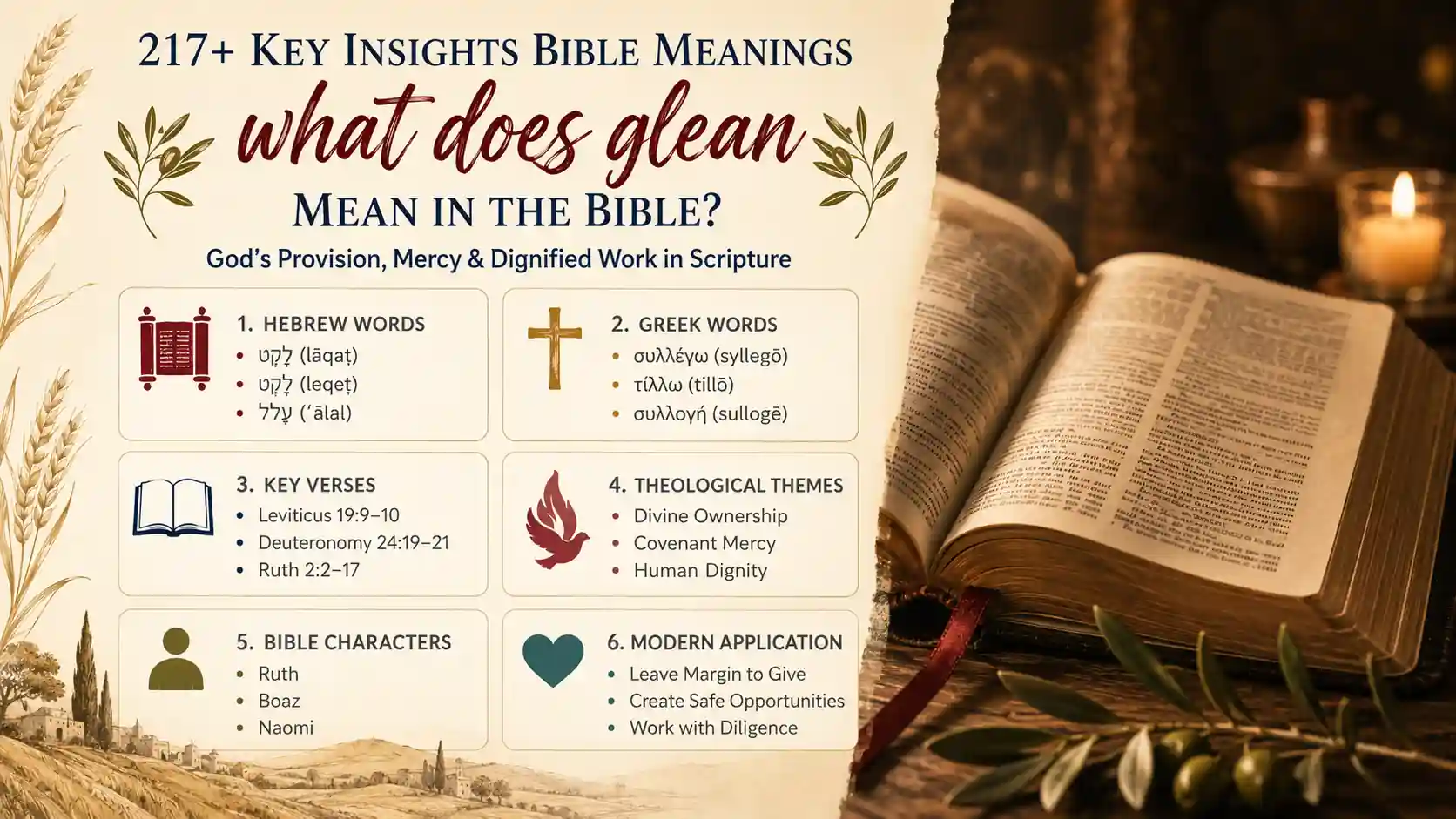
What does glean mean in the Bible? To glean is to gather grain, grapes, olives, or other produce left behind after the main harvest. Under Israel’s law, landowners were commanded not to harvest every corner, retrieve every fallen stalk, or make a second exhaustive pass through their crops.
Gleaning allowed poor people, foreigners, widows, and orphans to obtain food through honorable labor. The practice becomes especially vivid in Ruth, where God’s covenant instruction, Ruth’s diligence, and Boaz’s generosity work together to preserve a vulnerable family.
Glean in Key Scripture References
| Verse | Passage Snippet | Context |
|---|---|---|
| Leviticus 19:9 | Do not reap the corners | Field edges were reserved |
| Leviticus 19:10 | Do not glean your vineyard | Grapes remained for others |
| Leviticus 23:22 | Leave them for the poor | Gleaning repeated in festival law |
| Deuteronomy 24:19 | Do not retrieve a forgotten sheaf | Grain supported vulnerable people |
| Deuteronomy 24:20 | Do not beat olive trees twice | Remaining olives belonged to the needy |
| Deuteronomy 24:21 | Do not glean afterward | Vineyards were not stripped bare |
| Ruth 2:2 | Let me go and glean | Ruth seeks food through work |
| Ruth 2:3 | She gleaned after the reapers | Ruth enters Boaz’s field |
| Ruth 2:15 | Let her glean among the sheaves | Boaz exceeds the minimum law |
| Ruth 2:17 | She gleaned until evening | Ruth gathers an ephah of barley |
The Torah establishes gleaning as a covenant responsibility rather than an occasional charitable impulse. Israelite landowners were forbidden to maximize their harvest at the expense of the poor and foreigner.
Glean in Bible Translation Comparison
| Verse | KJV | NIV | ESV | NASB |
|---|---|---|---|---|
| Leviticus 19:9 | gather the gleanings | gather the gleanings | gather the gleanings | gather the gleaning |
| Leviticus 19:10 | glean thy vineyard | go over your vineyard | strip your vineyard bare | glean your vineyard |
| Leviticus 23:22 | gather any gleaning | gather the gleanings | gather the gleanings | gather the gleaning |
| Deuteronomy 24:19 | fetch it again | go back to get it | go back to get it | go back to get it |
| Deuteronomy 24:20 | go over the boughs again | go over branches a second time | go over them again | go over boughs again |
| Deuteronomy 24:21 | glean afterward | go over vines again | strip it afterward | glean it afterward |
| Ruth 2:2 | glean ears of corn | pick up leftover grain | glean among the ears | glean among the ears |
| Ruth 2:7 | glean and gather | glean and gather | glean and gather | glean and gather |
| Ruth 2:15 | glean among the sheaves | gather among the sheaves | glean even among the sheaves | glean even among the sheaves |
| Ruth 2:17 | gleaned in the field | gleaned in the field | gleaned in the field | gleaned in the field |
Older English uses “corn” broadly for cereal grain, not specifically modern American corn. In Ruth 2, the crop is barley, and the scene occurs during the barley harvest near Bethlehem.
People and Characters Associated with Glean
| Person | Role | Connection |
|---|---|---|
| Moses | Covenant mediator | Delivered Israel’s gleaning laws |
| Ruth | Moabite widow | Gleaned barley for food |
| Naomi | Israelite widow | Received Ruth’s gathered grain |
| Boaz | Bethlehem landowner | Protected and supplied Ruth |
| Boaz’s overseer | Harvest supervisor | Reported Ruth’s diligent work |
| Boaz’s reapers | Field workers | Harvested ahead of Ruth |
| Elimelech | Naomi’s husband | His family connection leads to Boaz |
| Mahlon | Ruth’s deceased husband | His death left Ruth vulnerable |
| Obed | Son of Ruth and Boaz | Result of the family’s restoration |
| David | Israel’s king | Descendant of Ruth and Boaz |
Ruth is central because she qualifies under several protected categories. She is poor, widowed, and a foreigner. Her work in Boaz’s field shows how Israel’s law was intended to function in an actual community rather than remain an abstract ideal.
Original Hebrew and Greek Words for Glean
| Original Word | Transliteration | Strong’s # | Literal Meaning |
|---|---|---|---|
| לָקַט | lāqaṭ | H3950 | Pick up or gather |
| לֶקֶט | leqeṭ | H3951 | Gleaning or gathered remains |
| עָלַל | ʿālal | H5953 | Glean thoroughly |
| פֶּרֶט | pereṭ | H6528 | Fallen grapes |
| עֹלֵלָה | ʿōlēlāh | H5955 | Gleaning grapes |
| שִׁכְחָה | shikhḥāh | H7911 related | What was forgotten |
| קָצִיר | qāṣîr | H7105 | Harvest or reaping |
| שִׁבֹּלֶת | shibbōleth | H7641 | Ear or head of grain |
| συλλέγω | syllegō | G4816 | Gather or collect |
| τίλλω | tillō | G5089 | Pluck or pull off |
The principal Hebrew verb is לָקַט, lāqaṭ, meaning to pick up or gather scattered items. Its related noun לֶקֶט, leqeṭ, refers specifically to gleanings. The vineyard law also uses עָלַל, ʿālal, for making a thorough pass over vines.
The New Testament does not reproduce Israel’s gleaning legislation as a church ordinance. However, συλλέγω, syllegō, expresses the broader action of gathering, while τίλλω, tillō, describes plucking grain in Gospel scenes. The Septuagint frequently uses συλλέγω to translate gathering language related to לָקַט.
Related Biblical Concepts Connected with Glean
| Concept | Connection | Supporting Verse |
|---|---|---|
| Holiness | Harvest ethics reflect God’s character | Leviticus 19:2, 9 |
| Love of neighbor | Profit is limited for another’s good | Leviticus 19:18 |
| Care for foreigners | Outsiders receive covenant protection | Leviticus 19:10 |
| Care for widows | Widows may gather forgotten produce | Deuteronomy 24:19 |
| Care for orphans | Fatherless people share the harvest | Deuteronomy 24:21 |
| Sabbath mercy | Productivity remains under God’s rule | Exodus 23:10-11 |
| Remembrance | Israel recalls slavery in Egypt | Deuteronomy 24:22 |
| Diligent work | Ruth actively gathers food | Ruth 2:7 |
| Generosity | Boaz orders extra grain dropped | Ruth 2:16 |
| Providence | Ruth reaches Boaz’s field | Ruth 2:3 |
Gleaning joins personal responsibility with communal mercy. The landowner leaves genuine opportunity, while the gleaner works to gather what has been left. Scripture therefore avoids presenting compassion as either cold self-reliance or passive dependency.
Historical and Cultural Context of Glean
| Aspect | Detail | Biblical Source |
|---|---|---|
| Field edges | Corners were not fully cut | Leviticus 19:9 |
| Fallen stalks | Dropped grain was not retrieved | Leviticus 19:9 |
| Forgotten sheaves | Owners could not return for them | Deuteronomy 24:19 |
| Olive harvest | Trees received only one main beating | Deuteronomy 24:20 |
| Vineyard harvest | Fallen grapes remained available | Leviticus 19:10 |
| Protected groups | Poor and foreigners could glean | Leviticus 23:22 |
| Expanded protection | Widows and orphans were included | Deuteronomy 24:19 |
| Harvest sequence | Gleaners followed reapers | Ruth 2:3 |
| Field danger | Workers could threaten vulnerable women | Ruth 2:9, 22 |
| Threshing | Ruth beat out gathered barley | Ruth 2:17 |
Gleaning was physically demanding. A gleaner followed harvesting crews, stooped to collect scattered stalks, carried the grain, and separated edible kernels from the stalks. Ruth worked from morning until evening, then threshed what she had gathered.
The arrangement also exposed vulnerable people to danger. Boaz commanded his men not to touch or rebuke Ruth and invited her to remain near his female workers. His protection was not decorative kindness. It made lawful access to the field practically safe.
Theological Themes Revealed Through Glean
| Theme | Explanation | Scripture |
|---|---|---|
| Divine ownership | The harvest ultimately belongs to God | Leviticus 19:10 |
| Covenant obedience | Land use was governed by God’s word | Leviticus 23:22 |
| Human dignity | The needy gathered through meaningful labor | Ruth 2:2 |
| Costly generosity | Owners surrendered potential profit | Leviticus 19:9 |
| Impartial mercy | Foreigners shared Israel’s provision | Leviticus 19:10 |
| Providence | Ordinary choices serve God’s purposes | Ruth 2:3 |
| Refuge under God | Ruth trusts Israel’s God | Ruth 2:12 |
| Loyal love | Boaz honors Ruth’s devotion | Ruth 2:11 |
| Redemption | Gleaning begins a family restoration | Ruth 4:9-10 |
| Messianic history | Ruth enters David’s royal line | Ruth 4:17, 22 |
The repeated declaration “I am the LORD your God” roots agricultural mercy in divine authority. Israel was not free to treat every available stalk as private gain. God’s ownership of the land required his people to make room for their neighbors.
Modern Application of Glean for Believers
| Area | Practice | Scripture |
|---|---|---|
| Personal finances | Leave margin for generosity | Proverbs 11:24-25 |
| Business | Refuse profit without compassion | James 5:4 |
| Employment | Create dignified opportunities | Ephesians 4:28 |
| Hospitality | Welcome people without status | Romans 12:13 |
| Food stewardship | Redirect usable surplus | John 6:12 |
| Church care | Support vulnerable households | James 1:27 |
| Treatment of immigrants | Show impartial neighbor love | Leviticus 19:34 |
| Workplace safety | Protect vulnerable workers | Ruth 2:9 |
| Daily labor | Work faithfully like Ruth | Ruth 2:17 |
| Generosity | Give beyond bare obligation | Ruth 2:15-16 |
Modern believers are not ancient Israelite farmers living under the Mosaic land laws. Yet the moral vision remains instructive. Your possessions, business practices, time, influence, and opportunities should reflect God’s concern for people who lack security.
You can practice a gleaning-shaped generosity by building margin into your life. Instead of consuming every dollar, hour, or advantage for yourself, you intentionally leave resources available to serve others. Such generosity should preserve dignity rather than turn needy people into objects of display.
לָקַט And the Basic Meaning of Glean in the Bible
The Hebrew verb לָקַט, lāqaṭ, pictures someone picking up scattered things one by one. It can describe gathering manna in the wilderness, collecting straw, or gathering grain after reapers. The word emphasizes repeated, careful collection rather than receiving a completed bundle.
In Ruth 2, that meaning helps you picture Ruth’s labor accurately. She did not arrive to receive a prepared donation. She moved behind the harvesters, searched for remaining stalks, gathered them, carried them home, and shared the resulting grain with Naomi.
What Does Glean Mean in the Bible’S Covenant Law?
Within the Mosaic covenant, gleaning was part of Israel’s holy way of life. Leviticus places the command near instructions about worship, justice, wages, truthfulness, and love for one’s neighbor. God did not separate religious devotion from economic conduct.
Deuteronomy connects the law with Israel’s memory of bondage in Egypt. Because the Israelites had experienced vulnerability and divine rescue, they were to treat foreigners, widows, and orphans with mercy. Remembered grace was meant to produce generous obedience.
Ruth’S Barley Gleaning and the Providence of God
Ruth 2 says that Ruth “happened” to reach the field belonging to Boaz. From her perspective, the location may have appeared accidental. Within the story, however, the reader sees quiet providence directing an ordinary workday toward protection, kinship, marriage, and redemption.
Boaz obeys the law but does not hide behind its minimum requirements. He welcomes Ruth, gives her water and food, protects her from harassment, permits access among the sheaves, and commands workers to pull out extra stalks. Covenant faithfulness blossoms into abundant kindness.
Gleaning, Grace, and the Dignity of Work
Gleaning illustrates grace without erasing human agency. Ruth receives an opportunity she could not create alone, yet she responds with humility, courage, and sustained labor. Boaz does not use generosity to control her. He makes productive work possible and ensures that she is safe.
This pattern can guide your care for others. Biblical compassion asks more than whether something was given. It also asks whether the recipient was honored, protected, welcomed, and treated as a responsible neighbor made in God’s image.
Questions About What Glean Means in the Bible
Is לָקַט, lāqaṭ, always an agricultural word?
No. It broadly means to pick up or gather, though many important occurrences concern food and harvest.
Why does Leviticus prohibit landowners from gleaning their own vineyards?
The final produce was intentionally reserved for poor people and foreigners rather than harvested for the owner.
Does συλλέγω, syllegō, establish a New Testament law of gleaning?
No. It means to gather or collect, but the New Testament does not restate the Mosaic gleaning system as church law.
Did Ruth have a legal right to glean, or did she depend entirely on Boaz’s favor?
The Torah protected poor foreigners, but Boaz’s favor gave Ruth safety and access beyond the law’s minimum requirements.
How can you practice the principle of gleaning without owning a field?
Leave intentional margin in your money, work, food, time, and influence so vulnerable people receive dignified help.