
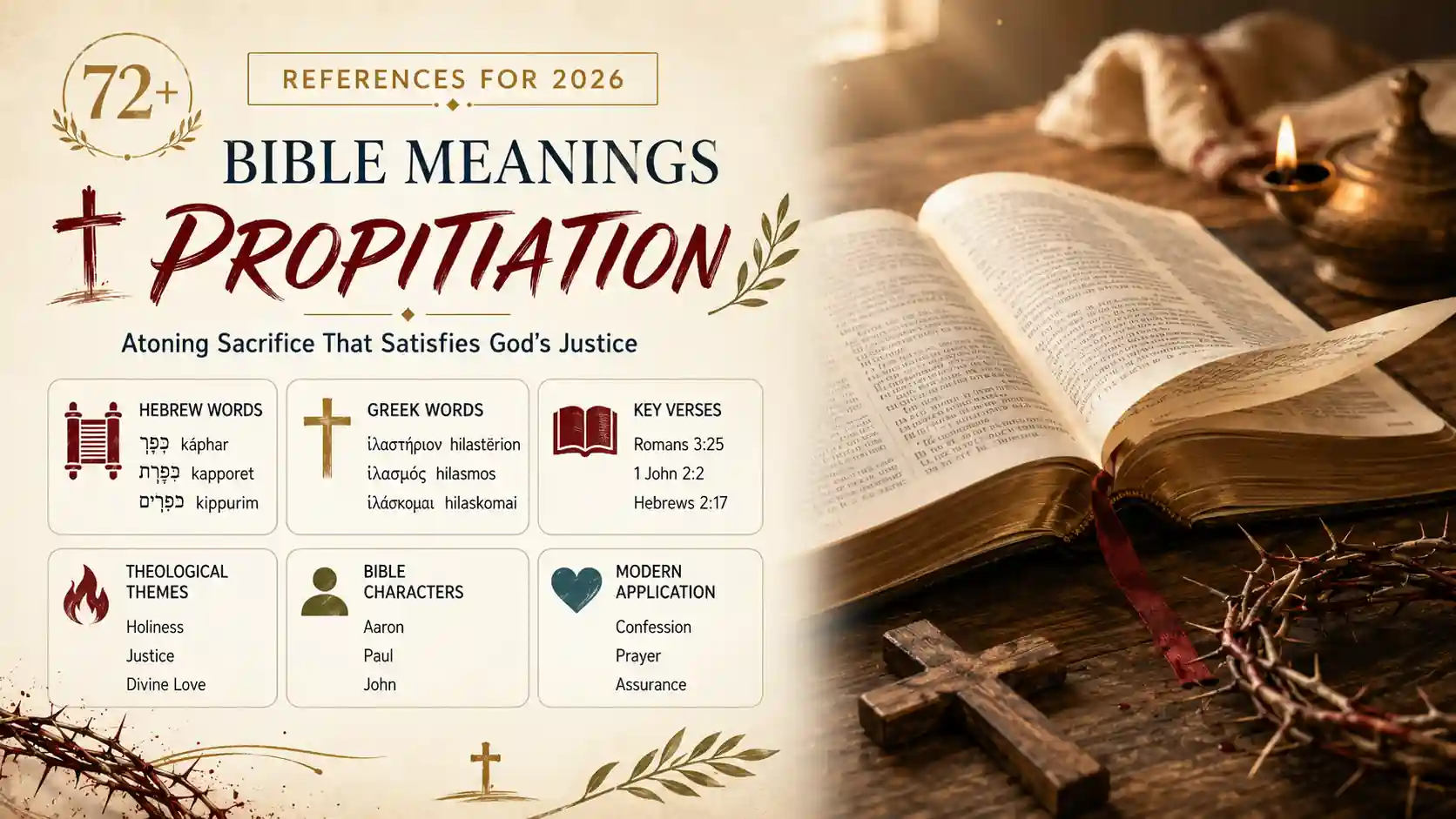
What does propitiation mean in the Bible? In your study, it means God’s holy wrath against sin is truly addressed through the sacrifice God himself provides. Propitiation is not sinners calming a reluctant God. It is the loving God satisfying his own justice so mercy can be given righteously.
The word gathers together altar, blood, covenant, priesthood, mercy seat, and Christ’s cross. It teaches you that forgiveness is not sentimental. It is costly, holy, and secure because God has acted first.
Propitiation Key Scripture References
| Verse | Passage Snippet | Context |
|---|---|---|
| Romans 3:25 | “propitiation through faith in his blood” | Christ publicly displayed |
| 1 John 2:2 | “propitiation for our sins” | Advocate with the Father |
| 1 John 4:10 | “sent his Son…propitiation” | Love defined by sacrifice |
| Hebrews 2:17 | “make propitiation” | Merciful high priest |
| Leviticus 16:15 | Blood before the mercy seat | Day of Atonement |
| Leviticus 17:11 | Blood makes atonement | Life given on altar |
| Exodus 25:22 | God meets above mercy seat | Covenant presence |
| Psalm 78:38 | God atoned and restrained wrath | Mercy toward Israel |
| Isaiah 53:10 | His soul made guilt offering | Servant bears sin |
Propitiation Bible Translation Comparison
| Verse | KJV | NIV | ESV | NASB |
|---|---|---|---|---|
| Romans 3:25 | propitiation | sacrifice of atonement | propitiation | propitiation |
| 1 John 2:2 | propitiation | atoning sacrifice | propitiation | propitiation |
| 1 John 4:10 | propitiation | atoning sacrifice | propitiation | propitiation |
| Hebrews 2:17 | reconciliation | atonement | propitiation | propitiation |
| Leviticus 16:16 | atonement | atonement | atonement | atonement |
| Leviticus 17:11 | atonement | atonement | atonement | atonement |
| Exodus 25:17 | mercy seat | atonement cover | mercy seat | mercy seat |
| Psalm 65:3 | purged away | forgive | atone for | atone for |
| Daniel 9:24 | reconciliation | atone for | atone for | make atonement |
Propitiation People & Characters Associated
| Person | Role | Connection |
|---|---|---|
| Aaron | High priest | Entered with blood |
| Moses | Covenant mediator | Received mercy seat pattern |
| Israel | Covenant people | Needed yearly atonement |
| David | Repentant king | Trusted cleansing mercy |
| Isaiah’s Servant | Suffering substitute | Guilt offering for many |
| John the Baptist | Forerunner | Called Jesus Lamb of God |
| Paul | Apostle | Explained Romans 3:25 |
| John | Apostle | Linked propitiation and love |
| Jesus Christ | Son and High Priest | Final propitiation |
Propitiation Original Hebrew & Greek Words
| Original Word | Transliteration | Strong’s # | Literal Meaning |
|---|---|---|---|
| כָּפַר | kāphar | H3722 | cover, make atonement |
| כִּפֻּרִים | kippurim | H3725 | atonements |
| כַּפֹּרֶת | kappōret | H3727 | mercy seat, cover |
| כֹּפֶר | kōpher | H3724 | ransom, covering price |
| חַטָּאת | ḥaṭṭā’t | H2403 | sin offering |
| אָשָׁם | ’āshām | H817 | guilt offering |
| ἱλαστήριον | hilastērion | G2435 | mercy seat, propitiatory place |
| ἱλασμός | hilasmos | G2434 | propitiation, atoning sacrifice |
| ἱλάσκομαι | hilaskomai | G2433 | make propitiation |
Propitiation Related Biblical Concepts
| Concept | Connection | Supporting Verse |
|---|---|---|
| Atonement | Sin covered before God | Leviticus 16:30 |
| Wrath | Holy anger answered | Romans 1:18 |
| Blood | Life offered for life | Leviticus 17:11 |
| Mercy seat | Place of covering | Exodus 25:22 |
| Sacrifice | Substitute given | Isaiah 53:10 |
| Priesthood | Mediator presents blood | Hebrews 2:17 |
| Covenant | Relationship restored | Exodus 24:8 |
| Forgiveness | Guilt removed | Psalm 32:1 |
| Reconciliation | Peace with God | Romans 5:10 |
Propitiation Historical & Cultural Context
| Aspect | Detail | Biblical Source |
|---|---|---|
| Tabernacle | God dwelt among Israel | Exodus 25:8 |
| Ark | Covenant tablets beneath cover | Exodus 25:16 |
| Mercy seat | Sprinkled with blood | Leviticus 16:14 |
| Day of Atonement | Annual cleansing rite | Leviticus 16:29 |
| Scapegoat | Sin carried away | Leviticus 16:21 |
| Holy of Holies | Entered once yearly | Hebrews 9:7 |
| Temple worship | Sacrifices continued | 2 Chronicles 29:24 |
| Exile hope | Sin would be ended | Daniel 9:24 |
| Cross | Once for all sacrifice | Hebrews 10:10 |
Propitiation Theological Themes
| Theme | Explanation | Scripture |
|---|---|---|
| God’s holiness | Sin cannot be ignored | Isaiah 6:3 |
| Divine love | God provides the Son | 1 John 4:10 |
| Justice | God remains righteous | Romans 3:26 |
| Substitution | One bears guilt for others | Isaiah 53:6 |
| Priesthood of Christ | Jesus represents his people | Hebrews 2:17 |
| Once for all | No repeated final offering | Hebrews 10:10 |
| Faith | Received, not earned | Romans 3:25 |
| Mercy | Judgment is satisfied | Hebrews 4:16 |
| Assurance | Advocacy rests on sacrifice | 1 John 2:1 |
Propitiation Modern Application for Believers
| Area | Practice | Scripture |
|---|---|---|
| Confession | Bring sin into the light | 1 John 1:9 |
| Worship | Praise the Lamb | Revelation 5:9 |
| Assurance | Rest in Christ’s advocacy | 1 John 2:1 |
| Prayer | Approach with confidence | Hebrews 4:16 |
| Repentance | Turn from cheap grace | Romans 6:1 |
| Communion | Remember shed blood | 1 Corinthians 11:25 |
| Evangelism | Proclaim God’s provision | Romans 3:25 |
| Forgiveness | Forgive as forgiven | Ephesians 4:32 |
| Holiness | Live bought by blood | 1 Peter 1:18 |
Ἱλαστήριον And the Mercy Seat Behind What Does Propitiation Mean in the Bible
Romans 3:25 is the central New Testament text for your study because Paul calls Christ ἱλαστήριον, hilastērion. The word points back to the mercy seat, the gold cover of the ark where sacrificial blood was sprinkled on the Day of Atonement.
That connection matters. Paul is not using an abstract religious term. He is saying that Jesus himself is the true meeting place between the holy God and guilty sinners. In Christ, the altar, priest, blood, and mercy seat come together.
כָּפַר And the Levitical World of Covering, Blood, and Cleansing
The Hebrew root כָּפַר, kāphar, often translated “make atonement,” carries the idea of covering sin before God. In Leviticus, the priest did not merely teach forgiveness. He enacted it through sacrifice, blood, and God’s appointed ritual.
Leviticus 17:11 explains why blood stands at the center. The life of the flesh is in the blood, and God gave it on the altar to make atonement. Propitiation is therefore not human payment to manipulate God. It is God’s gracious provision for guilty people.
The Cross as God’S Public Answer to Wrath and Mercy
Romans 3:21 to 26 holds together truths that people often separate. God is just, sin is real, wrath is deserved, and yet sinners are justified by grace through redemption in Christ Jesus. Propitiation protects every part of that gospel.
You do not have to imagine God choosing between holiness and love. At the cross, his holiness is honored and his love is revealed. The Father sends the Son, and the Son willingly gives himself, so mercy reaches you without denying justice.
Ἱλασμός In First John and the Comfort of Christ’S Advocacy
John uses ἱλασμός, hilasmos, when he tells believers that Jesus is the propitiation for our sins. The setting is pastoral. Christians still confess sin, grieve over failure, and need assurance that their standing with God is secure.
That assurance rests on Jesus Christ the righteous, your Advocate with the Father. His plea is not your religious performance. His plea is his finished sacrifice. Propitiation gives tender comfort because your forgiveness rests on Christ, not on the strength of your feelings.
Propitiation Questions Bible Students Often Ask
Does ἱλαστήριον in Romans 3:25 mean mercy seat or propitiation?
It carries both ideas, since Christ is the true mercy seat and the sacrifice that satisfies God’s justice.
Why do some translations avoid the word propitiation?
They often choose “atoning sacrifice” to make the idea clearer, though “propitiation” more directly names wrath being addressed.
Is כָּפַר mainly about covering sin or removing sin?
In Leviticus it emphasizes covering through atonement, while the wider canon shows God also cleansing and removing guilt.
How can 1 John 4:10 say propitiation proves God’s love?
Because God did not wait for sinners to appease him. He sent his Son as the sacrifice love itself provided.
Does propitiation mean the Father was angry and the Son was loving?
No. Scripture presents one united divine purpose, with the Father sending and the Son willingly offering himself.