
When you ask, “what does deity mean in the Bible,” you are asking how Scripture speaks about the true God, false gods, divine nature, and the fullness of God revealed in Jesus Christ. The Bible does not treat deity as a vague spiritual quality. It speaks of the living God who creates, rules, judges, saves, covenants, and makes Himself known.
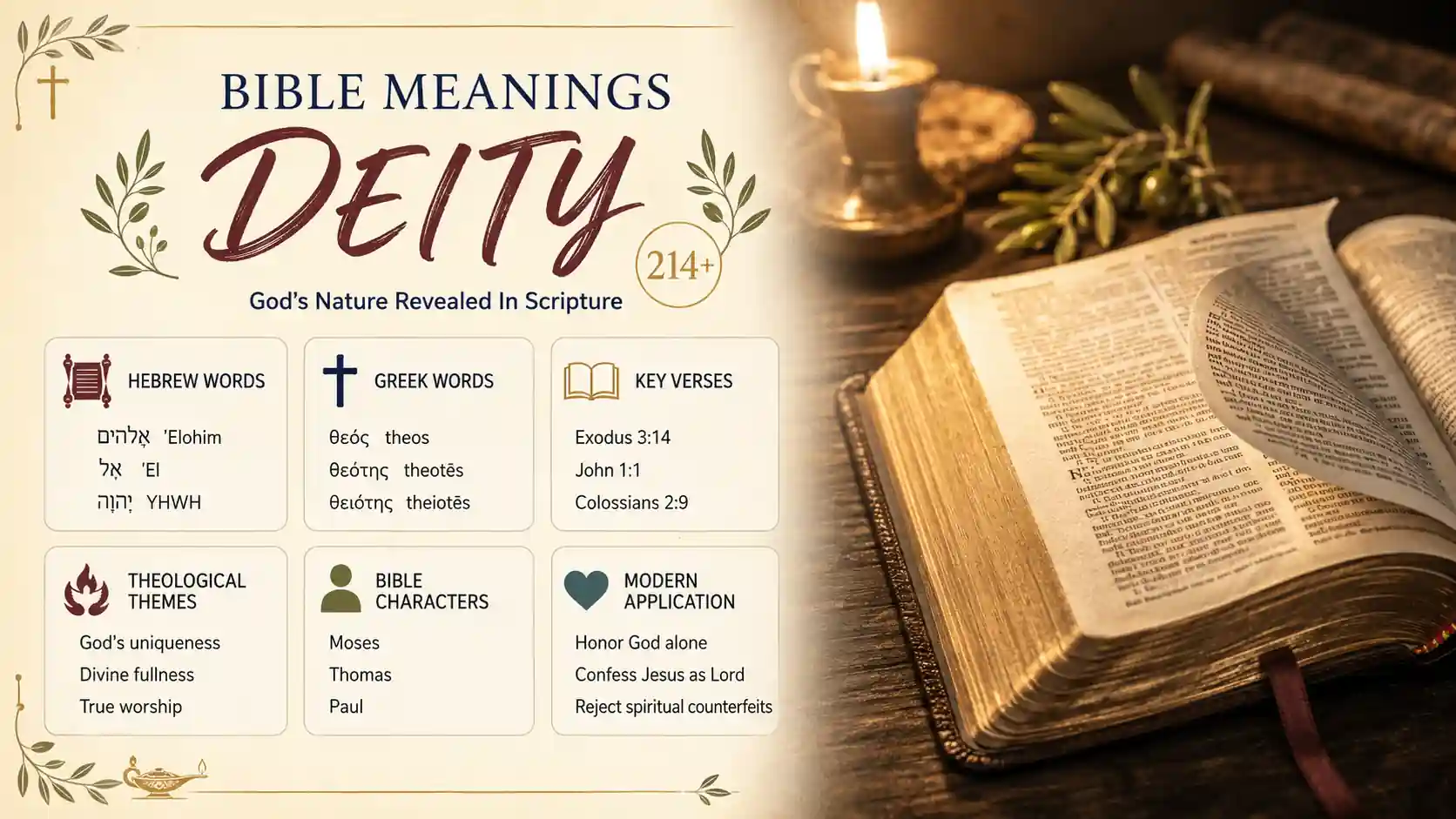
Your study should notice both Testaments. Hebrew terms like אֱלֹהִים, ʾElohim, and Greek terms like θεότης, theotēs, help you see the biblical depth behind the English word.
Deity Key Scripture References
| Verse | Passage Snippet | Context |
|---|---|---|
| Genesis 1:1 | God created | אֱלֹהִים opens creation |
| Exodus 3:14 | I AM WHO I AM | Yahweh reveals His name |
| Deuteronomy 6:4 | The LORD is one | Israel’s central confession |
| Psalm 82:1 | God among the gods | Divine judgment scene |
| Isaiah 43:10 | Before Me no god | Exclusive deity of Yahweh |
| John 1:1 | Word was God | Deity of the Logos |
| John 20:28 | My Lord and my God | Thomas confesses Christ |
| Romans 1:20 | Divine nature seen | Creation witnesses to God |
| Colossians 2:9 | Fullness of Deity bodily | Christ’s incarnate fullness |
| Hebrews 1:3 | Exact imprint | Son reveals God’s nature |
Deity Bible Translation Comparison
| Verse | KJV | NIV | ESV | NASB |
|---|---|---|---|---|
| Colossians 2:9 | Godhead | Deity | deity | Deity |
| Romans 1:20 | Godhead | divine nature | divine nature | divine nature |
| Acts 17:29 | Godhead | divine being | divine being | Divine Nature |
| John 1:1 | Word was God | Word was God | Word was God | Word was God |
| John 20:28 | my God | my God | my God | my God |
| Hebrews 1:3 | express image | exact representation | exact imprint | exact representation |
| Deuteronomy 6:4 | one LORD | one | one | one |
| Isaiah 9:6 | mighty God | Mighty God | Mighty God | Mighty God |
| Titus 2:13 | great God | great God | great God | great God |
Deity People & Characters Associated
| Person | Role | Connection |
|---|---|---|
| Moses | Prophet | Receives Yahweh’s name |
| Pharaoh | Rival ruler | Confronted by Yahweh’s power |
| Israel | Covenant people | Called to worship one God |
| Isaiah | Prophet | Proclaims no other god |
| Nebuchadnezzar | King | Humbled before Most High |
| Jesus Christ | Son of God | Fullness of deity bodily |
| Thomas | Apostle | Confesses Jesus as God |
| Paul | Apostle | Uses θεότης in Colossians |
| John | Evangelist | Calls the Word God |
| Angels | Servants | Not objects of worship |
Deity Original Hebrew & Greek Words
| Original Word | Transliteration | Strong’s # | Literal Meaning |
|---|---|---|---|
| אֱלֹהִים | ʾElohim | H430 | God, gods, mighty ones |
| אֵל | ʾEl | H410 | God, mighty one |
| אֱלוֹהַּ | ʾEloah | H433 | God, deity |
| יְהוָה | YHWH | H3068 | LORD, covenant name |
| אֲדֹנָי | ʾAdonai | H136 | Lord, Master |
| עֶלְיוֹן | ʿElyon | H5945 | Most High |
| θεός | theos | G2316 | God, a god |
| θεότης | theotēs | G2320 | Deity, Godhead |
| θειότης | theiotēs | G2305 | Divine nature |
| κύριος | kyrios | G2962 | Lord, master |
Deity Related Biblical Concepts
| Concept | Connection | Supporting Verse |
|---|---|---|
| Creation | God alone creates | Genesis 1:1 |
| Covenant name | Yahweh reveals Himself | Exodus 3:14 |
| Monotheism | One LORD confessed | Deuteronomy 6:4 |
| Idolatry | False gods condemned | Isaiah 44:9 |
| Glory | God shares it with no idol | Isaiah 42:8 |
| Incarnation | Deity dwells bodily | Colossians 2:9 |
| Worship | Due to God alone | Matthew 4:10 |
| Revelation | God made known in Son | John 1:18 |
| Judgment | God rules all beings | Psalm 82:1 |
| Salvation | Yahweh saves His people | Isaiah 43:11 |
Deity Historical & Cultural Context
| Aspect | Detail | Biblical Source |
|---|---|---|
| Ancient Near East | Nations had many gods | Exodus 12:12 |
| Egypt | Yahweh judges idols | Exodus 12:12 |
| Sinai | Covenant worship formed | Exodus 20:2 |
| Canaan | Baal worship challenged | 1 Kings 18:21 |
| Exile | Idols shown powerless | Isaiah 46:1 |
| Second Temple | Jewish monotheism sharpened | Mark 12:29 |
| Roman world | Many deities honored | Acts 17:23 |
| Colossae | False fullness corrected | Colossians 2:8 |
| Ephesus | Artemis cult opposed | Acts 19:27 |
| Early church | Christ worshiped as Lord | Philippians 2:11 |
Deity Theological Themes
| Theme | Explanation | Scripture |
|---|---|---|
| God’s uniqueness | No rival equals Him | Isaiah 45:5 |
| God’s self existence | He is I AM | Exodus 3:14 |
| God’s invisibility | Known by revelation | John 1:18 |
| Divine fullness | Dwells in Christ | Colossians 2:9 |
| Divine nature | Seen in creation | Romans 1:20 |
| True worship | Directed to God | Revelation 22:9 |
| False gods | Lifeless and judged | Psalm 115:4 |
| Sovereignty | God rules heaven | Daniel 4:35 |
| Trinity | Father, Son, Spirit named | Matthew 28:19 |
| Salvation | God alone saves | Jonah 2:9 |
Deity Modern Application for Believers
| Area | Practice | Scripture |
|---|---|---|
| Worship | Honor God alone | Matthew 4:10 |
| Prayer | Address God reverently | Matthew 6:9 |
| Christology | Confess Jesus as Lord | John 20:28 |
| Discernment | Reject spiritual counterfeits | 1 John 4:1 |
| Creation | See God’s witness | Romans 1:20 |
| Humility | Bow before the Most High | Daniel 4:37 |
| Scripture study | Compare words carefully | Colossians 2:9 |
| Ethics | Live before holy God | Leviticus 19:2 |
| Hope | Trust God’s rule | Revelation 21:3 |
| Mission | Proclaim the living God | Acts 14:15 |
θεότης In Colossians Shows What Deity Means in the Bible
The sharpest New Testament word for deity is θεότης, theotēs, in Colossians 2:9. Paul says that all the fullness of deity dwells bodily in Christ. He is not saying Jesus merely reflects God or carries a divine mood. He is saying the whole fullness of what makes God God resides in the incarnate Son.
That matters because Colossians warns against empty philosophy, angelic speculation, and spiritual substitutes. Christ is not one power among many. In your study, deity means the reality of God’s own being, not a lesser holiness borrowed from heaven.
אֱלֹהִים And יְהוָה Reveal the Living God of Israel
The Hebrew Bible often uses אֱלֹהִים, ʾElohim, for God, while יְהוָה, YHWH, is His covenant name. אֱלֹהִים can sometimes refer to gods, mighty beings, or judges, but when used of Israel’s God it points to the Creator who commands all reality. Context decides whether the term refers to the true God or lesser beings.
יְהוָה gives the doctrine of deity a personal covenant center. The God who simply is, the I AM of Exodus 3:14, binds Himself to Abraham’s family and redeems Israel from Egypt. Biblical deity is never abstract power. It is holy, personal, faithful lordship.
Deity and Divine Nature Are Related but Not Identical
Romans 1:20 uses θειότης, theiotēs, often translated “divine nature.” Paul says creation displays God’s eternal power and divine nature, leaving humanity without excuse. This word points to the recognizable quality of Godhood seen through what God has made.
Colossians 2:9 uses θεότης, theotēs, a stronger word for deity or Godhead. Creation reveals that God is real, powerful, and worthy. Christ reveals God personally and bodily. Together, the two passages teach that God is witnessed in creation and fully manifested in the Son.
The Bible’S Deity Language Guards Worship from Idols
The biblical world was crowded with gods, images, temples, and claims of sacred power. Israel’s confession, “The LORD our God, the LORD is one,” taught God’s people to resist the surrounding nations’ idols. Yahweh was not Israel’s tribal option. He was the Maker and Judge of all.
The New Testament carries that same worship into Christ-centered confession. Thomas calls the risen Jesus “my Lord and my God.” Paul calls believers away from idols to the living God. To understand deity in the Bible is to learn whom you must worship, trust, obey, and never replace.
Frequently Asked Questions About Deity in the Bible
Why does Colossians 2:9 use θεότης, theotēs, instead of θειότης, theiotēs?
θεότης points to the fullness of deity itself, while θειότης in Romans 1:20 points to divine nature perceived through creation.
Does אֱלֹהִים, ʾElohim, always mean the one true God?
No, context can refer to God, gods, mighty beings, or judges, but Genesis 1:1 clearly uses it for the Creator.
Why do some translations say “Godhead” and others say “Deity”?
“Godhead” is older English for divine being or deity, while modern translations often use “Deity” for clarity.
Does John 20:28 really teach the deity of Christ?
Yes, Thomas addresses the risen Jesus as “my Lord and my God,” a personal confession of worship.
How should belief in biblical deity shape daily life?
It calls you to worship God alone, trust Christ fully, reject idols, and live before the holy Lord who made and saves you.