
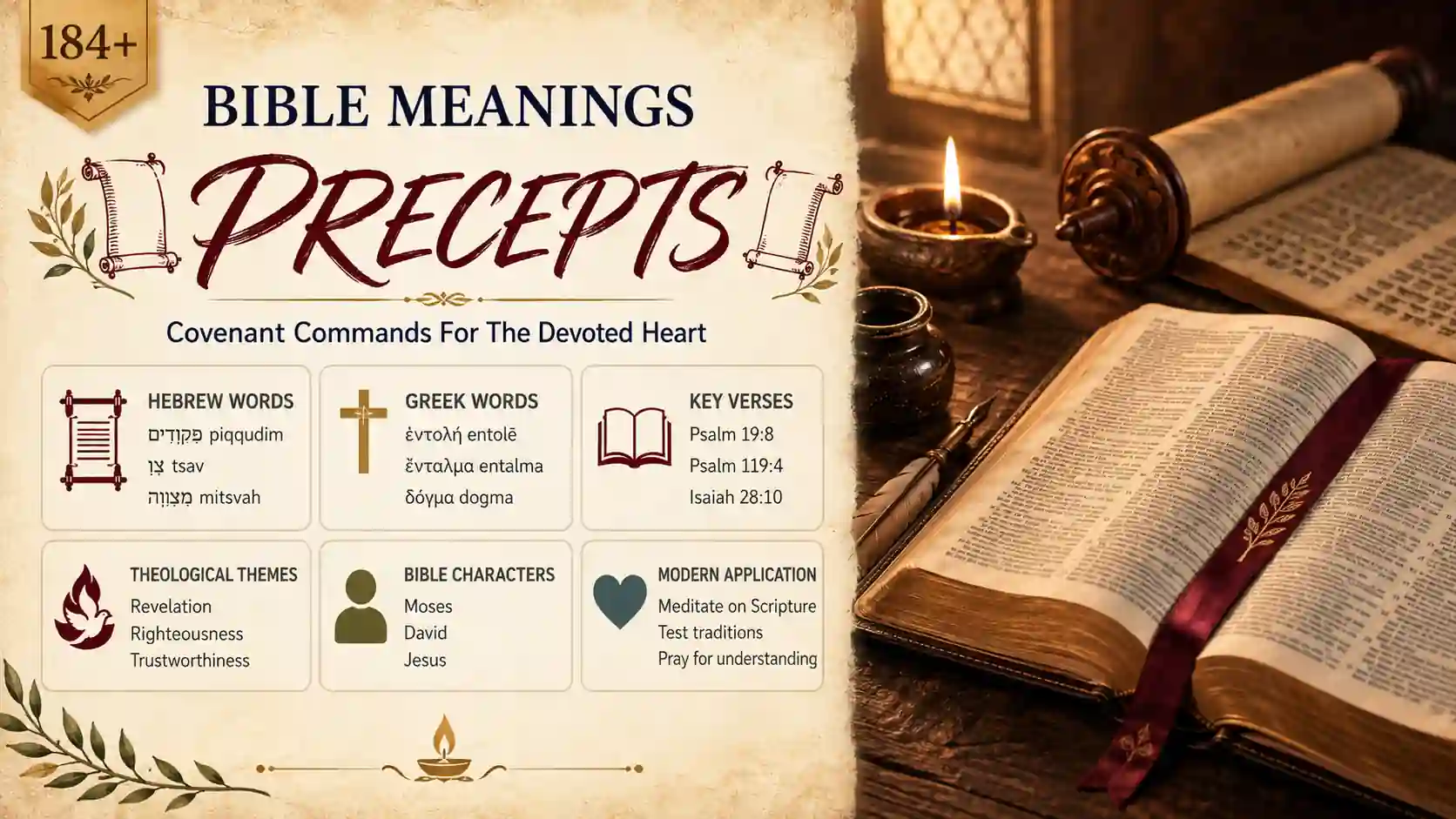
What does precepts mean in the Bible? In Scripture, “precepts” usually means the Lord’s appointed instructions, detailed charges, and authoritative directions for covenant life. The word often appears where God’s people are being taught how to walk wisely, worship rightly, and remain faithful.
In your study, “precepts” is not a cold legal term. It carries the warmth of divine guidance. God’s precepts reveal his holy character, guard the conscience, expose false worship, and train believers to love obedience from the heart.
Key Precepts Scripture References
| Verse | Passage Snippet | Context |
|---|---|---|
| Psalm 19:8 | “precepts of the LORD are right” | God’s law refreshes and enlightens |
| Psalm 103:18 | “remember his commandments” | Covenant mercy and faithful obedience |
| Psalm 111:7 | “all his precepts are trustworthy” | Praise for God’s righteous works |
| Psalm 119:4 | “precepts diligently” | God commands careful obedience |
| Psalm 119:15 | “meditate on your precepts” | Devotional reflection on Torah |
| Psalm 119:27 | “way of your precepts” | Learning leads to testimony |
| Psalm 119:40 | “long for your precepts” | Desire for righteous life |
| Isaiah 28:10 | “precept upon precept” | Warning against dull hearers |
| Matthew 15:9 | “commandments of men” | Jesus rebukes hollow tradition |
Precepts Bible Translation Comparison
| Verse | KJV | NIV | ESV | NASB |
|---|---|---|---|---|
| Psalm 19:8 | “statutes” | “precepts” | “precepts” | “precepts” |
| Psalm 103:18 | “commandments” | “precepts” | “commandments” | “precepts” |
| Psalm 111:7 | “commandments” | “precepts” | “precepts” | “precepts” |
| Psalm 119:4 | “precepts” | “precepts” | “precepts” | “precepts” |
| Psalm 119:15 | “precepts” | “precepts” | “precepts” | “precepts” |
| Psalm 119:27 | “precepts” | “precepts” | “precepts” | “precepts” |
| Isaiah 28:10 | “precept” | “do this, do that” | “precept” | “order” |
| Mark 7:7 | “commandments” | “rules” | “commandments” | “precepts” |
| Colossians 2:22 | “commandments” | “rules” | “precepts” | “commandments” |
People and Characters Associated with Precepts
| Person | Role | Connection |
|---|---|---|
| Moses | Lawgiver | Received covenant instruction at Sinai |
| Joshua | Covenant leader | Charged to meditate on the law |
| David | King and psalmist | Delighted in God’s statutes |
| Psalmist | Worshiping disciple | Loved and studied God’s precepts |
| Ezra | Scribe and teacher | Set his heart to teach Torah |
| Isaiah | Prophet | Exposed mechanical instruction |
| Jesus | Messiah and teacher | Opposed human precepts replacing God |
| Pharisees | Religious leaders | Elevated tradition over commandment |
| Paul | Apostle | Warned against man-made rules |
| Timothy | Young minister | Urged to keep apostolic charge |
Original Hebrew and Greek Words for Precepts
| Original Word | Transliteration | Strong’s # | Literal Meaning |
|---|---|---|---|
| פִּקּוּדִים | piqqudim | H6490 | Appointed instructions |
| פִּקּוּד | piqqud | H6490 | Precept, mandate |
| צַו | tsav | H6673 | Command, order |
| מִצְוָה | mitsvah | H4687 | Commandment |
| חֹק | choq | H2706 | Statute, decree |
| תּוֹרָה | torah | H8451 | Instruction, law |
| דָּבָר | dabar | H1697 | Word, matter |
| ἐντολή | entolē | G1785 | Commandment, charge |
| ἔνταλμα | entalma | G1778 | Command, precept |
| δόγμα | dogma | G1378 | Decree, ordinance |
Related Biblical Concepts Around Precepts
| Concept | Connection | Supporting Verse |
|---|---|---|
| Law | Precepts belong to Torah instruction | Psalm 119:1 |
| Commandments | Often overlaps in meaning | Psalm 119:6 |
| Statutes | Fixed covenant requirements | Psalm 119:8 |
| Testimonies | God’s witness to his will | Psalm 119:14 |
| Wisdom | Precepts make the simple wise | Psalm 19:7 |
| Meditation | Precepts are pondered deeply | Psalm 119:15 |
| Obedience | Precepts call for doing | Psalm 119:4 |
| Covenant | Precepts mark faithful relationship | Psalm 103:18 |
| Holiness | Precepts shape separated living | Leviticus 20:7 |
Historical and Cultural Context of Precepts
| Aspect | Detail | Biblical Source |
|---|---|---|
| Sinai covenant | Israel received ordered instruction | Exodus 20 |
| Wilderness life | Commands shaped daily dependence | Deuteronomy 8 |
| Priestly teaching | Levites taught divine law | Leviticus 10:11 |
| Kingship | Kings copied and read the law | Deuteronomy 17:18 |
| Psalms worship | Precepts became prayer language | Psalm 119 |
| Wisdom formation | Instruction trained the heart | Proverbs 6:23 |
| Prophetic rebuke | Empty rules could mask unbelief | Isaiah 29:13 |
| Second Temple era | Tradition often surrounded Torah | Mark 7:3 |
| Early church | Apostolic commands guarded doctrine | 1 Thessalonians 4:2 |
Theological Themes in Biblical Precepts
| Theme | Explanation | Scripture |
|---|---|---|
| Revelation | God makes his will known | Psalm 19:8 |
| Righteousness | His precepts are morally right | Psalm 119:128 |
| Trustworthiness | They stand firm and true | Psalm 111:7 |
| Covenant love | Obedience flows from loyal love | Psalm 103:18 |
| Joy | The heart delights in instruction | Psalm 119:16 |
| Discernment | Precepts expose false ways | Psalm 119:104 |
| Worship | True worship submits to God | Matthew 15:9 |
| Freedom | God’s way guards life | Psalm 119:45 |
| Christ’s authority | Jesus judges human traditions | Mark 7:8 |
Modern Application for Believers and Precepts
| Area | Practice | Scripture |
|---|---|---|
| Bible study | Trace words in context | Psalm 119:27 |
| Prayer | Ask for understanding | Psalm 119:34 |
| Worship | Reject empty formalism | Matthew 15:8 |
| Decisions | Let Scripture guide conscience | Psalm 119:105 |
| Discipleship | Teach obedience with humility | Matthew 28:20 |
| Family life | Speak God’s words often | Deuteronomy 6:7 |
| Church life | Test traditions by Scripture | Mark 7:9 |
| Holiness | Turn from false ways | Psalm 119:104 |
| Perseverance | Keep God’s way under pressure | Psalm 119:87 |
פִּקּוּדִים Piqqudim and the Devotional Heart of Psalm 119
The most important Hebrew word behind “precepts” is פִּקּוּדִים, piqqudim. It comes from a root idea of appointing, overseeing, or giving charge. In Psalm 119, it describes God’s careful instructions for the life of faith, not random religious advice.
This is why the psalmist can meditate on precepts, love them, long for them, and seek understanding through them. God’s precepts are personal because they come from the covenant Lord. They train your mind, but they also shepherd your affections.
What Does Precepts Mean in the Bible When Jesus Rebukes Tradition?
When Jesus quotes Isaiah against the scribes and Pharisees, the issue is not sincere obedience to Scripture. The issue is replacing God’s commandment with human religious systems. In Matthew 15 and Mark 7, ἔνταλμα, entalma, points to man-made commands treated as if they carried divine authority.
This is a serious warning for your study. Biblical precepts are life-giving because God speaks them. Human precepts become dangerous when they obscure Scripture, burden consciences, or permit disobedience while appearing devout.
Precept upon Precept in Isaiah’S Prophetic Warning
Isaiah 28 is often quoted as though “precept upon precept” simply means patient Bible teaching. Careful study shows a sharper setting. The prophet is confronting leaders in Ephraim and Judah who mock God’s message as childish repetition.
The phrase captures both the simplicity of God’s instruction and the hardness of those who refuse it. God’s word may sound repetitive to proud ears, yet faithful hearers receive even repeated instruction as mercy. The same precepts can humble one person and harden another.
Law, Grace, and the Trustworthiness of God’S Precepts
Psalm 111 says God’s precepts are trustworthy, established forever and ever. That does not mean believers are saved by rule keeping. It means God’s revealed will reflects his unchanging righteousness, wisdom, and covenant faithfulness.
For the Christian, precepts are read through Christ, who fulfilled the Law and taught his disciples to obey all that he commanded. Grace does not make God’s instruction irrelevant. Grace changes the heart so obedience becomes grateful worship rather than self-salvation.
Frequently Asked Questions About Biblical Precepts
Is פִּקּוּדִים, piqqudim, the main Hebrew word for precepts?
Yes, especially in Psalm 119, where it means God’s appointed instructions for faithful covenant living.
Why does Isaiah 28 say “precept upon precept”?
It appears in a prophetic rebuke where resistant hearers treat God’s instruction as childish repetition.
Why do some translations use “commandments” instead of “precepts”?
The Hebrew and Greek terms overlap, so translators choose words like commandments, statutes, rules, or precepts by context.
Are Jesus’ warnings about ἔνταλμα, entalma, against all tradition?
No, Jesus rebukes traditions that replace, weaken, or contradict the commandment of God.
How should I apply biblical precepts without becoming legalistic?
Receive them through faith in Christ, obeying God’s word as grateful worship rather than a way to earn salvation.