
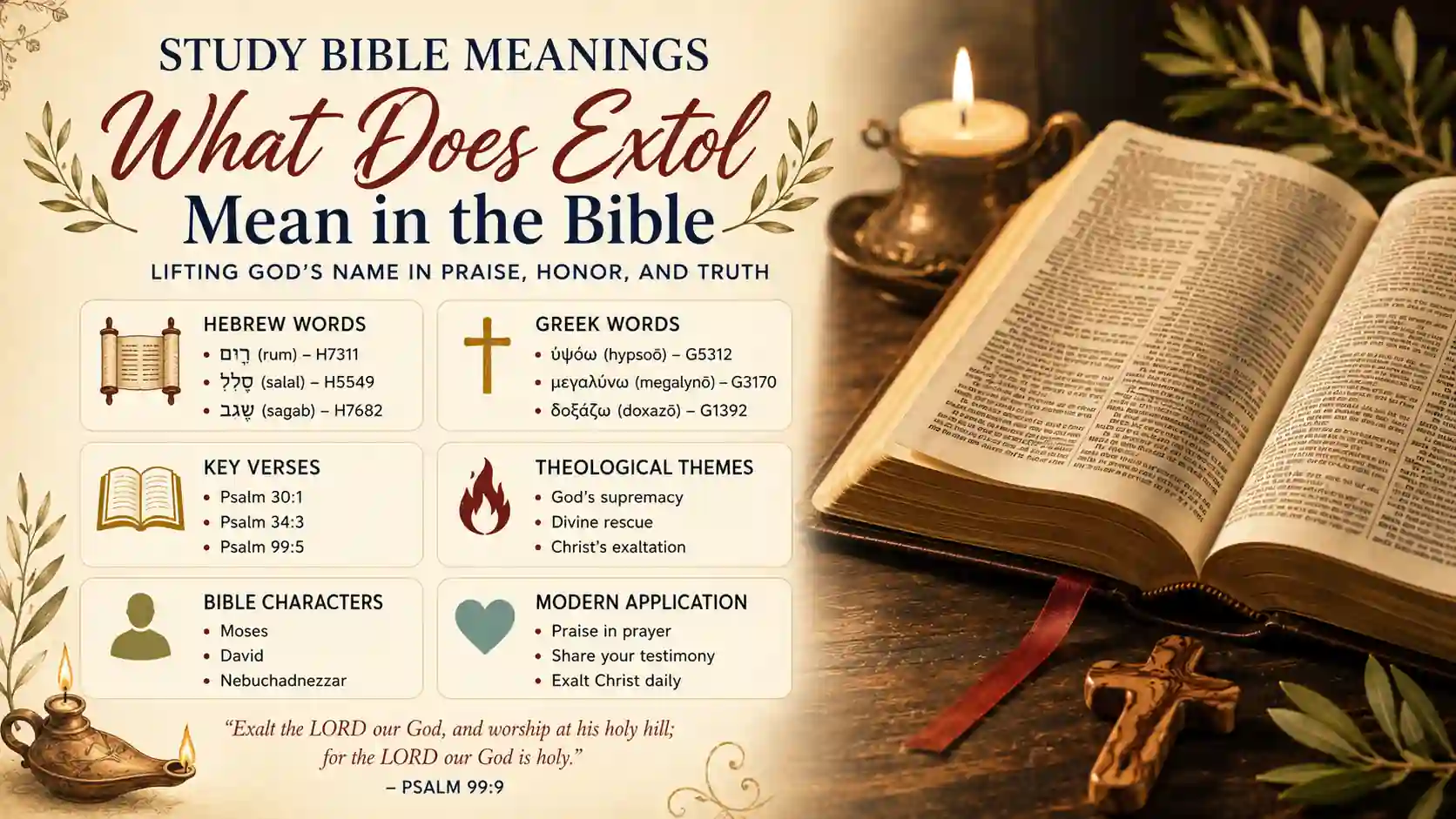
What does extol mean in the Bible? To extol is to lift high in praise, to exalt with spoken honor, and to declare the greatness of God above all rivals. In Scripture, extolling is not flattery or religious noise. It is worship that rises from truth.
When you extol the Lord, you name His works, His covenant mercy, His holiness, and His saving power. The word often appears in psalms, songs, royal prayers, and public testimony where God’s people lift His name before others.
Extol Key Scripture References
| Verse | Passage Snippet | Context |
|---|---|---|
| Exodus 15:2 | “I will exalt him” | Moses sings after the sea crossing |
| 2 Samuel 22:47 | “exalted be my God” | David praises deliverance |
| Psalm 18:46 | “exalted be the God” | Royal thanksgiving psalm |
| Psalm 30:1 | “I will extol you” | David rescued from danger |
| Psalm 34:3 | “exalt his name together” | Communal praise after deliverance |
| Psalm 68:4 | “extol him” | Processional worship song |
| Psalm 99:5 | “Exalt the LORD” | Holy kingship psalm |
| Psalm 145:1 | “I will extol you” | David’s alphabetic praise |
| Isaiah 25:1 | “I will exalt you” | Praise for divine faithfulness |
Extol Bible Translation Comparison
| Verse | KJV | NIV | ESV | NASB |
|---|---|---|---|---|
| Psalm 30:1 | “I will extol thee” | “I will exalt you” | “I will extol you” | “I will extol You” |
| Psalm 34:3 | “magnify the LORD” | “Glorify the LORD” | “magnify the LORD” | “exalt the LORD” |
| Psalm 68:4 | “extol him” | “extol him” | “exult before him” | “extol Him” |
| Psalm 99:5 | “Exalt ye the LORD” | “Exalt the LORD” | “Exalt the LORD” | “Exalt the LORD” |
| Psalm 107:32 | “exalt him also” | “exalt him” | “extol him” | “extol Him” |
| Psalm 145:1 | “I will extol thee” | “I will exalt you” | “I will extol you” | “I will extol You” |
| Isaiah 25:1 | “I will exalt thee” | “I will exalt you” | “I will exalt you” | “I will exalt You” |
| Daniel 4:37 | “praise and extol” | “praise and exalt” | “praise and extol” | “praise, exalt” |
Extol People and Characters Associated
| Person | Role | Connection |
|---|---|---|
| Moses | Prophet and leader | Extols God after redemption |
| Miriam | Prophetess | Leads praise by the sea |
| David | King and psalmist | Often extols God’s deliverance |
| Solomon | Temple king | Exalts God in worship setting |
| Sons of Korah | Temple singers | Lift God in public psalms |
| Isaiah | Prophet | Extols God’s faithful counsel |
| Nebuchadnezzar | Babylonian king | Extols the Most High after humbling |
| Mary | Mother of Jesus | Magnifies the Lord in song |
| Paul | Apostle | Exalts Christ’s name and lordship |
Extol Original Hebrew and Greek Words
| Original Word | Transliteration | Strong’s # | Literal Meaning |
|---|---|---|---|
| רוּם | rum | H7311 | to be high, raise |
| סָלַל | salal | H5549 | lift up, cast up |
| שָׂגַב | sagab | H7682 | set securely on high |
| גָּדַל | gadal | H1431 | make great, magnify |
| הָלַל | halal | H1984 | praise, boast |
| שָׁבַח | shabach | H7623 | laud, commend |
| ὑψόω | hypsoō | G5312 | lift up, exalt |
| μεγαλύνω | megalynō | G3170 | magnify, enlarge |
| δοξάζω | doxazō | G1392 | glorify, honor |
Extol Related Biblical Concepts
| Concept | Connection | Supporting Verse |
|---|---|---|
| Praise | Extol speaks praise aloud | Psalm 145:1 |
| Exaltation | God is lifted high | Psalm 99:5 |
| Magnifying | God is made great in witness | Psalm 34:3 |
| Thanksgiving | Gratitude fuels extolling | Psalm 30:1 |
| Testimony | Praise tells what God has done | Psalm 107:32 |
| Worship | Extolling belongs to gathered praise | Psalm 68:4 |
| Humility | Creatures bow while God is raised | Daniel 4:37 |
| Kingship | God’s reign is honored | Psalm 99:1 |
| Holiness | His holy name is exalted | Psalm 99:5 |
Extol Historical and Cultural Context
| Aspect | Detail | Biblical Source |
|---|---|---|
| Victory song | Praise after rescue at the sea | Exodus 15:2 |
| Royal psalm | King thanks God for deliverance | Psalm 18:46 |
| Temple worship | God’s name lifted in Zion | Psalm 99:5 |
| Public assembly | Elders hear God praised | Psalm 107:32 |
| Pilgrim praise | Worshipers exalt together | Psalm 34:3 |
| Exile lesson | Pagan king humbled by God | Daniel 4:37 |
| Prophetic hope | God praised for ancient plans | Isaiah 25:1 |
| Davidic devotion | Personal rescue becomes worship | Psalm 30:1 |
| Messianic worship | Christ receives glory | Philippians 2:9 |
Extol Theological Themes
| Theme | Explanation | Scripture |
|---|---|---|
| God’s supremacy | He alone is lifted highest | Psalm 97:9 |
| Covenant mercy | Praise answers steadfast love | Psalm 145:8 |
| Divine rescue | Deliverance calls forth extolling | Psalm 30:1 |
| Holy kingship | God reigns above peoples | Psalm 99:1 |
| Public witness | Praise invites others to join | Psalm 34:3 |
| Judgment and mercy | Humbling leads to praise | Daniel 4:37 |
| Christ’s exaltation | The Father highly exalts the Son | Philippians 2:9 |
| True humility | God is raised, self is lowered | James 4:10 |
| Eternal praise | God’s name is blessed forever | Psalm 145:1 |
Extol Modern Application for Believers
| Area | Practice | Scripture |
|---|---|---|
| Prayer | Begin by lifting God’s name | Psalm 145:1 |
| Worship | Sing truth, not vague emotion | Psalm 68:4 |
| Trials | Praise God after rescue | Psalm 30:1 |
| Community | Invite others to exalt Him | Psalm 34:3 |
| Humility | Let God be high, not self | Daniel 4:37 |
| Testimony | Tell specific works of God | Psalm 107:32 |
| Scripture reading | Mark God’s attributes | Isaiah 25:1 |
| Daily speech | Honor God openly | Hebrews 13:15 |
| Christ devotion | Confess Jesus as Lord | Philippians 2:11 |
רוּם And the Lifted Language Behind Biblical Extol
The Hebrew verb רוּם, rum, is one of the most important roots behind the idea of extolling. It means to be high, to rise, or to lift up. When Scripture uses this language for God, it does not mean people make Him greater than He already is.
Rather, God’s people recognize His true height. Your praise agrees with reality. Psalm 99:5 commands worshipers to exalt the LORD and worship at His footstool because He is holy. Extolling begins when the human heart bows low before the God who is already enthroned.
What Does Extol Mean in the Bible in David’S Psalms?
David’s use of extol is deeply personal. In Psalm 30:1, he says, “I will extol you,” because the Lord has drawn him up and not allowed his enemies to rejoice over him. His praise is tied to rescue, not religious performance.
Psalm 145 expands that personal praise into royal theology. David blesses the King forever and ever, declaring God’s greatness from one generation to another. In your study, notice that extolling is both intimate and public. The rescued soul becomes a witness.
Extol, Magnify, and Exalt in Israel’S Worship
English translations often vary between “extol,” “exalt,” “magnify,” and “glorify.” Psalm 34:3 is a clear example. The KJV and ESV say “magnify the LORD,” while the NIV says “Glorify the LORD,” and the NASB uses “exalt the LORD.”
These differences do not weaken the meaning. They show the richness of the biblical idea. To extol God is to raise His name in the hearing of others, to enlarge His reputation among the faithful, and to call the congregation into shared adoration.
Nebuchadnezzar and the Shock of Pagan Extolment
Daniel 4:37 is one of the most striking uses of this theme. Nebuchadnezzar, the proud Babylonian king, says he praises, extols, and honors the King of heaven. The man who once gloried in Babylon learns that heaven rules.
This scene gives extolling a sharp theological edge. God can humble rulers, correct arrogance, and draw praise even from imperial mouths. Biblical extolling is not limited to Israel’s sanctuary. It can erupt in royal courts when God exposes human pride.
ὑψόω And the Exaltation of Christ
In the New Testament, ὑψόω, hypsoō, carries the idea of lifting up or exalting. Philippians 2:9 says God highly exalted Jesus after His obedient humiliation. The pattern is central to Christian worship. The crucified servant is now the confessed Lord.
This does not replace Old Testament praise. It fulfills its deepest direction. The God who alone is high has revealed His glory in the Son. When you extol Christ, you join heaven’s confession that every knee will bow and every tongue will confess Him.
Extol as a Discipline of Truthful Speech
To extol God is to train your mouth in truth. Scripture does not invite you to exaggerate God, because exaggeration is impossible. It calls you to speak according to His works, names, attributes, promises, and judgments.
That is why biblical extolling is so different from empty enthusiasm. It is rooted in revelation. You extol God best when your praise is filled with Scripture, when your gratitude names real mercies, and when your worship places God above every fear.
Questions About Extol in the Bible
Is רוּם, rum, always translated “extol” in English Bibles?
No, it may appear as “exalt,” “lift up,” “raise,” or “be high,” depending on the verse.
Why does Psalm 34:3 say “magnify” in some translations but “exalt” in others?
The Hebrew idea is shared public praise, so translators choose words that stress making God’s greatness known.
What makes Daniel 4:37 unusual for the theme of extol?
A humbled Babylonian king praises and extols the Most High after learning that God rules over human kingdoms.
Does extolling God mean humans can increase God’s glory?
No, believers declare and honor the glory God already possesses eternally.
How should Philippians 2:9 shape Christian extolling?
It teaches you to praise Jesus as the humbled servant whom God has highly exalted as Lord.