
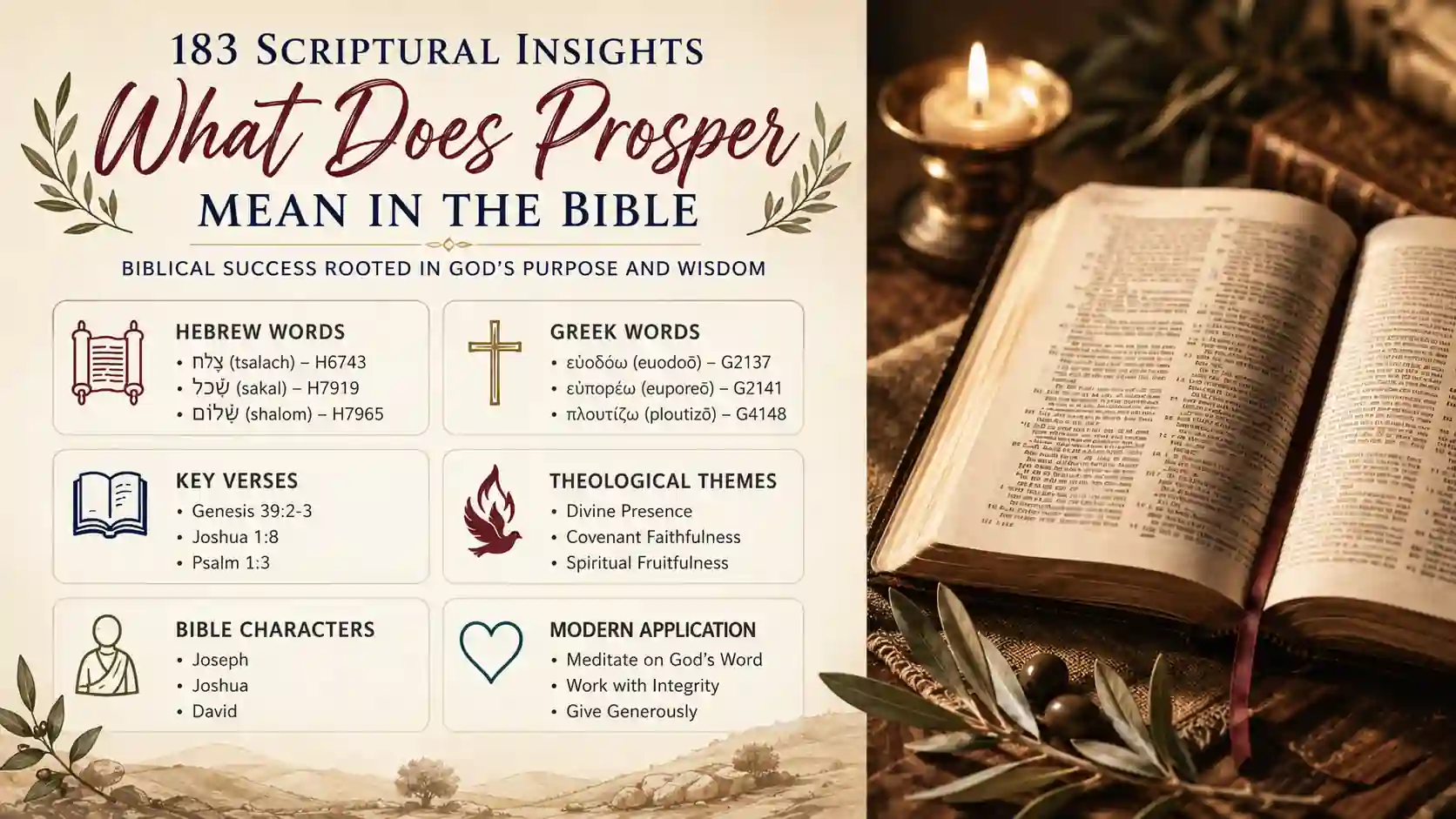
What does prosper mean in the Bible? Scripture uses prosperity language for success, well-being, fruitful labor, peaceful conditions, spiritual health, and the fulfillment of God-given purposes. It does not consistently mean becoming wealthy or escaping hardship.
The biblical words translated “prosper” receive their meaning from their setting. As you examine them, you discover that true prosperity is measured by faithfulness to God, wise obedience, fruitful service, and spiritual wholeness. Material provision may be included, but it is never the Bible’s only or highest definition of a prosperous life.
Key Prosper Scripture References
| Verse | Passage Snippet | Context |
|---|---|---|
| Genesis 39:2-3 | Joseph became prosperous | God blessed Joseph in slavery |
| Deuteronomy 29:9 | Prosper in what you do | Israel must keep the covenant |
| Joshua 1:8 | Make your way prosperous | Joshua must meditate and obey |
| 1 Kings 2:3 | Prosper in all you do | David instructs Solomon |
| 2 Chronicles 20:20 | Believe and prosper | Judah trusts God during crisis |
| Psalm 1:3 | Whatever he does prospers | The righteous delight in God’s law |
| Isaiah 53:10 | God’s pleasure shall prosper | The Servant fulfills God’s purpose |
| Jeremiah 29:11 | Plans for your welfare | Exiles receive hope for restoration |
| 3 John 2 | Prosper and be in health | John greets a faithful believer |
Prosper Bible Translation Comparison
| Verse | KJV | NIV | ESV | NASB |
|---|---|---|---|---|
| Genesis 39:3 | Made to prosper | Gave him success | Caused to succeed | Made to prosper |
| Deuteronomy 29:9 | Prosper in all | Prosper in everything | Prosper in all | Prosper in all |
| Joshua 1:8 | Make thy way prosperous | Be prosperous | Make your way prosperous | Make your way prosperous |
| 1 Kings 2:3 | Mayest prosper | Prosper in all | Prosper in all | Succeed in all |
| 2 Chronicles 20:20 | So shall ye prosper | You will be successful | You will succeed | You will be successful |
| Psalm 1:3 | Whatsoever he doeth shall prosper | Whatever they do prospers | In all he does, he prospers | Whatever he does, he prospers |
| Isaiah 53:10 | Shall prosper in his hand | Will prosper in his hand | Shall prosper in his hand | Will prosper in his hand |
| 3 John 2 | Mayest prosper | May enjoy good health | May go well with you | May prosper |
People Associated with Prosper in Scripture
| Person | Role | Connection |
|---|---|---|
| Abraham | Covenant patriarch | Blessed to become a blessing |
| Joseph | Administrator in Egypt | Prospered because God was with him |
| Moses | Covenant mediator | Connected prosperity with obedience |
| Joshua | Israel’s leader | Promised success through faithful action |
| David | King and psalmist | Taught covenant faithfulness to Solomon |
| Solomon | King of Israel | Received wealth, wisdom, and responsibility |
| Jehoshaphat | King of Judah | Called the people to trust God |
| Hezekiah | Reforming king | Prospered while seeking the Lord |
| Gaius | Early Christian believer | Commended for spiritual faithfulness |
Original Hebrew and Greek Words for Prosper
| Original Word | Transliteration | Strong’s # | Literal Meaning |
|---|---|---|---|
| צָלַח | tsalach | H6743 | Advance, succeed, accomplish |
| שָׂכַל | sakal | H7919 | Act wisely, understand, succeed |
| שָׁלוֹם | shalom | H7965 | Peace, welfare, completeness |
| טוֹב | tov | H2896 | Good, pleasant, beneficial |
| שָׁלָה | shalah | H7951 | Be quiet, secure, at ease |
| כָּשֵׁר | kasher | H3787 | Succeed, be advantageous |
| εὐοδόω | euodoō | G2137 | Have a good journey, prosper |
| εὐπορέω | euporeō | G2141 | Have resources, be well supplied |
| πλουτίζω | ploutizō | G4148 | Enrich, make abundant |
Related Biblical Concepts of Prosper
| Concept | Connection | Supporting Verse |
|---|---|---|
| Obedience | Prosperity follows covenant faithfulness | Deuteronomy 29:9 |
| Wisdom | Wise conduct produces sound outcomes | Joshua 1:8 |
| God’s presence | Joseph succeeded because God was with him | Genesis 39:2 |
| Fruitfulness | The righteous bear fruit in season | Psalm 1:3 |
| Peace | Shalom describes whole-person welfare | Jeremiah 29:7 |
| Stewardship | Resources are entrusted for faithful use | Deuteronomy 8:18 |
| Generosity | God supplies so believers can give | 2 Corinthians 9:11 |
| Endurance | Faithfulness may continue through suffering | James 1:12 |
| Mission | God’s saving purpose ultimately succeeds | Isaiah 53:10 |
Historical and Cultural Context of Prosper
| Aspect | Detail | Biblical Source |
|---|---|---|
| Agricultural life | Rain and harvest signified communal well-being | Deuteronomy 28:12 |
| Covenant structure | Blessings followed loyalty to God’s covenant | Deuteronomy 28:1-14 |
| Land inheritance | Israel’s welfare was tied to life in the land | Joshua 1:6-8 |
| Royal leadership | Kings prospered by governing under God’s law | 1 Kings 2:3 |
| Household economy | Flocks, fields, servants, and children showed abundance | Job 1:2-3 |
| Exile | Prosperity included seeking a foreign city’s welfare | Jeremiah 29:7 |
| Wisdom tradition | Diligence and righteousness were linked with fruitfulness | Proverbs 10:4 |
| Roman travel | Euodoō could describe a successful journey | Romans 1:10 |
| Early churches | Believers set aside funds according to their means | 1 Corinthians 16:2 |
Theological Themes of Biblical Prosper
| Theme | Explanation | Scripture |
|---|---|---|
| Divine presence | God Himself is the source of lasting success | Genesis 39:2 |
| Covenant faithfulness | Obedience shapes biblical prosperity | Deuteronomy 29:9 |
| Moral purpose | Success must remain under God’s commands | Joshua 1:8 |
| Spiritual fruit | Prosperity includes a productive righteous life | Psalm 1:3 |
| Divine sovereignty | God can prosper His work through suffering | Isaiah 53:10 |
| Contentment | Godliness is not a means of selfish gain | 1 Timothy 6:5-6 |
| Eternal treasure | Earthly riches are temporary | Matthew 6:19-20 |
| Generous abundance | Provision equips believers to bless others | 2 Corinthians 9:11 |
| Christ-centered hope | Life does not consist in possessions | Luke 12:15 |
Modern Application of Prosper for Believers
| Area | Practice | Scripture |
|---|---|---|
| Scripture | Meditate on God’s Word consistently | Joshua 1:8 |
| Work | Labor honestly and wholeheartedly | Colossians 3:23 |
| Finances | Practice stewardship rather than greed | Luke 16:10 |
| Giving | Share resources cheerfully | 2 Corinthians 9:7 |
| Decisions | Seek wisdom before pursuing success | James 1:5 |
| Relationships | Pursue peace and mutual good | Romans 12:18 |
| Suffering | Remain faithful without assuming divine rejection | Romans 5:3-5 |
| Health | Pray for well-being without demanding immunity | 3 John 2 |
| Ambition | Submit plans to the Lord’s will | James 4:15 |
What Does Prosper Mean in the Bible Through צָלַח Tsalach?
The Hebrew verb צָלַח, tsalach, often describes moving forward successfully, accomplishing a task, or having an undertaking turn out well. It can refer to military action, leadership, work, prophecy, or the fulfillment of God’s purpose. The word itself does not require financial wealth.
Genesis 39 gives you a clear picture. Joseph was called prosperous while enslaved and later while imprisoned. His circumstances were painful, yet the Lord was with him and caused the responsibilities entrusted to him to succeed. Biblical prosperity can therefore exist alongside injustice, limitation, and suffering.
In Psalm 1:3, tsalach appears within the image of a tree planted beside streams of water. The tree produces fruit in its proper season because it is rooted near a dependable source of life. The psalm is describing stability and righteous fruitfulness, not unlimited comfort or effortless achievement.
The contrast is not between rich people and poor people. It is between the righteous, whose lives are rooted in God’s instruction, and the wicked, who are compared with weightless chaff. Prosperity here means that a life directed by God reaches its proper, enduring purpose.
שָׂכַל Sakal Connects Prosperity with Wisdom and Obedience
Joshua 1:8 uses prosperity language in connection with שָׂכַל, sakal. This verb can mean to understand, act prudently, behave wisely, or achieve success through wise conduct. The verse does not hand Joshua an unrestricted promise that every personal ambition will succeed.
Joshua was preparing to lead Israel after Moses’ death. His task involved covenant responsibility, national leadership, warfare, and obedience to revealed instruction. He was told to speak, meditate upon, and carefully practice the Book of the Law. His promised success belonged to the mission God had assigned him.
This background guards your study from treating Joshua 1:8 as a formula for personal enrichment. The sequence is not positive speech followed by guaranteed wealth. It is revelation, meditation, obedience, wise conduct, and faithfulness within God’s calling.
The same pattern appears in David’s instructions to Solomon in 1 Kings 2:3. Solomon was to walk in God’s ways and keep His commandments so that he might act wisely or prosper. For Israel’s leaders, genuine success was inseparable from moral accountability.
What Does Prosper Mean in the Bible Under the New Covenant?
The principal New Testament verb is εὐοδόω, euodoō. It is formed from words associated with a good road or successful journey. Depending on the context, it may describe a journey going well, circumstances developing favorably, adequate financial means, or general well-being.
In Romans 1:10, Paul uses the word while praying that he might finally have a successful journey to Rome by God’s will. His later arrival involved arrest, dangerous travel, shipwreck, and confinement. The journey prospered because God’s mission advanced, not because the route was comfortable.
First Corinthians 16:2 uses euodoō when believers are instructed to set aside contributions according to how they have prospered. The idea concerns whatever means God had enabled each person to receive. The passage assumes differing levels of provision and directs available resources toward generous ministry.
In 3 John 2, John prays that Gaius may prosper and be healthy just as his soul prospers. The comparison is significant. Gaius already possessed spiritual well-being, demonstrated through truth, love, and hospitality. The prayer expresses pastoral affection, not a universal guarantee of wealth or perfect health.
Isaiah 53 Shows God’S Purpose Prospering Through Suffering
Isaiah 53:10 declares that the Lord’s pleasure or purpose would prosper in the hand of the suffering Servant. This is one of Scripture’s strongest corrections to the belief that prosperity must look like visible ease, social honor, or physical security.
The Servant is rejected, wounded, and put to grief, yet God’s saving purpose succeeds through his suffering. Christian readers recognize the fulfillment of this passage in Jesus Christ. The cross appeared to be defeat, but it accomplished redemption according to God’s will.
This means you must evaluate prosperity by God’s purpose rather than appearances alone. A faithful ministry may involve rejection. Obedience may require sacrifice. Generosity may reduce personal comfort. Truthfulness may close profitable opportunities. None of these realities proves that God has abandoned His servant.
Scripture also warns against confusing godliness with financial gain. First Timothy 6 rejects teachers who imagine religion as a path to profit and directs believers toward contentment. Wealth can be received gratefully, but it is uncertain and must be used generously rather than treated as evidence of superior faith.
Questions Bible Students Ask About Prosper
Does צָלַח, tsalach, always mean financial prosperity?
No. It usually means succeeding, advancing, or accomplishing a purpose, and the context determines whether material provision is involved.
Why was Joseph called prosperous while he was a slave and prisoner?
Genesis 39 defines his prosperity through God’s presence and the success of his entrusted work, not through personal freedom or comfort.
Does Joshua 1:8 promise that every believer will become wealthy?
No. It promises Joshua wise and effective leadership as he meditates on God’s law and obeys his covenant mission.
Is 3 John 2 a guarantee of health and wealth?
No. It is a personal prayer for Gaius’s outward well-being to correspond with his already evident spiritual health.
How should you pursue prosperity without becoming materialistic?
Seek faithfulness, wisdom, fruitful service, contentment, and generosity while submitting every ambition and resource to God’s will.