
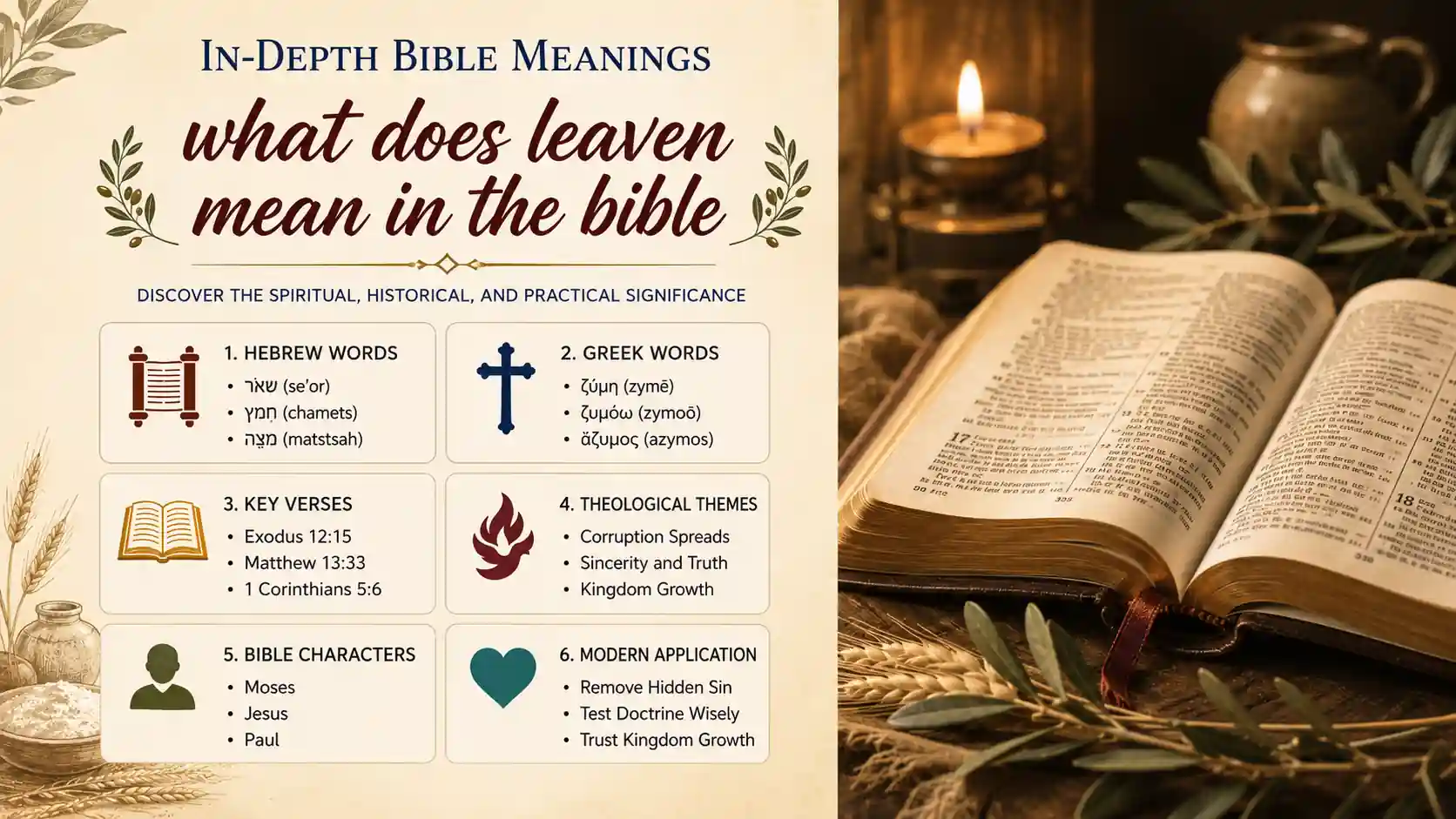
What does leaven mean in the Bible? In your study, leaven is more than a baking ingredient. Scripture uses it literally for fermented dough in Israel’s feasts and figuratively for hidden influence that spreads through a person, household, congregation, or kingdom.
Sometimes leaven pictures corruption, hypocrisy, false teaching, or tolerated sin. Yet Jesus also uses leaven to picture the quiet, permeating growth of God’s kingdom. The meaning depends on the passage, covenant setting, and speaker.
Key Leaven Scripture References
| Verse | Passage Snippet | Context |
|---|---|---|
| Exodus 12:15 | “remove leaven” | Passover preparation |
| Exodus 12:19 | “no leaven found” | Israelite houses |
| Exodus 13:7 | “unleavened bread” | Feast command |
| Leviticus 2:11 | “no leaven” | Grain offerings |
| Leviticus 23:17 | “baked with leaven” | Pentecost loaves |
| Matthew 13:33 | “like leaven” | Kingdom parable |
| Matthew 16:6 | “leaven of Pharisees” | False teaching warning |
| Luke 12:1 | “leaven… hypocrisy” | Religious pretense |
| 1 Corinthians 5:6 | “little leaven” | Church discipline |
| Galatians 5:9 | “whole lump” | Legalist influence |
Leaven Bible Translation Comparison
| Verse | KJV | NIV | ESV | NASB |
|---|---|---|---|---|
| Exodus 12:15 | “put away leaven” | “remove yeast” | “remove leaven” | “remove leaven” |
| Exodus 12:19 | “no leaven found” | “no yeast” | “no leaven” | “nothing leavened” |
| Exodus 13:7 | “unleavened bread” | “unleavened bread” | “unleavened bread” | “unleavened bread” |
| Leviticus 2:11 | “no meat offering” | “grain offering” | “grain offering” | “grain offering” |
| Matthew 13:33 | “hid in three measures” | “mixed into” | “hid in” | “hid in” |
| Matthew 16:6 | “beware of the leaven” | “guard against the yeast” | “beware of the leaven” | “watch out” |
| Luke 12:1 | “which is hypocrisy” | “which is hypocrisy” | “which is hypocrisy” | “which is hypocrisy” |
| 1 Corinthians 5:6 | “leaveneth the whole lump” | “works through” | “leavens the whole lump” | “leavens the whole lump” |
| Galatians 5:9 | “a little leaven” | “a little yeast” | “a little leaven” | “a little leaven” |
Leaven People and Characters Associated
| Person | Role | Connection |
|---|---|---|
| Moses | Lawgiver | Gave Passover leaven commands |
| Aaron | Priest | Served under offering laws |
| Israelites | Redeemed people | Removed leaven from homes |
| Priests | Temple servants | Guarded altar purity |
| Feast worshipers | Pilgrims | Ate unleavened bread |
| Jesus | Messiah | Used leaven in parables |
| Pharisees | Religious leaders | Linked with hypocrisy |
| Sadducees | Religious leaders | Linked with false doctrine |
| Paul | Apostle | Warned churches about leaven |
| Corinthian church | Congregation | Tolerated immoral sin |
Original Hebrew and Greek Leaven Words
| Original Word | Transliteration | Strong’s # | Literal Meaning |
|---|---|---|---|
| שְׂאֹר | seʾor | H7603 | leaven, sourdough starter |
| חָמֵץ | chamets | H2556 | leavened thing |
| חָמֵץ | chamets | H2557 | to be sour or leavened |
| מַצָּה | matstsah | H4682 | unleavened bread |
| ζύμη | zymē | G2219 | leaven, yeast |
| ζυμόω | zymoō | G2220 | to leaven |
| ἄζυμος | azymos | G106 | unleavened |
| ἄζυμα | azyma | G106 | unleavened bread |
| φύραμα | phyrama | G5445 | lump of dough |
Related Biblical Concepts Connected to Leaven
| Concept | Connection | Supporting Verse |
|---|---|---|
| Passover | Leaven removed from houses | Exodus 12:15 |
| Exodus haste | Bread had no time to rise | Exodus 12:39 |
| Holiness | Separation from corruption | Leviticus 2:11 |
| Firstfruits | Leavened loaves offered | Leviticus 23:17 |
| Hypocrisy | Hidden religious decay | Luke 12:1 |
| False teaching | Doctrine spreads quietly | Matthew 16:12 |
| Church purity | Sin affects the body | 1 Corinthians 5:6 |
| Sincerity | Unleavened moral life | 1 Corinthians 5:8 |
| Kingdom growth | Small becomes pervasive | Matthew 13:33 |
Historical and Cultural Context of Leaven
| Aspect | Detail | Biblical Source |
|---|---|---|
| Ancient baking | Starter dough fermented flour | Exodus 12:34 |
| Household search | Leaven removed before feast | Exodus 12:19 |
| Passover week | Seven days without leaven | Exodus 12:15 |
| Travel haste | Dough carried before rising | Exodus 12:39 |
| Grain offering | No leaven burned on altar | Leviticus 2:11 |
| Honey pairing | Also excluded from altar fire | Leviticus 2:11 |
| Pentecost loaves | Two leavened wave loaves | Leviticus 23:17 |
| Rabbinic concern | Leaven symbolized contamination | Matthew 16:6 |
| Church metaphor | Dough pictured congregation | 1 Corinthians 5:6 |
Theological Themes of Leaven
| Theme | Explanation | Scripture |
|---|---|---|
| Redemption | Israel left Egypt in haste | Exodus 12:39 |
| Consecration | Homes cleansed for feast | Exodus 12:15 |
| Corruption | Sin spreads if tolerated | 1 Corinthians 5:6 |
| Truth | Unleavened bread pictures sincerity | 1 Corinthians 5:8 |
| Discernment | Teaching must be tested | Matthew 16:12 |
| Hypocrisy | Hidden pretense defiles worship | Luke 12:1 |
| Kingdom | God’s reign permeates quietly | Matthew 13:33 |
| Covenant memory | Feast preserved deliverance | Exodus 13:8 |
| Corporate holiness | One sin affects many | Galatians 5:9 |
Modern Application for Believers Studying Leaven
| Area | Practice | Scripture |
|---|---|---|
| Personal sin | Remove what secretly spreads | 1 Corinthians 5:7 |
| Church life | Guard holiness with humility | 1 Corinthians 5:6 |
| Teaching | Test doctrine by Christ | Matthew 16:12 |
| Worship | Offer sincerity, not performance | 1 Corinthians 5:8 |
| Family | Remember redemption at home | Exodus 13:8 |
| Influence | Notice small compromises | Galatians 5:9 |
| Hope | Trust hidden kingdom growth | Matthew 13:33 |
| Speech | Refuse religious pretense | Luke 12:1 |
| Obedience | Let Scripture define symbols | Leviticus 23:17 |
שְׂאֹר And חָמֵץ in Israel’S Passover Memory
The Hebrew word שְׂאֹר, seʾor, usually points to leaven itself, the souring agent kept from an older batch of dough. The related חָמֵץ, chamets, describes what has become leavened, sour, or fermented. In Exodus, these words stand inside the story of rescue from Egypt, not abstract symbolism.
Israel removed leaven because the Lord delivered them quickly. Their bread did not have time to rise, so unleavened bread became edible memory. Each year, the feast preached that salvation came by God’s power, not by Israel’s patient preparation or cultural stability.
What Does Leaven Mean in the Bible When Jesus Warns His Disciples
When Jesus says, “beware of the leaven of the Pharisees and Sadducees,” He is not warning against bread. Matthew explains that He means their teaching. Luke identifies the leaven of the Pharisees as hypocrisy, a hidden inner contradiction between public piety and private reality.
That warning is pastorally serious. Leaven works quietly before it is obvious. A small false assumption about God, righteousness, authority, or repentance can spread through the whole mind. Jesus teaches you to watch not only open rebellion, but also respected religion that resists truth.
Paul’S “Little Leaven” and the Purity of the Church
Paul uses the familiar baking image in 1 Corinthians 5 to confront tolerated sexual immorality. His concern is not harshness for its own sake. He sees the church as a covenant community whose shared life can be shaped by either holiness or compromise.
He then connects the image to Christ our Passover. Because Christ has been sacrificed, believers keep the feast spiritually with “the unleavened bread of sincerity and truth.” The gospel does not make sin harmless. It creates a cleansed people who live from grace into holiness.
The Kingdom Parable Where Leaven Is Surprisingly Good
Matthew 13:33 and Luke 13:21 show another side of the image. A woman hides leaven in three measures of flour until all is leavened. Here the stress is not corruption, but permeation. The kingdom begins in hidden smallness and works until its effect is complete.
This positive use keeps you from flattening biblical symbols. Leaven does not always mean evil. Scripture’s meaning is governed by context. In Jesus’ parable, leaven pictures the quiet certainty of God’s reign, growing in ways human eyes may underestimate.
Questions Bible Students Ask About Leaven
Does ζύμη, zymē, always mean something evil in the New Testament?
No. It means leaven, and context decides whether the influence is corrupting, as in Luke 12:1, or kingdom-like, as in Matthew 13:33.
Why does Leviticus 23:17 allow leavened bread if Leviticus 2:11 forbids leaven on the altar?
The Pentecost loaves were waved before the Lord, while Leviticus 2:11 forbids burning leaven in offerings made by fire.
Is חָמֵץ, chamets, the same as שְׂאֹר, seʾor?
They are related but distinct. שְׂאֹר is the leavening agent, while חָמֵץ can describe what is leavened or sour.
Why does Paul say “a little leaven leavens the whole lump”?
He means that tolerated sin or false teaching can spread through the whole community if it is not addressed.
How should a believer apply the Feast of Unleavened Bread today?
You honor its fulfillment by trusting Christ our Passover and walking in sincerity, truth, repentance, and holiness.