
What does covenant mean in the Bible? A covenant is a solemn, binding relationship established through promises, commitments, signs, and obligations. Biblical covenants are more than ordinary contracts because they create or confirm a relationship, often initiated by God and grounded in his faithful character.
As you trace covenant through Scripture, you encounter Noah, Abraham, Israel, David, and ultimately Jesus Christ. Together, these passages reveal God’s unified purpose to dwell with his people, forgive their sins, form them into a holy community, and bring blessing to the nations.
Key Covenant Scripture References
| Verse | Passage Snippet | Context |
|---|---|---|
| Genesis 6:18 | “I will establish my covenant” | God promises to preserve Noah’s family |
| Genesis 9:11 | Never again destroyed by a flood | God covenants with creation |
| Genesis 15:18 | “The LORD made a covenant with Abram” | God promises land to Abram’s offspring |
| Genesis 17:7 | “An everlasting covenant” | Abraham’s descendants belong to God |
| Exodus 19:5 | “Keep my covenant” | Israel is called God’s treasured possession |
| Exodus 24:8 | “The blood of the covenant” | Israel’s covenant is formally ratified |
| 2 Samuel 7:16 | “Your throne shall be established” | God promises David an enduring dynasty |
| Jeremiah 31:31 | “I will make a new covenant” | God promises inward renewal and forgiveness |
| Luke 22:20 | “The new covenant in my blood” | Jesus interprets his death covenantally |
| Hebrews 8:6 | “A better covenant” | Christ mediates superior promises |
Covenant Bible Translation Comparison
| Verse | KJV | NIV | ESV | NASB |
|---|---|---|---|---|
| Genesis 6:18 | establish my covenant | establish my covenant | establish my covenant | establish My covenant |
| Genesis 9:13 | token of a covenant | sign of the covenant | sign of the covenant | sign of the covenant |
| Genesis 15:18 | made a covenant | made a covenant | made a covenant | made a covenant |
| Exodus 19:5 | keep my covenant | keep my covenant | keep my covenant | keep My covenant |
| Exodus 24:8 | blood of the covenant | blood of the covenant | blood of the covenant | blood of the covenant |
| 2 Samuel 7:16 | established for ever | established forever | made sure forever | established forever |
| Jeremiah 31:31 | a new covenant | a new covenant | a new covenant | a new covenant |
| Matthew 26:28 | blood of the new testament | blood of the covenant | blood of the covenant | blood of the covenant |
| Luke 22:20 | new testament in my blood | new covenant in my blood | new covenant in my blood | new covenant in My blood |
| Hebrews 9:15 | mediator of the new testament | mediator of a new covenant | mediator of a new covenant | mediator of a new covenant |
People and Characters Associated with Covenant
| Person | Role | Connection |
|---|---|---|
| Noah | Flood survivor | Receives God’s covenant with creation |
| Abraham | Patriarch | Receives promises of land, offspring, and blessing |
| Sarah | Matriarch | Bears the promised covenant son |
| Isaac | Promised son | Covenant line continues through him |
| Jacob | Father of Israel | Abrahamic promises are reaffirmed to him |
| Moses | Covenant mediator | Receives the law and represents Israel |
| Aaron | High priest | Serves within Israel’s covenant worship |
| David | King | Receives the promise of an enduring throne |
| Jeremiah | Prophet | Announces the coming new covenant |
| Jesus | Messiah and mediator | Establishes the new covenant through his blood |
Original Covenant Words in Hebrew and Greek
| Original Word | Transliteration | Strong’s # | Literal Meaning |
|---|---|---|---|
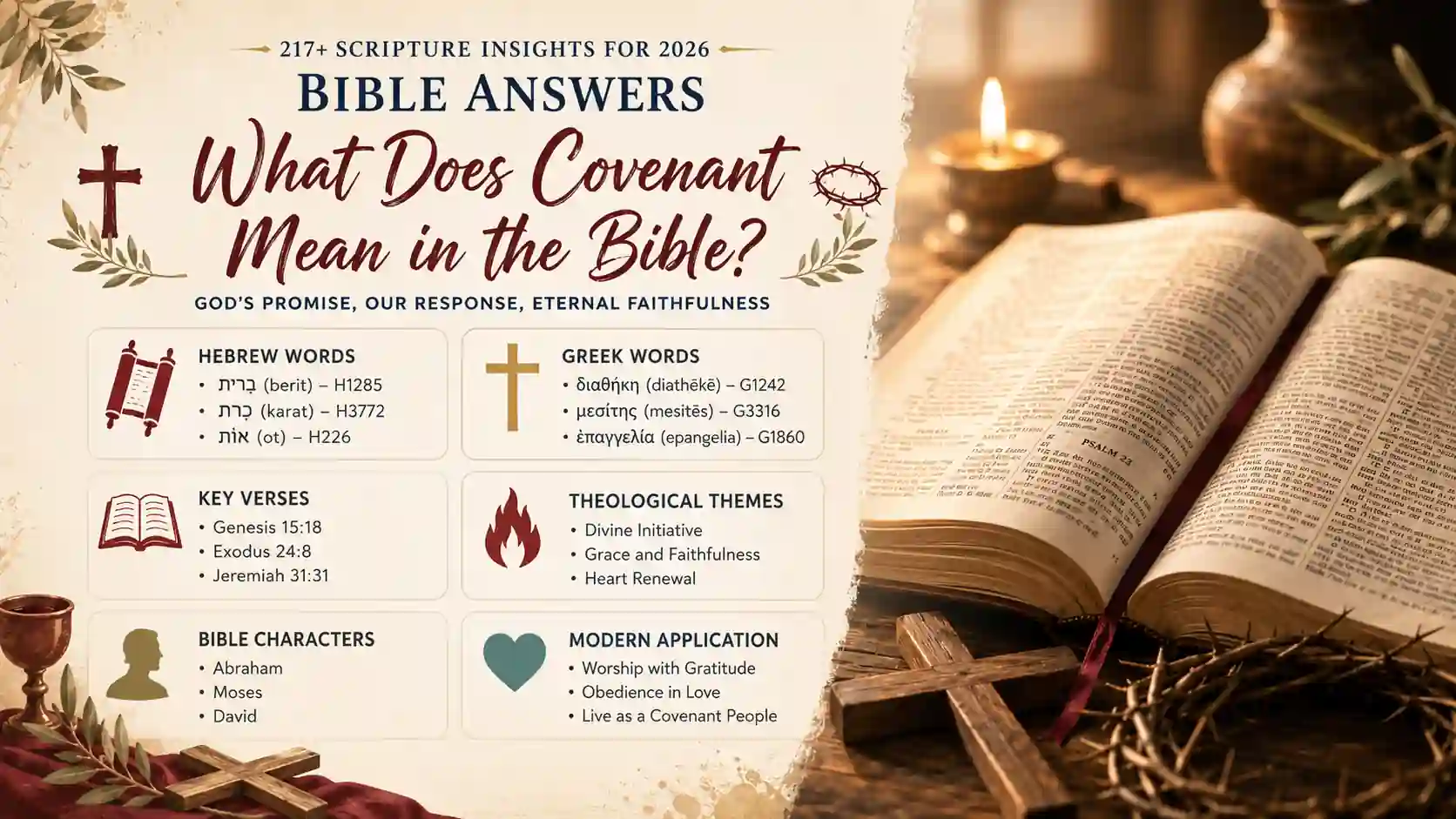
| בְּרִית | berit | H1285 | covenant, treaty, binding agreement |
| כָּרַת | karat | H3772 | to cut or make by cutting |
| אוֹת | ot | H226 | sign, mark, token |
| שָׁבַע | shava | H7650 | to swear, take an oath |
| חֶסֶד | hesed | H2617 | steadfast love, covenant loyalty |
| אָלָה | alah | H422 | oath, binding curse |
| תּוֹרָה | torah | H8451 | instruction, law |
| דִּיאַΘΗΚΗ | diathēkē | G1242 | covenant, testament, arrangement |
| ΜΕΣΊΤΗΣ | mesitēs | G3316 | mediator, one who intervenes |
| ἘΠΑΓΓΕΛΊΑ | epangelia | G1860 | promise, pledged declaration |
The principal Old Testament noun is בְּרִית, berit, identified as Strong’s H1285. The New Testament normally uses διαθήκη, diathēkē, Strong’s G1242, a word that can refer to a covenant or testament depending on context.
Biblical Concepts Related to Covenant
| Concept | Connection | Supporting Verse |
|---|---|---|
| Promise | God pledges future blessing | Genesis 12:1-3 |
| Oath | A sworn word confirms commitment | Genesis 22:16-18 |
| Election | God chooses a people for his purpose | Deuteronomy 7:6 |
| Law | Covenant life receives divine instruction | Exodus 24:7 |
| Sacrifice | Blood solemnizes covenant relationship | Exodus 24:8 |
| Circumcision | Sign of Abraham’s covenant | Genesis 17:11 |
| Sabbath | Sign of Israel’s covenant calling | Exodus 31:16-17 |
| Kingship | David’s dynasty carries messianic hope | 2 Samuel 7:12-16 |
| Forgiveness | New covenant removes remembered guilt | Jeremiah 31:34 |
| Communion | The church remembers Christ’s covenant blood | 1 Corinthians 11:25 |
Historical and Cultural Context of Covenant
| Aspect | Detail | Biblical Source |
|---|---|---|
| Covenant cutting | Sacrificial pieces pictured solemn consequences | Genesis 15:9-18 |
| Royal grant | A king bestowed benefits on a loyal servant | 2 Samuel 7:8-16 |
| Suzerain treaty | A ruler defined loyalty and obligations | Deuteronomy 6:1-15 |
| Covenant document | Terms were written and preserved | Exodus 24:4-7 |
| Public reading | The community heard covenant instruction | Deuteronomy 31:10-13 |
| Witnesses | Heaven and earth testified to the agreement | Deuteronomy 30:19 |
| Covenant meal | Shared food confirmed fellowship | Exodus 24:9-11 |
| Covenant sign | A visible marker recalled the promise | Genesis 9:12-17 |
| Blessings | Loyalty brought life and fruitfulness | Deuteronomy 28:1-14 |
| Curses | Rebellion brought covenant judgment | Deuteronomy 28:15-68 |
Theological Themes within Covenant
| Theme | Explanation | Scripture |
|---|---|---|
| Divine initiative | God begins the saving relationship | Genesis 6:18 |
| Grace | Promise precedes human achievement | Genesis 15:1-6 |
| Faithfulness | God remembers and keeps his word | Exodus 2:24 |
| Holiness | God’s people reflect his character | Exodus 19:6 |
| Presence | God chooses to dwell among his people | Exodus 29:45 |
| Redemption | Deliverance forms the covenant community | Exodus 20:2 |
| Kingdom | David’s covenant points toward the Messiah | Psalm 89:3-4 |
| Atonement | Covenant forgiveness requires cleansing | Hebrews 9:13-15 |
| Heart renewal | God writes his law within his people | Jeremiah 31:33 |
| Mission | Covenant blessing reaches every nation | Genesis 12:3 |
Modern Covenant Application for Believers
| Area | Practice | Scripture |
|---|---|---|
| Worship | Approach God through Christ’s mediation | Hebrews 10:19-22 |
| Communion | Remember Christ’s covenant sacrifice | 1 Corinthians 11:25-26 |
| Obedience | Receive God’s commands as loving instruction | John 14:15 |
| Marriage | Honor marriage as a solemn covenant | Malachi 2:14 |
| Community | Carry the burdens of fellow believers | Galatians 6:2 |
| Integrity | Let your words be truthful | Matthew 5:37 |
| Forgiveness | Forgive as God has forgiven you | Ephesians 4:32 |
| Mission | Share the promised blessing with the nations | Matthew 28:19 |
| Hope | Trust God’s unchangeable promise | Hebrews 6:17-19 |
| Perseverance | Hold firmly to your confession | Hebrews 10:23 |
What Does Covenant Mean in the Bible’S Story?
In its broad biblical sense, covenant describes a formally established relationship. Sometimes it governs relationships between human beings, as with Abraham and Abimelech in Genesis 21, David and Jonathan in 1 Samuel 18, or marriage in Malachi 2:14.
God’s covenants, however, carry the Bible’s story forward. Through them, he reveals whom he will bless, how his people should live, what signs will identify the relationship, and how his redemptive promises will reach their appointed fulfillment.
A covenant is therefore related to a contract, but the two ideas are not identical. A commercial contract usually concerns an exchange of goods or services, while a biblical covenant often establishes personal allegiance, communal identity, inherited promises, and enduring obligations.
You should also resist reducing covenant to a transaction between equal parties. God remains the sovereign Lord who graciously binds himself by promise, while human beings receive his word through faith and answer with worship, loyalty, and obedience.
בְּרִית Berit and the Practice of Cutting a Covenant
The Hebrew Bible commonly speaks of “cutting” a covenant. The expression combines בְּרִית, berit, with כָּרַת, karat, because covenant ceremonies could include divided sacrificial animals, as seen dramatically in Genesis 15.
Abram prepared the animals, but the smoking firepot and flaming torch passed between the pieces as signs of God’s presence. This scene emphasizes divine initiative because God solemnly guarantees the promise concerning Abram’s descendants and their inheritance.
Covenant signs made invisible promises visible. The rainbow recalled God’s preservation of the earth, circumcision marked Abraham’s household, the Sabbath distinguished Israel, and the bread and cup proclaim the new covenant established through Christ.
These signs were never meant to replace trust and obedience. They directed the worshiper back to God’s word, reminding the covenant community of his promise, their identity, and the kind of life appropriate to those who belonged to him.
From Sinai and David to Jeremiah’S New Covenant
At Sinai, God addressed a people he had already redeemed from Egypt. The law did not purchase their deliverance but instructed the rescued nation in worship, justice, holiness, and love within its covenant relationship with the Lord.
Israel promised obedience, sacrifices ratified the covenant, and Moses sprinkled blood on the altar and the people. Yet the nation’s later history exposed persistent unbelief, idolatry, and the inability of external commandments alone to produce faithful hearts.
The Davidic covenant concentrated Israel’s hope on a royal descendant whose throne would endure. Although David’s earthly dynasty experienced judgment, the prophets continued to anticipate a righteous king who would shepherd God’s people and establish justice.
Jeremiah 31 addresses the deeper problem by promising a new covenant. God would write his instruction on human hearts, establish intimate knowledge of himself, and forgive sin so fully that covenant guilt would no longer stand against his people.
Διαθήκη DiathēKē and the Covenant Fulfilled in Christ
The Greek word διαθήκη, diathēkē, carries the Old Testament covenant theme into the New Testament. In Hebrews 9 it also allows an association with a testament whose benefits become effective through death, making the word especially fitting for Christ’s saving work.
At the Last Supper, Jesus identified the cup with the new covenant in his blood. His words recall both the blood of Exodus 24 and Jeremiah’s promise of forgiveness, showing that his death brings Israel’s covenant hopes to their intended fulfillment.
Hebrews presents Jesus as the covenant mediator, high priest, and effective sacrifice. Unlike repeated animal offerings, his self-offering truly cleanses the conscience and grants believers confident access to God’s presence.
This does not make obedience irrelevant. The new covenant joins forgiveness with inward transformation, so grace produces faithful worship, love, endurance, generosity, and holiness rather than leaving you unchanged.
Questions Bible Students Ask About Covenant
Why does the Hebrew Bible say people “cut” a בְּרִית, berit?
Covenants were sometimes ratified with divided sacrifices, symbolizing the solemn and potentially deadly consequences of breaking the pledged word.
Does διαθήκη, diathēkē, mean covenant or testament in Hebrews 9?
It can carry both associations there, allowing Hebrews to explain God’s covenant promises through the death that secures the promised inheritance.
Was the Sinai covenant based on grace or obedience?
It began with God’s gracious redemption from Egypt, then called the redeemed nation to express covenant loyalty through obedience.
Did the new covenant completely cancel God’s promises to Abraham and David?
The New Testament presents Christ as the promised offspring and Davidic king through whom those promises reach their climactic fulfillment.
How should covenant shape your daily Christian life?
You can rest in God’s faithfulness, approach him through Christ, practice loyal love, keep your commitments, and live as a member of his covenant community.