
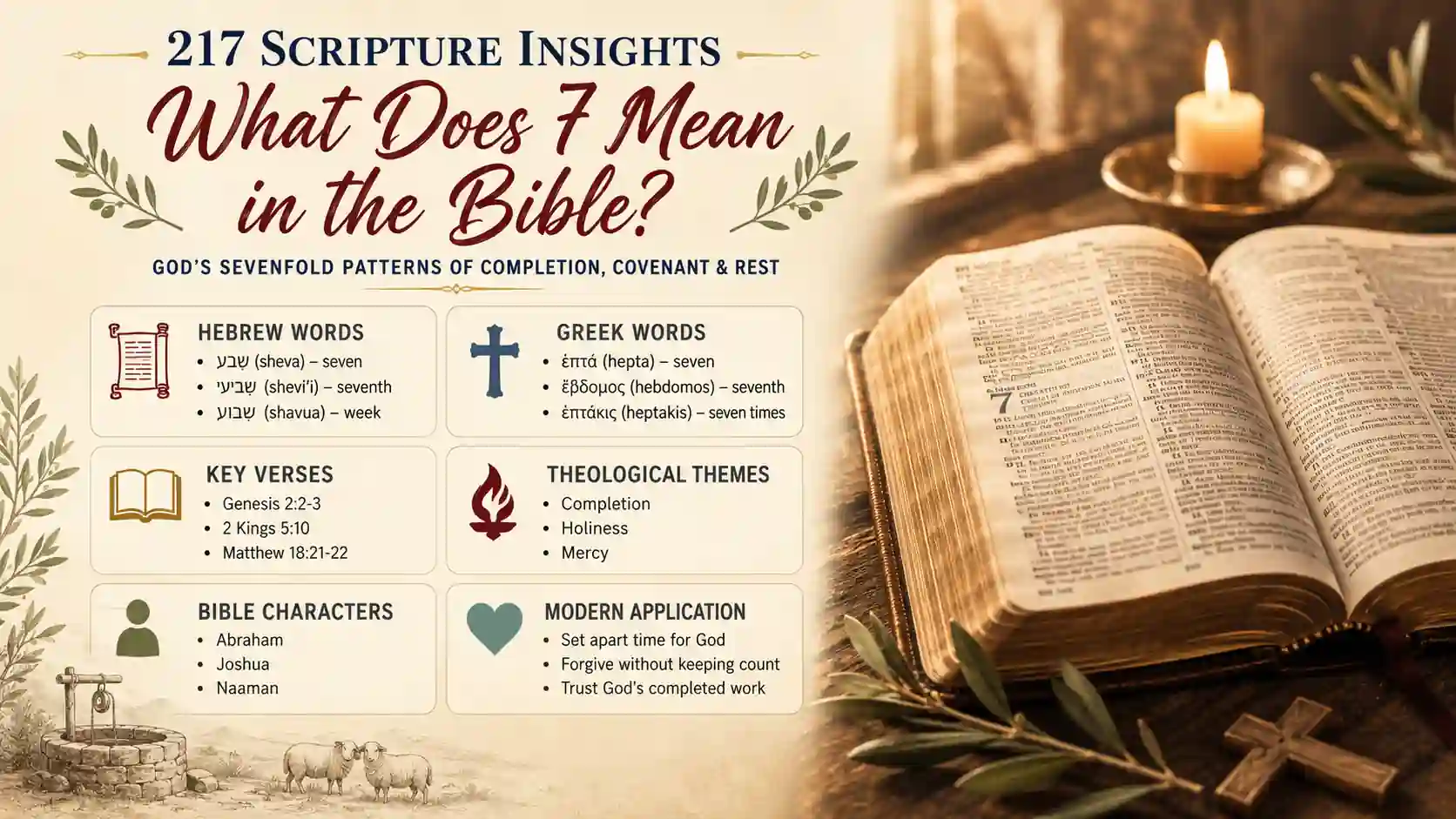
What does 7 mean in the Bible? Scripture repeatedly uses seven to express completion, consecration, covenant order, and the fullness of God’s appointed work. Its significance begins with the seven-day creation pattern and continues through Israel’s worship, Jesus’ teaching, and Revelation’s visions.
Yet seven is not a magical code attached to every occurrence. You should interpret each passage in its literary and historical setting. Biblical patterns become trustworthy when Scripture itself establishes them, especially through creation, Sabbath, covenant ceremonies, purification, judgment, forgiveness, and final restoration.
Key Scripture References About Seven
| Verse | Passage Snippet | Context |
|---|---|---|
| Genesis 2:2-3 | God blessed the seventh day | Creation reaches its appointed completion |
| Genesis 7:2-4 | Take seven pairs | Noah prepares for the flood |
| Genesis 21:28-31 | Seven ewe lambs | Abraham confirms a covenant oath |
| Leviticus 4:6 | Sprinkle it seven times | Priestly purification before the Lord |
| Joshua 6:4 | Seven priests, seven trumpets | Jericho falls through obedient faith |
| 2 Kings 5:10 | Wash seven times | Naaman receives cleansing from leprosy |
| Proverbs 24:16 | Falls seven times | The righteous repeatedly rises |
| Matthew 18:21-22 | Seventy-seven times | Jesus commands abundant forgiveness |
| Revelation 1:4 | The seven churches | Christ addresses congregations in Asia |
| Revelation 5:1 | Sealed with seven seals | God’s complete redemptive plan unfolds |
Seven in Major Bible Translations
| Verse | KJV | NIV | ESV | NASB |
|---|---|---|---|---|
| Genesis 2:2 | Seventh day God ended | By the seventh day | On the seventh day | By the seventh day |
| Genesis 2:3 | Blessed the seventh day | Blessed the seventh day | Blessed the seventh day | Blessed the seventh day |
| Joshua 6:4 | Seven priests shall bear | Have seven priests carry | Seven priests shall bear | Seven priests shall carry |
| 2 Kings 5:10 | Wash in Jordan seven times | Wash yourself seven times | Wash in the Jordan | Wash in the Jordan |
| Psalm 12:6 | Purified seven times | Purified seven times | Purified seven times | Refined seven times |
| Proverbs 24:16 | Falleth seven times | Falls seven times | Falls seven times | Falls seven times |
| Matthew 18:22 | Seventy times seven | Seventy-seven times | Seventy-seven times | Seventy-seven times |
| Revelation 1:4 | Seven churches in Asia | Seven churches in Asia | Seven churches in Asia | Seven churches in Asia |
The difference in Matthew 18:22 reflects two possible ways of understanding the Greek expression ἑβδομηκοντάκις ἑπτά, hebdomēkontakis hepta. Whether translated “seventy-seven times” or “seventy times seven,” Jesus’ point is not to establish a forgiveness limit. He rejects scorekeeping and commands a readiness to forgive that reflects God’s mercy.
People and Characters Associated with Seven
| Person | Role | Connection |
|---|---|---|
| God | Creator and covenant Lord | Completes creation within seven days |
| Noah | Preserver of his household | Receives seven-day warnings before the flood |
| Abraham | Covenant patriarch | Sets apart seven lambs at Beersheba |
| Jacob | Patriarch of Israel | Serves seven years for Rachel twice |
| Joseph | Governor and dream interpreter | Explains seven years of plenty and famine |
| Moses | Covenant mediator | Receives laws shaped by seven-day patterns |
| Joshua | Israel’s military leader | Leads the seven-day march around Jericho |
| Naaman | Aramean commander | Washes seven times and is cleansed |
| Jesus | Messiah and Son of God | Teaches limitless forgiveness with seven |
| John | Apostle and prophet | Records Revelation’s many groups of seven |
Original Hebrew and Greek Words for Seven
| Original Word | Transliteration | Strong’s # | Literal Meaning |
|---|---|---|---|
| שֶׁבַע | sheva or sheba | H7651 | Seven |
| שִׁבְעָה | shivah | H7651 | Seven, masculine form |
| שְׁבִיעִי | shevi‘i | H7637 | Seventh |
| שָׁבוּעַ | shavua | H7620 | Period of seven, week |
| שָׁבַע | shava | H7650 | To swear or take an oath |
| בְּאֵר שֶׁבַע | Be’er Sheva | H884 | Beersheba, well of seven or oath |
| ἑπτά | hepta | G2033 | Seven |
| ἕβδομος | hebdomos | G1442 | Seventh |
| ἑπτάκις | heptakis | G2034 | Seven times |
| ἑβδομηκοντάκις | hebdomēkontakis | G1441 | Seventy times or seventyfold |
The principal Hebrew numeral is שֶׁבַע, sheva, Strong’s H7651, while the common Greek numeral is ἑπτά, hepta, Strong’s G2033. The Hebrew verb שָׁבַע, shava, “to swear,” belongs to the same consonantal root family, helping explain the wordplay surrounding Abraham’s seven lambs and oath at Beersheba.
Biblical Concepts Related to Seven
| Concept | Connection | Supporting Verse |
|---|---|---|
| Creation | The seventh day completes creation | Genesis 2:2-3 |
| Sabbath | Every seventh day is holy rest | Exodus 20:8-11 |
| Covenant | Seven lambs witness Abraham’s oath | Genesis 21:28-31 |
| Purification | Blood is sprinkled seven times | Leviticus 16:14 |
| Forgiveness | Mercy exceeds calculated limits | Matthew 18:21-22 |
| Judgment | Seven trumpets announce divine judgments | Revelation 8:2 |
| Worship | Seven lamps burn before God | Exodus 25:37 |
| Providence | Seven years of plenty precede famine | Genesis 41:29-30 |
| Restoration | Naaman washes seven times | 2 Kings 5:14 |
| Praise | The psalmist praises seven times daily | Psalm 119:164 |
Historical and Cultural Context of Seven
| Aspect | Detail | Biblical Source |
|---|---|---|
| Ancient week | Israel measured time in seven-day cycles | Exodus 16:26 |
| Sabbath rest | The seventh day interrupted ordinary labor | Exodus 20:10 |
| Agricultural rhythm | Every seventh year rested the land | Leviticus 25:4 |
| Jubilee count | Seven sabbatical cycles preceded Jubilee | Leviticus 25:8-10 |
| Festival calendar | Unleavened Bread lasted seven days | Exodus 12:15 |
| Priestly ritual | Consecration continued for seven days | Leviticus 8:33 |
| Mourning practice | Job’s friends sat silently seven days | Job 2:13 |
| Wedding custom | Wedding celebrations could last seven days | Judges 14:12 |
| Military ceremony | Jericho’s procession followed sevens | Joshua 6:4 |
| Apocalyptic writing | Revelation organizes visions through sevens | Revelation 1:4 |
Theological Themes Expressed Through Seven
| Theme | Explanation | Scripture |
|---|---|---|
| Completion | God brings his appointed work to fullness | Genesis 2:2 |
| Holiness | God sets the seventh day apart | Genesis 2:3 |
| Rest | Completed work leads to sacred rest | Exodus 20:11 |
| Covenant faithfulness | God binds promises to his people | Genesis 21:31 |
| Cleansing | Repetition emphasizes thorough purification | Leviticus 14:7 |
| Obedience | Israel follows God’s unusual instructions | Joshua 6:15-16 |
| Mercy | Forgiveness must not be reduced to arithmetic | Matthew 18:22 |
| Sovereignty | God governs years of abundance and famine | Genesis 41:32 |
| Judgment | Divine justice unfolds completely | Revelation 15:1 |
| New creation | Revelation moves toward restored creation | Revelation 21:1-5 |
Modern Application of Seven for Believers
| Area | Practice | Scripture |
|---|---|---|
| Work | Receive rest as a gift, not laziness | Genesis 2:3 |
| Worship | Set apart regular time for God | Exodus 20:8 |
| Forgiveness | Refuse to keep a ledger of offenses | Matthew 18:22 |
| Perseverance | Rise again after repeated failure | Proverbs 24:16 |
| Prayer | Pray faithfully rather than superstitiously | Matthew 6:7-9 |
| Obedience | Follow God when his way seems unusual | Joshua 6:20 |
| Repentance | Seek complete cleansing before God | Psalm 51:2 |
| Stewardship | Build rhythms of work, rest, and release | Leviticus 25:4 |
| Trust | Remember that God completes his purposes | Philippians 1:6 |
| Hope | Look toward God’s final restoration | Revelation 21:5 |
What Does 7 Mean in the Bible from Creation to Sabbath?
The first major pattern of seven appears in Genesis 1:1 through 2:3. God forms and fills creation through six days, then blesses and sanctifies the seventh. The day is holy because God’s creative work has reached its intended goal, not because he has become physically weary.
This foundation joins seven with completion, holiness, order, and rest. Later Sabbath commandments look back to creation and teach Israel to trust God’s provision. Your study should therefore begin with God’s finished work rather than with speculative theories about secret numerical codes.
שֶׁבַע Sheva and the Covenant Oath at Beersheba
Genesis 21 places seven lambs beside an oath between Abraham and Abimelech. Abraham explains that the animals serve as a witness that he dug the disputed well. The place is called בְּאֵר שֶׁבַע, Be’er Sheva, a name connected with both “well of seven” and “well of the oath.”
This account does not prove that every seven means covenant. It does show that Hebrew storytelling can use the relationship between שֶׁבַע, sheva, and שָׁבַע, shava, to reinforce solemn commitment. Seven may mark a promise as publicly confirmed and covenantally weighty.
Sevenfold Cleansing in the Torah and the Prophets
Leviticus repeatedly prescribes sevenfold sprinkling in rites of purification, consecration, and atonement. The repeated action does not increase the power of blood through mathematics. It presents the cleansing as ceremonially thorough according to the command God gave Israel’s priests.
A similar pattern appears when Naaman dips seven times in the Jordan. The water itself is not magical, and the number is not a technique for controlling God. Naaman is healed when he humbly obeys the prophetic word, showing that divine grace overturns pride and calls for trusting submission.
Ἑπτά Hepta and the Fullness of Revelation
Revelation contains seven churches, seals, trumpets, bowls, spirits, lampstands, and stars. These are not random decorations. John uses ἑπτά, hepta, within an apocalyptic structure that presents God’s rule, judgment, witness, and saving purpose in comprehensive terms.
The seven churches were genuine first-century congregations in Roman Asia, yet their placement within a book saturated with sevenfold patterns gives them wider representative force. Revelation’s symbolism directs you toward the fullness of God’s Spirit, the sufficiency of Christ’s authority, and the certain completion of God’s redemptive plan.
Questions About the Biblical Meaning of Seven
Does שֶׁבַע, sheva, always symbolize spiritual perfection?
No. It can be an ordinary number, and its symbolic force must be established by the passage’s context.
Why do some Bibles translate Matthew 18:22 as “seventy-seven” and others as “seventy times seven”?
The Greek phrase permits both renderings, but either translation communicates forgiveness that refuses to keep count.
Is the Hebrew word for seven related to the word for swearing an oath?
שֶׁבַע, sheva, and שָׁבַע, shava, share a Hebrew root relationship highlighted by the Beersheba account.
Do the seven spirits in Revelation describe seven different Holy Spirits?
They are commonly understood as symbolic language for the fullness and perfect activity of the one Holy Spirit.
Should you use seven as a lucky number or a formula for answered prayer?
No. Scripture uses seven within God’s revelation, but it never teaches believers to treat the number as a magical power.