
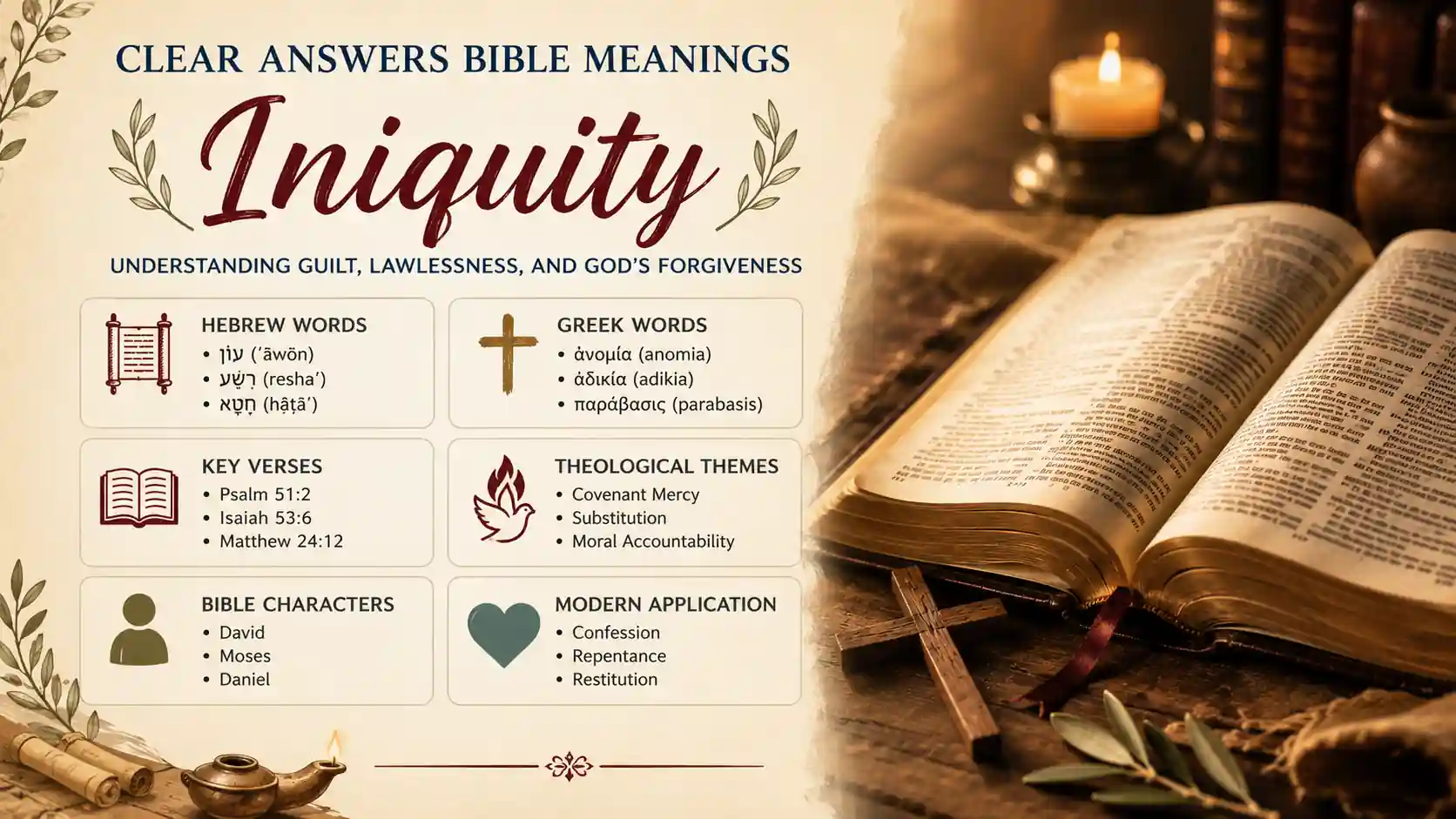
What does iniquity mean in the Bible? Iniquity is more than an isolated mistake. Scripture presents it as moral crookedness that produces guilt, damages relationships, and carries painful consequences. The principal Hebrew word, עָוֹן (ʿāwōn), can describe the corrupt act, the guilt arising from it, and the burden that follows.
In the New Testament, words such as ἀνομία (anomia) and ἀδικία (adikia) emphasize lawlessness, injustice, and conduct opposed to God’s righteous character. Your study of iniquity therefore leads directly to repentance, forgiveness, justice, and restoration.
Key Iniquity Scripture References
| Verse | Passage Snippet | Context |
|---|---|---|
| Exodus 34:7 | Forgiving iniquity and transgression | God reveals His merciful character |
| Leviticus 16:21 | All their iniquities | Israel’s guilt placed on the scapegoat |
| Numbers 14:18 | Forgiving iniquity | Moses appeals to covenant mercy |
| Psalm 32:5 | You forgave my iniquity | David confesses and receives pardon |
| Psalm 51:2 | Wash me from my iniquity | David seeks cleansing after grave sin |
| Isaiah 53:6 | Iniquity laid upon Him | The servant bears human guilt |
| Daniel 9:5 | We have committed iniquity | Daniel confesses Israel’s covenant failure |
| Matthew 7:23 | Workers of iniquity | Jesus rejects lawless profession |
| Matthew 24:12 | Iniquity shall abound | Lawlessness causes love to grow cold |
| Titus 2:14 | Redeem us from all iniquity | Christ forms a purified people |
Iniquity Bible Translation Comparison
| Verse | KJV | NIV | ESV | NASB |
|---|---|---|---|---|
| Exodus 34:7 | iniquity | wickedness | iniquity | iniquity |
| Leviticus 16:21 | iniquities | wickedness | iniquities | iniquities |
| Psalm 32:5 | iniquity | guilt | iniquity | guilt |
| Psalm 51:2 | iniquity | iniquity | iniquity | guilt |
| Isaiah 53:5 | iniquities | iniquities | iniquities | wrongdoings |
| Isaiah 53:6 | iniquity | iniquity | iniquity | wrongdoing |
| Daniel 9:5 | iniquity | wicked | wrong | wickedly |
| Matthew 7:23 | iniquity | evildoers | lawlessness | lawlessness |
| Matthew 24:12 | iniquity | wickedness | lawlessness | lawlessness |
| Titus 2:14 | iniquity | wickedness | lawlessness | lawless deed |
People and Characters Associated with Iniquity
| Person | Role | Connection |
|---|---|---|
| Adam | Humanity’s representative | Disobedience introduced condemnation and corruption |
| Cain | First murderer | His guilt became a burden he could not bear |
| Aaron | High priest | Confessed Israel’s iniquities on the scapegoat |
| Moses | Covenant mediator | Pleaded for forgiveness of Israel’s iniquity |
| David | King and psalmist | Confessed iniquity after adultery and murder |
| Saul | Rejected king | Samuel compared rebellion with idolatrous iniquity |
| Isaiah | Prophet | Announced atonement and removal of guilt |
| Daniel | Exilic prophet | Confessed national iniquity before God |
| Jesus | Suffering servant and Messiah | Bore guilt and redeems from lawlessness |
| Paul | Apostle | Taught justification and freedom from unrighteousness |
Original Hebrew and Greek Iniquity Words
| Original Word | Transliteration | Strong’s # | Literal Meaning |
|---|---|---|---|
| עָוֹן | ʿāwōn | H5771 | Perversity, guilt, punishment |
| עָוָה | ʿāwâ | H5753 | To bend, twist, pervert |
| אָוֶן | ʾāwen | H205 | Trouble, wickedness, emptiness |
| רֶשַׁע | reshaʿ | H7562 | Wickedness, guilt |
| חָטָא | ḥāṭāʾ | H2398 | To miss, sin, incur guilt |
| ἀνομία | anomia | G458 | Lawlessness, violation of law |
| ἀδικία | adikia | G93 | Injustice, unrighteousness |
| ἀδίκημα | adikēma | G92 | A wrong or unjust deed |
| παράβασις | parabasis | G3847 | Transgression, stepping beyond |
| ἁμαρτία | hamartia | G266 | Sin, failure, missing the mark |
The Hebrew noun עָוֹן (ʿāwōn, H5771) joins the ideas of a crooked deed, resulting guilt, and its consequences. The Greek noun ἀνομία (anomia, G458) stresses rejection or violation of divine law, while ἀδικία (adikia, G93) identifies conduct contrary to righteousness and justice.
Related Biblical Concepts of Iniquity
| Concept | Connection | Supporting Verse |
|---|---|---|
| Sin | Broad category of moral failure | Romans 3:23 |
| Transgression | Deliberate crossing of a boundary | Psalm 32:1 |
| Guilt | Liability produced by wrongdoing | Leviticus 5:17 |
| Lawlessness | Rejection of God’s moral rule | 1 John 3:4 |
| Unrighteousness | Opposition to divine justice | Romans 1:18 |
| Rebellion | Defiant resistance to God | 1 Samuel 15:23 |
| Confession | Honest acknowledgment of guilt | Psalm 32:5 |
| Atonement | God’s provision for guilt | Leviticus 16:30 |
| Forgiveness | Removal of the guilty burden | Exodus 34:7 |
| Repentance | Turning from crooked ways | Isaiah 55:7 |
Historical and Cultural Context of Iniquity
| Aspect | Detail | Biblical Source |
|---|---|---|
| Covenant law | Iniquity violated Israel’s covenant obligations | Deuteronomy 29:18 |
| Priestly sacrifice | Offerings addressed sin and guilt | Leviticus 5:6 |
| Day of Atonement | National guilt was confessed annually | Leviticus 16:21 |
| Scapegoat ritual | Iniquities were symbolically carried away | Leviticus 16:22 |
| Family consequences | Parental evil could affect later generations | Exodus 20:5 |
| Personal accountability | Each sinner remained responsible before God | Ezekiel 18:20 |
| Prophetic lawsuits | Prophets exposed covenant corruption | Micah 3:8 |
| Exile | Persistent rebellion brought covenant judgment | Daniel 9:11 |
| Temple worship | Forgiveness was sought through prayer and sacrifice | 2 Chronicles 7:14 |
| Messianic hope | The servant would bear human guilt | Isaiah 53:11 |
Theological Themes of Iniquity
| Theme | Explanation | Scripture |
|---|---|---|
| God’s holiness | Crookedness cannot harmonize with His character | Habakkuk 1:13 |
| Human corruption | Iniquity arises from disordered hearts | Psalm 53:1 |
| Moral accountability | People answer for chosen wrongdoing | Ezekiel 18:30 |
| Corporate guilt | Communities may share patterns of rebellion | Daniel 9:5 |
| Divine justice | Persistent evil receives righteous judgment | Psalm 7:14–16 |
| Covenant mercy | God forgives confessed iniquity | Exodus 34:7 |
| Substitution | Another bears the sinner’s burden | Isaiah 53:6 |
| Justification | God declares believers righteous in Christ | Romans 4:5–8 |
| Sanctification | Grace trains believers to reject lawlessness | Titus 2:11–14 |
| Final cleansing | God’s people will be freed from corruption | Revelation 21:27 |
Modern Application of Iniquity for Believers
| Area | Practice | Scripture |
|---|---|---|
| Self-examination | Ask God to reveal crooked motives | Psalm 139:23–24 |
| Confession | Name wrongdoing honestly before God | 1 John 1:9 |
| Repentance | Abandon sinful patterns and return | Isaiah 55:7 |
| Restitution | Repair damage where possible | Luke 19:8 |
| Justice | Refuse exploitation and partiality | Micah 6:8 |
| Speech | Reject deceit and harmful words | Ephesians 4:25 |
| Relationships | Forgive as you have been forgiven | Colossians 3:13 |
| Accountability | Receive correction from mature believers | James 5:16 |
| Worship | Approach God through Christ’s cleansing | Hebrews 10:19–22 |
| Hope | Trust Christ to redeem and purify | Titus 2:14 |
What Does Iniquity Mean in the Bible Through עָוֹן?
The Hebrew עָוֹן (ʿāwōn) portrays evil as something twisted rather than morally straight. A person bends what God designed as good, then carries the guilt and consequences of that distortion. This helps explain why the same word can refer to the offense, the culpability, or the punishment connected with it.
Cain illustrates this range when he says his עָוֹן is too great to bear in Genesis 4:13. Depending on how the statement is understood, he may be speaking of his guilt, his punishment, or both. Scripture does not always separate wrongdoing from its destructive fruit as sharply as modern readers do.
Leviticus 16 and the Removal of Israel’S Iniquity
On the Day of Atonement, Aaron confessed the iniquities, transgressions, and sins of Israel over the living goat. The animal was then sent into the wilderness, visibly portraying the removal of covenant guilt from the community. The ritual taught that forgiveness required God’s provision, not human denial.
Psalm 103:12 later celebrates the same truth poetically, declaring that God removes transgressions far from His people. The ceremony did not treat iniquity as harmless. It displayed both its seriousness and the mercy of the God who provides cleansing for repentant worshipers.
Isaiah 53 and the Servant Who Bears Iniquity
Isaiah 53 brings the language of guilt and sacrifice into its clearest messianic focus. Humanity has wandered like sheep, yet the Lord places the iniquity of the many upon His servant. The servant does not merely sympathize with sinners. He bears the burden they cannot remove themselves.
The New Testament identifies Jesus with this suffering servant. His death reveals that divine forgiveness is neither sentimental nor unjust. God deals truthfully with guilt while graciously providing the substitute. Through Christ, you are not only pardoned but also called away from the crooked life that required His sacrifice.
Ἀνομία, Ἀδικία, And the New Testament Call to Righteousness
The Greek ἀνομία (anomia) literally communicates lawlessness and can describe contempt for God’s will. In Matthew 7:23, religious activity cannot compensate for a life characterized by lawlessness. Jesus warns that impressive claims and spiritual works are not substitutes for knowing Him and doing the Father’s will.
The related term ἀδικία (adikia) emphasizes injustice and unrighteousness. Together, these words show that iniquity includes both rebellion against God and wrong committed against others. The gospel therefore produces worship, integrity, compassion, and justice rather than merely changing your religious vocabulary.
Frequently Asked Questions About Iniquity
Does עָוֹן mean sin, guilt, or punishment?
It can express all three, with the immediate biblical context showing whether the emphasis is the crooked act, its guilt, or its consequences.
Why does Matthew 7:23 translate ἀνομία as “iniquity” in the KJV but “lawlessness” in newer versions?
“Iniquity” reflects moral wickedness, while “lawlessness” more directly displays the Greek word’s connection with violating or disregarding law.
Does Exodus 20:5 teach that children are personally guilty for their parents’ iniquity?
No. It warns that rebellion produces generational consequences, while Ezekiel 18:20 affirms that each person is accountable for his or her own sin.
How can God forgive iniquity and still be perfectly just?
Scripture answers through atonement, ultimately fulfilled when Christ bears guilt and God remains both just and the justifier of believers.
How should you respond when Scripture exposes iniquity in your life?
Confess it without excuse, turn from the crooked pattern, receive Christ’s cleansing, and pursue restitution and obedient living.