
What does righteous mean in the Bible? Scripture uses the word for what is right, just, faithful, and consistent with God’s holy character. A righteous person stands in a right relationship with God and expresses that relationship through upright conduct toward others.
Yet biblical righteousness is not merely respectable behavior. It includes God’s just rule, His covenant faithfulness, His gracious acceptance of believers, and the transformed life that follows faith. Your study must therefore consider both God’s gift of righteousness and His call to practice righteousness.
Key Righteous Scripture References
| Verse | Passage Snippet | Context |
|---|---|---|
| Genesis 6:9 | “Noah was a righteous man” | Noah trusts God amid corruption |
| Genesis 15:6 | “Counted it to him as righteousness” | Abram believes God’s promise |
| Deuteronomy 6:25 | “It will be righteousness for us” | Israel obeys covenant commands |
| Psalm 1:6 | “The way of the righteous” | Two contrasting paths |
| Proverbs 21:3 | “Righteousness and justice” | Right conduct exceeds ritual |
| Isaiah 53:11 | “My righteous servant” | The servant bears human guilt |
| Matthew 5:6 | “Hunger and thirst for righteousness” | Jesus describes kingdom desire |
| Romans 3:22 | “Righteousness of God through faith” | God justifies believers in Christ |
| James 2:23 | “Counted to him as righteousness” | Abraham’s faith becomes visible |
| 1 John 3:7 | “Practices righteousness is righteous” | Conduct reveals spiritual allegiance |
These passages show that righteousness can describe character, conduct, judicial standing, covenant loyalty, and conformity to God’s will. Genesis 15:6 becomes especially important because Paul and James both use Abraham to explain living faith.
Righteous Bible Translation Comparison
| Verse | KJV | NIV | ESV | NASB |
|---|---|---|---|---|
| Genesis 6:9 | “just man” | “righteous man” | “righteous man” | “righteous man” |
| Genesis 15:6 | “counted it…for righteousness” | “credited it…as righteousness” | “counted it…as righteousness” | “credited it…as righteousness” |
| Psalm 1:6 | “way of the righteous” | “way of the righteous” | “way of the righteous” | “way of the righteous” |
| Proverbs 10:2 | “righteousness delivereth” | “righteousness delivers” | “righteousness delivers” | “righteousness rescues” |
| Habakkuk 2:4 | “just shall live by his faith” | “righteous person will live” | “righteous shall live by his faith” | “righteous one will live by faith” |
| Matthew 1:19 | “just man” | “faithful to the law” | “just man” | “righteous man” |
| Matthew 5:6 | “thirst after righteousness” | “thirst for righteousness” | “thirst for righteousness” | “thirst for righteousness” |
| Romans 1:17 | “just shall live by faith” | “righteous will live by faith” | “righteous shall live by faith” | “righteous one will live by faith” |
| James 5:16 | “righteous man” | “righteous person” | “righteous person” | “righteous person” |
The comparison reveals why your study should look beyond one English term. The KJV often translates the same word as “just,” while modern translations frequently use “righteous.” Matthew 1:19 also shows interpretive variation. Joseph’s righteousness involved respect for God’s law joined with mercy toward Mary.
People and Characters Associated with Righteousness
| Person | Role | Connection |
|---|---|---|
| Noah | Flood survivor | Called righteous and blameless |
| Abraham | Covenant patriarch | Belief counted as righteousness |
| Lot | Resident of Sodom | Called righteous despite serious weakness |
| Job | Suffering worshiper | Described as upright and God-fearing |
| David | King and psalmist | Appeals to God’s righteous judgment |
| Joseph | Husband of Mary | Acts justly and compassionately |
| Zechariah | Priest | Walks faithfully in God’s commands |
| Elizabeth | Mother of John | Called righteous before God |
| Simeon | Temple worshiper | Called righteous and devout |
| Jesus Christ | Righteous Servant | Fulfills righteousness and bears sin |
These lives prevent a shallow definition. Righteous people are not portrayed as naturally flawless. Noah, Abraham, Lot, Job, and David all demonstrate human limitations. Their stories show people responding to God in faith, while Jesus alone embodies righteousness without sin.
Original Righteous Hebrew and Greek Words
| Original Word | Transliteration | Strong’s # | Literal Meaning |
|---|---|---|---|
| צַדִּיק | ṣaddîq | H6662 | Righteous, just |
| צֶדֶק | ṣedeq | H6664 | Rightness, justice |
| צְדָקָה | ṣĕdāqâ | H6666 | Righteousness, justice |
| צָדַק | ṣādaq | H6663 | Be right, be justified |
| יָשָׁר | yāšār | H3477 | Upright, straight |
| תָּמִים | tāmîm | H8549 | Complete, blameless |
| δίκαιος | dikaios | G1342 | Righteous, just |
| δικαιοσύνη | dikaiosynē | G1343 | Righteousness, justice |
| δικαιόω | dikaioō | G1344 | Declare righteous, justify |
| δικαίωμα | dikaiōma | G1345 | Righteous requirement |
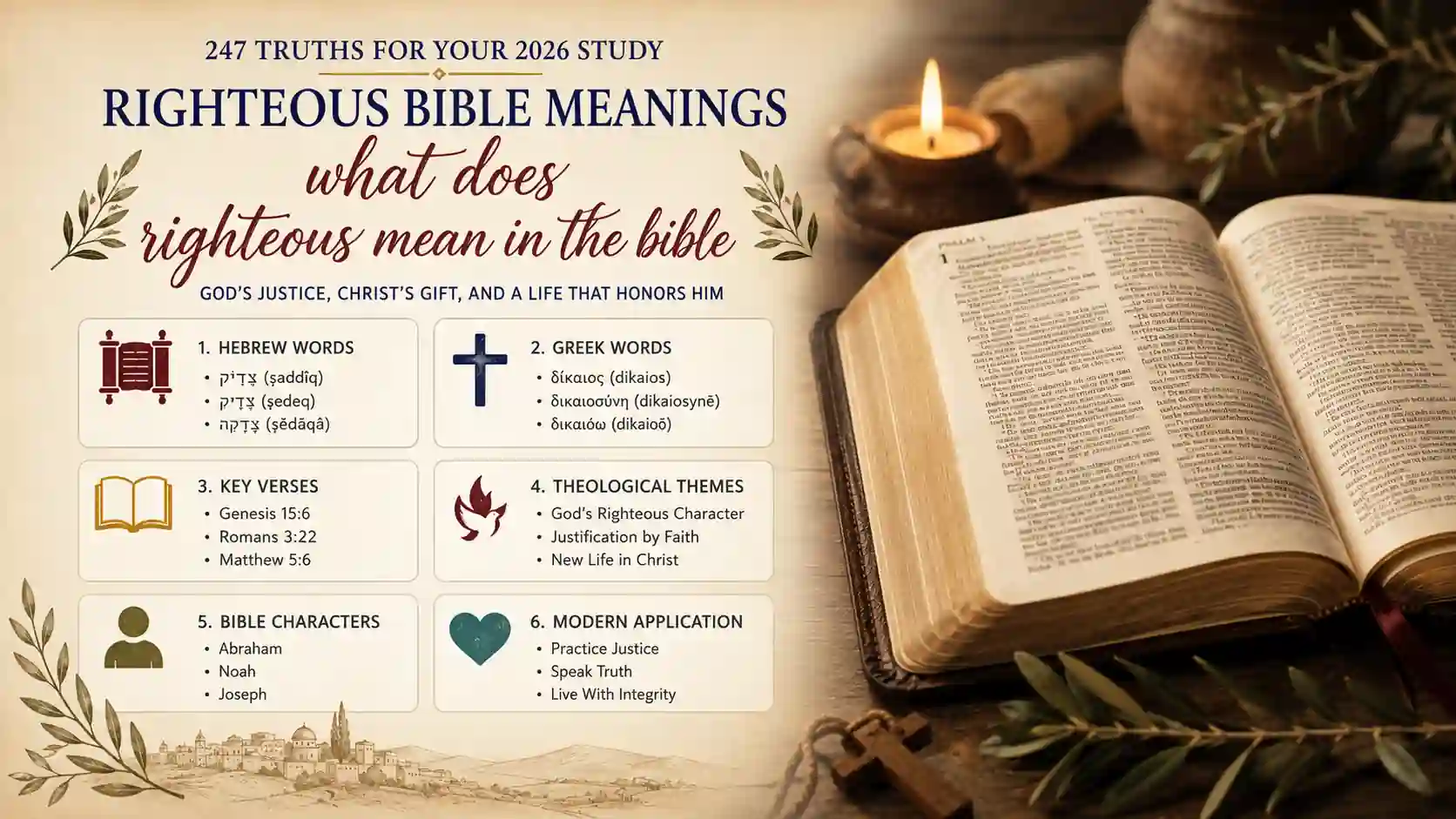
The principal Hebrew adjective is צַדִּיק, ṣaddîq, Strong’s H6662. It describes someone or something that is just, lawful, right, or in the right. The main New Testament adjective is δίκαιος, dikaios, Strong’s G1342, meaning righteous, just, or upright.
The related nouns צְדָקָה, ṣĕdāqâ, and δικαιοσύνη, dikaiosynē, can refer to righteous character, justice, right conduct, or a right standing. The verb δικαιόω, dikaioō, often carries a courtroom sense of declaring or recognizing someone as righteous.
Related Righteous Biblical Concepts
| Concept | Connection | Supporting Verse |
|---|---|---|
| Justice | Righteousness gives impartial judgment | Psalm 89:14 |
| Faith | Trust receives God’s righteous verdict | Genesis 15:6 |
| Justification | God declares believers righteous | Romans 5:1 |
| Holiness | Righteous living reflects God’s purity | Ephesians 4:24 |
| Obedience | Faithful conduct follows God’s commands | Deuteronomy 6:25 |
| Mercy | Biblical justice protects the vulnerable | Zechariah 7:9 |
| Covenant | God acts faithfully toward His promises | Nehemiah 9:8 |
| Repentance | Turning from sin restores right conduct | Ezekiel 18:21 |
| Wisdom | The righteous follow God’s ordered way | Proverbs 2:20 |
| Peace | Righteousness produces peaceful fruit | Isaiah 32:17 |
Righteousness and justice are frequently paired because the biblical idea is relational and public. It concerns how judges rule, how rulers govern, how neighbors treat one another, and how God defends those who have been wronged.
Historical and Cultural Context of Righteousness
| Aspect | Detail | Biblical Source |
|---|---|---|
| Ancient courts | Judges declared the innocent righteous | Deuteronomy 25:1 |
| Covenant law | Israel’s conduct reflected loyalty to God | Deuteronomy 6:25 |
| Honest commerce | Accurate weights expressed righteousness | Leviticus 19:36 |
| Care for the poor | Justice included practical generosity | Deuteronomy 24:13 |
| Royal duty | Kings defended the weak and oppressed | Psalm 72:1–4 |
| Prophetic critique | Worship without justice was condemned | Isaiah 1:11–17 |
| Wisdom teaching | Two ways contrasted righteous and wicked | Psalm 1:1–6 |
| Temple worship | Worshipers sought clean hands and hearts | Psalm 24:3–5 |
| Roman courtroom | Justification used legal imagery | Romans 3:24 |
| Second Temple hope | Israel awaited righteous deliverance | Luke 2:25 |
In Israel’s world, righteousness was not confined to private morality. A righteous judge issued fair verdicts. A righteous merchant used honest measurements. A righteous king defended the poor. A righteous worshiper approached God sincerely rather than hiding injustice beneath religious ceremonies.
The prophets repeatedly challenged people who maintained sacrifices while exploiting their neighbors. Their message was not that worship was worthless, but that genuine worship must agree with God’s righteous character.
Righteous Theological Themes
| Theme | Explanation | Scripture |
|---|---|---|
| God’s character | God is always morally right and just | Psalm 11:7 |
| Human guilt | No sinner is righteous by nature | Romans 3:10 |
| Faith credited | Abraham receives righteousness through belief | Genesis 15:6 |
| Christ’s obedience | Jesus fulfills God’s righteous purpose | Romans 5:18–19 |
| Justification | God declares the believer righteous | Romans 3:24–26 |
| Union with Christ | Christ becomes righteousness for believers | 1 Corinthians 1:30 |
| New life | Grace produces righteous conduct | Titus 2:11–12 |
| Final judgment | God judges the world righteously | Acts 17:31 |
| Kingdom hope | Righteousness marks God’s reign | Matthew 6:33 |
| New creation | Righteousness dwells in the renewed world | 2 Peter 3:13 |
The Bible never solves human unrighteousness by pretending sin is insignificant. At the cross, God remains just while justifying those who trust Jesus. Christ bears sin’s judgment, and believers receive a standing they could never earn.
This gift does not make obedience unnecessary. It gives obedience a new foundation. You do not practice righteousness to purchase God’s acceptance. You pursue righteousness because grace has reconciled you to God and is renewing your life.
Modern Righteous Application for Believers
| Area | Practice | Scripture |
|---|---|---|
| Faith | Trust Christ rather than personal merit | Philippians 3:9 |
| Prayer | Confess sin and seek a clean heart | Psalm 51:10 |
| Speech | Speak truth without manipulation | Ephesians 4:25 |
| Work | Act honestly when unseen | Colossians 3:23 |
| Money | Use fair and transparent practices | Proverbs 11:1 |
| Relationships | Show justice, mercy, and humility | Micah 6:8 |
| Conflict | Refuse revenge and pursue peace | Romans 12:17–18 |
| Compassion | Defend people who lack power | Proverbs 31:8–9 |
| Temptation | Present yourself to God for righteous use | Romans 6:13 |
| Hope | Await the world where righteousness dwells | 2 Peter 3:13 |
Modern righteousness is visible in ordinary decisions. It shapes how you handle money, fulfill promises, speak about absent people, respond to mistreatment, and treat those who cannot advance your interests.
It also guards you from moral pride. Your confidence rests in Christ, not in comparison with weaker neighbors. At the same time, Christ’s grace trains you to reject ungodliness and live with integrity.
What Does Righteous Mean in the Bible Through צַדִּיק
The Hebrew word צַדִּיק, ṣaddîq, identifies someone who is in the right according to a legitimate standard. Because God is the supreme judge, His character and revealed will establish that standard. The righteous person respects God’s order rather than inventing a private definition of goodness.
In legal passages, the righteous person may be the innocent party who should not be condemned. In wisdom literature, the righteous person follows the path of life. In narrative, the term can summarize a person’s faithful orientation without claiming that the person never sins.
Abraham and Covenant Righteousness in Genesis 15
Genesis 15 places righteousness within God’s covenant promise. Abram has no visible heir, yet he believes what God says. God counts that faith as righteousness before circumcision and before the giving of the Mosaic law.
Paul uses this sequence to show that justification rests on faith rather than human achievement. James later emphasizes that Abraham’s actions confirmed the reality of that faith. Paul opposes earning; James opposes empty profession. Both direct your attention to a faith that genuinely relies on God.
δικαιοσύνη And the Righteousness Revealed in Christ
In Romans, δικαιοσύνη, dikaiosynē, carries both moral and saving significance. God reveals His righteousness by judging sin justly and providing redemption through Jesus. The gospel does not portray God as lowering His standard. It reveals how He saves sinners without ceasing to be righteous.
The justified believer receives peace with God and begins a new life of obedience. Scripture therefore distinguishes righteous standing from righteous practice without separating them. Acceptance is God’s gracious verdict, while transformed conduct is the fitting fruit of that verdict.
The Righteous Way in Psalms, Proverbs, and the Prophets
Psalms and Proverbs portray righteousness as a path. The righteous person receives instruction, controls speech, practices generosity, rejects dishonest gain, and depends on God. This path may include suffering, since present prosperity is not a reliable measure of God’s approval.
The prophets broaden the picture by confronting corrupt courts, oppressive rulers, and empty worship. They teach you that personal devotion and social justice belong together. Loving righteousness means honoring God in prayer while also acting truthfully, mercifully, and fairly toward your neighbor.
Questions About Biblical Righteousness
Does צַדִּיק, ṣaddîq, mean that Noah and Job were sinless?
No. It describes their faithful and upright orientation toward God, not absolute moral perfection.
Why does the KJV say “just” where other translations say “righteous”?
“Just” and “righteous” commonly translate the same Hebrew and Greek word families, with context determining the best English wording.
How can Romans 3 say no one is righteous while Genesis 6 calls Noah righteous?
Romans denies righteousness independent of grace, while Genesis describes Noah’s covenant relationship and faithful conduct before God.
Do Paul and James disagree about Abraham being counted righteous?
No. Paul rejects righteousness earned by works, while James rejects a claimed faith that never produces obedient action.
How should δικαιοσύνη, dikaiosynē, shape your daily life?
Receive righteousness through faith in Christ, then express that gift through truthful, merciful, just, and obedient living.