
What does atonement mean in the Bible? Atonement is God’s gracious work of dealing with human sin so that guilty people may be forgiven, cleansed, and reconciled to him. Scripture develops this truth through sacrifices, priestly rituals, covenant promises, and prophetic hope.
The biblical story reaches its fulfillment in Jesus Christ, whose death accomplishes what Israel’s repeated offerings anticipated. As you study atonement, you encounter both the seriousness of sin and the depth of divine mercy. God provides the sacrifice, removes guilt, restores fellowship, and opens the way into his holy presence.
Key Atonement Scripture References
| Verse | Passage Snippet | Context |
|---|---|---|
| Exodus 30:10 | “Make an atonement upon the horns” | Annual cleansing of the incense altar |
| Leviticus 1:4 | “Accepted for him to make atonement” | The worshiper identifies with the burnt offering |
| Leviticus 16:16 | “Make an atonement for the holy place” | Sin contaminates Israel’s sanctuary |
| Leviticus 16:30 | “To cleanse you” | Day of Atonement purification |
| Leviticus 17:11 | “The blood that makes atonement” | Life in the blood is given by God |
| Isaiah 53:5 | “Wounded for our transgressions” | The Servant suffers for sinners |
| Romans 3:25 | Christ presented as an atoning sacrifice | God demonstrates his righteousness |
| Romans 5:11 | “Received the atonement” | Reconciliation comes through Christ |
| Hebrews 9:12 | “Having obtained eternal redemption” | Christ enters by his own blood |
| 1 John 2:2 | “Propitiation for our sins” | Christ’s sufficiency for the world |
Atonement Bible Translation Comparison
| Verse | KJV | NIV | ESV | NASB |
|---|---|---|---|---|
| Leviticus 1:4 | “Make atonement for him” | “Make atonement for you” | “Make atonement for him” | “Make atonement on his behalf” |
| Leviticus 16:30 | “Cleanse you” | “Cleanse you” | “Cleanse you” | “Cleanse you” |
| Leviticus 17:11 | “Atonement for the soul” | “Atonement for one’s life” | “Atonement by the life” | “Atonement by reason of the life” |
| Isaiah 53:5 | “Bruised for our iniquities” | “Crushed for our iniquities” | “Crushed for our iniquities” | “Crushed for our wrongdoings” |
| Romans 3:25 | “Propitiation” | “Sacrifice of atonement” | “Propitiation” | “Propitiation” |
| Romans 5:11 | “Received the atonement” | “Received reconciliation” | “Received reconciliation” | “Received the reconciliation” |
| Hebrews 2:17 | “Reconciliation for the sins” | “Atonement for the sins” | “Propitiation for the sins” | “Propitiation for the sins” |
| 1 John 2:2 | “Propitiation” | “Atoning sacrifice” | “Propitiation” | “Propitiation” |
| 1 John 4:10 | “Propitiation for our sins” | “Atoning sacrifice for our sins” | “Propitiation for our sins” | “Propitiation for our sins” |
People and Characters Associated with Atonement
| Person | Role | Connection |
|---|---|---|
| Adam | Humanity’s covenant representative | His disobedience brings sin and death |
| Moses | Covenant mediator | Receives Israel’s sacrificial instructions |
| Aaron | First high priest | Enters the sanctuary on the Day of Atonement |
| Eleazar | Aaronic priest | Participates in purification rituals |
| David | King and psalmist | Seeks cleansing and forgiven guilt |
| Isaiah’s Servant | Suffering representative | Bears the sins of many |
| John the Baptist | Prophetic witness | Identifies Jesus as God’s Lamb |
| Jesus Christ | High Priest and sacrifice | Offers himself once for all |
| Paul | Apostle and interpreter | Explains justification and reconciliation |
| John | Apostle and witness | Calls Christ the propitiation for sin |
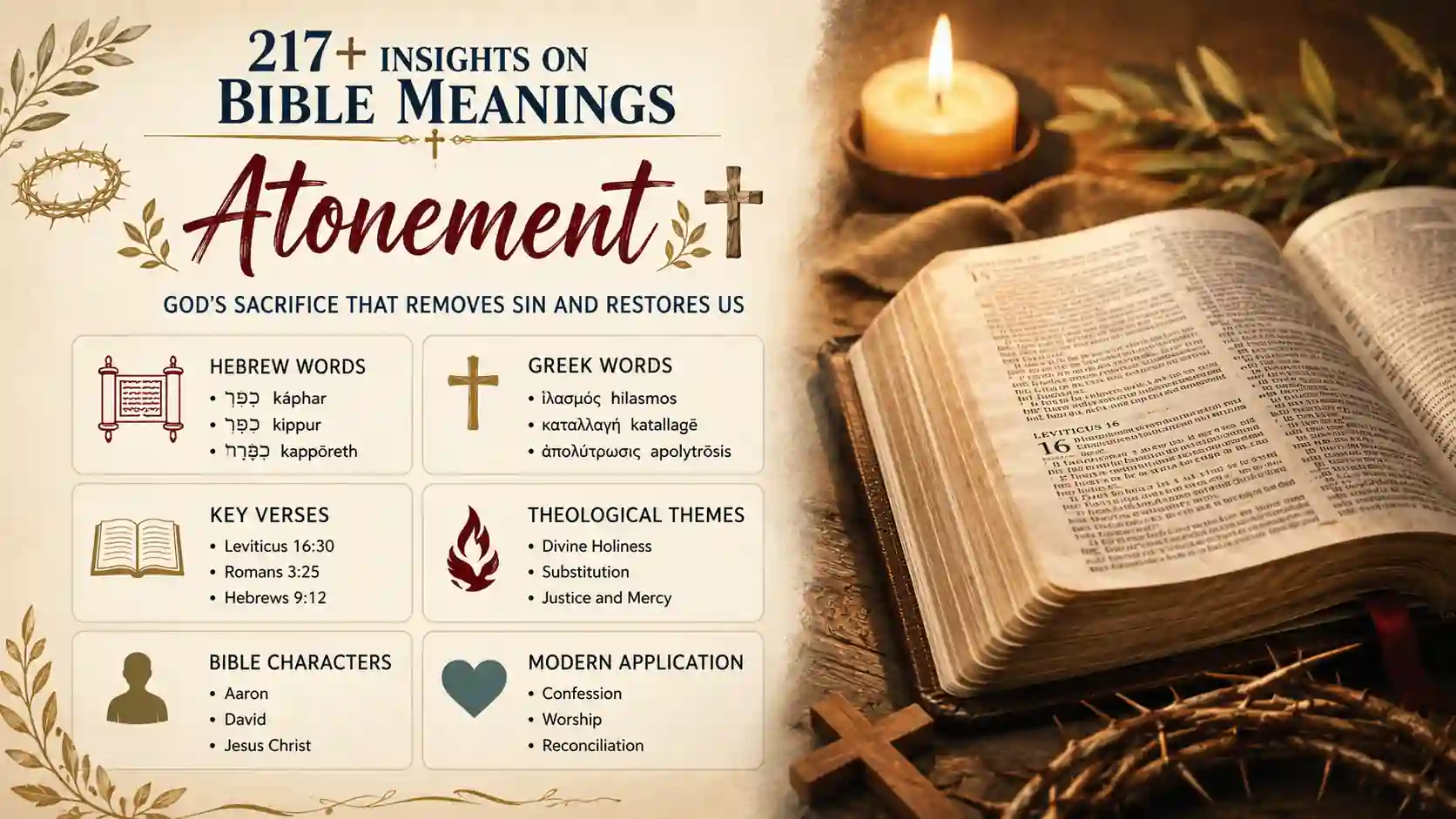
Original Hebrew and Greek Atonement Words
| Original Word | Transliteration | Strong’s # | Literal Meaning |
|---|---|---|---|
| כָּפַר | kāphar | H3722 | Cover, purge, make atonement |
| כִּפֻּר | kippur | H3725 | Atonement, expiation |
| כַּפֹּרֶת | kappōreth | H3727 | Mercy seat, atonement cover |
| אָשָׁם | ʾāshām | H817 | Guilt, guilt offering |
| חַטָּאת | ḥaṭṭāʾth | H2403 | Sin, purification offering |
| ἱλάσκομαι | hilaskomai | G2433 | Make propitiation, show mercy |
| ἱλασμός | hilasmos | G2434 | Propitiation, atoning sacrifice |
| ἱλαστήριον | hilastērion | G2435 | Mercy seat, propitiatory sacrifice |
| καταλλαγή | katallagē | G2643 | Reconciliation, restored relationship |
| ἀπολύτρωσις | apolytrōsis | G629 | Redemption, release by ransom |
Related Biblical Atonement Concepts
| Concept | Connection | Supporting Verse |
|---|---|---|
| Sacrifice | An offered life represents the worshiper | Leviticus 1:4 |
| Substitution | One suffers on behalf of another | Isaiah 53:5 |
| Blood | God appoints life-blood for atonement | Leviticus 17:11 |
| Cleansing | Defilement is removed from people and sanctuary | Leviticus 16:30 |
| Forgiveness | Guilt no longer stands against the sinner | Leviticus 4:31 |
| Propitiation | God’s righteous judgment against sin is addressed | Romans 3:25 |
| Expiation | Sin and impurity are removed | Hebrews 9:26 |
| Redemption | Captives are released through a costly payment | Ephesians 1:7 |
| Justification | Believers are declared righteous through faith | Romans 5:9 |
| Reconciliation | Enemies are restored to fellowship with God | Romans 5:10 |
Historical and Cultural Context of Atonement
| Aspect | Detail | Biblical Source |
|---|---|---|
| Tabernacle | God dwells among a sinful people | Exodus 25:8 |
| Priesthood | Aaron’s descendants mediate sanctuary worship | Exodus 28:1 |
| Sacrificial altar | Offerings are presented before the Lord | Leviticus 1:5 |
| Laying on hands | The worshiper identifies with the offering | Leviticus 1:4 |
| Blood application | Blood is placed on altars or sanctuary objects | Leviticus 4:7 |
| Day of Atonement | Annual cleansing occurs on the tenth day | Leviticus 16:29 |
| Two goats | One is killed and one carries sins away | Leviticus 16:7-10 |
| Holy of Holies | The high priest enters once each year | Hebrews 9:7 |
| Temple worship | Sacrifices continue in Jerusalem | 2 Chronicles 7:12 |
| Passover setting | Jesus dies during Israel’s festival season | John 19:14 |
Theological Themes of Atonement
| Theme | Explanation | Scripture |
|---|---|---|
| Divine holiness | Sin cannot remain untreated before God | Habakkuk 1:13 |
| Human guilt | Every person stands accountable | Romans 3:23 |
| Divine initiative | God himself provides the means of atonement | Leviticus 17:11 |
| Substitution | The innocent bears consequences for the guilty | Isaiah 53:6 |
| Covenant faithfulness | God preserves fellowship with his people | Exodus 34:6-7 |
| Justice and mercy | God remains just while justifying believers | Romans 3:26 |
| Representative obedience | Christ acts for those united to him | Romans 5:18-19 |
| Final sacrifice | Jesus’ offering needs no repetition | Hebrews 10:10 |
| Victory over evil | The cross disarms hostile powers | Colossians 2:15 |
| Restored communion | Believers receive access to God | Hebrews 10:19-22 |
Modern Application of Atonement for Believers
| Area | Practice | Scripture |
|---|---|---|
| Confession | Admit sin honestly before God | 1 John 1:9 |
| Assurance | Rest in Christ’s completed offering | Hebrews 10:14 |
| Worship | Approach God with gratitude and reverence | Hebrews 12:28 |
| Prayer | Draw near through Christ’s priestly ministry | Hebrews 4:16 |
| Repentance | Turn from sin without hiding guilt | Acts 3:19 |
| Forgiveness | Forgive others as God forgave you | Ephesians 4:32 |
| Reconciliation | Pursue peace in damaged relationships | Matthew 5:23-24 |
| Holiness | Live as one purchased by Christ | 1 Peter 1:18-19 |
| Communion | Remember Christ’s covenant blood | 1 Corinthians 11:25 |
| Mission | Announce God’s reconciling message | 2 Corinthians 5:20 |
כָּפַר KāPhar and the Old Testament Pattern of Atonement
The principal Hebrew verb for making atonement is כָּפַר, kāphar, Strong’s H3722. Depending on its context, it can describe making atonement, purging defilement, or securing forgiveness through a divinely appointed rite.
Some readers reduce kāphar to the English idea of “covering,” but its biblical use is richer. In Leviticus, atonement removes obstacles created by sin and impurity so that God may continue dwelling among his covenant people.
The sacrificial system did not teach that animal blood possessed magical power. God assigned blood an atoning function because the creature’s life was represented in it, and because atonement had to occur according to his gracious provision rather than human invention.
This explains the wording of Leviticus 17:11. God says that he has given the blood upon the altar to make atonement, placing the emphasis on divine initiative rather than on humanity purchasing God’s favor.
What Does Atonement Mean in the Bible’S Day of Atonement?
Leviticus 16 presents Yom Kippur, יוֹם הַכִּפֻּרִים, Yom HaKippurim, as the climactic cleansing day in Israel’s worship. The high priest offered sacrifices for himself, the priesthood, the people, and the sanctuary contaminated by Israel’s uncleanness.
The ritual involving two goats portrays complementary dimensions of atonement. The slaughtered goat’s blood cleanses the sanctuary, while the living goat symbolically carries Israel’s confessed iniquities into the wilderness, showing both purification and removal.
The high priest entered behind the veil with sacrificial blood only once each year. His careful washing, special garments, incense, and offerings emphasized that sinful humanity cannot approach the Holy One casually or on its own terms.
Hebrews uses this ceremony to explain Christ’s superior priesthood. Jesus enters the true heavenly sanctuary, not with another creature’s blood, but through his own self-offering, obtaining redemption that does not need annual renewal.
Ἱλαστήριον HilastēRion and the Cross of Christ
Paul declares in Romans 3:25 that God presented Christ as ἱλαστήριον, hilastērion, Strong’s G2435. The word can evoke both an atoning means and the mercy seat where sacrificial blood was presented before God in the Most Holy Place.
Translations differ between “propitiation,” “sacrifice of atonement,” and related expressions because no single English term carries every part of the concept. Propitiation stresses that God’s righteous opposition to sin is addressed, while expiation stresses sin’s removal.
These ideas need not compete. At the cross, sin is judged, guilt is removed, justice is upheld, mercy is displayed, and fellowship with God is restored through the one sacrifice God himself provides.
Jesus is not a reluctant victim persuading an unwilling Father to become loving. The Father sends the Son in love, and the Son willingly gives himself through the eternal Spirit, revealing the united saving purpose of the triune God.
The Once for All Atonement in Hebrews
Hebrews contrasts repeated Levitical sacrifices with Christ’s decisive offering. Animal sacrifices provided real covenant cleansing within Israel’s appointed system, yet they could not perfect the conscience or bring God’s redemptive purpose to its final completion.
Jesus fulfills the roles of priest, sacrifice, and mediator. Because he is sinless and his self-offering is perfect, his death accomplishes what earlier sacrifices anticipated and establishes the new covenant promised by the prophets.
The phrase “once for all” guards your assurance. Christ does not return repeatedly to suffer, nor must you supplement his sacrifice through personal merit, religious performance, or prolonged self-punishment.
This completed atonement also calls you into holiness. Grace does not make sin trivial, because the cross reveals its terrible cost, but grace frees you to obey from gratitude rather than from fear of earning acceptance.
Questions Bible Students Ask About Atonement
Does כָּפַר, kāphar, simply mean that God covers sin without removing it?
No. Its Levitical contexts include cleansing, purging, forgiveness, and restored access to God, not merely concealing wrongdoing.
Why does Romans 5:11 say “atonement” in the KJV but “reconciliation” in many modern translations?
The Greek noun καταλλαγή, katallagē, Strong’s G2643, specifically means reconciliation or restored relationship.
Is “propitiation” or “atoning sacrifice” the better translation of ἱλασμός, hilasmos?
Both communicate part of the meaning, since Christ’s sacrifice addresses righteous judgment and removes the guilt that separates sinners from God.
Why were two goats required in Leviticus 16?
Together they portray the cleansing accomplished through sacrificial blood and the removal of confessed sins from the covenant community.
How should Christ’s completed atonement affect your response to personal guilt?
You should confess sin, turn from it, seek needed reconciliation, and trust Christ’s sufficient sacrifice rather than trying to punish yourself.