
What does longsuffering mean in the Bible? It describes the God-given capacity to endure provocation, delay, hardship, and human weakness without surrendering to sinful anger or retaliation. Biblical longsuffering is not passive resignation. It is patient strength governed by love, mercy, and hope.
In Scripture, God shows longsuffering toward sinners, Christ displays it toward His people, and the Holy Spirit produces it within believers. Your study of this virtue reveals a heart that remains faithful, restrains anger, forgives offenses, and patiently seeks another person’s good.
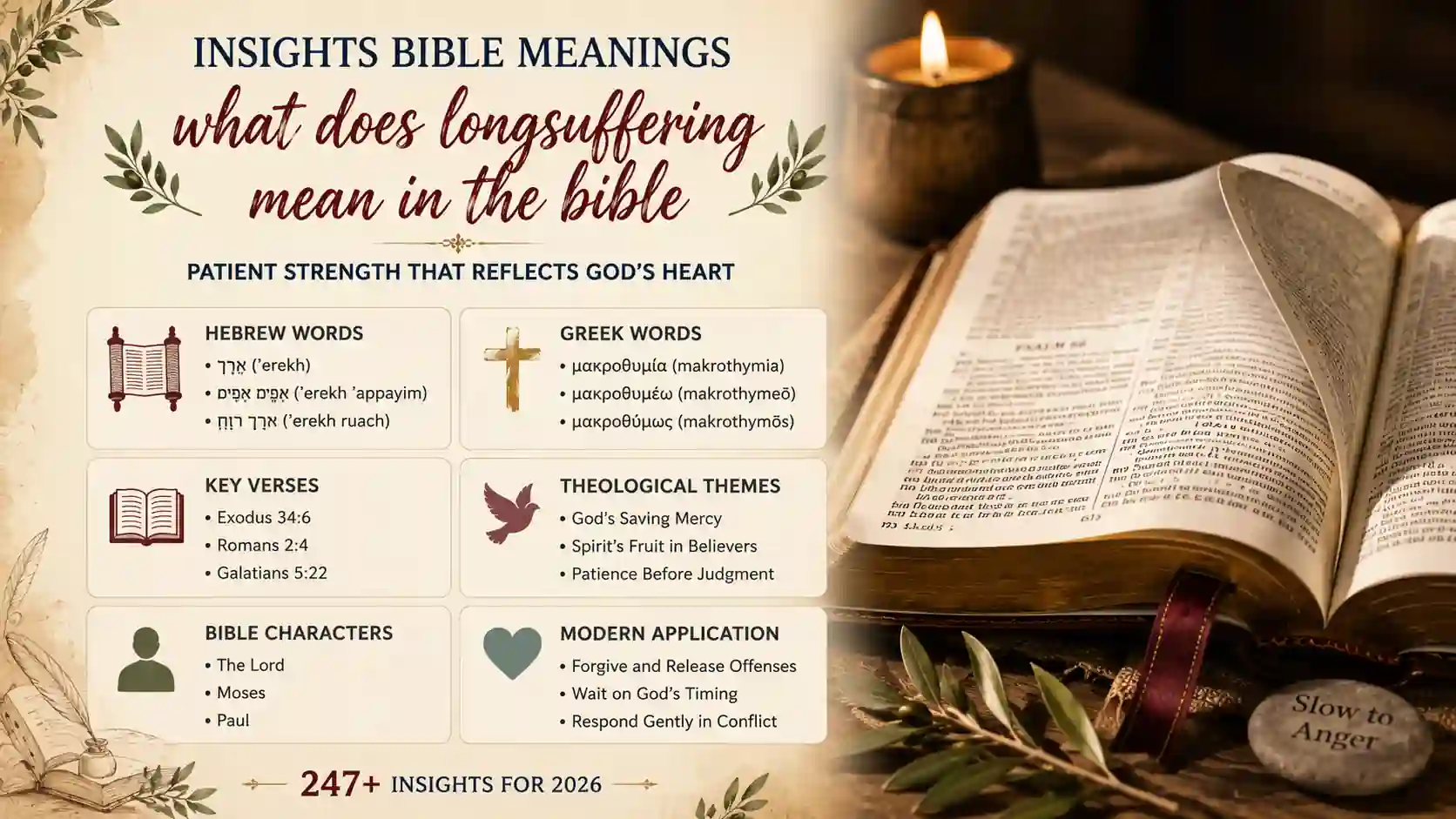
Key Longsuffering Scripture References
| Verse | Passage Snippet | Context |
|---|---|---|
| Exodus 34:6 | “Longsuffering” and abundant in goodness | God declares His covenant name |
| Numbers 14:18 | The Lord is longsuffering | Moses appeals for rebellious Israel |
| Psalm 86:15 | Full of compassion and longsuffering | David asks God for mercy |
| Proverbs 16:32 | Slow to anger is better than mighty | Wisdom praises controlled strength |
| Romans 2:4 | Riches of His forbearance and longsuffering | Divine patience leads toward repentance |
| Galatians 5:22 | The Spirit’s fruit includes longsuffering | Spirit-formed Christian character |
| Colossians 1:11 | Longsuffering with joyfulness | Paul prays for strengthened endurance |
| 2 Peter 3:9 | The Lord is longsuffering toward us | Delayed judgment allows repentance |
These passages show that longsuffering begins with God’s own character. Exodus 34:6 became a foundational confession repeated throughout Israel’s Scriptures. God is not indifferent to evil, but He restrains deserved judgment while extending mercy and calling sinners to return.
Longsuffering Bible Translation Comparison
| Verse | KJV | NIV | ESV | NASB |
|---|---|---|---|---|
| Exodus 34:6 | longsuffering | slow to anger | slow to anger | slow to anger |
| Romans 2:4 | longsuffering | patience | patience | patience |
| Romans 9:22 | longsuffering | great patience | much patience | much patience |
| 2 Corinthians 6:6 | longsuffering | patience | patience | patience |
| Galatians 5:22 | longsuffering | forbearance | patience | patience |
| Ephesians 4:2 | longsuffering | patient | patience | patience |
| Colossians 3:12 | longsuffering | patience | patience | patience |
| 1 Timothy 1:16 | longsuffering | immense patience | perfect patience | perfect patience |
“Longsuffering” is especially familiar to readers of the King James Version. Modern translations usually employ “patience,” “forbearance,” or “slow to anger.” These choices do not remove the idea of suffering. They express the underlying sense of restraining anger and patiently bearing with others.
The NIV’s “forbearance” in Galatians 5:22 emphasizes self-restraint toward difficult people. The ESV and NASB use “patience,” a broader English term whose precise meaning must be learned from the Greek context.
People and Characters Associated with Longsuffering
| Person | Role | Connection |
|---|---|---|
| The Lord | Covenant God of Israel | Slow to anger and rich in mercy |
| Moses | Prophet and intercessor | Appealed to God’s longsuffering |
| David | King and psalmist | Trusted God’s patient compassion |
| Jeremiah | Prophet to Judah | Pleaded for God’s restraint |
| Jesus Christ | Savior and Lord | Displays perfect patience toward sinners |
| Paul | Apostle to the Gentiles | Became an example of Christ’s patience |
| Noah | Preacher of righteousness | Lived while divine patience waited |
| Peter | Apostle and witness | Explained patience before final judgment |
| Believers | Spirit-indwelt people | Called to bear patiently with others |
Moses relied upon God’s revealed character after Israel refused to enter Canaan. He did not pretend that rebellion was harmless. Instead, he appealed to the Lord who is slow to anger, forgiving, and just.
Paul viewed his own conversion as a public display of Christ’s “perfect patience” in 1 Timothy 1:16. The former persecutor became evidence that divine longsuffering does not approve sin. It gives mercy time to produce repentance and faith.
Original Longsuffering Hebrew and Greek Words
| Original Word | Transliteration | Strong’s # | Literal Meaning |
|---|---|---|---|
| אֶרֶךְ | ʾerekh | H750 | Long, patient, slow |
| אַף | ʾaph | H639 | Nose, anger, wrath |
| אֶרֶךְ אַפַּיִם | ʾerekh ʾappayim | H750 and H639 | Long of nostrils, slow to anger |
| אֶרֶךְ רוּחַ | ʾerekh ruach | H750 and H7307 | Long or patient in spirit |
| אָרַךְ | ʾarakh | H748 | To prolong or lengthen |
| μακροθυμία | makrothymia | G3115 | Patience, forbearance |
| μακροθυμέω | makrothymeō | G3114 | To remain patient |
| μακροθύμως | makrothymōs | G3116 | Patiently, with forbearance |
| μακρός | makros | G3117 | Long or distant |
| θυμός | thymos | G2372 | Passion, anger, wrath |
The Hebrew expression אֶרֶךְ אַפַּיִם, ʾerekh ʾappayim, pictures someone who is “long of nostrils.” In ancient Hebrew imagery, rapidly flaring nostrils represented rising anger. To be “long” of nostrils was to be slow to become angry rather than easily provoked.
The principal New Testament noun is μακροθυμία, makrothymia, Strong’s G3115. It combines the ideas of length and passion, describing extended restraint before anger is expressed. It can signify patience, forbearance, steadfastness, or slowness in avenging wrongs.
Related Biblical Longsuffering Concepts
| Concept | Connection | Supporting Verse |
|---|---|---|
| Mercy | Withholds immediate deserved judgment | Psalm 103:8 |
| Grace | Gives sinners undeserved opportunity | 1 Timothy 1:16 |
| Forbearance | Restrains retaliation against offenses | Romans 2:4 |
| Repentance | God’s patience provides time to turn | 2 Peter 3:9 |
| Forgiveness | Releases personal claims for revenge | Colossians 3:13 |
| Gentleness | Responds without harsh aggression | Ephesians 4:2 |
| Love | Suffers long and seeks another’s good | 1 Corinthians 13:4 |
| Hope | Waits confidently for God’s purpose | James 5:7 |
| Self-control | Governs anger and impulsive reactions | Proverbs 16:32 |
Longsuffering is closely related to mercy, yet the words are not identical. Mercy concerns compassion shown to the needy or guilty. Longsuffering stresses the patient restraint that continues when wrongdoing, weakness, or delay persists.
It also differs somewhat from endurance. Endurance often concerns standing firm beneath difficult circumstances. Longsuffering frequently focuses on bearing patiently with people who provoke, disappoint, oppose, or injure you, though the meanings can overlap.
Historical and Cultural Context of Longsuffering
| Aspect | Detail | Biblical Source |
|---|---|---|
| Covenant revelation | God disclosed Himself as slow to anger | Exodus 34:6 |
| Golden calf crisis | Mercy followed Israel’s grave rebellion | Exodus 32 to 34 |
| Wilderness rebellion | Moses appealed to divine patience | Numbers 14:17–19 |
| Hebrew body imagery | Anger was pictured through the nostrils | Proverbs 14:29 |
| Prophetic warnings | Delayed judgment allowed time to return | Joel 2:12–13 |
| Assyrian threat | Patience did not cancel justice | Nahum 1:3 |
| Roman society | Patience opposed honor-based retaliation | Romans 12:17–21 |
| Early churches | Diverse believers had to bear together | Colossians 3:12–15 |
| Final judgment | Apparent delay expressed saving patience | 2 Peter 3:8–10 |
In the ancient world, strength was often associated with defeating enemies and defending personal honor. Biblical wisdom offered a striking correction. Proverbs 16:32 declares that ruling your spirit is greater than capturing a city.
The New Testament churches included people from different ethnic, social, and religious backgrounds. Longsuffering was therefore essential to their unity. It enabled Jewish and Gentile believers, masters and servants, and mature and immature Christians to remain one body without answering every offense with division.
Theological Themes within Longsuffering
| Theme | Explanation | Scripture |
|---|---|---|
| God’s character | Patience belongs to who God is | Exodus 34:6 |
| Holiness | Patience never calls evil good | Nahum 1:3 |
| Saving mercy | Judgment is delayed for repentance | 2 Peter 3:9 |
| Christ’s example | Jesus shows patience toward sinners | 1 Timothy 1:16 |
| Spirit’s fruit | Longsuffering is divinely produced | Galatians 5:22 |
| Sanctification | Believers learn patient Christlikeness | Colossians 3:12 |
| Church unity | Patience supports loving fellowship | Ephesians 4:2–3 |
| Divine sovereignty | God fulfills promises in His time | Hebrews 6:13–15 |
| Final justice | Patience ends in righteous judgment | Romans 9:22 |
God’s longsuffering must never be confused with moral weakness. Nahum 1:3 places two truths together. The Lord is slow to anger, yet He will not leave the guilty unpunished. His patience delays judgment, but it does not deny His holiness.
This balance guards your theology from two errors. You must not portray God as impatient and eager to condemn, nor may you treat His patience as permission to continue in sin. Romans 2:4 teaches that divine kindness and patience are intended to lead you to repentance.
Modern Longsuffering Application for Believers
| Area | Practice | Scripture |
|---|---|---|
| Marriage | Listen before answering defensively | James 1:19 |
| Family | Correct without uncontrolled anger | Ephesians 6:4 |
| Church | Bear with differing weaknesses | Ephesians 4:2 |
| Conflict | Refuse personal vengeance | Romans 12:19 |
| Forgiveness | Release complaints as Christ forgave | Colossians 3:13 |
| Leadership | Teach with patient correction | 2 Timothy 4:2 |
| Evangelism | Speak gently to opponents | 2 Timothy 2:24–25 |
| Waiting | Trust God’s appointed season | James 5:7–8 |
| Persecution | Endure without repaying evil | 1 Peter 2:20–23 |
| Prayer | Persist when answers seem delayed | Luke 18:1 |
Longsuffering does not require you to ignore abuse, conceal crime, or remain in immediate danger. Biblical patience can coexist with truthful confrontation, lawful protection, wise boundaries, and church discipline. Jesus endured hostility without revenge, yet He openly exposed hypocrisy and protected the vulnerable.
Your goal is not to become emotionally numb. It is to place your anger beneath the lordship of Christ. You may recognize evil, seek justice, and speak firmly while refusing hatred, cruelty, impulsive vengeance, or delight in another person’s ruin.
What Does Longsuffering Mean in the Bible Through μακροθυμία?
Μακροθυμία, makrothymia, describes prolonged restraint toward people and circumstances that might ordinarily provoke anger. It is the disposition of someone who possesses the power to retaliate but refuses to act from selfish rage.
This is why Paul names longsuffering as fruit of the Spirit. Natural temperament may make one person calmer than another, but biblical longsuffering is deeper than personality. The Spirit shapes your reactions so that love, holiness, and hope govern your conduct.
אֶרֶךְ אַפַּיִם And the Covenant Patience of God
When God proclaimed Himself אֶרֶךְ אַפַּיִם, ʾerekh ʾappayim, He did so after Israel’s worship of the golden calf. The setting gives the phrase theological weight. God remained faithful to His covenant despite the people’s shocking unfaithfulness.
His longsuffering did not remove consequences. Israel faced discipline, and persistent rebellion eventually brought judgment. Yet judgment was neither reckless nor arbitrary. The Lord repeatedly warned, invited repentance, forgave the contrite, and preserved His redemptive purpose.
Longsuffering as Strength Under the Spirit’S Rule
Longsuffering is sometimes mistaken for weakness because it refuses immediate retaliation. Scripture presents the opposite picture. The person who rules his spirit possesses greater strength than the warrior who conquers a city, because uncontrolled anger reveals bondage rather than freedom.
The Spirit produces this strength by directing your attention toward Christ. When you remember how patiently the Lord has dealt with your sins, you gain reason to bear with the weaknesses of others. Received mercy becomes practiced mercy.
Divine Patience, Repentance, and Coming Judgment
Second Peter 3 addresses scoffers who interpreted Christ’s delayed return as evidence that God would never judge. Peter answers that the delay reflects divine longsuffering. God’s patience leaves room for repentance and the gathering of His people.
Still, the day of the Lord will come. Longsuffering therefore creates urgency rather than complacency. You should receive God’s mercy with repentance, extend patience to others, and live faithfully while awaiting Christ’s promised return.
Frequently Asked Questions About Longsuffering
Does μακροθυμία mean exactly the same thing as ordinary patience?
Not always. It especially emphasizes prolonged restraint, forbearance, and slowness to retaliate when provoked.
Why does the KJV say “longsuffering” while the NIV and ESV often say “patience”?
The translations use different English terms to express the same Greek idea of sustained, restrained, and merciful patience.
What does אֶרֶךְ אַפַּיִם literally communicate in Exodus 34:6?
It literally conveys being “long of nostrils,” a Hebrew image for being slow to become angry.
Does God’s longsuffering mean He will never punish sin?
No. Scripture joins God’s patience with His justice, showing that judgment may be delayed without being canceled.
How can you practice longsuffering without tolerating serious wrongdoing?
You can reject revenge and uncontrolled anger while speaking truth, establishing boundaries, protecting others, and pursuing just correction.