
What does shrewd mean in the Bible? Scripture uses the idea for perceptive, practical, and forward-looking intelligence. Yet shrewdness is morally flexible. It can describe wisdom that recognizes danger, or cunning that exploits another person. The decisive question is whether insight serves truth, love, and faithfulness or deception and selfish ambition.
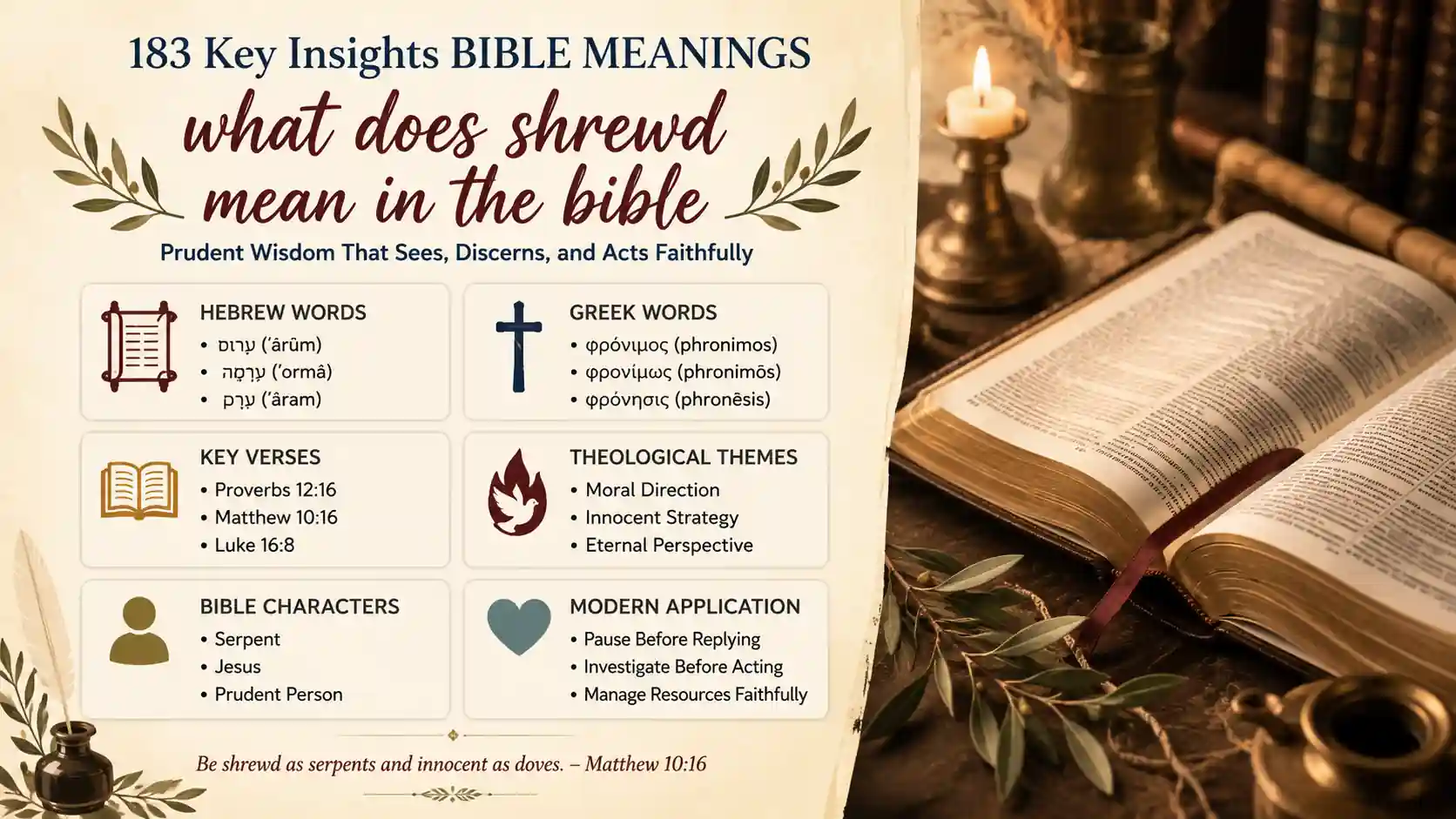
In your study, two words are especially significant: the Hebrew עָרוּם (ʿārûm) and the Greek φρόνιμος (phronimos). Their contexts show why biblical shrewdness must always be joined to innocence, integrity, and obedience to God.
Shrewd Key Scripture References
| Verse | Passage Snippet | Context |
|---|---|---|
| Genesis 3:1 | Serpent was crafty | Intelligence used to tempt |
| Job 5:12 | Schemes of the crafty | God frustrates manipulation |
| Job 15:5 | Tongue of the crafty | Speech shaped by deceit |
| Proverbs 12:16 | Prudent ignores an insult | Disciplined emotional response |
| Proverbs 12:23 | Prudent conceals knowledge | Humble restraint in speech |
| Proverbs 13:16 | Prudent acts with knowledge | Informed decision-making |
| Proverbs 14:8 | Wisdom discerns the way | Moral self-examination |
| Proverbs 14:15 | Prudent considers each step | Careful evaluation |
| Matthew 10:16 | Shrewd as snakes | Mission amid hostility |
| Luke 16:8 | Manager acted shrewdly | Urgent planning for the future |
Shrewd Bible Translation Comparison
| Verse | KJV | NIV | ESV | NASB |
|---|---|---|---|---|
| Genesis 3:1 | subtil | crafty | crafty | crafty |
| Proverbs 12:16 | prudent | prudent | prudent | prudent |
| Proverbs 12:23 | prudent man | prudent keep knowledge | prudent conceals knowledge | prudent man conceals knowledge |
| Proverbs 13:16 | prudent man | prudent act | prudent acts | prudent man acts |
| Proverbs 14:8 | prudent | prudent | prudent | sensible |
| Proverbs 14:15 | prudent man | prudent give thought | prudent gives thought | sensible considers steps |
| Proverbs 22:3 | prudent man | prudent see danger | prudent sees danger | prudent sees evil |
| Matthew 10:16 | wise | shrewd | wise | wary |
| Luke 16:8 | wisely | shrewdly | shrewdness | shrewdly |
English translations vary because neither “shrewd” nor “wise” captures every nuance. The same underlying word may emphasize practical judgment, caution, intelligence, or craftiness according to its setting. Matthew 10:16 is a clear example, with translations choosing “wise,” “shrewd,” or “wary” for φρόνιμος.
Shrewd People and Characters Associated
| Person | Role | Connection |
|---|---|---|
| Serpent | Tempter in Eden | Used craftiness deceptively |
| Eliphaz | Job’s counselor | Spoke of crafty schemers |
| Solomon | Wisdom teacher | Commended prudent foresight |
| Prudent person | Proverbs ideal | Thinks before acting |
| Fool | Proverbs contrast | Reacts without restraint |
| Simple person | Inexperienced learner | Believes claims too quickly |
| Jesus | Messiah and teacher | Commanded innocent shrewdness |
| Twelve apostles | Missionary disciples | Sent among hostile opponents |
| Dishonest manager | Parable character | Planned urgently for his future |
| Faithful steward | Responsible servant | Joined wisdom with faithfulness |
Shrewd Original Hebrew and Greek Words
| Original Word | Transliteration | Strong’s # | Literal Meaning |
|---|---|---|---|
| עָרוּם | ʿārûm | H6175 | Crafty, prudent, sensible |
| עָרְמָה | ʿormâ | H6195 | Prudence, craftiness |
| עָרַם | ʿāram | H6191 | To be crafty |
| חָכָם | ḥākām | H2450 | Wise, skillful |
| בִּין | bîn | H995 | Discern, understand |
| שֵׂכֶל | śēkel | H7922 | Insight, prudence |
| φρόνιμος | phronimos | G5429 | Prudent, sensible, wise |
| φρονίμως | phronimōs | G5430 | Prudently, shrewdly |
| φρόνησις | phronēsis | G5428 | Practical understanding |
| πανουργία | panourgia | G3834 | Cunning, unscrupulous craft |
The principal Hebrew adjective is עָרוּם (ʿārûm), Strong’s H6175. It describes the serpent’s craftiness in Genesis 3:1 but usually describes prudent people in Proverbs. The principal New Testament adjective is φρόνιμος (phronimos), Strong’s G5429, meaning thoughtful, sensible, prudent, or wise.
Shrewd Related Biblical Concepts
| Concept | Connection | Supporting Verse |
|---|---|---|
| Wisdom | Directs insight toward righteousness | Proverbs 14:8 |
| Prudence | Considers consequences before acting | Proverbs 14:15 |
| Discernment | Distinguishes truth from appearance | Hebrews 5:14 |
| Foresight | Recognizes approaching danger | Proverbs 22:3 |
| Self-control | Refuses impulsive retaliation | Proverbs 12:16 |
| Innocence | Keeps cleverness free from evil | Matthew 10:16 |
| Stewardship | Uses present resources purposefully | Luke 16:9 |
| Faithfulness | Governs wise administration | Luke 12:42 |
| Integrity | Rejects deceptive advantage | Proverbs 10:9 |
| Watchfulness | Remains alert to spiritual danger | 1 Peter 5:8 |
Shrewd Historical and Cultural Context
| Aspect | Detail | Biblical Source |
|---|---|---|
| Ancient wisdom teaching | Proverbs trained covenant judgment | Proverbs 1:1-7 |
| Oral culture | Restrained speech protected honor | Proverbs 12:23 |
| Dangerous roads | Travelers watched for visible threats | Proverbs 22:3 |
| Patron estates | Managers administered large households | Luke 16:1 |
| Debt records | Managers handled written obligations | Luke 16:5-7 |
| Honor and shame | Public disgrace affected social standing | Luke 16:3 |
| Reciprocal hospitality | Favors created future obligations | Luke 16:4 |
| Mission travel | Disciples depended on local hospitality | Matthew 10:9-13 |
| Social hostility | Witnesses faced courts and persecution | Matthew 10:17-23 |
| Serpent imagery | Serpents suggested caution and danger | Matthew 10:16 |
The manager in Luke 16 belongs to an estate economy in which a trusted administrator could handle accounts, debts, and produce owed to a wealthy owner. His position gave him access to records and debtors, which explains how he could alter obligations rapidly after learning that his employment was ending.
Jesus did not praise the manager’s dishonesty. The manager is explicitly called unrighteous. What receives attention is his realistic assessment of the crisis and his decisive preparation for what would follow.
Shrewd Theological Themes
| Theme | Explanation | Scripture |
|---|---|---|
| Moral direction | Intelligence serves good or evil | Genesis 3:1 |
| Common grace | Unbelievers may show practical insight | Luke 16:8 |
| Sanctified wisdom | God reforms judgment and motives | James 3:17 |
| Innocent strategy | Wisdom must remain morally pure | Matthew 10:16 |
| Human accountability | Plans are judged by God | Job 5:12 |
| Eternal perspective | Present resources serve lasting purposes | Luke 16:9 |
| Faithful stewardship | Wisdom manages entrusted responsibilities | Luke 12:42 |
| Humble restraint | Prudence does not display all it knows | Proverbs 12:23 |
| Protective foresight | Wisdom responds before danger arrives | Proverbs 27:12 |
| Christlike witness | Disciples combine courage and gentleness | Matthew 10:16 |
Shrewd Modern Application for Believers
| Area | Practice | Scripture |
|---|---|---|
| Speech | Pause before answering an insult | Proverbs 12:16 |
| Decisions | Investigate before accepting a claim | Proverbs 14:15 |
| Planning | Consider probable consequences | Proverbs 22:3 |
| Work | Manage resources faithfully | Luke 12:42 |
| Money | Use possessions for kingdom good | Luke 16:9 |
| Conflict | Stay perceptive without retaliating | Matthew 10:16 |
| Ministry | Understand people and circumstances | Colossians 4:5 |
| Leadership | Join competence with integrity | Proverbs 11:3 |
| Temptation | Recognize deceptive reasoning | Genesis 3:1 |
| Relationships | Keep wisdom peaceable and sincere | James 3:17 |
What Does Shrewd Mean in the Bible Through עָרוּם?
The Hebrew עָרוּם (ʿārûm) demonstrates that shrewdness is an ability, not automatically a virtue. In Genesis 3:1, the serpent uses perception and calculated speech to undermine trust in God. In Job, similar craftiness appears in schemes and manipulative language that God exposes.
Proverbs normally places עָרוּם in a positive light. The prudent person controls anger, guards knowledge, evaluates testimony, and foresees danger. The difference lies in moral purpose. Godly shrewdness sees clearly so that you can act faithfully, while sinful cunning sees clearly so that it can exploit weakness.
Jesus Joins φρόνιμος Wisdom with Dove-Like Innocence
When Jesus sends the Twelve among wolves, he commands them to be φρόνιμοι (phronimoi), “wise” or “shrewd,” as serpents and innocent as doves. He does not call them to gullibility. They must recognize danger, anticipate opposition, and respond wisely without adopting the malice of their persecutors.
The two images interpret one another. Serpent-like awareness without dove-like innocence becomes manipulation. Dove-like innocence without alertness can become avoidable vulnerability. Christian maturity holds both together, allowing you to recognize hostile intentions while refusing dishonesty, cruelty, and revenge.
Luke’S Shrewd Manager and Wisdom About Eternity
Luke 16:8 is difficult because a master commends an unrighteous manager. The praise concerns neither fraud nor disloyalty. It concerns the manager’s practical foresight. He understands that his present position is temporary, takes the coming reckoning seriously, and uses his remaining opportunity to prepare for his future.
Jesus turns that uncomfortable example toward discipleship. People devoted to the present age often pursue temporary goals with striking energy, while “children of light” may treat eternal matters casually. Your resources are temporary trusts. Shrewd stewardship uses money, influence, time, and opportunity in ways consistent with God’s kingdom.
From Cleverness to Wisdom Shaped by God’S Character
Biblical shrewdness is not permission to pursue good results through questionable methods. James distinguishes earthly wisdom marked by selfish ambition from wisdom that is pure, peaceable, gentle, open to reason, merciful, impartial, and sincere. God judges both your objective and the means you use to reach it.
You may therefore pray for perceptiveness without becoming suspicious, and for strategic wisdom without becoming calculating. Shrewd faith recognizes patterns, tests claims, prepares for danger, and uses opportunities well. Yet it remains truthful because Christian wisdom is shaped by the character of Christ, not merely by successful outcomes.
Frequently Asked Questions About Shrewdness in Scripture
Does עָרוּם mean both prudent and crafty?
Yes. עָרוּם (ʿārûm) describes perceptive cleverness whose moral quality is determined by its purpose and context.
Why does Jesus tell believers to be shrewd as serpents in Matthew 10:16?
He commands alert, realistic judgment in dangerous circumstances while requiring the moral innocence symbolized by doves.
Did Jesus approve of dishonesty in the parable of the shrewd manager?
No. Jesus used the manager’s urgent foresight, not his unrighteous conduct, to challenge disciples toward purposeful eternal stewardship.
Why do translations render φρόνιμος as wise, prudent, wary, or shrewd?
The Greek word covers thoughtful practical judgment, so translators choose the English term that best communicates each context.
How can you practice biblical shrewdness without becoming manipulative?
Examine your motives, tell the truth, consider consequences, protect others, and keep every strategy accountable to love and obedience.