
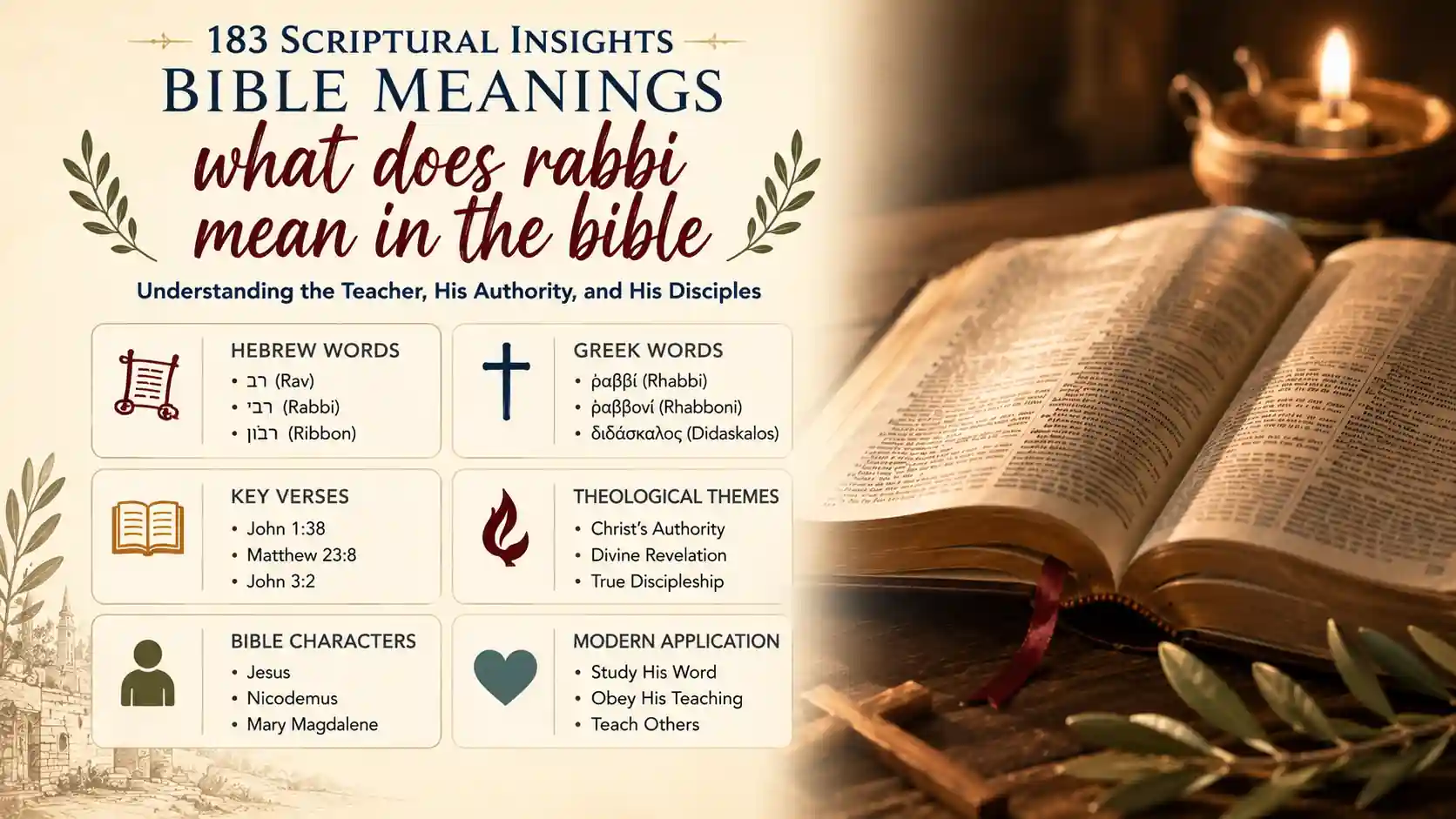
What does rabbi mean in the Bible? The word identifies a respected Jewish teacher or master, especially one recognized for explaining Scripture and guiding disciples. In the Gospels, people frequently address Jesus as “Rabbi,” acknowledging His authority, wisdom, and role as a teacher.
Yet the title carries greater significance when applied to Christ. Jesus does not merely interpret God’s truth as other teachers do. He speaks with divine authority, fulfills the Scriptures, forms disciples around Himself, and reveals the Father. Your study of “Rabbi” therefore leads directly to the identity and lordship of Jesus.
Rabbi in Key Scripture References
| Verse | Passage Snippet | Context |
|---|---|---|
| Matthew 23:7 | “Rabbi, Rabbi” | Religious leaders loved honorable greetings |
| Matthew 23:8 | “Do not be called Rabbi” | Jesus warned against prideful titles |
| Matthew 26:25 | “Rabbi, is it I?” | Judas questioned Jesus at Passover |
| Matthew 26:49 | “Greetings, Rabbi” | Judas betrayed Jesus with a kiss |
| Mark 9:5 | “Rabbi, it is good” | Peter spoke at the transfiguration |
| Mark 11:21 | “Rabbi, look” | Peter noticed the withered fig tree |
| John 1:38 | “Rabbi… where are You staying?” | Two disciples began following Jesus |
| John 1:49 | “Rabbi, You are the Son of God” | Nathanael confessed Jesus’ identity |
| John 3:2 | “Rabbi, we know” | Nicodemus approached Jesus at night |
| John 6:25 | “Rabbi, when did You come?” | The crowd sought Jesus after the feeding |
Rabbi in Bible Translation Comparison
| Verse | KJV | NIV | ESV | NASB |
|---|---|---|---|---|
| Matthew 23:7 | Rabbi, Rabbi | Rabbi | rabbi | Rabbi |
| Matthew 23:8 | called Rabbi | be called Rabbi | be called rabbi | be called Rabbi |
| Matthew 26:25 | Master, is it I? | Surely not I, Rabbi? | Is it I, Rabbi? | Surely it is not I, Rabbi? |
| Matthew 26:49 | Hail, master | Greetings, Rabbi | Greetings, Rabbi | Hail, Rabbi |
| Mark 9:5 | Master | Rabbi | Rabbi | Rabbi |
| Mark 11:21 | Master, behold | Rabbi, look | Rabbi, look | Rabbi, look |
| John 1:38 | Master | Rabbi | Rabbi | Rabbi |
| John 1:49 | Rabbi | Rabbi | Rabbi | Rabbi |
| John 3:2 | Rabbi | Rabbi | Rabbi | Rabbi |
| John 20:16 | Rabboni | Rabboni | Rabboni | Rabboni |
The KJV sometimes translates ῥαββί as “Master,” while newer translations commonly preserve “Rabbi.” This difference reflects translation style rather than a different Greek text. Both words communicate honor, instruction, and recognized authority.
Rabbi Among People and Characters
| Person | Role | Connection |
|---|---|---|
| Jesus | Messiah and Teacher | Most frequently addressed as Rabbi |
| John the Baptist | Prophet and teacher | His disciples called him Rabbi |
| Andrew | Early disciple | First addressed Jesus as Rabbi |
| Nathanael | Disciple | Called Jesus Rabbi and Son of God |
| Nicodemus | Pharisee and ruler | Recognized Jesus as God-sent teacher |
| Peter | Leading apostle | Addressed Jesus as Rabbi |
| Judas Iscariot | Betrayer | Used Rabbi instead of Lord |
| Mary Magdalene | Resurrection witness | Called Jesus Rabboni |
| Blind Bartimaeus | Healed beggar | Addressed Jesus as Rabboni |
| Scribes and Pharisees | Religious teachers | Desired public recognition as rabbis |
Judas provides a sobering contrast with faithful disciples. In Matthew’s passion narrative, the disciples call Jesus “Lord,” but Judas calls Him “Rabbi.” The title itself is honorable, yet Judas’ words reveal that correct religious language can exist without faithful surrender.
Rabbi in Original Hebrew and Greek Words
| Original Word | Transliteration | Strong’s # | Literal Meaning |
|---|---|---|---|
| רַב | rav | H7227 | Great, chief, master |
| רַבִּי | rabbi | Related to H7227 | My master, my teacher |
| רִבּוֹן | ribbon | Related to H7227 | Lord, master |
| ῥαββί | rhabbi | G4461 | My master, Rabbi |
| ῥαββονί | rhabboni | G4462 | My master, honored teacher |
| διδάσκαλος | didaskalos | G1320 | Teacher, instructor |
| καθηγητής | kathēgētēs | G2519 | Guide, leader, instructor |
| κύριος | kyrios | G2962 | Lord, master |
| μαθητής | mathētēs | G3101 | Disciple, learner |
| διδάσκω | didaskō | G1321 | To teach |
The Greek ῥαββί, rhabbi, is Strong’s G4461 and comes from a Semitic expression meaning “my master.” It became a respectful form of address for a Jewish teacher. The related ῥαββονί, rhabboni, is Strong’s G4462 and appears in Mark 10:51 and John 20:16.
John 1:38 directly explains ῥαββί for Greek-speaking readers by saying it means διδάσκαλος, didaskalos, “Teacher.” John 20:16 similarly interprets Rabboni as “Teacher,” showing that the title communicates both reverence and a personal teacher-disciple relationship.
Rabbi and Related Biblical Concepts
| Concept | Connection | Supporting Verse |
|---|---|---|
| Teaching | A rabbi explained God’s truth | John 3:2 |
| Discipleship | Students followed and learned | John 1:37-39 |
| Authority | Jesus taught with unique authority | Matthew 7:28-29 |
| Scripture | Teachers interpreted God’s Word | Matthew 22:23-33 |
| Wisdom | Jesus answered difficult questions | Mark 12:28-34 |
| Imitation | Disciples learned through example | John 13:13-15 |
| Obedience | True learning includes practice | Matthew 7:24 |
| Humility | Titles must not feed pride | Matthew 23:8-12 |
| Revelation | Jesus made the Father known | John 1:18 |
| Mission | Disciples teach Christ’s commands | Matthew 28:19-20 |
Biblical discipleship involved more than attending occasional instruction. A μαθητής, mathētēs, organized life around the teacher’s words and example. When Jesus called disciples, He summoned them to follow Him, observe His works, receive His teaching, and participate in His mission.
Rabbi in Historical and Cultural Context
| Aspect | Detail | Biblical Source |
|---|---|---|
| Jewish setting | Rabbi was a Semitic title | John 1:38 |
| Honorific use | It expressed respect for a teacher | John 3:2 |
| Public greetings | Rabbis received marketplace recognition | Matthew 23:7 |
| Teacher-disciple bond | Students followed their teacher | John 1:35-39 |
| Synagogue instruction | Teachers read and explained Scripture | Luke 4:16-22 |
| Questioning method | Students asked theological questions | John 9:2 |
| Traveling ministry | Jesus taught across towns and villages | Matthew 9:35 |
| Table fellowship | Teachers shaped disciples through meals | Luke 5:29-32 |
| First-century debates | Rabbis discussed law and interpretation | Matthew 19:3-9 |
| Developing title | Formal rabbinic usage grew over time | Matthew 23:7-8 |
The New Testament belongs to a period when “Rabbi” was becoming an established title of honor. Teachers were respected for their knowledge of Torah, their interpretations, and their ability to guide others in faithful living.
Jesus participated in recognizable Jewish teaching practices. He read Scripture, answered questions, used memorable illustrations, debated interpretations, and gathered disciples. Still, the crowds recognized something unusual because He taught with authority rather than merely repeating accepted authorities.
Rabbi and Major Theological Themes
| Theme | Explanation | Scripture |
|---|---|---|
| Christ’s authority | Jesus teaches with sovereign authority | Matthew 7:29 |
| Divine revelation | His teaching reveals the Father | John 8:28 |
| Messiahship | Rabbi is joined with messianic confession | John 1:49 |
| Incarnation | God’s Word teaches among humanity | John 1:14 |
| Kingdom of God | Jesus announces God’s reign | Mark 1:14-15 |
| Fulfillment | Jesus fulfills Law and Prophets | Matthew 5:17 |
| Humble leadership | Greatness appears through service | Matthew 23:11 |
| True discipleship | Learners remain in Jesus’ word | John 8:31 |
| Resurrection | Mary recognizes the risen Teacher | John 20:16 |
| Lordship | The Teacher is also Lord | John 13:13 |
Calling Jesus “Rabbi” is true, but it is not the whole confession of Christian faith. He is Teacher, yet He is also Christ, Son of God, Savior, and Lord. His teaching cannot be separated from His person, His cross, or His resurrection.
Rabbi in Modern Application for Believers
| Area | Practice | Scripture |
|---|---|---|
| Bible study | Listen carefully to Jesus’ words | Matthew 7:24 |
| Obedience | Put His teaching into practice | John 14:23 |
| Humility | Avoid craving spiritual status | Matthew 23:8 |
| Discipleship | Follow Christ, not personalities | 1 Corinthians 3:4-7 |
| Worship | Honor Jesus as Lord and Teacher | John 13:13 |
| Leadership | Serve rather than seek titles | Matthew 23:11 |
| Discernment | Test teaching by Scripture | Acts 17:11 |
| Prayer | Ask Christ for understanding | Luke 24:45 |
| Community | Remember believers are siblings | Matthew 23:8 |
| Mission | Teach others Christ’s commands | Matthew 28:20 |
You honor Jesus as Rabbi when His words govern your beliefs, habits, relationships, and priorities. Admiring His wisdom is not enough. The wise disciple hears His words and acts upon them.
What Does Rabbi Mean in the Bible Through ῥαββί?
The Greek word ῥαββί, rhabbi, preserves a Jewish title within the Greek New Testament. Its underlying sense is “my master,” although John explains it for his readers with the Greek word διδάσκαλος, didaskalos, meaning “teacher.”
This title recognizes a relationship. A rabbi teaches, while a disciple listens, follows, and learns. When the first disciples call Jesus Rabbi in John 1:38, they are beginning a life of personal attachment and instruction under Him.
Rabboni and the Risen Teacher in John 20
Mary Magdalene’s cry “Rabboni” in John 20:16 is one of Scripture’s most personal uses of the title. Grief had prevented her from recognizing Jesus until He spoke her name. She then responded in the familiar language of discipleship.
The resurrection did not erase Jesus’ relationship with His followers. The Teacher who had instructed Mary was alive. Yet she would soon learn that the risen Christ could not simply be held within the former pattern of earthly fellowship. He was ascending to the Father and sending His witnesses.
Why Jesus Warned Against Being Called Rabbi
In Matthew 23:8, Jesus says, “You are not to be called rabbi, for you have one teacher, and you are all brothers.” His concern is not a mechanical prohibition of every educational or respectful title. The surrounding passage condemns pride, public display, and the pursuit of religious rank.
Christian teachers remain necessary, as other New Testament passages plainly show. Still, no teacher may occupy Christ’s place. Every faithful instructor remains a disciple under the authority of the one true Teacher.
Jesus Is More than a Rabbi
Many people in the Gospels begin with a limited understanding of Jesus. They may call Him Rabbi because they recognize wisdom or divine assistance. Nicodemus, for example, knows that Jesus is a teacher from God, but Jesus immediately leads him toward the deeper truth of spiritual rebirth.
Nathanael’s confession moves further. He says, “Rabbi, You are the Son of God! You are the King of Israel!” The titles belong together, but they are not equal. Rabbi describes Jesus’ teaching role, while Son of God and King identify His unique person and messianic authority.
Frequently Asked Questions About Rabbi in the Bible
Does ῥαββί, rhabbi, literally mean teacher?
It literally carries the sense “my master,” but it functioned as an honorable title for a teacher.
Why does the KJV sometimes translate Rabbi as “Master”?
“Master” once commonly described a respected teacher, so the KJV uses it to express the authority contained in ῥαββί.
Is Rabboni in John 20:16 different from Rabbi?
Ῥαββονί, rhabboni, is a related and heightened form of respectful address that John interprets as “Teacher.”
Did Jesus forbid Christians from having teachers in Matthew 23:8?
No, He condemned status-seeking leadership and taught that every human instructor remains subordinate to Christ.
Why is calling Jesus Rabbi not a complete confession of faith?
Rabbi rightly identifies Jesus as Teacher, but the Gospel also reveals Him as Messiah, Son of God, Savior, risen Lord, and King.