
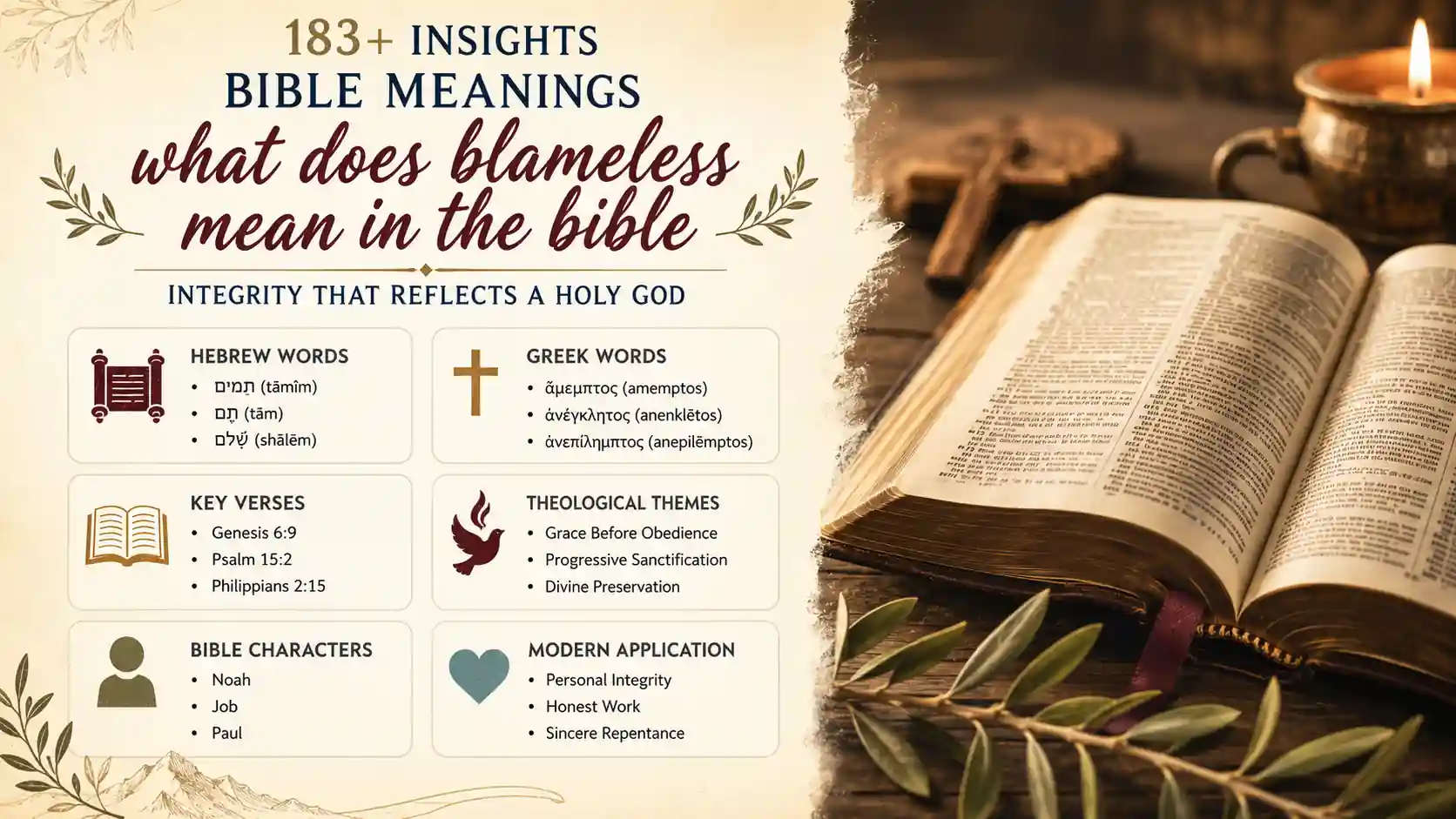
What does blameless mean in the Bible? Scripture uses the word for a life of integrity that can withstand honest examination. It does not usually describe a person who has never sinned. Instead, it points to wholeness, sincerity, covenant faithfulness, and freedom from a valid accusation of ongoing wrongdoing.
The biblical languages deepen this picture. Hebrew terms emphasize completeness and wholehearted devotion, while Greek terms stress being above reproach or without a legitimate charge. As you study these passages, you will see that blamelessness rests on God’s grace and produces visible obedience.
Key Blameless Scripture References
| Verse | Passage Snippet | Context |
|---|---|---|
| Genesis 6:9 | Noah was blameless | Faithfulness in a corrupt generation |
| Genesis 17:1 | Walk before me blamelessly | God’s covenant command to Abraham |
| Job 1:1 | Job was blameless and upright | Character established before his testing |
| Psalm 15:2 | Walks blamelessly | Qualification for fellowship with God |
| Psalm 18:23 | I was blameless before him | David describes guarded integrity |
| Psalm 119:1 | Blameless in their way | Blessed life shaped by God’s law |
| Proverbs 2:21 | Blameless will remain | Wisdom’s promise concerning the land |
| Luke 1:6 | Blameless in the commandments | Zechariah and Elizabeth’s faithful conduct |
| Philippians 2:15 | Blameless and innocent | Christian witness in a crooked generation |
| 1 Thessalonians 5:23 | Kept blameless | God’s sanctifying work until Christ returns |
Blameless Bible Translation Comparison
| Verse | KJV | NIV | ESV | NASB |
|---|---|---|---|---|
| Genesis 6:9 | Perfect | Blameless | Blameless | Blameless |
| Genesis 17:1 | Perfect | Blameless | Blameless | Blameless |
| Job 1:1 | Perfect | Blameless | Blameless | Blameless |
| Psalm 15:2 | Uprightly | Blameless | Blamelessly | Integrity |
| Psalm 18:23 | Upright | Blameless | Blameless | Blameless |
| Luke 1:6 | Blameless | Blamelessly | Blameless | Blamelessly |
| Philippians 2:15 | Blameless | Blameless | Blameless | Blameless |
| 1 Timothy 3:2 | Blameless | Above reproach | Above reproach | Above reproach |
| Titus 1:6 | Blameless | Blameless | Above reproach | Above reproach |
| Jude 24 | Faultless | Without fault | Blameless | Blameless |
People and Characters Associated with Blamelessness
| Person | Role | Connection |
|---|---|---|
| Noah | Ark builder and covenant recipient | Called blameless among his contemporaries |
| Abraham | Patriarch of Israel | Commanded to walk blamelessly before God |
| Job | Righteous sufferer | Described as blameless yet deeply tested |
| David | King and psalmist | Pursued integrity while depending on mercy |
| Asa | King of Judah | His heart was wholly devoted to God |
| Zechariah | Priest and father of John | Walked blamelessly in God’s commands |
| Elizabeth | Mother of John the Baptist | Shared Zechariah’s faithful covenant life |
| Paul | Apostle to the Gentiles | Blameless regarding outward legal righteousness |
| Timothy | Pastoral leader | Instructed to serve without reproach |
| Jesus Christ | Sinless Savior | The spotless Lamb who removes guilt |
Original Hebrew and Greek Words for Blameless
| Original Word | Transliteration | Strong’s # | Literal Meaning |
|---|---|---|---|
| תָּמִים | tāmîm | H8549 | Complete, sound, without defect |
| תָּם | tām | H8535 | Whole, upright, morally innocent |
| שָׁלֵם | shālēm | H8003 | Complete, whole, fully devoted |
| נָקִי | nāqî | H5355 | Clean, innocent, free from guilt |
| ἄμεμπτος | amemptos | G273 | Without blame or fault |
| ἄμωμος | amōmos | G299 | Without blemish, spotless |
| ἀνέγκλητος | anenklētos | G410 | Not open to accusation |
| ἀνεπίλημπτος | anepilēmptos | G423 | Beyond reproach, unassailable |
| ἀπρόσκοπος | aproskopos | G677 | Without offense or stumbling |
| ἀκέραιος | akeraios | G185 | Unmixed, innocent, sincere |
Biblical Concepts Related to Blamelessness
| Concept | Connection | Supporting Verse |
|---|---|---|
| Integrity | Life is morally whole rather than divided | Psalm 15:2 |
| Uprightness | Conduct follows what is right before God | Job 1:1 |
| Covenant faithfulness | The believer walks consistently with God | Genesis 17:1 |
| Holiness | Life is set apart for God’s purposes | 1 Thessalonians 5:23 |
| Innocence | No legitimate charge can be established | Philippians 2:15 |
| Sincerity | Motives are genuine and undivided | Philippians 1:10 |
| Perseverance | Faithfulness continues through testing | James 1:4 |
| Repentance | Sin is confessed rather than protected | Psalm 32:5 |
| Wisdom | God’s instruction shapes daily conduct | Proverbs 2:7 |
| Watchfulness | Believers prepare for Christ’s return | 2 Peter 3:14 |
Historical and Cultural Context of Blamelessness
| Aspect | Detail | Biblical Source |
|---|---|---|
| Sacrificial animals | Offerings were to be without physical defect | Leviticus 1:3 |
| Covenant walking | Loyalty was expressed through obedient living | Genesis 17:1 |
| Ancient courts | Accusations required evidence and witnesses | Deuteronomy 19:15 |
| Wisdom tradition | Integrity marked the wise and secure path | Proverbs 10:9 |
| Priestly service | Priests faced strict standards of holiness | Leviticus 21:6 |
| Royal leadership | Kings were judged by covenant faithfulness | 1 Kings 11:4 |
| Jewish piety | Obedience included worship and daily ethics | Luke 1:6 |
| Greco-Roman honor | Public reputation affected leadership | 1 Timothy 3:7 |
| Church oversight | Elders needed freedom from credible scandal | Titus 1:6 |
| Final judgment | God will reveal hidden motives and deeds | 1 Corinthians 4:5 |
Theological Themes within Biblical Blamelessness
| Theme | Explanation | Scripture |
|---|---|---|
| Grace before obedience | God calls and enables covenant faithfulness | Genesis 17:1 |
| Wholeness of heart | God seeks undivided devotion | 1 Kings 8:61 |
| Sinlessness of Christ | Jesus alone possesses absolute moral perfection | Hebrews 4:15 |
| Imputed righteousness | Believers are accepted through faith in Christ | Romans 5:1 |
| Progressive sanctification | God increasingly transforms Christian conduct | Philippians 1:9-10 |
| Public credibility | Holy character supports faithful testimony | 1 Timothy 3:2 |
| Divine preservation | God is able to keep his people faithful | Jude 24 |
| Final presentation | Christ will present his church without blemish | Ephesians 5:27 |
| Covenant accountability | Privilege brings responsibility to obey | Deuteronomy 18:13 |
| Hope of Christ’s return | Future hope encourages present purity | 2 Peter 3:14 |
Modern Application of Blameless Living
| Area | Practice | Scripture |
|---|---|---|
| Personal integrity | Keep private behavior consistent with public faith | Proverbs 10:9 |
| Speech | Refuse slander, deception, and corrupt talk | Psalm 15:3 |
| Work | Serve honestly even without supervision | Colossians 3:22-23 |
| Relationships | Seek peace and make wrongs right | Romans 12:18 |
| Sexual conduct | Practice holiness and self-control | 1 Thessalonians 4:3-7 |
| Leadership | Remain above credible moral accusation | 1 Timothy 3:2 |
| Finances | Handle money honestly and transparently | 2 Corinthians 8:21 |
| Repentance | Confess sin instead of concealing it | 1 John 1:9 |
| Witness | Shine without compromise in a dark culture | Philippians 2:15 |
| Spiritual growth | Depend on God to sanctify your whole life | 1 Thessalonians 5:23-24 |
תָּמִים And the Wholehearted Walk Before God
The principal Old Testament word תָּמִים, tāmîm, describes something complete, sound, or whole. It was used for sacrificial animals without defect, but when applied to people it concerns the integrity of the entire life. Noah was tāmîm in his generation, and Abraham was commanded to walk before God and be tāmîm.
This does not imply that Noah or Abraham never sinned. Genesis openly records their failures. Their blamelessness meant that their lives were genuinely oriented toward God rather than governed by the rebellion of their cultures. You pursue this quality when your worship, relationships, choices, and hidden motives belong to the same faithful walk.
The related Hebrew adjective תָּם, tām, describes Job as a man of integrity. Job’s blamelessness did not mean he possessed complete knowledge or responded perfectly to every stage of suffering. It meant Satan’s accusation that Job served God only for material reward was false.
Job’s story therefore guards you against treating every affliction as proof of secret wickedness. Blameless people may suffer intensely. Their trials can reveal real weaknesses without proving that their entire profession of faith is fraudulent. God may refine an upright servant while rejecting the careless accusations made against that servant.
What Does Blameless Mean in the Bible’S New Testament Churches?
New Testament writers use several Greek words rather than one exact equivalent. The term ἀνέγκλητος, anenklētos, means that no sustainable accusation can be brought. The term ἀνεπίλημπτος, anepilēmptos, describes someone whose conduct gives opponents no legitimate handle for reproach.
These words appear prominently in qualifications for elders and deacons. Church leaders are not required to have flawless histories, since Peter, Paul, and other servants received mercy after serious sin. They must, however, display a settled pattern of repentance, fidelity, self-control, hospitality, sound teaching, and responsible household leadership.
Leadership standards also show that blamelessness has a public dimension. A leader’s reputation cannot rest merely on personal claims of sincerity. Family members, church members, and outsiders should be able to observe credible evidence of mature character.
This does not mean every rumor disqualifies a believer. Scripture requires careful treatment of accusations, particularly accusations against elders. Being above reproach means that honest examination does not uncover a continuing pattern that contradicts the gospel being taught.
From the Spotless Lamb to a Blameless People
The Greek word ἄμωμος, amōmos, was used for something without blemish. The New Testament applies this sacrificial language supremely to Christ, the spotless Lamb whose blood redeems sinners. His blamelessness is absolute because he was tempted as we are, yet remained without sin.
Christian blamelessness must begin here. You are not reconciled to God because your record becomes impressive enough to deserve acceptance. You are justified through faith in Christ, whose righteousness and atoning death provide the foundation for forgiveness, peace, and a transformed life.
Grace does not make conduct irrelevant. The Christ who removes your guilt also gives his Spirit to sanctify you. Paul prays that believers will be sincere and blameless for the day of Christ, showing that gospel assurance and ethical growth belong together.
Your present blamelessness remains dependent and developing. You confess real sins, receive cleansing, make restitution where necessary, and continue walking in the light. Your final blameless presentation will be God’s achievement, as Jude celebrates when he praises the One able to present his people faultless before divine glory.
Blameless without Claiming Sinless Perfection
Scripture distinguishes blamelessness from sinless perfection. Job was blameless, yet he later confessed that he had spoken beyond his understanding. David could speak of integrity while also praying for cleansing, mercy, and protection from hidden faults.
A blameless believer is therefore not someone who denies failure. Denial actually undermines blamelessness because it protects falsehood. Biblical integrity responds to conviction honestly, turns from sin, accepts correction, and refuses to make peace with destructive patterns.
You should also avoid confusing blamelessness with an obsession over appearances. Jesus rebuked religious leaders who looked clean outwardly while nourishing corruption within. God examines motives, desires, loyalties, speech, and secret conduct as well as visible actions.
The goal is a whole life before a holy and merciful God. You cannot control every opinion or prevent every accusation, but you can live transparently, seek reconciliation, welcome accountability, and entrust your reputation to the Judge who knows the heart.
Questions Bible Students Ask About Blamelessness
Does תָּמִים, tāmîm, mean that Noah and Abraham were completely sinless?
No. It describes wholeness and covenant integrity, while Genesis also records sins and weaknesses in both men.
Why does the KJV sometimes say “perfect” where newer translations say “blameless”?
Older English used “perfect” for completeness or maturity, while modern versions often use “blameless” to prevent readers from assuming absolute sinlessness.
How could Job be blameless if he later repented in Job 42:6?
Job possessed genuine integrity, but his suffering exposed limited understanding and words that required humble correction.
What is the difference between ἄμωμος, amōmos, and ἀνέγκλητος, anenklētos?
Amōmos emphasizes being without blemish, while anenklētos emphasizes freedom from a charge that can be successfully sustained.
Can you become blameless after serious past sin?
Yes. Through Christ’s forgiveness, sincere repentance, restored conduct, and sustained faithfulness, your present life can become genuinely above reproach.