
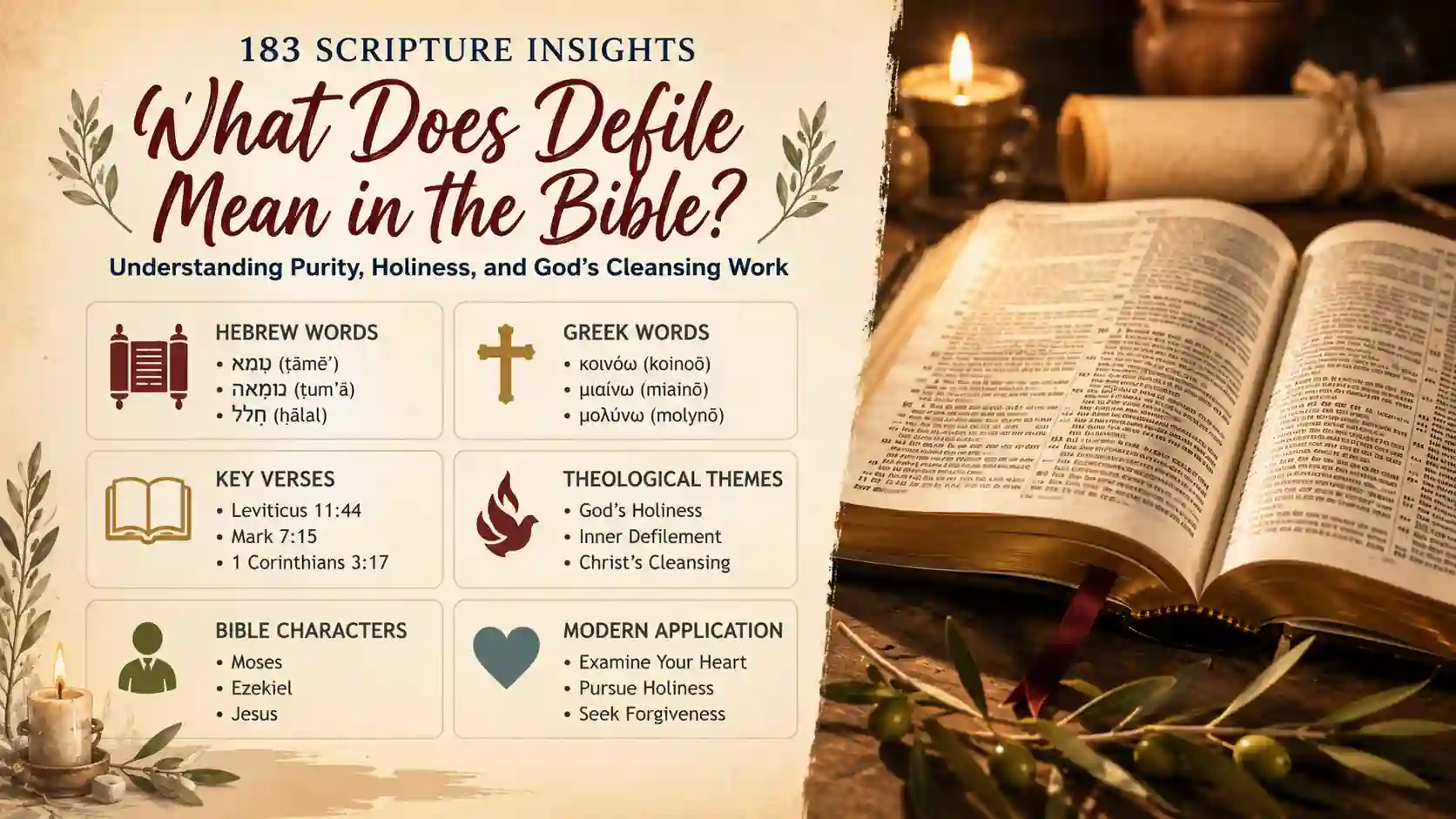
What does defile mean in the Bible? The word describes becoming unclean, polluted, desecrated, or unfit for holy use. Scripture applies it to bodies, consciences, worship, land, food, marriage, speech, and sacred places. Yet not every form of defilement is identical.
In your study, you must distinguish ceremonial uncleanness from deliberate sin. Israel’s purity laws taught reverence for God’s holiness, while Jesus emphasized that moral corruption flows from the heart. The biblical story ultimately moves from contamination and exclusion toward cleansing, restoration, and access to God through Christ.
Key Defile Scripture References
| Verse | Passage Snippet | Context |
|---|---|---|
| Leviticus 11:44 | “Do not defile yourselves” | Unclean animals and covenant holiness |
| Leviticus 15:31 | “Defiling my tabernacle” | Bodily discharges and sanctuary purity |
| Leviticus 18:24 | “Defile not yourselves” | Forbidden sexual practices |
| Numbers 35:34 | “Defile not therefore the land” | Bloodshed pollutes the promised land |
| Psalm 106:39 | “Defiled with their own works” | Israel’s idolatry and child sacrifice |
| Ezekiel 36:17 | “They defiled it” | Sin compared with ceremonial impurity |
| Mark 7:15 | “Can defile him” | Jesus identifies inward moral pollution |
| 1 Corinthians 3:17 | “Defile the temple of God” | Warning against corrupting God’s church |
| Hebrews 12:15 | “Many be defiled” | Bitterness spreading through a community |
Defile Bible Translation Comparison
| Verse | KJV | NIV | ESV | NASB |
|---|---|---|---|---|
| Leviticus 11:44 | “defile yourselves” | “make yourselves unclean” | “defile yourselves” | “make yourselves unclean” |
| Leviticus 18:24 | “defile not yourselves” | “do not defile yourselves” | “do not make yourselves unclean” | “do not defile yourselves” |
| Numbers 35:34 | “defile not therefore the land” | “do not defile the land” | “You shall not defile the land” | “You shall not defile the land” |
| Psalm 106:39 | “defiled with their own works” | “defiled themselves by what they did” | “became unclean by their acts” | “became unclean in their practices” |
| Mark 7:15 | “can defile him” | “can defile them” | “can defile him” | “can defile the person” |
| John 18:28 | “lest they should be defiled” | “avoid ceremonial uncleanness” | “would not be defiled” | “would not be defiled” |
| Titus 1:15 | “mind and conscience is defiled” | “minds and consciences are corrupted” | “minds and consciences are defiled” | “mind and conscience are defiled” |
| Hebrews 12:15 | “many be defiled” | “defile many” | “many become defiled” | “many become defiled” |
People and Characters Associated with Defilement
| Person | Role | Connection |
|---|---|---|
| Moses | Covenant mediator | Delivered laws concerning uncleanness and cleansing |
| Aaron | High priest | Guarded the sanctuary from Israel’s impurities |
| Nadab and Abihu | Priests | Violated the holiness of worship |
| Phinehas | Priest | Stopped covenant pollution at Peor |
| David | King and psalmist | Prayed for cleansing after grave sin |
| Manasseh | King of Judah | Defiled the temple through idolatry |
| Josiah | Reforming king | Removed objects connected with false worship |
| Ezekiel | Exilic prophet | Described Israel’s sin as defiling God’s land |
| Jesus | Messiah and teacher | Located moral defilement within the human heart |
| Paul | Apostle | Applied purity language to conscience and church life |
Original Hebrew and Greek Words for Defile
| Original Word | Transliteration | Strong’s # | Literal Meaning |
|---|---|---|---|
| טָמֵא | ṭāmēʾ | H2930 | To become or make unclean |
| טָמֵא | ṭāmēʾ | H2931 | Unclean, polluted, impure |
| טֻמְאָה | ṭumʾâ | H2932 | Uncleanness or impurity |
| חָלַל | ḥālal | H2490 | To profane, desecrate, pollute |
| κοινόω | koinoō | G2840 | To make common or unclean |
| μιαίνω | miainō | G3392 | To stain, pollute, or defile |
| μολύνω | molynō | G3435 | To soil or stain |
| ἀκαθαρσία | akatharsia | G167 | Impurity or uncleanness |
The Hebrew טָמֵא, ṭāmēʾ, can describe ceremonial, sexual, religious, or moral uncleanness. The Greek κοινόω, koinoō, means treating something as common rather than sacred, while μιαίνω, miainō, and μολύνω, molynō, emphasize staining or pollution.
Related Biblical Concepts of Defilement
| Concept | Connection | Supporting Verse |
|---|---|---|
| Holiness | Defilement conflicts with belonging to God | Leviticus 11:44 |
| Uncleanness | A condition restricting sacred participation | Leviticus 15:31 |
| Profanation | Treating holy things as ordinary | Leviticus 22:32 |
| Idolatry | False worship defiles people and sanctuary | Ezekiel 5:11 |
| Bloodguilt | Unpunished murder pollutes the land | Numbers 35:33 |
| Sexual immorality | Covenant-breaking conduct brings impurity | Leviticus 18:24 |
| Corrupt speech | Words reveal and spread inner pollution | Matthew 15:18 |
| Conscience | Sin distorts inward moral judgment | Titus 1:15 |
| Cleansing | God removes guilt and impurity | Psalm 51:2 |
| Sanctification | Believers are set apart for holy living | 1 Thessalonians 4:7 |
Historical and Cultural Context of Defilement
| Aspect | Detail | Biblical Source |
|---|---|---|
| Tabernacle worship | Uncleanness restricted approach to sacred space | Leviticus 15:31 |
| Priestly service | Priests required heightened ceremonial purity | Leviticus 21:1–6 |
| Food distinctions | Animals were classified as clean or unclean | Leviticus 11 |
| Childbirth | Temporary impurity followed childbirth | Leviticus 12 |
| Skin disease | Priests examined suspected impurity | Leviticus 13 |
| Contact with death | Corpses produced temporary uncleanness | Numbers 19:11 |
| Day of Atonement | Sanctuary impurities required yearly cleansing | Leviticus 16:16 |
| Promised land | Idolatry, violence, and immorality polluted it | Leviticus 18:25 |
| Second Temple customs | Purity affected Passover participation | John 18:28 |
| Gentile inclusion | God overturned ritual barriers between peoples | Acts 10:15 |
Theological Themes within Defilement
| Theme | Explanation | Scripture |
|---|---|---|
| God’s holiness | His presence cannot be treated casually | Leviticus 10:3 |
| Human corruption | Sin affects actions, desires, and conscience | Titus 1:15 |
| Sacred boundaries | God distinguishes holy from common | Leviticus 10:10 |
| Corporate consequences | One person’s corruption can affect many | Hebrews 12:15 |
| Covenant judgment | Persistent pollution leads to exile | Ezekiel 36:17–19 |
| Inner defilement | Evil proceeds from the fallen heart | Mark 7:21–23 |
| Atoning blood | Cleansing requires God’s appointed remedy | Leviticus 16:19 |
| Messianic cleansing | Christ purifies the conscience | Hebrews 9:14 |
| Restored presence | God cleanses his people to dwell with them | Ezekiel 37:23 |
| Final purity | Nothing unclean enters the holy city | Revelation 21:27 |
Modern Application of Defilement for Believers
| Area | Practice | Scripture |
|---|---|---|
| Heart | Examine desires, not merely appearances | Mark 7:21 |
| Speech | Reject words that spread corruption | Ephesians 4:29 |
| Sexual conduct | Honor God with your body | 1 Corinthians 6:18–20 |
| Conscience | Receive cleansing through Christ’s sacrifice | Hebrews 9:14 |
| Worship | Approach God with reverence and sincerity | Hebrews 12:28 |
| Relationships | Refuse bitterness before it spreads | Hebrews 12:15 |
| Church life | Protect the congregation from destructive teaching | 1 Corinthians 3:17 |
| Culture | Resist adopting idolatrous values | 2 Corinthians 6:16–17 |
| Repentance | Confess sin and seek cleansing | 1 John 1:9 |
| Hope | Pursue holiness while awaiting Christ | 1 John 3:3 |
What Does Defile Mean in the Bible Under the Mosaic Covenant?
Under the Mosaic covenant, defilement often describes a state of ceremonial uncleanness. Contact with a corpse, certain bodily discharges, skin diseases, childbirth, and unclean animals could make an Israelite temporarily unclean. Such conditions were not always sinful. They restricted access to holy space until the prescribed washing, waiting period, examination, or sacrifice was completed.
These laws taught Israel that the holy God dwelling among them was distinct from death, decay, disorder, and impurity. Ceremonial boundaries turned ordinary experiences into visible lessons about divine holiness. They also protected the sanctuary, because bringing uncleanness into sacred space symbolically violated the purity of God’s dwelling.
טָמֵא And the Difference Between Ritual Uncleanness and Sin
The Hebrew root טָמֵא, ṭāmēʾ, appears throughout Leviticus, Numbers, the historical books, and the prophets. Its meaning depends upon context. A person could become ṭāmēʾ without committing a moral offense, as when touching a dead body. In such cases, uncleanness was a regulated condition rather than personal guilt.
Yet the prophets use the same purity vocabulary for idolatry, violence, sexual sin, and covenant rebellion. Ezekiel describes Israel as defiling the land through its conduct. This prophetic usage reveals the deeper lesson behind the ceremonies. Sin contaminates human life, corrupts worship, damages communities, and makes people unfit for fellowship with the Holy One.
κοινόω And Jesus’ Teaching About the Defiled Heart
In Mark 7, Jesus uses κοινόω, koinoō, while answering a dispute about ritual handwashing. He does not teach that physical actions are meaningless or that God’s earlier commands were mistaken. He exposes the error of concentrating on external purity while tolerating evil within. Food enters the body, but wicked thoughts and actions proceed from the heart.
Jesus names sexual immorality, theft, murder, adultery, greed, deceit, envy, slander, pride, and foolishness as defiling realities. His teaching moves your attention from surface respectability to the moral center of your life. Biblical purity therefore requires more than correct ceremonies. You need a cleansed heart that produces faithful conduct.
Christ’S Cleansing of the Conscience from Defilement
The New Testament presents Jesus as the one who touches the unclean without becoming polluted. When he touches a leper, his holiness overcomes the disease. When a woman with a flow of blood touches him, healing moves outward from Christ. These encounters anticipate the cleansing accomplished through his sacrificial death.
Hebrews declares that Christ’s blood cleanses your conscience from dead works so that you may serve the living God. His sacrifice addresses both guilt and pollution. You are not restored by ignoring sin, relabeling it, or performing outward rituals. You are cleansed through Christ, called to repentance, and set apart for a life that reflects God’s holiness.
Frequently Asked Questions About Defilement
Does טָמֵא, ṭāmēʾ, always mean that someone has sinned?
No. It may describe temporary ceremonial uncleanness, although prophets also use it for morally sinful pollution.
Why did the Jewish leaders fear defilement in John 18:28?
They feared ceremonial impurity that could prevent them from participating in the Passover meal.
What is the difference between κοινόω, koinoō, and μιαίνω, miainō?
Koinoō stresses making something common or unclean, while miainō emphasizes staining, contaminating, or corrupting.
Can bitterness really defile other people according to Hebrews 12:15?
Yes. Unresolved resentment can spread destructive attitudes and behavior throughout a believing community.
How should you respond when your conscience feels defiled?
Confess your sin, trust Christ’s sufficient sacrifice, receive God’s forgiveness, and pursue renewed obedience.