
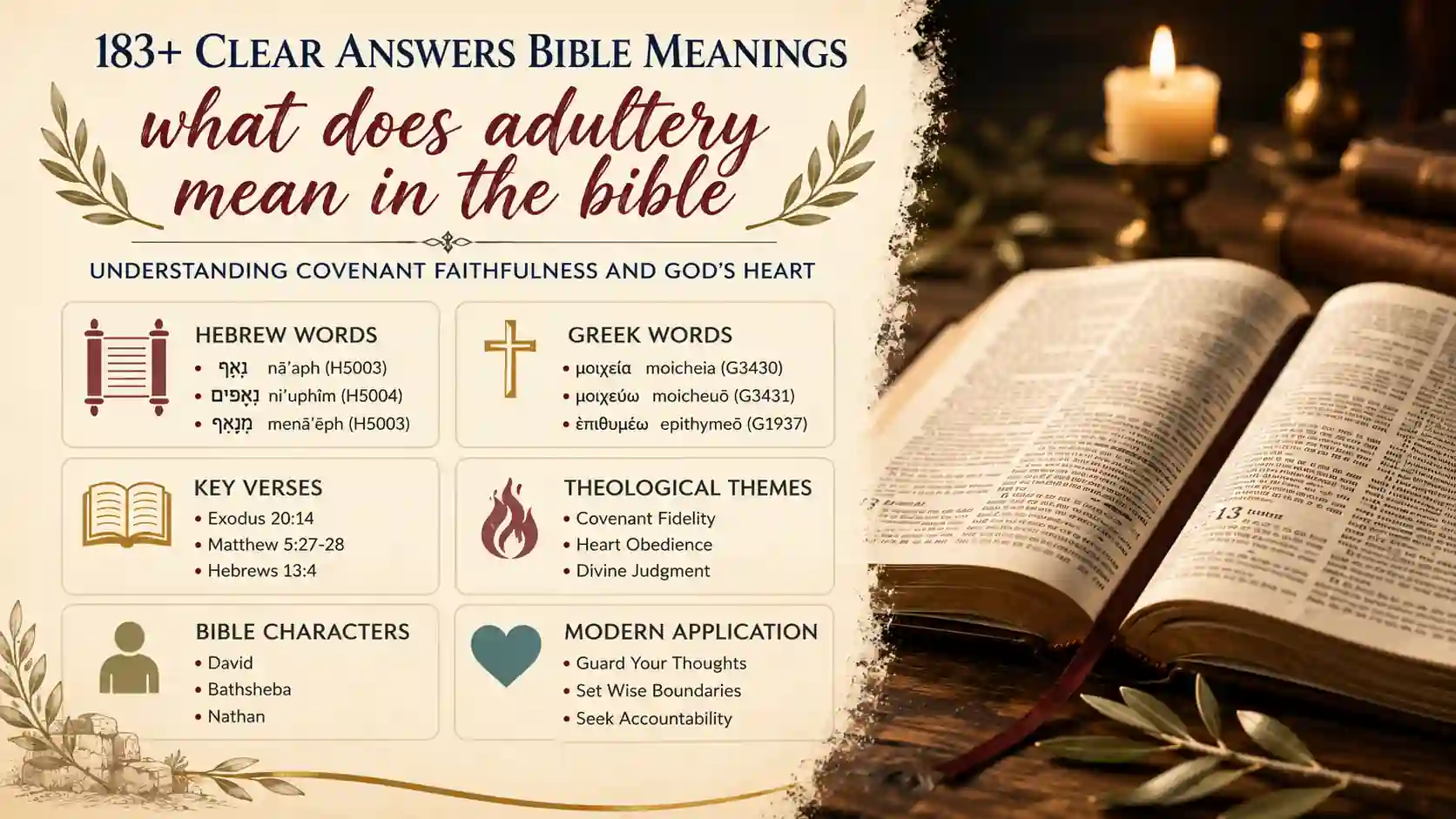
What does adultery mean in the Bible? Scripture presents adultery as sexual unfaithfulness that violates a marriage covenant. Yet the biblical teaching reaches beyond the outward act. The prophets use adultery as a picture of Israel’s spiritual betrayal, and Jesus exposes the deliberate lust from which physical betrayal grows.
As you study this subject, you encounter law, wisdom, prophecy, Gospel teaching, apostolic instruction, judgment, repentance, and grace. Together, these passages show why God protects marital faithfulness and how he restores repentant sinners.
Key Adultery Scripture References
| Verse | Passage Snippet | Context |
|---|---|---|
| Exodus 20:14 | “Thou shalt not commit adultery” | Seventh commandment at Sinai |
| Leviticus 20:10 | Adulterer and adulteress judged | Covenant law for Israel |
| Deuteronomy 5:18 | “Neither shalt thou commit adultery” | Commandment repeated to Israel |
| 2 Samuel 11:4 | David lay with Bathsheba | A king violates another marriage |
| Proverbs 6:32 | The adulterer destroys himself | Wisdom warning against folly |
| Jeremiah 3:8 | Faithless Israel committed adultery | Idolatry portrayed as marital betrayal |
| Matthew 5:27-28 | Adultery committed in the heart | Jesus addresses intentional lust |
| Matthew 19:9 | Wrongful divorce and remarriage | Jesus defends marriage permanence |
| John 8:3-11 | A woman accused of adultery | Mercy joined with a call to forsake sin |
| Hebrews 13:4 | God judges adulterers | Christians commanded to honor marriage |
The seventh commandment states the prohibition with unmistakable brevity, while later passages reveal its covenantal depth.
Adultery Bible Translation Comparison
| Verse | KJV | NIV | ESV | NASB |
|---|---|---|---|---|
| Exodus 20:14 | “Thou shalt not” | “You shall not” | “You shall not” | “You shall not” |
| Matthew 5:28 | “looketh…to lust” | “looks…lustfully” | “looks…with lustful intent” | “looks…with lust” |
| Matthew 19:9 | “put away his wife” | “divorces his wife” | “divorces his wife” | “divorces his wife” |
| Mark 10:11 | “put away his wife” | “divorces his wife” | “divorces his wife” | “divorces his wife” |
| Luke 16:18 | “marrieth her” | “marries a woman” | “marries a woman” | “marries one” |
| Romans 7:3 | “called an adulteress” | “called an adulteress” | “called an adulteress” | “called an adulteress” |
| James 4:4 | “adulterers and adulteresses” | “adulterous people” | “adulterous people” | “adulteresses” |
| Hebrews 13:4 | “whoremongers and adulterers” | “sexually immoral and adulterers” | “sexually immoral and adulterous” | “sexually immoral persons and adulterers” |
The translations agree on the central meaning. Their differences mainly concern English style, the expression of lustful intention, and whether certain figurative language is rendered literally or interpretively. Matthew 5:28, for example, consistently describes a purposeful look joined to wrongful desire.
People and Characters Associated with Adultery
| Person | Role | Connection |
|---|---|---|
| David | King of Israel | Committed adultery with Bathsheba |
| Bathsheba | Wife of Uriah | Drawn into David’s sin |
| Uriah | Faithful soldier | Betrayed by David |
| Nathan | Prophet | Confronted David’s concealed guilt |
| Hosea | Prophet | Marriage illustrated covenant unfaithfulness |
| Gomer | Hosea’s wife | Embodied Israel’s faithlessness |
| Herod Antipas | Galilean ruler | Took his brother’s wife |
| Herodias | Wife of Herod | Marriage condemned by John |
| John the Baptist | Prophet and forerunner | Rebuked Herod’s unlawful union |
| Accused woman | Figure in John 8 | Received mercy and a call to holiness |
David’s account shows that adultery rarely remains isolated. His act led to deception, abuse of royal power, Uriah’s death, family grief, and public dishonor. Nathan’s confrontation in 2 Samuel 12 also demonstrates that divine forgiveness does not make sin trivial or erase every earthly consequence.
Hosea’s household functions differently. The prophet’s painful marriage becomes a living sign of Israel’s pursuit of other gods. The imagery does not redefine physical adultery. It uses the recognized horror of marital betrayal to explain the seriousness of covenant apostasy.
Original Hebrew and Greek Words for Adultery
| Original Word | Transliteration | Strong’s # | Literal Meaning |
|---|---|---|---|
| נָאַף | nāʾaph | H5003 | To commit adultery |
| נִאֻפִים | niʾuphîm | H5004 | Adulteries |
| נַאֲפוּפִים | naʾăphûphîm | H5005 | Acts of adultery |
| מְנָאֵף | menāʾēph | H5003 | One committing adultery |
| μοιχεία | moicheia | G3430 | Adultery |
| μοιχεύω | moicheuō | G3431 | To commit adultery |
| μοιχάω | moichaō | G3429 | To commit adultery with |
| μοιχός | moichos | G3432 | Male adulterer |
| μοιχαλίς | moichalis | G3428 | Adulteress or unfaithful one |
| ἐπιθυμέω | epithymeō | G1937 | To desire or covet |
The principal Hebrew verb is נָאַף, nāʾaph, Strong’s H5003. It describes committing adultery and can also be used figuratively for apostasy. Its related Hebrew nouns identify adulteries or repeated acts of unfaithfulness.
In the New Testament, μοιχεία, moicheia, Strong’s G3430, names adultery, while μοιχεύω, moicheuō, Strong’s G3431, expresses the act of committing it. Matthew 5:28 also uses ἐπιθυμέω, epithymeō, a verb for desiring or coveting, showing that Jesus addresses a cultivated intention rather than an involuntary awareness of beauty.
Related Biblical Concepts of Adultery
| Concept | Connection | Supporting Verse |
|---|---|---|
| Marriage covenant | Adultery breaks pledged fidelity | Malachi 2:14 |
| Coveting | Wrongful desire seeks another’s spouse | Exodus 20:17 |
| Sexual immorality | Broader category of sexual sin | Matthew 15:19 |
| Lust | Adultery begins within the heart | Matthew 5:28 |
| Deception | Unfaithfulness often requires concealment | Proverbs 30:20 |
| Idolatry | Spiritual adultery betrays God | Jeremiah 3:8-9 |
| Divorce | Faithless separation can foster adultery | Matthew 5:32 |
| Repentance | Confession seeks cleansing and renewal | Psalm 51:1-12 |
| Forgiveness | Grace is available to repentant sinners | 1 Corinthians 6:11 |
| Holiness | Believers must honor God bodily | 1 Thessalonians 4:3-4 |
Adultery is related to sexual immorality, but the terms are not identical. Biblical adultery specifically concerns the violation of a marital bond. Sexual immorality can describe a wider range of unlawful sexual conduct.
The final commandment against coveting helps explain the internal dimension of the seventh. Adultery takes what belongs within another marriage covenant. Coveting nurtures the desire to possess what God has not given.
Historical and Cultural Context of Adultery
| Aspect | Detail | Biblical Source |
|---|---|---|
| Sinai covenant | Adultery forbidden in the Decalogue | Exodus 20:14 |
| Covenant identity | Israel’s homes reflected communal holiness | Deuteronomy 5:18 |
| Legal gravity | Both guilty parties faced judgment | Leviticus 20:10 |
| Betrothal | Betrothed persons were legally pledged | Deuteronomy 22:23-24 |
| Jealousy procedure | Suspected adultery received formal inquiry | Numbers 5:11-31 |
| Patriarchal society | A wife was vulnerable to male power | 2 Samuel 11 |
| Royal accountability | Kings remained subject to God’s law | 2 Samuel 12:7-9 |
| Prophetic metaphor | Idolatry pictured as marital infidelity | Hosea 2:2 |
| Roman Judea | Jewish law operated under imperial rule | John 18:31 |
| Early churches | Converts left sexually permissive cultures | 1 Corinthians 6:9-11 |
Ancient Israel treated adultery as both a sin against God and a grave social offense. Marriage affected inheritance, household stability, kinship, and covenant order. The legal penalties therefore reflect Israel’s unique life as a theocratic covenant nation, not permission for private retaliation by later believers.
The law named both the adulterer and the adulteress as accountable. This matters when reading stories in which powerful men attempted to shift shame onto women. David’s royal position did not shield him from Nathan’s rebuke, and Jesus refused to participate in the manipulative condemnation of one accused woman while her male partner was absent.
Theological Themes within Biblical Adultery
| Theme | Explanation | Scripture |
|---|---|---|
| God’s holiness | Sexual conduct belongs under God’s rule | Leviticus 20:7-10 |
| Covenant fidelity | Marriage reflects solemn faithfulness | Malachi 2:14-16 |
| Neighbor love | Adultery wrongs a spouse and household | Romans 13:9-10 |
| Heart obedience | God examines motives and desires | Matthew 5:27-28 |
| Human dignity | People must not become objects of appetite | Job 31:1 |
| Divine judgment | Hidden sexual sin remains known to God | Hebrews 13:4 |
| Prophetic warning | Idolatry resembles spousal betrayal | Ezekiel 16:32 |
| Honest repentance | Sin must be confessed without excuse | Psalm 51:3-4 |
| Cleansing grace | Former sinners can be washed | 1 Corinthians 6:11 |
| Restored holiness | Forgiveness leads toward changed conduct | John 8:11 |
Biblical theology never treats adultery merely as the breaking of a social convention. Marriage is a covenant witnessed by God. Betrayal therefore wounds a spouse, damages neighbors, disorders the family, and rejects the Lord’s authority.
Yet judgment is not Scripture’s final theological word for the repentant. Psalm 51 records David’s plea for cleansing after his sin. Paul tells Corinthian believers that some had once lived in serious sexual sin, but they had been washed, sanctified, and justified in the name of Jesus Christ.
Modern Application of Adultery for Believers
| Area | Practice | Scripture |
|---|---|---|
| Marriage | Keep vows with deliberate faithfulness | Hebrews 13:4 |
| Thought life | Reject intentional lustful fantasy | Matthew 5:28 |
| Digital habits | Remove sources that cultivate temptation | Matthew 5:29-30 |
| Boundaries | Avoid secret emotional intimacy | Proverbs 5:8 |
| Speech | Refuse flirtation that dishonors marriage | Ephesians 5:3-4 |
| Accountability | Confess struggles to mature believers | James 5:16 |
| Repentance | Name sin honestly before God | Psalm 51:3 |
| Reconciliation | Seek truth, safety, and wise counsel | Ephesians 4:25 |
| Church care | Restore the repentant gently | Galatians 6:1 |
| Hope | Remember Christ cleanses sinners | 1 Corinthians 6:11 |
Faithfulness requires more than avoiding physical intercourse outside marriage. You guard your imagination, communication, private relationships, online behavior, and emotional attachments. A relationship may cross sinful boundaries before physical contact occurs if secrecy, romantic dependence, or sexual intention begins displacing marital loyalty.
At the same time, careful application should not label every conversation, friendship, temptation, or unwanted thought as adultery. Scripture distinguishes temptation from chosen consent. Jesus condemns the purposeful cultivation of lust, not the mere experience of noticing another person or being confronted by an intrusive thought.
נָאַף And the Marriage Covenant in the Law
When Exodus 20:14 says, “You shall not commit adultery,” the Hebrew verb נָאַף, nāʾaph, identifies a concrete breach of marital faithfulness. The command protects the covenant bond, the betrayed spouse, the integrity of households, and the holiness of Israel’s communal life.
This command also stands beside the prohibitions against murder, stealing, false witness, and coveting. Adultery is not presented as private self-expression. It is an act that wrongs your neighbor by taking what you have no covenant right to claim.
What Does Adultery Mean in the Bible According to Jesus?
Jesus does not cancel the seventh commandment. He reveals the heart-level rebellion from which the outward act develops. In Matthew 5:28, the wording describes looking in order to desire, a sustained gaze directed by covetous intent.
You should therefore distinguish attraction from cultivated lust. Temptation may arise without invitation, but sin grows when the will welcomes, feeds, and rehearses the desire. Jesus calls you to decisive purity at the level of intention, before hidden desire becomes outward betrayal.
His forceful language about the eye and hand is deliberate moral urgency, not a command for bodily mutilation. You are to remove occasions of sin seriously. That may require ending secret communication, changing routines, installing safeguards, or seeking accountable pastoral and professional care.
Prophetic Adultery and Israel’S Covenant Unfaithfulness
Jeremiah, Hosea, and Ezekiel call idolatry adultery because Israel belonged to the Lord by covenant. Worshiping other gods resembled a spouse abandoning exclusive marital fidelity. The metaphor conveys grief, treachery, misplaced desire, and broken promises.
This prophetic usage rests upon the ordinary meaning of adultery rather than replacing it. Because marital betrayal is personal and devastating, it becomes a fitting image for spiritual apostasy. Idolatry is not merely an intellectual error. It gives the love, trust, worship, and obedience owed to God to a rival.
The metaphor also reveals God’s covenant love. His warnings are not detached legal announcements. They express the holy jealousy of the God who redeemed his people and rightly desires their undivided worship.
Judgment, Repentance, and Grace After Adultery
Scripture speaks plainly about judgment because adultery causes genuine harm. Hebrews 13:4 warns that God will judge the sexually immoral and adulterous. Grace must never be used to silence an injured spouse, conceal abuse of power, or avoid truthful accountability.
Still, adultery is not beyond the reach of divine mercy. David confessed his guilt, though painful consequences remained. The Corinthians were reminded that people once marked by serious sin had been washed and sanctified through Christ.
True repentance includes confession, the ending of the sinful relationship, acceptance of consequences, and a changed pattern of life. Forgiveness may be immediate before God, while human trust often requires time, truth, safety, and demonstrated faithfulness. Grace restores the sinner without pretending the wound was small.
Frequently Asked Questions About Adultery in the Bible
Does נָאַף, nāʾaph, refer to every form of sexual sin?
No. It specifically denotes adultery, while Scripture uses broader terms for other forms of sexual immorality.
Does Matthew 5:28 mean that noticing an attractive person is adultery?
No. Jesus condemns the intentional cultivation of covetous sexual desire, not involuntary awareness or unwanted temptation.
Why does James 4:4 call believers “adulterous people”?
James uses prophetic covenant language to describe friendship with the world as spiritual unfaithfulness toward God.
Can someone who committed adultery receive biblical forgiveness?
Yes. Genuine repentance and faith bring cleansing through Christ, though relational and earthly consequences may remain.
How should a believer resist adultery before any physical act occurs?
Guard your thoughts, reject secrecy, establish wise boundaries, flee tempting situations, and seek mature accountability.