
When you ask what does be still and know that i am god mean in the bible, you are asking about a call to quiet trust in the middle of trouble. Psalm 46 speaks to a people who feel the ground shake, and it points them to a God who remains steady.
This guide walks through the Hebrew word behind the command, the psalm that carries it, and the way Jesus uses a similar word on a stormy sea. You will see why stillness here means surrender and knowledge, not empty silence or cold detachment.
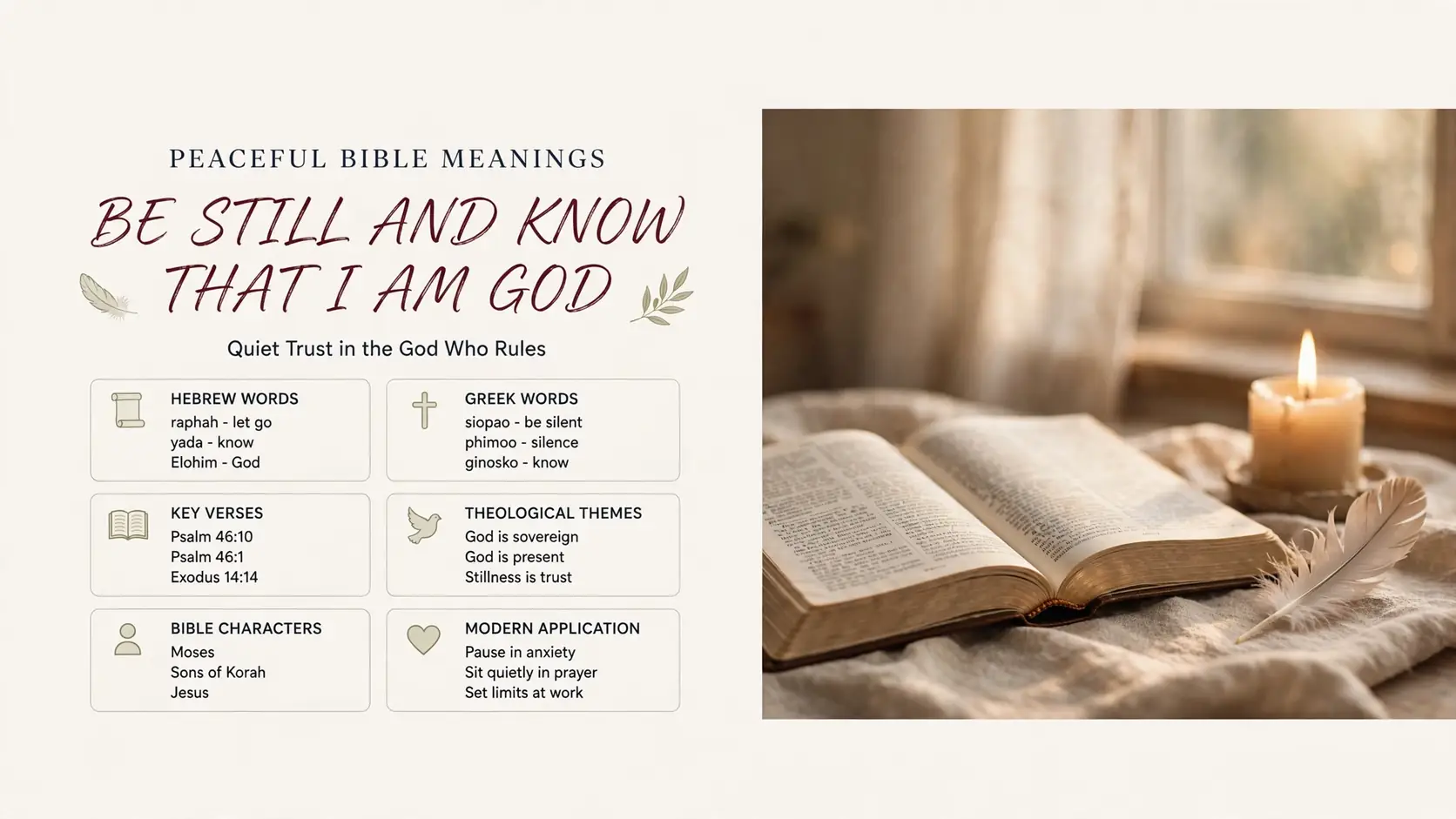
Key Scripture References for Be Still
| Verse | Passage Snippet | Context |
|---|---|---|
| Psalm 46:10 | Be still, and know that I am God | God speaks amid shaking nations |
| Psalm 46:1 | God is our refuge and strength | Opening claim of present help |
| Psalm 46:2 | We will not fear though earth gives way | Trust when creation trembles |
| Psalm 46:11 | The LORD of hosts is with us | Closing assurance after the command |
| Exodus 14:14 | The LORD will fight for you | Israel still before the Red Sea |
| Psalm 37:7 | Be still before the LORD | Waiting without envy or anger |
| Isaiah 30:15 | In quietness and trust is strength | Judah urged to rest not rush |
| Mark 4:39 | Peace, be still, and the wind ceased | Jesus calms a storm at sea |
| Lamentations 3:26 | Wait quietly for salvation | Hope held in grief and ruin |
Bible Translation Comparison for Be Still
| Verse | KJV | NIV | ESV | NASB |
|---|---|---|---|---|
| Psalm 46:10 | Be still, and know that I am God | Be still, and know that I am God | Be still, and know that I am God | Stop striving and know that I am God |
| Exodus 14:14 | The LORD shall fight for you | The LORD will fight for you | The LORD will fight for you | The LORD will fight for you |
| Psalm 37:7 | Rest in the LORD | Be still before the LORD | Be still before the LORD | Rest in the LORD |
| Isaiah 30:15 | In quietness and in confidence | In repentance and rest | In returning and rest | In quietness and trust |
| Psalm 62:5 | Wait thou only upon God | Find rest, O my soul, in God | For God alone, O my soul, wait | My soul, wait in silence for God |
| Mark 4:39 | Peace, be still | Quiet, be still | Peace, be still | Hush, be still |
| Lamentations 3:26 | Wait quietly for salvation | Wait quietly for salvation | Wait quietly for salvation | Wait silently for salvation |
| 1 Kings 19:12 | A still small voice | A gentle whisper | The sound of a low whisper | A sound of a gentle blowing |
People and Characters Associated with Be Still
| Person | Role | Connection |
|---|---|---|
| Moses | Leader of Israel | Told Israel to stand still at the sea |
| Israelites | Freed people | Learned trust while trapped and afraid |
| Sons of Korah | Temple singers | Sang Psalm 46 in worship |
| David | King and psalmist | Wrote psalms of quiet trust |
| Hezekiah | King of Judah | Faced Assyrian threats with prayer |
| Elijah | Prophet | Heard God in a gentle whisper |
| Jesus | Son of God | Stilled wind and waves by word |
| Disciples | Followers of Jesus | Watched fear turn to awe |
| Paul | Apostle | Urged quiet trust amid hardship |
Original Hebrew and Greek Words for Be Still
| Original Word | Transliteration | Strong’s # | Literal Meaning |
|---|---|---|---|
| רָפָה | raphah | H7503 | To sink down, relax, let go |
| יָדַע | yada | H3045 | To know by experience and relation |
| אֱלֹהִים | Elohim | H430 | God, the divine Creator and Judge |
| דָּמַם | damam | H1826 | To be silent, still, and waiting |
| שָׁקַט | shaqat | H8252 | To be quiet and undisturbed |
| בָּטַח | batach | H982 | To trust with confident reliance |
| נוּחַ | nuach | H5117 | To rest and settle down |
| σιωπάω | siopao | G4623 | To be silent and hold peace |
| φιμόω | phimoo | G5392 | To muzzle, silence, and restrain |
| γινώσκω | ginosko | G1097 | To know and come to understand |
Related Biblical Concepts for Be Still
| Concept | Connection | Supporting Verse |
|---|---|---|
| Trust | Stillness rests on God, not self | Psalm 37:7 |
| Sovereignty | God rules nations and nature | Psalm 46:10 |
| Refuge | God shelters fearful people | Psalm 46:1 |
| Peace | Calm follows surrender to God | Isaiah 30:15 |
| Waiting | Hope grows in quiet patience | Lamentations 3:26 |
| Worship | Songs voice trust in trouble | Psalm 46:11 |
| Surrender | Letting go yields control to God | Exodus 14:14 |
| Silence | Quiet makes room to hear God | 1 Kings 19:12 |
| Salvation | God saves when people cannot | Exodus 14:13 |
Historical and Cultural Context for Be Still
| Aspect | Detail | Biblical Source |
|---|---|---|
| Psalm setting | A song for temple worship | Psalm 46 heading |
| Sons of Korah | A family of temple musicians | 1 Chronicles 6:31 |
| Jerusalem imagery | A city with a life giving river | Psalm 46:4 |
| Nations at war | Kingdoms rage and melt away | Psalm 46:6 |
| Ancient warfare | Armies trusted bows and spears | Psalm 46:9 |
| Refuge language | Fortress words fit a walled city | Psalm 46:7 |
| Selah pauses | Musical pauses invite reflection | Psalm 46:3 |
| Covenant people | Israel knew God as their God | Psalm 46:10 |
| Exile echoes | Later readers heard hope in ruin | Lamentations 3:26 |
Theological Themes for Be Still
| Theme | Explanation | Scripture |
|---|---|---|
| God is sovereign | No nation outruns his rule | Psalm 46:10 |
| God is present | Help is near, not distant | Psalm 46:1 |
| Stillness is trust | Rest shows faith in action | Psalm 37:7 |
| Knowledge is relational | Knowing God grows through nearness | Psalm 46:10 |
| God will be exalted | His name rises above nations | Psalm 46:10 |
| Fear loses ground | Trust answers shaking earth | Psalm 46:2 |
| God breaks weapons | War ends by his power | Psalm 46:9 |
| Quiet strength | Power comes through calm reliance | Isaiah 30:15 |
| Hope in trouble | Waiting holds fast in sorrow | Lamentations 3:26 |
Modern Application for Be Still Believers
| Area | Practice | Scripture |
|---|---|---|
| Anxiety | Pause and name God as refuge | Psalm 46:1 |
| Prayer | Sit quietly before speaking requests | Psalm 62:5 |
| Work | Stop striving and set clear limits | Psalm 46:10 |
| Decisions | Wait one day before rushing | Psalm 37:7 |
| Family conflict | Listen fully before answering | James 1:19 |
| Digital noise | Keep one phone free hour daily | Psalm 46:10 |
| Worship | Sing Psalm 46 slowly together | Psalm 46:11 |
| Suffering | Hold a short verse through grief | Lamentations 3:26 |
| Community | Share burdens without fixing quickly | Galatians 6:2 |
What Raphah Teaches You About Letting Go in Psalm 46
Raphah does not picture a frozen body or a mind switched off. The word can mean hands sinking down, a grip loosening, and a struggle coming to rest. When God says raphah in Psalm 46:10, he tells a striving people to release their grip on control.
That release is not weakness, and it is not surrender to fear. It is a deliberate choice to let God carry what you cannot carry alone. In that quiet space, knowledge of God grows deeper than facts learned in a hurry.
How What Does Be Still and Know That I AM God Mean in the Bible Shapes Trust in a Noisy World
Your question reaches beyond a single verse, because the psalm joins personal calm to public truth. God speaks to raging nations as well as to one anxious heart, and both hear the same command. Stillness therefore becomes a witness that God rules even when events look out of control.
You can test this meaning in daily life by noticing where you grasp for control. News, deadlines, and family strain can pull you into constant motion, yet Psalm 46 invites a pause that trusts God first. That pause does not solve every problem, but it changes how you meet it.
Stillness as Worship in the Temple Songs of the Sons of Korah
The Sons of Korah sang for worship in the temple, and their songs gave fear a voice and trust a melody. Psalm 46 moves from shaking mountains to a river that gladdens the city of God. Music helped a whole community remember that God was present in their midst.
When you sing or read this psalm slowly, you join that older worship. Your voice does not need to sound perfect, and your heart does not need to feel calm first. Worship can lead you into stillness, rather than waiting for stillness to arrive on its own.
From the Red Sea to the Storm on Galilee, Stillness Points to God
At the Red Sea, Moses told Israel to stand still and see salvation, because God would fight for them. That story gives Psalm 46 a memory to stand on, since the same God who parted water still guards his people. Stillness there meant watching God act, not forcing a way through the sea.
On Galilee, Jesus spoke a similar word to wind and waves, and the storm obeyed his voice. The disciples moved from terror to wonder, because they saw power joined to personal care. Together these stories show that stillness points to a God who is both mighty and near.
Questions Readers Ask About Be Still and Stillness
Does raphah mean doing nothing at all?
No, raphah means releasing control to God while still acting wisely and trusting his power.
Why does the NASB say stop striving instead of be still in Psalm 46:10?
Stop striving brings out the active sense of raphah, which means ceasing struggle rather than merely sitting quietly.
Is Psalm 46:10 a promise for personal anxiety or a word to nations at war?
It speaks first to nations in conflict, and believers also draw personal comfort from its claim that God rules and remains near.
How is be still in Mark 4:39 different from be still in Psalm 46:10?
Mark uses Greek words for silencing a storm, while Psalm 46 uses Hebrew raphah for people releasing their grip on control.
How can you practice stillness without neglecting urgent work?
You can pause briefly to pray and set priorities, then return to work with a calmer focus on what God has given you to do.