
When you ask what is the golden rule in the bible, you are asking about a short teaching that can reshape how you treat every person you meet. Jesus gives this rule in the Sermon on the Mount, and he presents it as a summary of the Law and the Prophets.
It does not ask you to guess what others want, and it does not reduce love to a feeling. It asks you to act from the care you already hope to receive, and it turns that hope into a clear daily practice.
Key Scripture References for the Golden Rule
| Verse | Passage Snippet | Context |
|---|---|---|
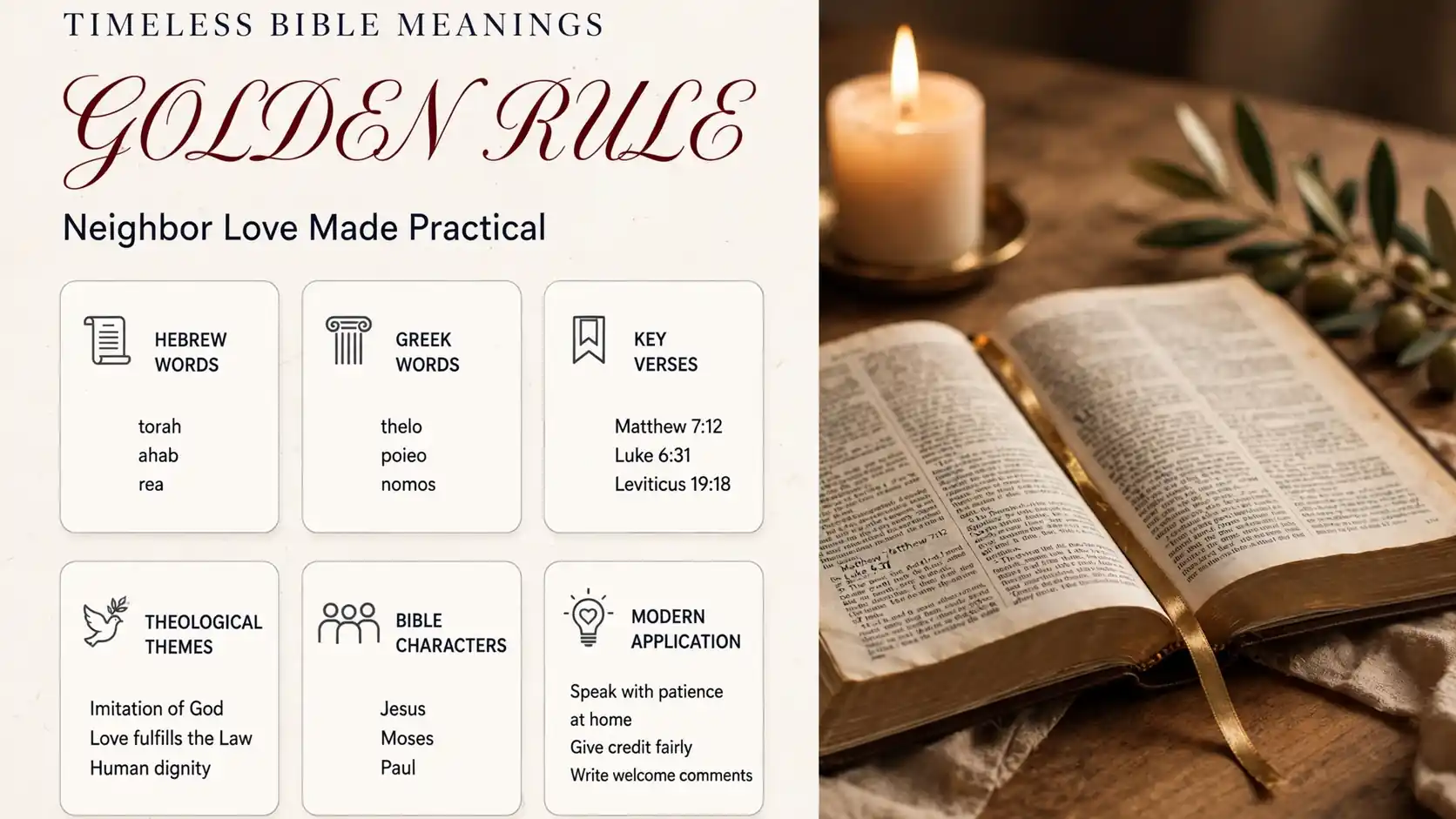
| Matthew 7:12 | Do to others what you would have them do to you | Sermon on the Mount summary |
| Luke 6:31 | Do to others as you would have them do to you | Teaching on love for enemies |
| Leviticus 19:18 | Love your neighbor as yourself | Holiness code for Israel |
| Matthew 22:39 | Love your neighbor as yourself | Second great commandment |
| Mark 12:31 | Love your neighbor as yourself | Greatest commandment answer |
| Romans 13:10 | Love does no harm to a neighbor | Love fulfills the Law |
| Galatians 5:14 | The entire law is fulfilled in love your neighbor | Freedom joined to service |
| James 2:8 | Keep the royal law of love your neighbor | Warning against partiality |
| Luke 10:27 | Love your neighbor as yourself | Lawyer command affirmed by Jesus |
Bible Translation Comparison for the Golden Rule
| Verse | KJV | NIV | ESV | NASB |
|---|---|---|---|---|
| Matthew 7:12 | Do to others as ye would | Do to others what you would have | Whatever you wish others would do | Treat people as you want treatment |
| Luke 6:31 | As ye would men should do | Do to others as you would have | As you wish others would do | Treat people as you want treatment |
| Leviticus 19:18 | Love thy neighbour as thyself | Love your neighbor as yourself | Love your neighbor as yourself | Love your neighbor as yourself |
| Matthew 22:39 | Love thy neighbour as thyself | Love your neighbor as yourself | Love your neighbor as yourself | Love your neighbor as yourself |
| Mark 12:31 | Love thy neighbour as thyself | Love your neighbor as yourself | Love your neighbor as yourself | Love your neighbor as yourself |
| Romans 13:10 | Love worketh no ill | Love does no harm | Love does no wrong | Love does no wrong |
| Galatians 5:14 | Love thy neighbour as thyself | Love your neighbor as yourself | Love your neighbor as yourself | Love your neighbor as yourself |
| Luke 10:27 | Love thy neighbour as thyself | Love your neighbor as yourself | Love your neighbor as yourself | Love your neighbor as yourself |
People and Characters Associated with the Golden Rule
| Person | Role | Connection |
|---|---|---|
| Jesus | Teacher and Lord | States the rule in Matthew and Luke |
| Moses | Lawgiver of Israel | Records neighbor love in Leviticus |
| Matthew | Gospel writer | Places the rule in the Sermon on the Mount |
| Luke | Gospel writer | Places the rule in enemy love teaching |
| Paul | Apostle to the nations | Teaches love fulfills the Law |
| James | Leader in Jerusalem | Calls neighbor love the royal law |
| The Good Samaritan | Neighbor in a parable | Shows mercy across division |
| The Lawyer | Questioner of Jesus | Quotes neighbor love and asks who is neighbor |
| The Scribe | Teacher of the Law | Affirms neighbor love above sacrifice |
Original Hebrew and Greek Words for the Golden Rule
| Original Word | Transliteration | Strong’s # | Literal Meaning |
|---|---|---|---|
| תּוֹרָה | torah | H8451 | Instruction or law |
| מִצְוָה | mitsvah | H4687 | Commandment to obey |
| אָהַב | ahab | H157 | To love |
| רֵעַ | rea | H7453 | Neighbor or fellow person |
| שָׁמַר | shamar | H8104 | To keep or observe |
| πᾶς | pas | G3956 | All or every |
| θέλω | thelo | G2309 | To wish or desire |
| ποιέω | poieo | G4160 | To do or make |
| ἄνθρωπος | anthropos | G444 | A human person |
| νόμος | nomos | G3551 | Law or governing principle |
Related Biblical Concepts for the Golden Rule
| Concept | Connection | Supporting Verse |
|---|---|---|
| Love of neighbor | Neighbor love gains a practical test | Leviticus 19:18 |
| Law and Prophets | The rule sums up the Old Testament | Matthew 7:12 |
| Mercy in action | Mercy meets a real need | Luke 10:33 |
| Enemy love | Fair treatment extends to an enemy | Luke 6:27 |
| Justice and fairness | No double standard in judgment | Leviticus 19:15 |
| Humility in judgment | Checks harsh judgment | Matthew 7:1 |
| Generosity | Hoped for kindness becomes given kindness | Luke 6:38 |
| Peacemaking | Seeks repair not revenge | Matthew 5:9 |
| Service to others | Love becomes visible in deeds | Galatians 5:13 |
Historical and Cultural Context of the Golden Rule
| Aspect | Detail | Biblical Source |
|---|---|---|
| Sermon on the Mount | Jesus teaches crowds in Galilee | Matthew 5:1 |
| Second Temple Judaism | Teachers debated a summary of the Law | Matthew 22:36 |
| Rabbinic negative form | Some teachers used a negative form | Luke 6:31 |
| Roman rule | Judea lived under Roman power | Luke 20:22 |
| Village honor culture | Honor and shame shaped relations | Luke 10:30 |
| Sabbath community life | Neighbors shared worship and aid | Mark 2:27 |
| Temple worship | Sacrifice framed covenant loyalty | Matthew 5:23 |
| Prophetic justice tradition | Prophets linked worship and justice | Micah 6:8 |
| Early church practice | Believers shared goods | Acts 4:34 |
Theological Themes of the Golden Rule
| Theme | Explanation | Scripture |
|---|---|---|
| Imitation of God | Kindness reflects divine mercy | Luke 6:36 |
| Covenant faithfulness | Neighbor love keeps the covenant | Deuteronomy 6:5 |
| Christ centered ethics | The rule shapes kingdom life | Matthew 7:12 |
| Love fulfills the Law | Love carries out the intent of the Law | Romans 13:10 |
| Justice and mercy together | Fairness and compassion belong together | Micah 6:8 |
| Community formation | Shared love builds community | John 13:35 |
| Human dignity | Every neighbor deserves fair treatment | Genesis 1:27 |
| Repentance and repair | The rule calls for changed action | Luke 19:8 |
| Hope for restoration | Loving action points to renewal | Revelation 21:4 |
Modern Application for Believers of the Golden Rule
| Area | Practice | Scripture |
|---|---|---|
| Family life | Speak with patience at home | Ephesians 4:32 |
| Workplace conduct | Give credit fairly and refuse gossip | Proverbs 11:3 |
| Online speech | Write welcome comments | James 3:9 |
| Church community | Welcome newcomers warmly | Romans 15:7 |
| Conflict and apology | Listen fully and own your part | Matthew 18:15 |
| Money and generosity | Share resources openly | 2 Corinthians 9:7 |
| Care for strangers | Offer help when you safely can | Hebrews 13:2 |
| Leadership and power | Use authority to protect people | Mark 10:43 |
| Daily decisions | Pause and ask how you wish treatment | Matthew 7:12 |
How the Greek Word Thelo Shapes What Is the Golden Rule in the Bible
The Greek word thelo points to a wish that is strong enough to guide action. When Jesus says to do what you wish others would do, he is not talking about a passing fancy. He is talking about the settled hopes you carry for respect, honesty, patience, and care. That wording keeps the rule honest, because it ties your action to a wish you can name.
You can test a choice by naming the wish behind it in plain words. If you wish for a fair hearing, give a fair hearing first. If you wish for privacy about a mistake, guard the reputation of another person. This test works in a home, at work, and in a church, because it starts with a wish you already understand from your own life.
The Golden Rule in the Covenant Story from Leviticus to the Sermon on the Mount
Leviticus places neighbor love inside a holy life shaped by God, and it joins that love to fair weights, honest speech, and care for the poor. The command does not stand alone as a nice saying. It stands inside a covenant people who were called to show the character of God in ordinary dealings with a neighbor.
Jesus carries that same command into the Sermon on the Mount and gives it a positive and active form. He does not only forbid harm. He calls you to do the good you hope to receive, and he says that this practice sums up the Law and the Prophets. That link shows that the Golden Rule is not a new ethic apart from Scripture. It is the old covenant ethic brought to full and active life.
Love of Neighbor as the Measure of the Law and the Prophets
Paul and James both return to neighbor love when they explain what the Law requires in real life. Paul says that love does no harm to a neighbor, and James calls the same command the royal law. Their agreement matters for your study, because it shows that the early church did not treat the Golden Rule as a minor proverb. It treated neighbor love as a royal measure for conduct.
This measure also guards you against a narrow reading of faith. Worship, correct belief, and generous giving can still miss the mark when a neighbor is treated with contempt. The Golden Rule asks whether your faith can be seen in how you speak, pay, forgive, and share. When love shapes those acts, your faith gains a visible and credible form.
Living the Golden Rule without Keeping Score
A common struggle with this rule is the quiet habit of keeping score. You may give kindness and then wait for a matching return, and disappointment can turn into resentment. Jesus places the rule beside teaching on mercy and enemy love, and that setting breaks the bargain mindset. The rule describes the kind of person you are becoming, not a contract you enforce on others.
You can practice this freedom by choosing one generous act each day with no expected payback. Thank a coworker who cannot repay you, help a neighbor who may never learn your name, or forgive a small debt of pride. Such acts train your heart to love without a ledger, and they make the Golden Rule a way of life rather than a test that others must pass.
Frequently Asked Questions About the Golden Rule
What does the Greek word thelo add to what is the golden rule in the bible?
Thelo shows that the rule rests on a real wish for fair and kind treatment, not on a vague feeling.
Is Matthew 7:12 the only verse that states the Golden Rule?
Luke 6:31 states the same rule in the context of enemy love, and Leviticus 19:18 gives its Old Testament root.
Why do Bible translations word the Golden Rule in different ways?
Translators balance the Greek wish and action words with natural English, so some versions stress wish and others stress treatment.
Does the Golden Rule mean you must agree with every neighbor?
The rule calls for fair and loving treatment, and it does not require you to agree with every belief or choice.
How can you practice the Golden Rule when a neighbor has harmed you?
You can set wise boundaries, seek honest repair, and still refuse revenge while choosing fair speech and action.