
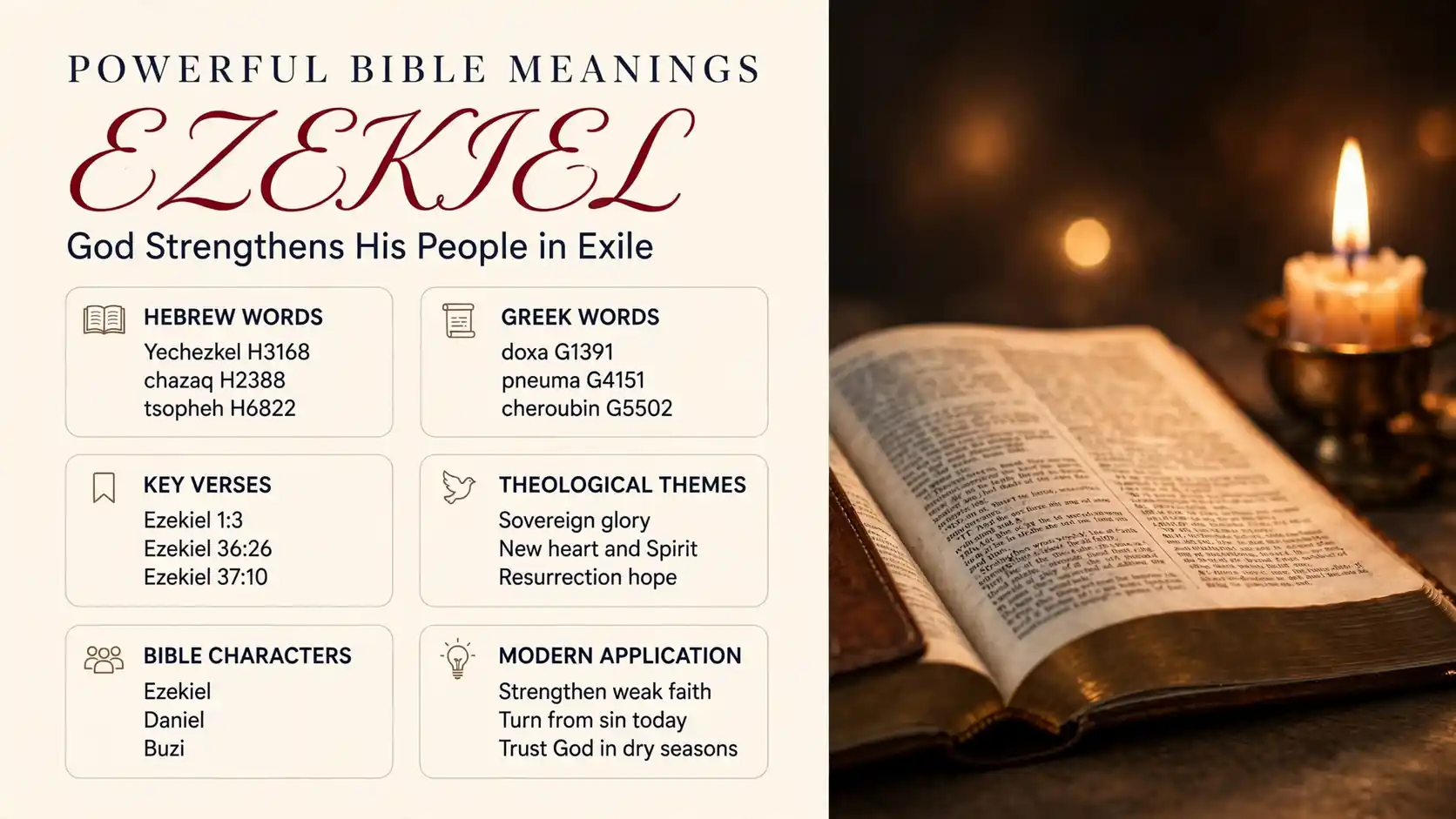
When you ask what does ezekiel mean in the bible, you meet a priest turned prophet whose name carried hope into exile. Ezekiel son of Buzi was called by the Kebar River at age thirty, far from Jerusalem and the temple he loved.
His name Yechezkel declares that God strengthens His people even when everything visible looks broken. That promise runs through his watchman warnings, dry bones vision, and the returning glory that closes his book with living water for every generation after him.
Key Scripture References for Ezekiel
| Verse | Passage Snippet | Context |
|---|---|---|
| Ezekiel 1:3 | The word of the Lord came to Ezekiel | Call among exiles by Kebar River |
| Ezekiel 2:3 | Son of man, I send you to Israel | Commission to a rebellious house |
| Ezekiel 3:17 | I have made you a watchman | Duty to warn the wicked |
| Ezekiel 11:19 | I will give them one heart | Promise of a new spirit |
| Ezekiel 18:32 | I have no pleasure in death | Call to repent and live |
| Ezekiel 24:24 | Ezekiel is a sign to you | Death of his wife as sign |
| Ezekiel 33:11 | Turn back from your ways | Watchman message renewed |
| Ezekiel 36:26 | A new heart I will give you | Cleansing and restoration promise |
| Ezekiel 37:10 | An exceedingly great army | Dry bones stand alive |
| Ezekiel 43:2 | The glory of the God of Israel | Glory returns to the temple |
Bible Translation Comparison for Ezekiel
| Verse | KJV | NIV | ESV | NASB |
|---|---|---|---|---|
| Ezekiel 1:3 | Word came expressly | Word came to Ezekiel | Word came to Ezekiel | Word came expressly |
| Ezekiel 3:17 | Made thee a watchman | Made you a watchman | Made you a watchman | Given you as watchman |
| Ezekiel 11:19 | Give one heart | Give undivided heart | Give one heart | Give one heart |
| Ezekiel 18:32 | No pleasure in death | No pleasure in death | No pleasure in death | No pleasure in death |
| Ezekiel 33:11 | No pleasure in death of wicked | No pleasure in death of wicked | No pleasure in death of wicked | No pleasure in death of wicked |
| Ezekiel 36:26 | New heart also will I give | I will give you a new heart | I will give you a new heart | I will give you a new heart |
| Ezekiel 37:9 | Breathe on these slain | Breath enter these slain | Breath enter these slain | Breathe on these slain |
| Ezekiel 37:14 | Put my spirit in you | Put my Spirit in you | Put my Spirit in you | Put My Spirit within you |
| Ezekiel 43:2 | Glory of God of Israel | Glory of God of Israel | Glory of God of Israel | Glory of God of Israel |
| Ezekiel 47:9 | Every living creature will live | Everything shall live | Everything will live | Every living thing will live |
People and Characters Associated with Ezekiel
| Person | Role | Connection |
|---|---|---|
| Ezekiel | Priest and prophet | Son of Buzi called in exile |
| Buzi | Father and priest | Named in the opening verse |
| Wife of Ezekiel | Delight of his eyes | Her death became a sign |
| Daniel | Prophet in Babylon | Named Ezekiel beside Noah and Job |
| Noah | Righteous patriarch | Example of saving only himself |
| Job | Righteous sufferer | Example in Ezekiel chapter 14 |
| Jehoiachin | Exiled king of Judah | His exile dates the call |
| Nebuchadnezzar | King of Babylon | Ruler who carried Judah captive |
| Elders of Israel | Leaders in exile | Sat before Ezekiel for counsel |
| Gog | Prince from Magog | Enemy in the later prophecies |
Original Hebrew and Greek Words for Ezekiel
| Original Word | Transliteration | Strong’s # | Literal Meaning |
|---|---|---|---|
| יְחֶזְקֵאל | Yechezkel | H3168 | God strengthens |
| חָזַק | chazaq | H2388 | To strengthen or be strong |
| צֹפֶה | tsopheh | H6822 | Watchman who looks out |
| עֶצֶם | etsem | H6106 | Bone or essence |
| רוּחַ | ruach | H7307 | Breath or spirit or wind |
| δόξα | doxa | G1391 | Glory or splendor |
| πνεῦμα | pneuma | G4151 | Spirit or breath |
| χερουβίν | cheroubin | G5502 | Cherubim heavenly beings |
| προφήτης | prophetes | G4396 | Prophet who speaks forth |
| כָּבוֹד | kavod | H3519 | Glory or weighty honor |
Related Biblical Concepts for Ezekiel
| Concept | Connection | Supporting Verse |
|---|---|---|
| God strengthens | The name itself preaches hope | Ezekiel 1:3 |
| Watchman duty | Warn so blood is not required | Ezekiel 3:17 |
| New heart | God removes the heart of stone | Ezekiel 36:26 |
| Dry bones restored | Dead Israel lives by breath | Ezekiel 37:14 |
| Glory departing | Glory left a defiled temple | Ezekiel 10:18 |
| Glory returning | Glory enters from the east | Ezekiel 43:2 |
| Personal responsibility | Each soul answers for sin | Ezekiel 18:20 |
| Temple river | Water heals from the sanctuary | Ezekiel 47:9 |
| Sign of the wife | Private grief pictures public loss | Ezekiel 24:16 |
| Sign acts | Prophet acts out the message | Ezekiel 24:24 |
Historical and Cultural Context for Ezekiel
| Aspect | Detail | Biblical Source |
|---|---|---|
| First exile | Jehoiachin taken to Babylon in 597 BC | Ezekiel 1:2 |
| Settlement | Exiles lived at Tel Abib | Ezekiel 3:15 |
| River setting | Kebar River canal in Babylon | Ezekiel 1:1 |
| Call date | Fifth year of exile, 593 BC | Ezekiel 1:2 |
| Age at call | Ezekiel was thirty years old | Ezekiel 1:1 |
| Priesthood | Priests served at Jerusalem temple | Ezekiel 1:3 |
| Siege news | Jerusalem besieged then destroyed | Ezekiel 24:2 |
| Temple loss | Sanctuary burned in 586 BC | Ezekiel 33:21 |
| Measured temple | Vision given in twenty fifth year | Ezekiel 40:1 |
| Captive community | Exiles built homes and families abroad | Ezekiel 3:15 |
Theological Themes in Ezekiel
| Theme | Explanation | Scripture |
|---|---|---|
| Sovereign glory | God rules even in Babylon | Ezekiel 1:28 |
| Watchman accountability | Silence in warning brings guilt | Ezekiel 33:8 |
| Personal repentance | God delights when sinners turn | Ezekiel 18:32 |
| New heart and Spirit | God renews His people inside | Ezekiel 36:26 |
| Resurrection hope | Breath raises what looks dead | Ezekiel 37:14 |
| Holy presence | Glory returns to a holy house | Ezekiel 43:2 |
| Divine strength | God strengthens weak exiles | Ezekiel 3:8 |
| Restoration of Israel | Scattered people gathered home | Ezekiel 34:13 |
| Healing river | Life flows from God’s presence | Ezekiel 47:9 |
| Knowing the Lord | Judgments teach that He is Lord | Ezekiel 6:7 |
Modern Application for Believers from Ezekiel
| Area | Practice | Scripture |
|---|---|---|
| Prayer | Ask God to strengthen weak faith | Ezekiel 36:37 |
| Warning others | Speak truth with love early | Ezekiel 33:7 |
| Repentance | Turn from sin the same day | Ezekiel 18:32 |
| Hope | Trust God in dry seasons | Ezekiel 37:11 |
| Listening | Sit with God’s word quietly | Ezekiel 3:15 |
| Holiness | Guard your heart from idols | Ezekiel 14:3 |
| Courage | Stand firm when people resist | Ezekiel 3:9 |
| Renewal | Seek a soft responsive heart | Ezekiel 36:26 |
| Worship | Welcome God’s glory daily | Ezekiel 43:4 |
| Service | Use your post faithfully in exile seasons | Ezekiel 33:22 |
Yechezkel and the Name That Says God Strengthens
Yechezkel joins the verb chazaq with the name of God, so every mention of Ezekiel repeats a sermon. He did not carry a name about his own strength or priestly rank. He carried a confession that God Himself would hold His people together when their own strength, plans, and national pride had completely failed them in a foreign land.
That confession mattered because Ezekiel preached to people who had lost land, temple, and king. Your study of his name should start there, in exile rather than in comfort. The name was not decoration or family habit, it was survival truth spoken daily over a community that wondered whether God had forgotten them altogether.
What Does Ezekiel Mean in the Bible for the Watchman on the Wall
God made Ezekiel a watchman, a tsopheh who scans the horizon and cries out before danger arrives. A silent watchman was not kind or neutral in God’s sight. His warning gave the wicked a real chance to turn and live, and it also protected the watchman himself from sharing in guilt through silence, fear, or lazy indifference toward people in danger.
That calling still shapes how you read his sharpest chapters today. Ezekiel was not free to soften the message to keep friends comfortable. He was free only to speak what God gave him, exactly as God gave it, and then trust God completely with the result among hearers who often resisted, argued, mocked, or simply refused to change.
The Valley Where Dry Bones Learned to Live Again
In Ezekiel 37 the prophet stood in a valley full of very dry bones and heard God ask if they could live. He answered with humble trust, leaving the outcome with the Lord who knows. Then bone joined bone, breath entered, and a vast army stood on its feet.
The vision was first about Israel, hopeless in exile yet not finished in God’s plan. It also teaches you how renewal usually comes in Scripture and in life, word first and Spirit next, prophecy heard and breath received. God speaks, God breathes, and what looked dead, scattered, and beyond every human repair begins to stand, walk, and serve again.
The Glory That Left and the Glory That Returns
Ezekiel watched the glory of the Lord rise from the cherubim and pause at the temple threshold in chapter 10. That slow departure showed how serious persistent idolatry had become among God’s own people. The house was still standing, but the presence was withdrawing step by step.
Yet the book does not end with departure, because chapters 40 to 48 show glory returning from the east. A measured temple, a renamed city, a prince provided for, land fairly divided, and a healing river flowing to the Dead Sea close the story with order, holiness, and life restored in every direction. The final name of the city declares simply that the Lord is there.
Frequently Asked Questions About Ezekiel
What does Yechezkel mean in Hebrew and what is Strong’s H3168?
Yechezkel in Strong’s H3168 means God strengthens or God will strengthen, built on chazaq H2388, a fitting name for a prophet sent to weak exiles in Babylon.
Why is Ezekiel 37 and the valley of dry bones so important?
It shows God raising hopeless Israel by His word and breath, giving resurrection hope to exiles who said their bones were dried and their hope was gone.
What was the watchman calling given to Ezekiel?
God set him to warn Israel in Ezekiel 3 and 33, so hearers could turn from wicked ways and live, while his own faithfulness kept him clear of their blood.
Why could Ezekiel not mourn when his wife died in Ezekiel 24?
God made his silent grief a sign that Jerusalem, the delight of the nations eyes, would fall suddenly and its shocked people would not mourn in the usual public ways.
What does the returning glory in Ezekiel 43 teach believers?
It teaches that the holy God who departed because of sin gladly returns to dwell with His cleansed people, filling His house and bringing lasting restoration, order, and life.