
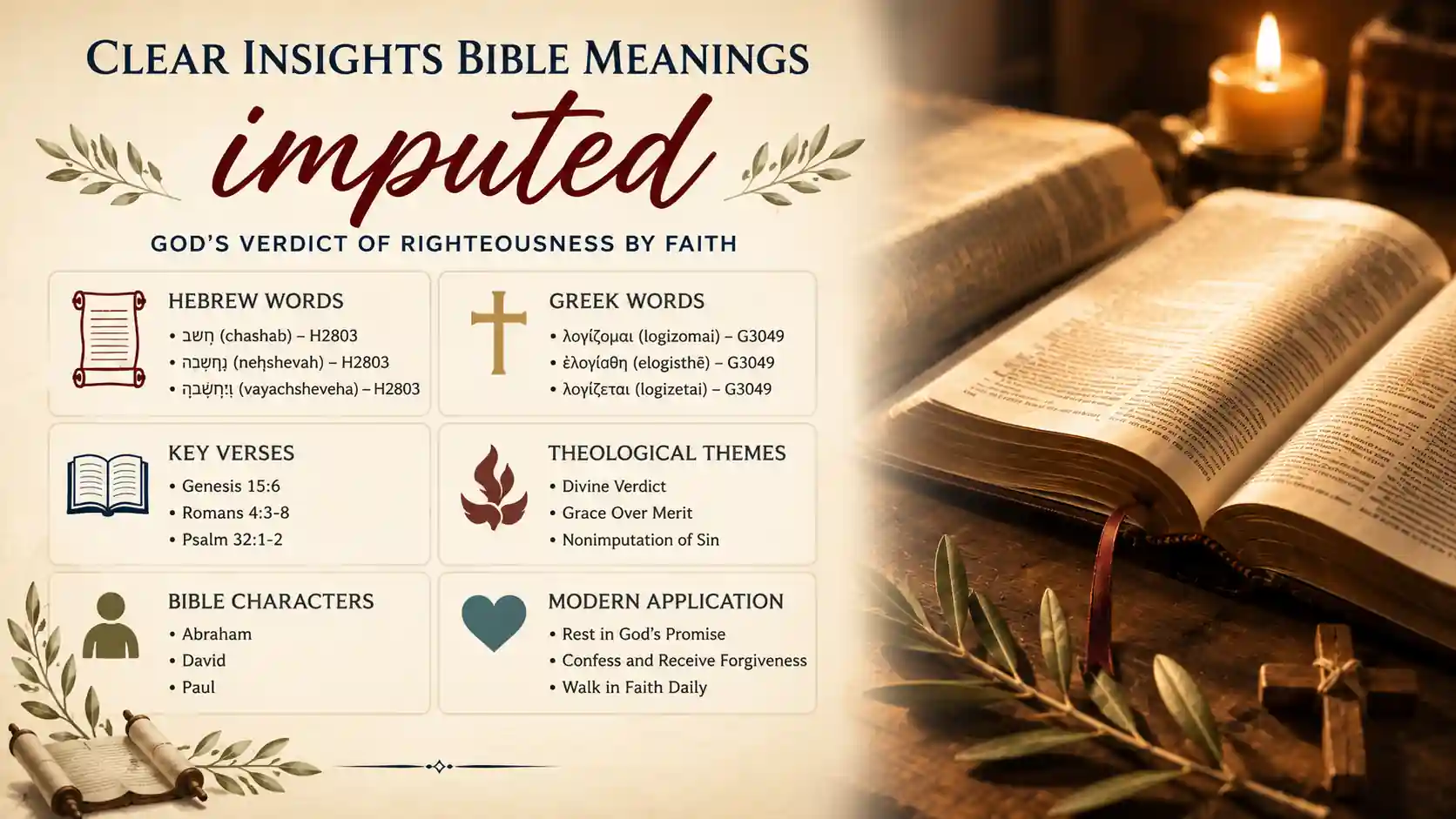
What does imputed mean in the Bible? In Scripture, to impute means to reckon, credit, count, or assign something to a person’s account. The term often describes God’s judgment concerning righteousness or sin, especially in Genesis 15, Psalm 32, and Romans 4.
As you study this theme, you encounter more than a financial metaphor. Imputation concerns God’s truthful verdict. He counts Abraham’s faith as righteousness, does not count forgiven sin against the blessed person, and grants righteousness to those who trust the God who raised Jesus from the dead.
Imputed Key Scripture References
| Verse | Passage Snippet | Context |
|---|---|---|
| Genesis 15:6 | “Counted it to him for righteousness” | Abram believes God’s covenant promise |
| Leviticus 7:18 | “Neither shall it be imputed” | An invalid sacrifice brings no acceptance |
| Leviticus 17:4 | “Blood shall be imputed” | Unlawful slaughter creates bloodguilt |
| Psalm 32:2 | “The Lord imputeth not iniquity” | David celebrates forgiven sin |
| Romans 4:3 | “Counted unto him for righteousness” | Paul cites Abraham against boasting |
| Romans 4:6 | “Imputeth righteousness without works” | David supports justification by grace |
| Romans 4:8 | “Will not impute sin” | Forgiveness includes nonreckoning of guilt |
| Romans 4:11 | “Righteousness might be imputed” | Abraham fathers uncircumcised believers |
| Romans 4:22 | “Imputed to him for righteousness” | Abraham trusts despite human impossibility |
| Romans 4:24 | “Imputed, if we believe” | Abraham’s pattern points believers to Christ |
Imputed Bible Translation Comparison
| Verse | KJV | NIV | ESV | NASB |
|---|---|---|---|---|
| Genesis 15:6 | Counted it | Credited it | Counted it | Credited it |
| Leviticus 7:18 | Imputed unto him | Credited to him | Credited to him | Reckoned to him |
| Leviticus 17:4 | Blood imputed | Bloodguilt | Bloodguilt | Bloodguiltiness |
| Psalm 32:2 | Imputeth not | Does not count | Counts no iniquity | Does not count wrongdoing |
| Romans 4:3 | Counted unto him | Credited to him | Counted to him | Credited to him |
| Romans 4:5 | Counted for righteousness | Credited as righteousness | Counted as righteousness | Credited as righteousness |
| Romans 4:6 | Imputeth righteousness | Credits righteousness | Counts righteousness | Credits righteousness |
| Romans 4:8 | Will not impute sin | Will never count sin | Counts no sin | Will not take sin into account |
| Romans 4:11 | Might be imputed | Might be credited | Would be counted | Might be credited |
| Romans 4:24 | Shall be imputed | Will credit righteousness | Will be counted | Will be credited |
People and Characters Associated with Imputed Truth
| Person | Role | Connection |
|---|---|---|
| Abraham | Covenant patriarch | Faith is counted as righteousness |
| David | King and psalmist | Describes blessed nonimputation of sin |
| Paul | Apostle to the Gentiles | Explains reckoning in Romans 4 |
| Jesus Christ | Crucified and risen Lord | The object and ground of saving faith |
| Moses | Covenant mediator | Records Abraham’s faith and sacrificial laws |
| Sarah | Wife of Abraham | Shares the humanly impossible promise |
| Isaac | Promised son | His birth confirms God’s covenant faithfulness |
| Uncircumcised believers | Gentile Christians | Receive righteousness through faith |
| Circumcised believers | Jewish Christians | Must walk in Abraham’s believing footsteps |
| God | Divine Judge and Giver | Credits righteousness and forgives guilt |
Original Hebrew and Greek Words for Imputed
| Original Word | Transliteration | Strong’s # | Literal Meaning |
|---|---|---|---|
| חָשַׁב | ḥāšab, chashab | H2803 | Think, calculate, reckon |
| נֶחְשְׁבָה | neḥshevah | H2803 | It shall be reckoned |
| וַיַּחְשְׁבֶהָ | vayachsheveha | H2803 | He reckoned it |
| יַחְשֹׁב | yaḥshov | H2803 | He will reckon |
| λογίζομαι | logizomai | G3049 | Reckon, count, consider |
| ἐλογίσθη | elogisthē | G3049 | It was counted |
| λογίζεται | logizetai | G3049 | It is counted |
| λογίσηται | logisētai | G3049 | He might count |
| λογισθῆναι | logisthēnai | G3049 | To be counted |
| λογισθήσεται | logisthēsetai | G3049 | It will be counted |
Related Biblical Concepts Connected with Imputed
| Concept | Connection | Supporting Verse |
|---|---|---|
| Faith | Receives God’s promise rather than earning favor | Romans 4:5 |
| Righteousness | The status God credits to the believer | Romans 4:6 |
| Justification | God declares the ungodly righteous through faith | Romans 4:5 |
| Forgiveness | Sin is covered and not counted against a person | Romans 4:7-8 |
| Grace | The promise rests on God’s gift | Romans 4:16 |
| Works | Wages earned by works differ from gracious credit | Romans 4:4 |
| Covenant | Abraham believes God’s promised offspring | Genesis 15:4-6 |
| Resurrection | Believers trust the God who raised Jesus | Romans 4:24 |
| Atonement | Christ was delivered because of transgressions | Romans 4:25 |
| Union with Christ | Believers belong to the risen Lord by faith | Romans 4:24-25 |
Historical and Cultural Context of Imputed Language
| Aspect | Detail | Biblical Source |
|---|---|---|
| Ancient accounting | Reckoning language described what was entered to an account | Romans 4:4 |
| Covenant promise | Abram awaited an heir and innumerable descendants | Genesis 15:1-5 |
| Patriarchal barrenness | Abraham and Sarah lacked natural ability to produce the heir | Romans 4:19 |
| Circumcision | The covenant sign followed Abraham’s righteous reckoning | Romans 4:10-11 |
| Jewish identity | Circumcision distinguished covenant membership | Genesis 17:10-14 |
| Sacrificial worship | Offerings required obedience to God’s instructions | Leviticus 7:16-18 |
| Bloodguilt | Unauthorized killing could be charged as shed blood | Leviticus 17:3-4 |
| Psalmic confession | David connected forgiveness with covered sin | Psalm 32:1-5 |
| First-century debate | Jewish and Gentile believers questioned covenant inclusion | Romans 3:29-30 |
| Roman legal setting | Declarative and accounting imagery clarified status | Romans 4:5-8 |
Theological Themes within Imputed Righteousness
| Theme | Explanation | Scripture |
|---|---|---|
| Divine verdict | God alone gives the decisive judgment of righteousness | Romans 8:33 |
| Grace over merit | Righteousness is credited apart from works | Romans 4:6 |
| Faith in God | Abraham trusts the Speaker of the promise | Genesis 15:6 |
| Justification of the ungodly | God receives those who cannot establish their own claim | Romans 4:5 |
| Nonimputation of sin | Forgiven guilt is not charged to the believer | Romans 4:8 |
| Universal promise | Abraham becomes father of believing Jews and Gentiles | Romans 4:11-12 |
| Christ’s death | Jesus is delivered because of human transgressions | Romans 4:25 |
| Christ’s resurrection | His rising confirms God’s saving work | Romans 4:24-25 |
| Assurance | The promise depends on grace and remains secure | Romans 4:16 |
| Transforming faith | Genuine trust follows Abraham’s faithful footsteps | Romans 4:12 |
Modern Application of Imputed Truth for Believers
| Area | Practice | Scripture |
|---|---|---|
| Assurance | Rest in God’s promise rather than personal merit | Romans 4:16 |
| Confession | Bring sin honestly before the forgiving Lord | Psalm 32:5 |
| Humility | Reject boasting about religious achievements | Romans 4:2 |
| Faith | Trust God when circumstances appear impossible | Romans 4:18 |
| Worship | Thank God for righteousness given by grace | Romans 4:6-8 |
| Identity | Receive your standing from God’s verdict | Romans 8:33-34 |
| Obedience | Walk in the footsteps of Abraham’s faith | Romans 4:12 |
| Evangelism | Welcome believers from every ethnic background | Romans 4:11 |
| Endurance | Grow strong in faith while waiting for promises | Romans 4:20 |
| Christ-centered living | Fix faith on the crucified and risen Jesus | Romans 4:24-25 |
חָשַׁב Shows That Imputed Means Reckoned by a True Judge
The primary Hebrew verb behind imputation is חָשַׁב, ḥāšab or chashab, Strong’s H2803. Its range includes thinking, planning, calculating, considering, and reckoning. The word does not always carry a saving meaning. Its sense depends on what is reckoned, who performs the reckoning, and the covenant setting in which the judgment occurs.
In Genesis 15:6, Abram believes the Lord, and the Lord reckons that faith to him as righteousness. God is not deceived about Abram’s weaknesses. He gives a favorable covenant verdict to a man who trusts His promise. In Psalm 32:2, the same root describes the blessed person to whom the Lord does not reckon iniquity.
What Does Imputed Mean in the Bible According to Romans 4?
Romans 4 builds its argument around λογίζομαι, logizomai, Strong’s G3049. The verb appears repeatedly because Paul wants you to distinguish a wage from a gift. A worker receives wages as an obligation, but the person who trusts God receives righteousness according to grace. The reckoning comes from God, not from human achievement.
Paul joins Genesis 15:6 with Psalm 32:1-2. Abraham shows righteousness counted through faith, while David shows sin forgiven and not counted. Together, these texts present two sides of one blessing. God does not charge forgiven guilt to the believer, and He grants a righteous standing apart from works.
Abraham’S Covenant Faith Before Circumcision
The timing of Abraham’s circumcision is central to Paul’s reasoning. Genesis 15 records the reckoning of righteousness, while Genesis 17 introduces circumcision as the covenant sign. Abraham was therefore counted righteous before receiving the sign. Circumcision confirmed the righteousness of faith that he already possessed.
This sequence allows Paul to describe Abraham as the father of all who believe. Uncircumcised Gentiles do not need to become ethnic Jews before receiving the promise, and circumcised Jews cannot rely on the sign alone. Both groups must share the faith Abraham had before circumcision.
Christ’S Death and Resurrection Complete Paul’S Imputed Argument
Romans 4 does not end with Abraham. Scripture recorded his reckoning for the sake of later believers who trust the God who raised Jesus. Christian faith is not confidence in faith itself. You trust the living God who acted decisively through the death and resurrection of His Son.
Jesus was delivered because of transgressions and raised in relation to justification. Paul’s compressed statement places the cross and resurrection at the center of the righteous verdict. Imputation is therefore not an abstract entry in a heavenly ledger. It is God’s gracious judgment grounded in His saving action through Christ.
Frequently Asked Questions About Imputed Meaning
Does חָשַׁב, chashab, always mean that righteousness is transferred?
No. The verb broadly means to reckon or account, and its precise meaning must be determined from each passage.
Why does Romans 4 use “counted,” “credited,” and “imputed” in different translations?
These English terms translate λογίζομαι, logizomai, emphasizing the related ideas of reckoning, accounting, and assigning a status.
Was Abraham counted righteous because faith was a meritorious work?
No. Paul contrasts faith with earning wages and presents the reckoning as an act of grace toward one who trusts God.
How can God justify the ungodly without ignoring sin?
Romans 4 directs you to Jesus, who was delivered because of transgressions and raised in connection with justification.
How should imputed righteousness affect your daily life?
It should produce assurance, humility, confession, gratitude, and obedient trust rather than pride or spiritual passivity.