
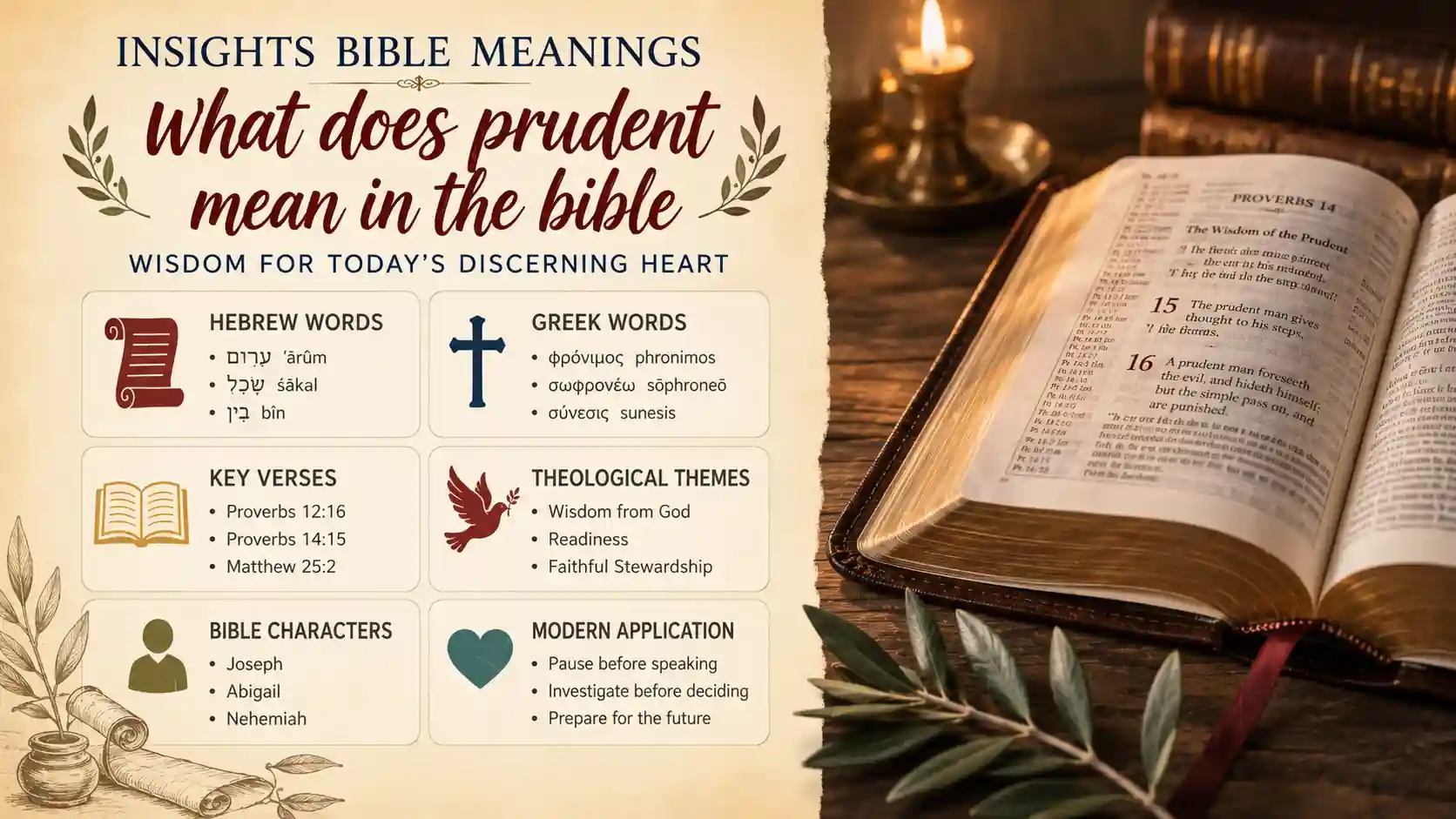
What does prudent mean in the Bible? Biblical prudence is the God-directed ability to understand a situation, foresee its likely outcome, and choose a wise course of action. It is neither fearful hesitation nor clever self-protection. Prudence listens to God, receives correction, weighs consequences, and acts at the proper time.
Scripture expresses this quality through several Hebrew and Greek words. Together they describe discernment, foresight, sound judgment, thoughtful preparation, and obedient wisdom. As you study them, you discover that prudence begins with reverence for God and becomes visible in everyday decisions.
Key Prudent Scripture References
| Verse | Passage Snippet | Context |
|---|---|---|
| Proverbs 12:16 | The prudent overlooks an insult | Self-control prevents needless conflict |
| Proverbs 12:23 | A prudent person conceals knowledge | Wisdom does not display everything known |
| Proverbs 13:16 | The prudent acts with knowledge | Conduct should follow understanding |
| Proverbs 14:8 | The prudent considers his way | Wisdom examines direction and motives |
| Proverbs 14:15 | The prudent gives thought to steps | Discernment tests claims before acting |
| Proverbs 14:18 | The prudent are crowned with knowledge | Teachability produces lasting understanding |
| Proverbs 22:3 | The prudent sees danger and hides | Foresight responds before harm arrives |
| Amos 5:13 | The prudent keeps silent in evil times | Corrupt conditions can require restraint |
These passages place prudence within Israel’s wisdom tradition, where choices reveal whether a person is teachable, discerning, and attentive to consequences.
Prudent Bible Translation Comparison
| Verse | KJV | NIV | ESV | NASB |
|---|---|---|---|---|
| Proverbs 12:16 | prudent man | prudent man | prudent ignores | prudent person |
| Proverbs 12:23 | prudent man | prudent keep | prudent conceals | prudent man |
| Proverbs 13:16 | prudent man | prudent act | prudent acts | prudent man |
| Proverbs 14:8 | wisdom of prudent | wisdom of prudent | wisdom of prudent | wisdom of sensible |
| Proverbs 14:15 | prudent man | prudent give thought | prudent gives thought | sensible considers |
| Proverbs 14:18 | prudent crowned | prudent crowned | prudent crowned | sensible crowned |
| Proverbs 22:3 | prudent man foreseeth | prudent see danger | prudent sees danger | prudent sees evil |
| Matthew 25:2 | five wise | five wise | five wise | five prudent |
The translations show that “prudent,” “wise,” and “sensible” often represent overlapping ideas. The differences usually reflect English style rather than opposing interpretations of the underlying word.
People and Characters Associated with Prudent Conduct
| Person | Role | Connection |
|---|---|---|
| Joseph | Egyptian administrator | Stored grain before the famine |
| Abigail | Wife of Nabal | Prevented bloodshed through timely action |
| David | King of Israel | Behaved wisely under Saul’s hostility |
| Solomon | Wisdom teacher | Taught foresight and disciplined judgment |
| Nehemiah | Governor of Judah | Inspected Jerusalem before announcing plans |
| Daniel | Exiled Judean official | Answered dangerous demands with discretion |
| Esther | Persian queen | Chose the proper time to reveal her request |
| Wise virgins | Parable characters | Prepared oil before the bridegroom arrived |
| Faithful servant | Parable character | Managed his master’s household responsibly |
Joseph illustrates prudence through long-term preparation. Abigail, Esther, Daniel, and Nehemiah show that prudent action may include tactful speech, careful timing, private investigation, or restrained disclosure. Jesus’ parables present preparedness and faithful stewardship as marks of wisdom.
Original Hebrew and Greek Words for Prudent
| Original Word | Transliteration | Strong’s # | Literal Meaning |
|---|---|---|---|
| עָרוּם | ʿārûm | H6175 | Shrewd, sensible, cautious |
| עָרַם | ʿāram | H6191 | To act craftily or prudently |
| שָׂכַל | śākal | H7919 | Understand wisely, act circumspectly |
| בִּין | bîn | H995 | Discern, distinguish, understand |
| חָכָם | ḥākām | H2450 | Wise, skillful, learned |
| תְּבוּנָה | təḇûnâ | H8394 | Understanding, insight |
| פָּקַח | pāqaḥ | H6491 | Open the eyes, perceive |
| φρόνιμος | phronimos | G5429 | Sensible, thoughtful, practically wise |
| σωφρονέω | sōphroneō | G4993 | Think soberly, exercise sound judgment |
The principal Hebrew adjective in Proverbs is עָרוּם, ʿārûm. Depending on its moral setting, it can describe commendable shrewdness or blameworthy craftiness. שָׂכַל, śākal, emphasizes intelligent consideration and successful conduct, while בִּין, bîn, concerns distinguishing and understanding. The New Testament’s φρόνιμος, phronimos, describes thoughtful, practical wisdom.
Related Prudent Biblical Concepts
| Concept | Connection | Supporting Verse |
|---|---|---|
| Fear of the Lord | Gives wisdom its proper foundation | Proverbs 9:10 |
| Discernment | Distinguishes sound paths from harmful ones | Proverbs 2:11 |
| Knowledge | Supplies facts needed for wise action | Proverbs 13:16 |
| Foresight | Recognizes danger before it causes harm | Proverbs 22:3 |
| Self-control | Restrains immediate emotional reactions | Proverbs 12:16 |
| Teachability | Receives correction rather than resisting it | Proverbs 15:5 |
| Preparation | Provides wisely for future responsibility | Matthew 25:4 |
| Watchfulness | Remains spiritually ready | Matthew 24:42 |
| Integrity | Keeps shrewdness from becoming deceit | Proverbs 10:9 |
Prudence belongs to the larger biblical portrait of wisdom. It works alongside knowledge, discernment, integrity, self-control, and reverence for the Lord. Separated from righteousness, shrewdness can become manipulation. Submitted to God, it becomes faithful judgment.
Historical and Cultural Context of Prudent Conduct
| Aspect | Detail | Biblical Source |
|---|---|---|
| Wisdom schools | Proverbs trained hearers in godly judgment | Proverbs 1:1-6 |
| Royal courts | Officials needed discretion and careful speech | Daniel 2:14 |
| Agriculture | Harvest planning required attention to seasons | Proverbs 10:5 |
| City defenses | Visible danger required early protective action | Proverbs 22:3 |
| Household stores | Oil, food, and supplies required preparation | Matthew 25:1-13 |
| Honor culture | Public insults could provoke destructive retaliation | Proverbs 12:16 |
| Community gates | Elders judged disputes in public gathering places | Ruth 4:1-12 |
| Famine conditions | Administrators stored produce during abundance | Genesis 41:33-36 |
| Persecution | Believers needed innocence joined with wisdom | Matthew 10:16 |
Ancient households could not depend on immediate transportation, modern forecasting, or instant communication. Failure to prepare for famine, travel, harvest, or a wedding procession could bring serious consequences. Biblical images of storage, watchfulness, guarded speech, and timely action therefore carried practical weight.
The wisdom books also addressed communal life. A reckless word could damage honor, intensify a feud, or influence legal proceedings at the city gate. Prudence protected relationships by governing what was said, when it was said, and how strongly it was expressed.
Theological Themes within Biblical Prudence
| Theme | Explanation | Scripture |
|---|---|---|
| Wisdom from God | True judgment begins with divine instruction | Proverbs 2:6 |
| Moral responsibility | People answer for knowingly chosen paths | Proverbs 14:8 |
| Providence | Preparation trusts God without presuming upon him | Genesis 41:32-36 |
| Human limitation | The prudent recognizes incomplete knowledge | Proverbs 14:15 |
| Obedient hearing | Wisdom practices Christ’s teaching | Matthew 7:24 |
| Readiness | Faithful disciples prepare for Christ’s coming | Matthew 25:1-13 |
| Sanctified speech | Wisdom governs timing, tone, and disclosure | Proverbs 12:23 |
| Stewardship | Prudence manages entrusted duties faithfully | Matthew 24:45 |
| Christlike mission | Disciples combine wisdom with innocence | Matthew 10:16 |
Prudence does not compete with faith. Joseph’s preparation for famine rested on God’s revelation, yet that revelation called for organized action. Biblical trust rejects anxious self-reliance, but it does not reject planning, stewardship, or careful judgment.
Jesus joins prudence with obedience. The prudent builder does not merely hear his words but acts on them. In the parable of the virgins, foresight reveals readiness. In the faithful-servant teaching, prudent wisdom appears as dependable service.
Modern Application of Prudent Wisdom for Believers
| Area | Practice | Scripture |
|---|---|---|
| Speech | Pause before responding to provocation | Proverbs 12:16 |
| Decisions | Investigate facts before forming conclusions | Proverbs 14:15 |
| Finances | Prepare responsibly for foreseeable needs | Proverbs 21:20 |
| Relationships | Choose the right time for difficult words | Proverbs 15:23 |
| Work | Act with knowledge rather than impulse | Proverbs 13:16 |
| Safety | Take reasonable precautions around danger | Proverbs 27:12 |
| Spiritual life | Hear and practice Christ’s commands | Matthew 7:24 |
| Service | Manage entrusted responsibilities faithfully | Matthew 24:45 |
| Witness | Join wise conduct with moral innocence | Matthew 10:16 |
עָרוּם And the Moral Direction of Shrewdness
The Hebrew word עָרוּם, ʿārûm, shows why prudence cannot be defined as cleverness alone. The term can describe the sensible person who sees danger, tests information, and considers each step. A related form can also describe craftiness, including the serpent’s subtlety in Genesis 3:1.
Context determines whether shrewdness serves truth or deception. Godly prudence sees clearly while remaining honest. It does not exploit another person’s weakness, conceal sin, or manipulate events. Its intelligence is governed by righteousness, love, and reverence for God.
What Does Prudent Mean in the Bible’S Wisdom Literature?
In Proverbs, prudence is applied wisdom. The prudent person does not believe every report, advertise every piece of knowledge, or continue toward visible danger. Your judgment becomes prudent when you slow down, examine your path, accept instruction, and respond according to truth.
This wisdom is especially visible in ordinary choices. Proverbs applies it to speech, correction, conflict, planning, safety, and companionship. Prudence is therefore not reserved for scholars or leaders. It is a daily discipline through which God’s instruction shapes your habits.
φρόνιμος In the Teaching of Jesus
The Greek adjective φρόνιμος, phronimos, appears in Jesus’ descriptions of wise builders, faithful servants, prepared virgins, and discerning disciples. It conveys practical sense expressed through appropriate action. The prudent builder hears Christ and constructs life upon obedient practice, not intellectual agreement alone.
The wise virgins prepare before the bridegroom’s arrival, while the faithful servant performs his assigned work during the master’s absence. In both teachings, prudence looks beyond the present moment. It accepts that future accountability should govern present conduct.
Prudence, Providence, and Faithful Preparation
Some believers worry that planning may reveal weak faith. Scripture offers a better distinction. Presumption acts without listening to God, while prudence responds faithfully to what God has revealed. Joseph stored grain because God had disclosed the coming famine, and his preparation became a means of preserving life.
You can plan humbly while acknowledging that the Lord directs your steps. Prudent faith holds intentions with open hands, seeks biblical counsel, considers likely consequences, and remains willing to change course. It neither idolizes plans nor excuses carelessness by appealing to providence.
Questions About Prudent Wisdom in Scripture
Why can עָרוּם, ʿārûm, mean both prudent and crafty?
The word describes shrewdness, while its moral quality depends on whether that shrewdness serves wisdom and truth or deception and selfishness.
Does Proverbs 22:3 teach believers to avoid every danger?
No. It commends recognizing foreseeable harm and taking suitable precautions, not abandoning faithful obedience whenever obedience carries risk.
Why does the NASB sometimes use “sensible” where other translations use “prudent”?
“Sensible” communicates the practical judgment contained in Hebrew wisdom vocabulary, though “prudent” more clearly emphasizes foresight and restraint.
How is φρόνιμος, phronimos, different from merely being intelligent?
Phronimos describes intelligence translated into timely, responsible action, especially obedience, preparation, and faithful stewardship.
Can prudence become an excuse for fear or silence?
Yes, when self-protection replaces obedience, but biblical prudence uses restraint and timing to serve truth rather than avoid responsibility.