
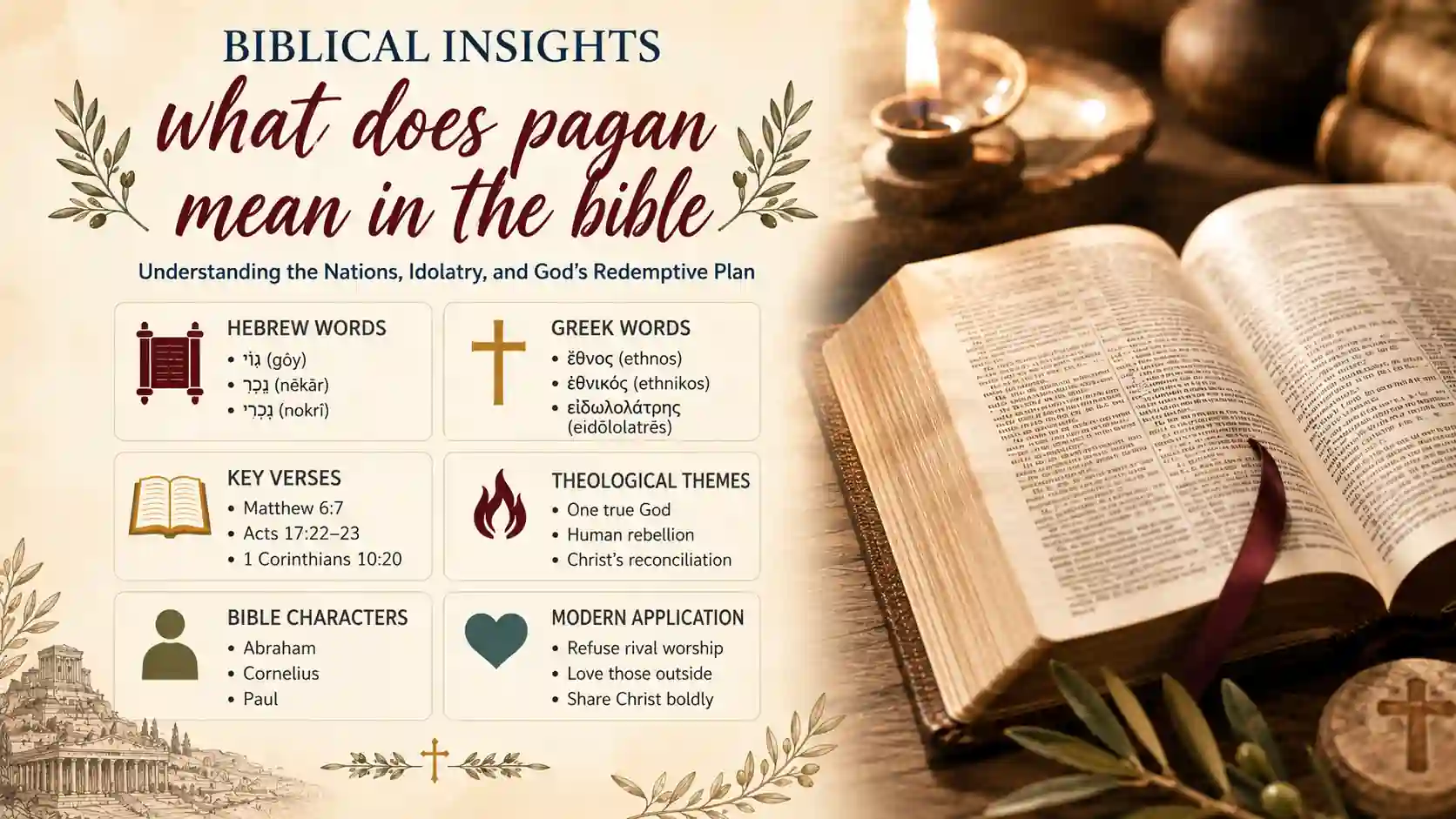
What does pagan mean in the Bible? Scripture uses several Hebrew and Greek terms that English translations render as “pagan,” “heathen,” “Gentile,” or “the nations.” These words usually identify people outside Israel’s covenant community, especially when their worship and conduct oppose the living God.
Yet “pagan” is not simply an ethnic label or a term of contempt. The Bible condemns idolatry while repeatedly revealing God’s purpose to bless, redeem, and gather people from every nation through Jesus Christ.
Pagan Key Scripture References
| Verse | Passage Snippet | Context |
|---|---|---|
| Matthew 5:47 | “Do not even the pagans do that?” | Jesus challenges selective love |
| Matthew 6:7 | “Do not keep on babbling like pagans” | Christ corrects manipulative prayer |
| Matthew 6:32 | “The pagans run after all these things” | Gentile anxiety contrasts with trust |
| Matthew 18:17 | “As you would a pagan” | Church discipline and broken fellowship |
| Acts 14:15 | “Turn from these worthless things” | Paul confronts pagan worship at Lystra |
| Acts 17:22–23 | “An altar with this inscription” | Paul addresses Athenian religion |
| 1 Corinthians 10:20 | “Sacrifices of pagans are offered to demons” | Idolatrous meals threaten loyalty |
| 1 Corinthians 12:2 | “When you were pagans” | Former idol worship in Corinth |
| 1 Peter 2:12 | “Live such good lives among the pagans” | Christian witness among unbelieving nations |
| 1 Peter 4:3 | “Doing what pagans choose to do” | Believers leave their former lifestyle |
Pagan Bible Translation Comparison
| Verse | KJV | NIV | ESV | NASB |
|---|---|---|---|---|
| Matthew 5:47 | publicans | pagans | Gentiles | Gentiles |
| Matthew 6:7 | heathen | pagans | Gentiles | Gentiles |
| Matthew 6:32 | Gentiles | pagans | Gentiles | Gentiles |
| Matthew 18:17 | heathen man | pagan | Gentile | Gentile |
| 1 Corinthians 5:1 | Gentiles | pagans | pagans | Gentiles |
| 1 Corinthians 10:20 | Gentiles | pagans | pagans | Gentiles |
| 1 Corinthians 12:2 | Gentiles | pagans | pagans | pagans |
| 1 Peter 2:12 | Gentiles | pagans | Gentiles | Gentiles |
| 1 Peter 4:3 | Gentiles | pagans | Gentiles | Gentiles |
| 3 John 7 | Gentiles | pagans | Gentiles | Gentiles |
People and Characters Associated with Pagan Contexts
| Person | Role | Connection |
|---|---|---|
| Abraham | Patriarch | Called from an idolatrous culture |
| Rahab | Canaanite woman | Left Jericho’s world and trusted God |
| Ruth | Moabite convert | Joined Israel and worshiped the Lord |
| Naaman | Syrian commander | Renounced other gods after healing |
| Jezebel | Phoenician queen | Promoted Baal worship in Israel |
| Nebuchadnezzar | Babylonian king | Learned that God rules earthly kingdoms |
| Cyrus | Persian ruler | Served God’s purpose without Israelite ancestry |
| Cornelius | Roman centurion | First major Gentile household in Acts |
| Paul | Apostle to Gentiles | Preached Christ throughout pagan cities |
| Dionysius | Athenian convert | Believed after Paul’s Areopagus sermon |
Original Hebrew and Greek Words for Pagan
| Original Word | Transliteration | Strong’s # | Literal Meaning |
|---|---|---|---|
| גּוֹי | gôy | H1471 | nation or people |
| גּוֹיִם | gôyim | H1471 | nations or Gentiles |
| נֵכָר | nēkār | H5236 | foreignness or foreign land |
| נָכְרִי | nokrî | H5237 | foreign or foreigner |
| זָר | zār | H2114 | strange or unauthorized |
| ἔθνος | ethnos | G1484 | nation or people group |
| ἐθνικός | ethnikos | G1482 | Gentile or pagan |
| ἐθνικῶς | ethnikōs | G1483 | in a Gentile manner |
| εἰδωλολάτρης | eidōlolatrēs | G1496 | idol worshiper |
| εἰδωλολατρία | eidōlolatria | G1495 | idolatry |
Related Pagan Biblical Concepts
| Concept | Connection | Supporting Verse |
|---|---|---|
| Gentiles | Nations outside ethnic Israel | Romans 3:29 |
| Idolatry | Worship directed toward created things | Romans 1:23 |
| Covenant | Pagans stood outside Israel’s covenants | Ephesians 2:12 |
| Conversion | Turning from idols to serve God | 1 Thessalonians 1:9 |
| Holiness | God’s people reject pagan practices | Leviticus 20:26 |
| Mission | Disciples are sent to all nations | Matthew 28:19 |
| Witness | Good conduct answers pagan accusations | 1 Peter 2:12 |
| Spiritual conflict | Idol worship may involve demons | 1 Corinthians 10:20 |
| Inclusion | Gentiles become fellow heirs in Christ | Ephesians 3:6 |
| Judgment | God judges idolatry and injustice | Acts 17:30–31 |
Pagan Historical and Cultural Context
| Aspect | Detail | Biblical Source |
|---|---|---|
| Canaanite religion | Baal and Asherah worship shaped local life | Judges 2:11–13 |
| Household idols | Families sometimes possessed portable images | Genesis 31:19 |
| High places | Elevated sites hosted unauthorized worship | 2 Kings 17:10–11 |
| Temple feasts | Sacrificed food was eaten in social gatherings | 1 Corinthians 8:10 |
| Imperial religion | Rulers could receive divine honors | Acts 12:21–23 |
| Greek temples | Cities honored many gods and goddesses | Acts 19:24–27 |
| Divination | Pagan cultures sought supernatural guidance | Deuteronomy 18:10–12 |
| Ritual sexuality | Some worship systems joined religion and immorality | Numbers 25:1–3 |
| Magic practices | Converts sometimes destroyed occult materials | Acts 19:18–19 |
| Ancestral customs | Religious identity was tied to inherited traditions | 1 Peter 1:18 |
Pagan Theological Themes
| Theme | Explanation | Scripture |
|---|---|---|
| One true God | The Lord alone deserves worship | Deuteronomy 6:4 |
| Human rebellion | People exchange God’s glory for images | Romans 1:21–23 |
| Universal creation | God made every nation and person | Acts 17:24–26 |
| Covenant privilege | Israel received a distinct calling | Romans 9:4–5 |
| Impartial judgment | God judges Jews and Gentiles justly | Romans 2:9–11 |
| Gentile faith | Outsiders may display remarkable trust | Matthew 8:10 |
| Christ’s reconciliation | Jesus unites Jews and Gentiles | Ephesians 2:14–16 |
| Repentance | God commands all people to turn | Acts 17:30 |
| Worldwide mission | The gospel is announced among all nations | Luke 24:47 |
| Final worship | Every nation gathers before the Lamb | Revelation 7:9 |
Modern Application of Pagan Teaching for Believers
| Area | Practice | Scripture |
|---|---|---|
| Worship | Refuse every rival to God | Matthew 4:10 |
| Prayer | Speak sincerely rather than mechanically | Matthew 6:7–8 |
| Anxiety | Seek God’s kingdom before material security | Matthew 6:31–33 |
| Culture | Test customs by Scripture | Romans 12:2 |
| Entertainment | Avoid participation in idolatrous devotion | 1 Corinthians 10:14 |
| Relationships | Love those outside your community | Matthew 5:46–48 |
| Witness | Maintain honorable conduct | 1 Peter 2:12 |
| Mission | Share Christ across cultural boundaries | Acts 13:47 |
| Humility | Remember salvation is received by grace | Ephesians 2:8–13 |
| Hope | Anticipate worship from every nation | Revelation 7:9–10 |
What Does Pagan Mean in the Bible’S Covenant Vocabulary?
The English word “pagan” commonly translates terms that mean “nation,” “Gentile,” or “foreigner.” In the Old Testament, גּוֹי, gôy, can describe any nation, including Israel. God promised to make Abraham a “great nation,” using this same basic vocabulary. The word itself does not automatically mean wicked or idolatrous.
Context gives the term its moral force. When the “nations” are contrasted with Israel, they often represent peoples outside the Mosaic covenant whose cultures practiced idolatry. Scripture distinguishes Israel so that Israel may serve God and become a channel of blessing to those very nations, not so that ethnic pride may flourish.
Ἐθνικός And Ἔθνος in the Teaching of Jesus
The Greek adjective ἐθνικός, ethnikos, Strong’s G1482, comes from ἔθνος, ethnos, Strong’s G1484. The noun means a nation or people group, while the adjective can identify someone belonging to the Gentile world. Depending on context and translation, it appears as “Gentile,” “heathen,” or “pagan.”
In Matthew 6:7, Jesus does not condemn every repeated prayer or every Gentile person. He rejects prayer that treats words as a technique for controlling divine power. Pagan worshipers might assume that quantity, formulas, or ritual performance compelled a deity to respond. Jesus teaches you to pray as a child speaking to a Father who already knows your needs.
From Pagan Idolatry to the People of God
Paul reminds Corinthian believers, “When you were pagans, somehow or other you were influenced and led astray to mute idols.” His phrase describes their former religious identity. They had worshiped lifeless images, but the Holy Spirit had brought them to confess that Jesus is Lord.
Conversion does not erase a believer’s ethnicity or cultural background. It redirects worship, loyalty, and conduct. Ruth remained a Moabite by ancestry, yet she embraced Israel’s God. Cornelius remained a Roman, yet he received the Holy Spirit. In Christ, former outsiders become members of God’s household without needing to despise their earthly heritage.
Pagan Practices, Christian Witness, and the Nations’ Hope
The Bible speaks firmly against pagan practices because idolatry distorts humanity’s relationship with the Creator. Sacrifices, occult arts, ritual immorality, and trust in images all redirect devotion away from God. Paul therefore tells believers to flee idolatry rather than experiment with its spiritual boundaries.
At the same time, Scripture never treats pagan peoples as unreachable. God promised Abraham that all families of the earth would be blessed through him. The prophets anticipated nations seeking the Lord, and Jesus commissioned His followers to make disciples of all nations. Revelation completes the theme with a redeemed multitude from every people and language worshiping the Lamb.
Frequently Asked Questions About Pagan Meaning in Scripture
Does גּוֹי, gôy, always mean a pagan nation?
No. It ordinarily means “nation” and can describe Israel, although context may refer to Gentile or idolatrous peoples.
Why does Matthew 6:7 say “pagans” in the NIV but “Gentiles” in the ESV?
Both translate ἐθνικοί, ethnikoi, but the NIV emphasizes religious practice while the ESV preserves the ethnic and covenantal sense.
Does Jesus forbid repeated prayers when He condemns pagan babbling?
No. He forbids empty, manipulative wordiness, not sincere persistence or meaningful repetition in prayer.
Is every Gentile called an idol worshiper in the Bible?
No. Gentile identifies non-Jewish people, while idolatry describes worship that belongs to God being given elsewhere.
How should you apply biblical warnings about paganism without becoming judgmental?
Reject idolatry in your own life, love your neighbors, speak truth graciously, and remember that God saves people from every nation.