
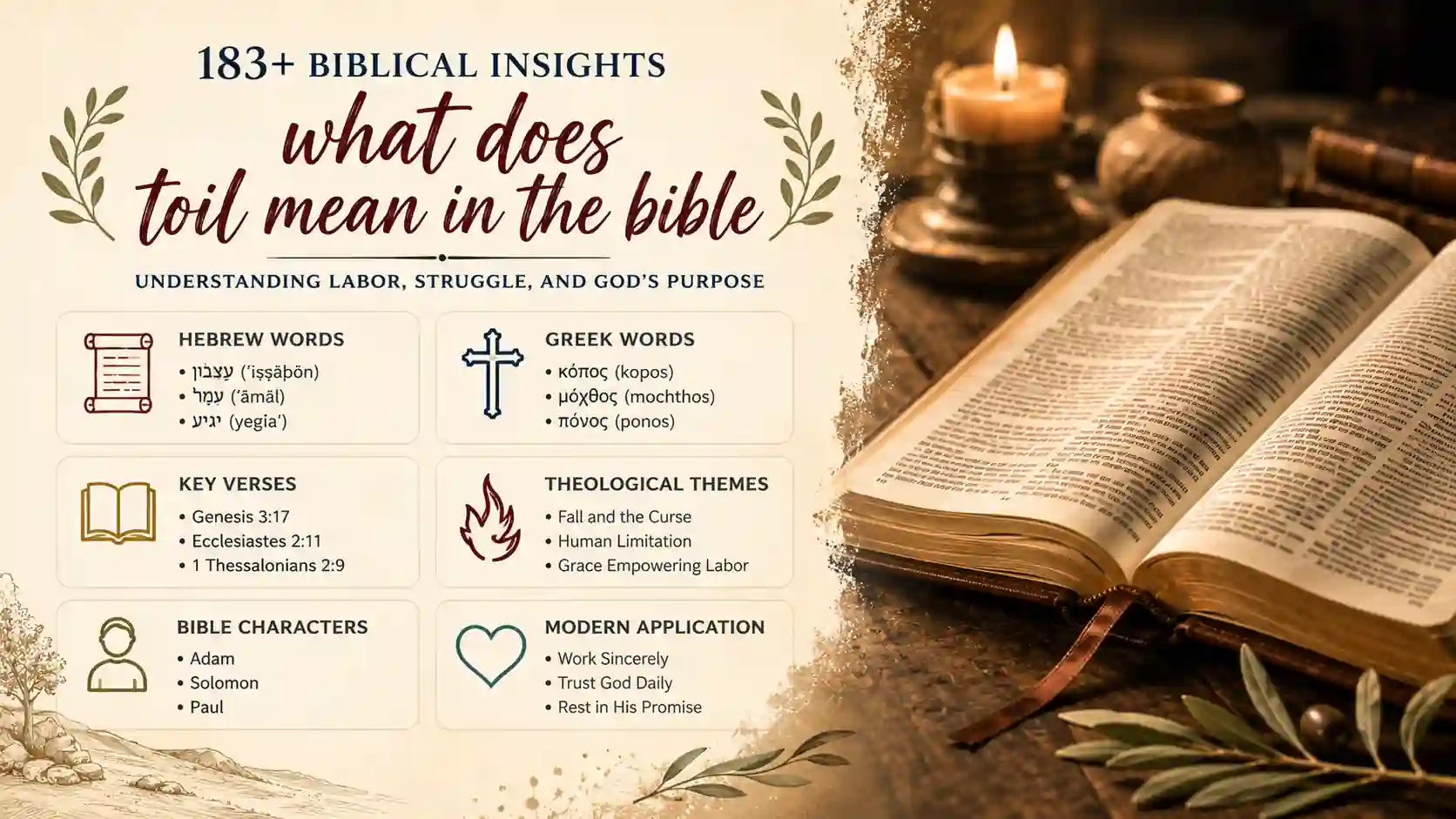
What does toil mean in the Bible? Scripture uses toil for exhausting labor, painful struggle, anxious effort, and faithful work performed at personal cost. The idea first appears in humanity’s life outside Eden, where sin makes ordinary labor difficult and frustrating.
Yet toil is not always meaningless. Ecclesiastes exposes work pursued without God, while the apostles describe sacrificial ministry as worthy toil. As you study the biblical vocabulary, you see a distinction between burdensome striving under the curse and steadfast labor that the Lord receives, strengthens, and ultimately rewards.
Key Toil Scripture References
| Verse | Passage Snippet | Context |
|---|---|---|
| Genesis 3:17 | “In toil you shall eat” | Adam faces cursed ground |
| Genesis 5:29 | “Toil of our hands” | Noah’s name expresses hoped-for relief |
| Psalm 90:10 | “Toil and trouble” | Human life is brief and burdened |
| Ecclesiastes 2:11 | “All the toil” | Achievement proves vaporous |
| Ecclesiastes 2:22 | “Toil and striving” | Work cannot secure lasting gain |
| Isaiah 53:11 | “Anguish of his soul” | The Servant suffers redemptively |
| 1 Thessalonians 2:9 | “Labor and toil” | Paul works while preaching |
| Revelation 14:13 | “Rest from their labors” | Faithful saints receive final rest |
Toil Bible Translation Comparison
| Verse | KJV | NIV | ESV | NASB |
|---|---|---|---|---|
| Genesis 3:17 | “In sorrow” | “Through painful toil” | “In pain” | “With hard labor” |
| Genesis 5:29 | “Toil of our hands” | “Painful toil of our hands” | “Painful toil of our hands” | “Toil of our hands” |
| Psalm 90:10 | “Labour and sorrow” | “Trouble and sorrow” | “Toil and trouble” | “Labor and sorrow” |
| Ecclesiastes 2:11 | “Labor that I had laboured” | “Toiled to achieve” | “Toil I had expended” | “Labor which I had exerted” |
| Ecclesiastes 2:22 | “Labour of his heart” | “Anxious striving” | “Striving of heart” | “Striving with which he labors” |
| 1 Thessalonians 2:9 | “Labour and travail” | “Toil and hardship” | “Labor and toil” | “Labor and hardship” |
| 2 Thessalonians 3:8 | “Travail night and day” | “Laboring and toiling” | “Labor and toil” | “Labor and hardship” |
| Revelation 14:13 | “Rest from their labours” | “Rest from their labor” | “Rest from their labors” | “Rest from their labors” |
People and Characters Associated with Toil
| Person | Role | Connection |
|---|---|---|
| Adam | First man | Tilled ground under the curse |
| Eve | First woman | Experienced multiplied pain in childbirth |
| Noah | Ark builder | His name expressed hope for comfort |
| Jacob | Patriarch and shepherd | Endured heat, cold, and sleeplessness |
| Moses | Prophet and lawgiver | Described life as toil and sorrow |
| Solomon | King and wisdom teacher | Examined toil performed under the sun |
| Paul | Apostle and tentmaker | Joined manual work with gospel ministry |
| Jesus Christ | Suffering Servant | Bore anguish that brought justification |
Original Hebrew and Greek Words for Toil
| Original Word | Transliteration | Strong’s # | Literal Meaning |
|---|---|---|---|
| עִצָּבוֹן | ʿiṣṣāḇôn | H6093 | Pain, hardship, toil |
| עָמָל | ʿāmāl | H5999 | Wearisome labor, trouble |
| יְגִיעַ | yegîaʿ | H3018 | Product or result of toil |
| עָבַד | ʿābad | H5647 | Work, serve, cultivate |
| κόπος | kopos | G2873 | Exhausting labor, weariness |
| κοπιάω | kopiaō | G2872 | To labor until weary |
| μόχθος | mochthos | G3449 | Difficult labor, hardship |
| πόνος | ponos | G4192 | Pain, distress, grievous labor |
Related Biblical Concepts of Toil
| Concept | Connection | Supporting Verse |
|---|---|---|
| Work | God assigned work before sin | Genesis 2:15 |
| Curse | Sin introduced painful frustration | Genesis 3:17 |
| Vanity | Toil cannot produce permanence | Ecclesiastes 2:11 |
| Anxiety | Striving often troubles the heart | Ecclesiastes 2:22 |
| Contentment | God’s gifts may be enjoyed gratefully | Ecclesiastes 3:12–13 |
| Diligence | Faithful effort opposes laziness | Proverbs 14:23 |
| Ministry | Gospel service requires costly labor | Colossians 1:29 |
| Rest | God promises relief from faithful labor | Revelation 14:13 |
Historical and Cultural Context of Toil
| Aspect | Detail | Biblical Source |
|---|---|---|
| Agriculture | Farmers battled thorns and resistant soil | Genesis 3:17–19 |
| Shepherding | Heat, cold, danger, and lost sleep were common | Genesis 31:38–40 |
| Construction | Building demanded organized physical labor | 1 Kings 5:13–18 |
| Forced labor | Kings sometimes conscripted workers | 1 Samuel 8:11–17 |
| Slavery | Egypt made Israel’s service bitter | Exodus 1:13–14 |
| Wisdom culture | Sages examined labor’s value and limits | Ecclesiastes 2:18–23 |
| Tentmaking | Skilled artisans supported themselves manually | Acts 18:2–3 |
| Missionary travel | Ministry included hunger and sleeplessness | 2 Corinthians 11:27 |
Theological Themes within Toil
| Theme | Explanation | Scripture |
|---|---|---|
| Creation | Work belongs to God’s good design | Genesis 2:15 |
| Fall | Sin turned work into painful struggle | Genesis 3:17–19 |
| Providence | God gives enjoyment within labor | Ecclesiastes 3:13 |
| Human limitation | Death prevents earthly toil from lasting | Ecclesiastes 2:18 |
| Justice | God sees exploited and burdened workers | Exodus 3:7 |
| Discipleship | Christian service may require exhausting effort | 1 Corinthians 15:10 |
| Grace | Divine power energizes faithful labor | Colossians 1:29 |
| New creation | God will remove pain and weariness | Revelation 21:4 |
Modern Application of Toil for Believers
| Area | Practice | Scripture |
|---|---|---|
| Employment | Work sincerely before the Lord | Colossians 3:23 |
| Fatigue | Receive sleep as God’s gift | Psalm 127:2 |
| Ambition | Test whether success has become an idol | Ecclesiastes 2:11 |
| Anxiety | Entrust tomorrow’s needs to the Father | Matthew 6:31–34 |
| Ministry | Serve through God’s supplied strength | Colossians 1:29 |
| Finances | Labor honestly and share generously | Ephesians 4:28 |
| Discouragement | Remember that godly labor is not empty | 1 Corinthians 15:58 |
| Sabbath | Practice rhythms of work and rest | Exodus 20:9–10 |
עִצָּבוֹן And the Painful Toil of the Cursed Ground
The earliest major biblical use of toil occurs in Genesis 3:17. God tells Adam that he will eat from the ground through עִצָּבוֹן, ʿiṣṣāḇôn, a word encompassing pain, hardship, sorrow, and labor. The ground itself is cursed because of human rebellion, producing thorns and resisting Adam’s cultivation.
This does not mean that work originated as punishment. Before the fall, Adam was placed in Eden “to work it and keep it.” Sin corrupted the conditions of work, not the basic goodness of purposeful activity. Your labor can therefore be honorable while still being marked by fatigue, frustration, delay, and loss.
Genesis 5:29 uses the same noun when Lamech names his son Noah. He hopes Noah will bring comfort from “the toil of our hands” caused by the cursed ground. Noah does become an agent of preservation, but his story does not completely reverse Adam’s condition.
The persistence of toil after the flood teaches you not to expect human ingenuity to recreate Eden. Better tools may lessen certain burdens, yet they cannot remove sin, mortality, or the heart’s restlessness. Full deliverance requires God’s redemptive work rather than technological or economic progress alone.
What Does Toil Mean in the Bible’S Wisdom Literature?
The Hebrew noun עָמָל, ʿāmāl, often describes labor together with trouble, misery, or weariness. It appears prominently in Ecclesiastes, where the Teacher repeatedly asks what lasting advantage a person receives from all the toil performed “under the sun.”
Ecclesiastes is not condemning craftsmanship, planning, or productivity. It confronts your attempt to obtain permanent meaning through temporary achievements. Wealth passes to another person, projects decay, memories fade, and death separates every worker from the results of earthly effort.
The Teacher also identifies “striving of heart,” showing that toil can be inward as well as physical. You may leave your workplace while continuing to labor mentally through worry, comparison, resentment, and the need to control outcomes. Such striving deprives the worker of peaceful rest.
Yet Ecclesiastes also presents daily enjoyment as God’s gift. Eating, drinking, companionship, and satisfaction in work can be received gratefully without being treated as ultimate. Toil becomes especially oppressive when you demand that work provide the identity, security, or immortality that only God can give.
Κόπος And Μόχθος in Apostolic Ministry
The New Testament frequently uses κόπος, kopos, for labor that produces weariness. The term can suggest a beating, trouble, or exertion that reduces one’s strength. Paul applies it to manual employment, pastoral care, missionary service, and the demanding work of fellow believers.
Μόχθος, mochthos, emphasizes hardship or difficult labor. Paul joins κόπος and μόχθος when reminding the Thessalonians that he worked night and day. He wished to avoid burdening the young church and to provide a visible pattern of disciplined responsibility.
These descriptions prevent you from assuming that Spirit-empowered ministry is effortless. Paul could say that he worked harder than others while immediately crediting the grace of God within him. Grace did not eliminate labor. Grace supplied the power, humility, and endurance required for it.
Colossians 1:29 holds human effort and divine action together. Paul labors, or κοπιάω, kopiaō, while Christ’s energy works powerfully within him. Biblical dependence is not passivity. You act diligently, yet you refuse to treat your strength, insight, or results as self-generated.
From Adam’S Weariness to Christ’S Promised Rest
Isaiah 53:11 speaks of the suffering Servant seeing the result of the anguish or toil of his soul. Jesus does not merely sympathize with humanity’s burden from a distance. He enters a world of sweat, opposition, suffering, and death, then accomplishes redemption through obedient suffering.
Because Christ bears sin and defeats death, your toil no longer has to be empty. First Corinthians 15 connects the resurrection directly to steadfast labor, assuring believers that work performed “in the Lord” is not in vain. Resurrection gives eternal significance to otherwise perishable effort.
This promise does not guarantee that every earthly project succeeds. Faithful workers may remain unnoticed, ministries may appear unfruitful, and righteous efforts may be interrupted. The value of Christian labor rests finally in the risen Lord, not in visible recognition or measurable results.
Revelation 14:13 promises that those who die in the Lord will rest from their labors, while their deeds follow them. Revelation 21 extends that hope by announcing the removal of death, mourning, pain, and πόνος, ponos. God’s final kingdom brings not endless idleness, but creation freed from painful toil.
Frequently Asked Questions About Biblical Toil
Does עִצָּבוֹן mean that all work is a curse?
No. Work existed before sin, while עִצָּבוֹן describes the pain and frustration that entered human labor after the fall.
Why does Genesis 3:17 say “sorrow,” “pain,” or “toil” in different translations?
The Hebrew noun עִצָּבוֹן includes overlapping ideas of painful labor, hardship, sorrow, and distress.
Is עָמָל in Ecclesiastes always morally wrong?
No. It often describes wearisome effort, but Ecclesiastes especially challenges toil pursued as a source of permanent gain.
How can Paul’s κόπος be good when toil is linked with the curse?
Paul’s exhausting labor is good because grace redirects human effort toward Christ, love, and gospel service.
What should you do when faithful work feels fruitless?
Continue steadfastly in the Lord, trusting that resurrection ensures your God-directed labor is never ultimately empty.