
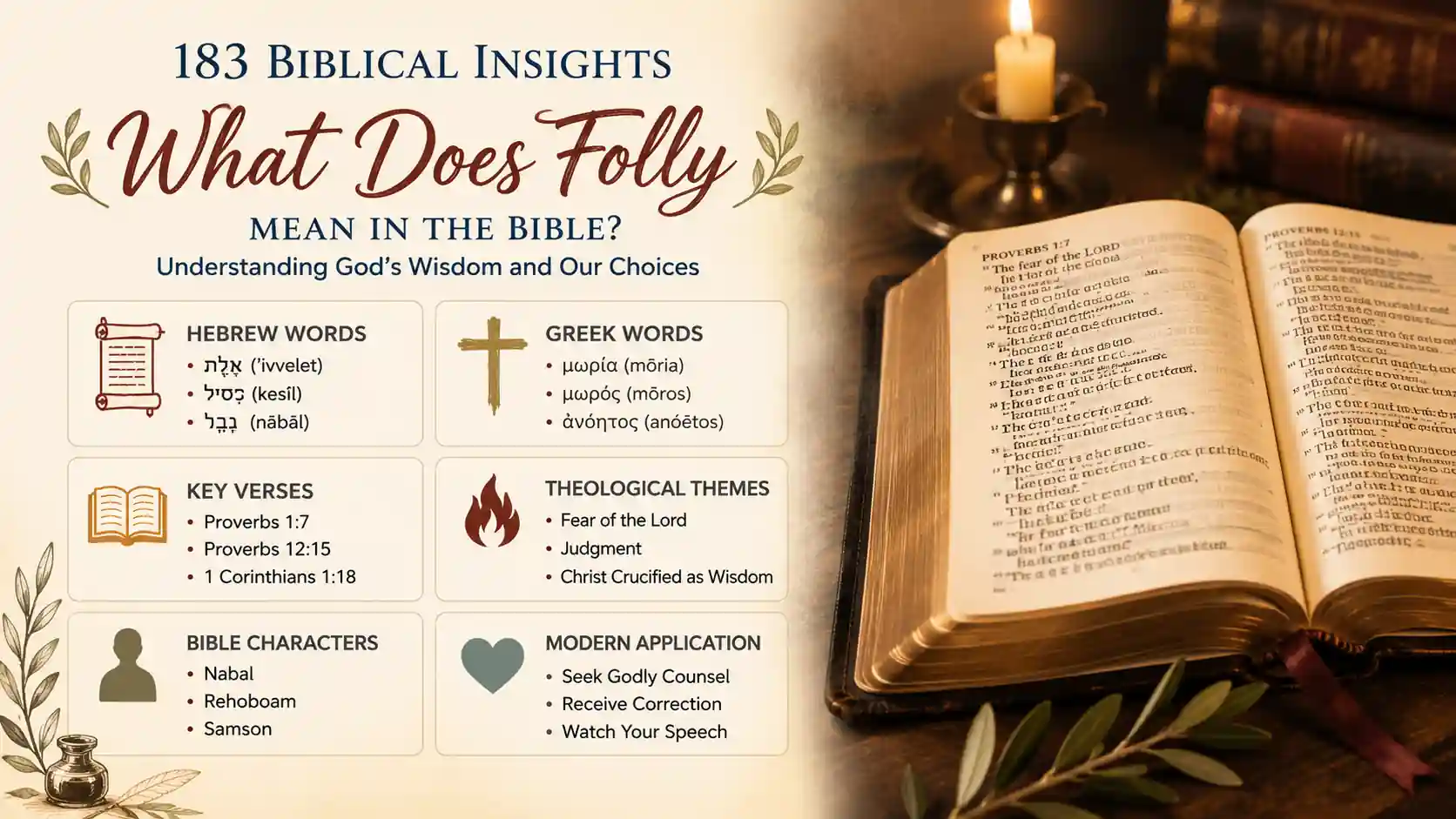
What does folly mean in the Bible? Scripture presents folly as far more than low intelligence, poor education, or an innocent mistake. Folly is a moral and spiritual disorder that rejects God’s wisdom, resists correction, misuses speech, and chooses destructive paths despite clear warnings.
The biblical fool may possess knowledge, wealth, or influence, yet live as though God’s authority does not matter. As you study folly, you discover both a warning against hardened rebellion and a gracious invitation to receive the wisdom found in fearing the Lord.
Folly in Key Scripture References
| Verse | Passage Snippet | Context |
|---|---|---|
| Psalm 14:1 | “The fool hath said in his heart” | Denial of God produces corruption |
| Proverbs 1:7 | Fools despise wisdom and instruction | Opening theme of Proverbs |
| Proverbs 9:6 | Forsake folly and live | Wisdom invites the inexperienced |
| Proverbs 10:23 | Folly is sport to a fool | Evil becomes entertainment |
| Proverbs 12:15 | A fool trusts his own way | Pride rejects wise counsel |
| Proverbs 14:9 | Fools mock at guilt | Sin is treated carelessly |
| Proverbs 15:2 | A fool’s mouth pours out folly | Speech reveals the heart |
| Proverbs 26:11 | A fool returns to folly | Repeated sin becomes habitual |
| Ecclesiastes 10:1 | A little folly outweighs wisdom | One failure can ruin honor |
| Mark 7:22 | Foolishness comes from within | Jesus identifies heart corruption |
Folly in Bible Translation Comparison
| Verse | KJV | NIV | ESV | NASB |
|---|---|---|---|---|
| Psalm 14:1 | “The fool” | “The fool” | “The fool” | “The fool” |
| Proverbs 1:7 | “Fools despise” | “Fools despise” | “Fools despise” | “Fools despise” |
| Proverbs 9:6 | “Forsake the foolish” | “Leave your simple ways” | “Leave your simple ways” | “Abandon your foolishness” |
| Proverbs 14:8 | “Folly of fools” | “Folly of fools” | “Folly of fools” | “Foolishness of fools” |
| Proverbs 14:9 | “Fools make a mock at sin” | “Fools mock at making amends” | “Fools mock at the guilt offering” | “Fools mock at sin” |
| Proverbs 15:14 | “Feedeth on foolishness” | “Mouth of a fool feeds on folly” | “Mouth of fools feeds on folly” | “Mouth of fools feeds on foolishness” |
| Ecclesiastes 2:3 | “Lay hold on folly” | “Embrace folly” | “Lay hold on folly” | “Take hold of folly” |
| 1 Corinthians 1:18 | “Foolishness” | “Foolishness” | “Folly” | “Foolishness” |
| 1 Corinthians 3:19 | “Foolishness with God” | “Foolishness in God’s sight” | “Folly with God” | “Foolishness before God” |
People and Characters Associated with Folly
| Person | Role | Connection |
|---|---|---|
| Nabal | Wealthy man in Carmel | His name and conduct reflect senseless folly |
| Saul | First king of Israel | Confessed acting foolishly after disobedience |
| Rehoboam | King of Judah | Rejected experienced counsel and divided the kingdom |
| Samson | Judge of Israel | Repeatedly ignored warnings concerning Delilah |
| Amnon | Son of David | Followed corrupt advice and committed wickedness |
| Absalom | Rebellious prince | Pride drove him against God’s appointed king |
| Job’s wife | Suffering spouse | Urged Job to curse God and die |
| Rich fool | Character in Jesus’ parable | Stored wealth without preparing to meet God |
| Five foolish virgins | Parable characters | Failed to prepare for the bridegroom |
| Corinthian believers | New Testament church | Mistook worldly status for spiritual wisdom |
Folly in Original Hebrew and Greek Words
| Original Word | Transliteration | Strong’s # | Literal Meaning |
|---|---|---|---|
| אִוֶּלֶת | ʾivvelet | H200 | Folly, foolish behavior |
| אֱוִיל | ʾevîl | H191 | Fool, one morally perverse |
| כְּסִילוּת | kesîlût | H3690 | Foolishness, stupidity |
| כְּסִיל | kesîl | H3684 | Dull or obstinate fool |
| נָבָל | nābāl | H5036 | Senseless, impious person |
| נְבָלָה | nebālāh | H5039 | Disgraceful folly, outrage |
| סִכְלוּת | siklût | H5531 | Foolishness, lack of sense |
| מוֹרָה | mōrāh | H4175 | Rebelliousness, disobedience |
| μωρία | mōria | G3472 | Foolishness, apparent absurdity |
| μωρός | mōros | G3474 | Foolish, morally dull |
Folly and Related Biblical Concepts
| Concept | Connection | Supporting Verse |
|---|---|---|
| Fear of the Lord | Its absence is folly’s foundation | Proverbs 1:7 |
| Pride | Makes a person trust personal judgment | Proverbs 12:15 |
| Rebellion | Rejects God’s authority and commands | 1 Samuel 15:22-23 |
| Unbelief | Lives as though God is absent | Psalm 14:1 |
| Careless speech | Reveals foolishness within | Proverbs 15:2 |
| Lack of discipline | Resists correction and restraint | Proverbs 15:5 |
| Spiritual blindness | Misjudges God’s truth | 1 Corinthians 2:14 |
| Presumption | Plans without submitting to God | Luke 12:20 |
| Repeated sin | Returns to destructive habits | Proverbs 26:11 |
| Wisdom | Provides folly’s biblical opposite | Proverbs 14:8 |
Folly in Historical and Cultural Context
| Aspect | Detail | Biblical Source |
|---|---|---|
| Israelite wisdom tradition | Wisdom joined moral conduct with covenant faithfulness | Proverbs 1:1-7 |
| Family instruction | Parents trained children to avoid foolish paths | Proverbs 4:1-9 |
| City gates | Elders gave judgment and counsel publicly | Proverbs 31:23 |
| Royal courts | Kings required wise advisers for stable rule | 1 Kings 12:6-11 |
| Honor and shame | Folly brought disgrace upon families and communities | Proverbs 10:1 |
| Agricultural life | Laziness illustrated foolish neglect | Proverbs 24:30-34 |
| Feasting culture | Excessive drinking exposed poor judgment | Proverbs 20:1 |
| Prophetic ministry | Prophets confronted rebellion disguised as wisdom | Isaiah 5:20-21 |
| Greco-Roman rhetoric | Public speakers prized eloquence and philosophy | 1 Corinthians 1:20-25 |
| Early church conflict | Social pride distorted Christian fellowship | 1 Corinthians 3:1-4 |
Folly in Major Theological Themes
| Theme | Explanation | Scripture |
|---|---|---|
| Human sinfulness | Folly flows from a heart turned from God | Mark 7:21-23 |
| Divine revelation | God’s Word defines true wisdom | Psalm 19:7 |
| Fear of God | Reverence begins a wise life | Proverbs 9:10 |
| Judgment | Persistent folly carries real consequences | Proverbs 19:3 |
| Repentance | Turning from folly leads toward life | Proverbs 9:6 |
| Christ crucified | God’s saving wisdom appears foolish to unbelief | 1 Corinthians 1:18 |
| Spiritual discernment | The Spirit enables reception of divine truth | 1 Corinthians 2:12-14 |
| Humility | Wisdom receives correction rather than resisting it | Proverbs 9:8-9 |
| Sanctification | Believers must leave former foolish desires | Titus 3:3-5 |
| Final accountability | Earthly success cannot prevent divine judgment | Luke 12:20-21 |
Modern Application of Folly for Believers
| Area | Practice | Scripture |
|---|---|---|
| Decision-making | Seek godly counsel before major choices | Proverbs 15:22 |
| Speech | Pause before answering in anger | Proverbs 29:11 |
| Correction | Receive rebuke without immediate defensiveness | Proverbs 17:10 |
| Relationships | Avoid companions who normalize sin | Proverbs 13:20 |
| Money | Reject greed and false security | Luke 12:15-21 |
| Digital habits | Refuse entertainment that celebrates evil | Proverbs 10:23 |
| Doctrine | Test teachings by Scripture | Acts 17:11 |
| Conflict | Avoid answering folly in a matching spirit | Proverbs 26:4 |
| Planning | Submit future plans to God’s will | James 4:13-16 |
| Repentance | Confess recurring patterns honestly | 1 John 1:9 |
אִוֶּלֶת And the Moral Character of Biblical Folly
The Hebrew noun אִוֶּלֶת, ʾivvelet, commonly describes behavior that is morally distorted rather than merely uninformed. Proverbs associates it with pride, uncontrolled speech, resistance to discipline, impulsive anger, and repeated wrongdoing. A person may be intellectually capable while remaining thoroughly foolish in the biblical sense.
This distinction matters for your study. Scripture does not ridicule people with limited education or natural ability. Its warnings are directed toward those who refuse truth, despise correction, and persist in paths that damage themselves and others. Biblical folly is often chosen, defended, and repeated.
The related noun כְּסִיל, kesîl, depicts an obstinate fool whose confidence exceeds his understanding. Such a person speaks too quickly, trusts personal instincts, and resents anyone who challenges him. His central problem is not that wisdom is unavailable, but that he does not love it enough to receive it.
What Does Folly Mean in the Bible’S Wisdom Literature?
In Proverbs, folly functions as wisdom’s active rival. Both are pictured as calling to the inexperienced and inviting them to a way of life. Wisdom offers instruction, righteousness, and lasting life. Folly offers immediate pleasure while hiding the ruin waiting inside her house.
Ecclesiastes examines folly from another angle. The Teacher observes that foolishness can corrupt an otherwise honorable life, just as a small dead fly spoils costly perfume. He also sees folly elevated in society while capable people are overlooked, revealing how disordered human communities can become.
The wisdom books therefore ask more than whether you possess information. They ask which voice shapes your choices. You walk in wisdom when reverence for God governs your desires, speech, work, relationships, and response to correction.
Nabal, Rehoboam, and the Public Cost of Folly
Nabal provides one of Scripture’s clearest personal portraits of folly. His name, נָבָל, nābāl, corresponds with the description of someone senseless and irreverent. Although wealthy, he answered David’s reasonable request with contempt. Abigail recognized that his foolish character endangered their entire household.
Rehoboam demonstrates folly in leadership. He rejected the seasoned counsel of Israel’s elders and followed the aggressive advice of younger companions. His harsh response intensified national resentment, and most of the tribes withdrew from David’s dynasty.
These accounts show that folly rarely remains private. A foolish word can divide a family, a reckless desire can wound innocent people, and an arrogant decision can destabilize a community. Your choices always carry relational consequences, even when you imagine that they concern only you.
μωρία, The Cross, and God’S Wisdom in the New Testament
The Greek noun μωρία, mōria, appears prominently in Paul’s discussion of the cross. To those who measure truth by worldly prestige, political power, or rhetorical brilliance, the message of a crucified Messiah appears foolish. Yet God saves through the very proclamation human pride dismisses.
Paul is not teaching that Christian faith is irrational. He is exposing the limits of wisdom that begins without God. Human philosophies cannot remove guilt, reconcile sinners to their Creator, or produce resurrection life. The cross overturns pride because salvation rests on God’s grace rather than human achievement.
Jesus also locates foolishness within the heart. In Mark 7, He places foolishness among the evils that arise from within and defile a person. The cure therefore requires more than improved manners. You need forgiveness, a renewed mind, and a heart increasingly formed by God’s Spirit and Word.
Questions About Folly in Scripture
Does אִוֶּלֶת, ʾivvelet, mean that someone lacks intelligence?
No. It usually describes morally reckless conduct, resistance to correction, and disregard for God’s wisdom.
Why does Psalm 14:1 call the person who denies God a fool?
The verse condemns practical unbelief that removes God from one’s moral life and produces corrupt behavior.
Why do some translations render μωρία as “folly” and others as “foolishness”?
Both English terms represent the same basic idea, while translators choose wording that best fits context and style.
How can the cross be God’s wisdom if Paul says it appears foolish?
It appears foolish according to fallen human standards, but it reveals God’s power, justice, mercy, and saving purpose.
How should you respond when you recognize folly in your own life?
Receive correction humbly, confess the sin, seek biblical counsel, and replace the foolish pattern with obedient wisdom.