
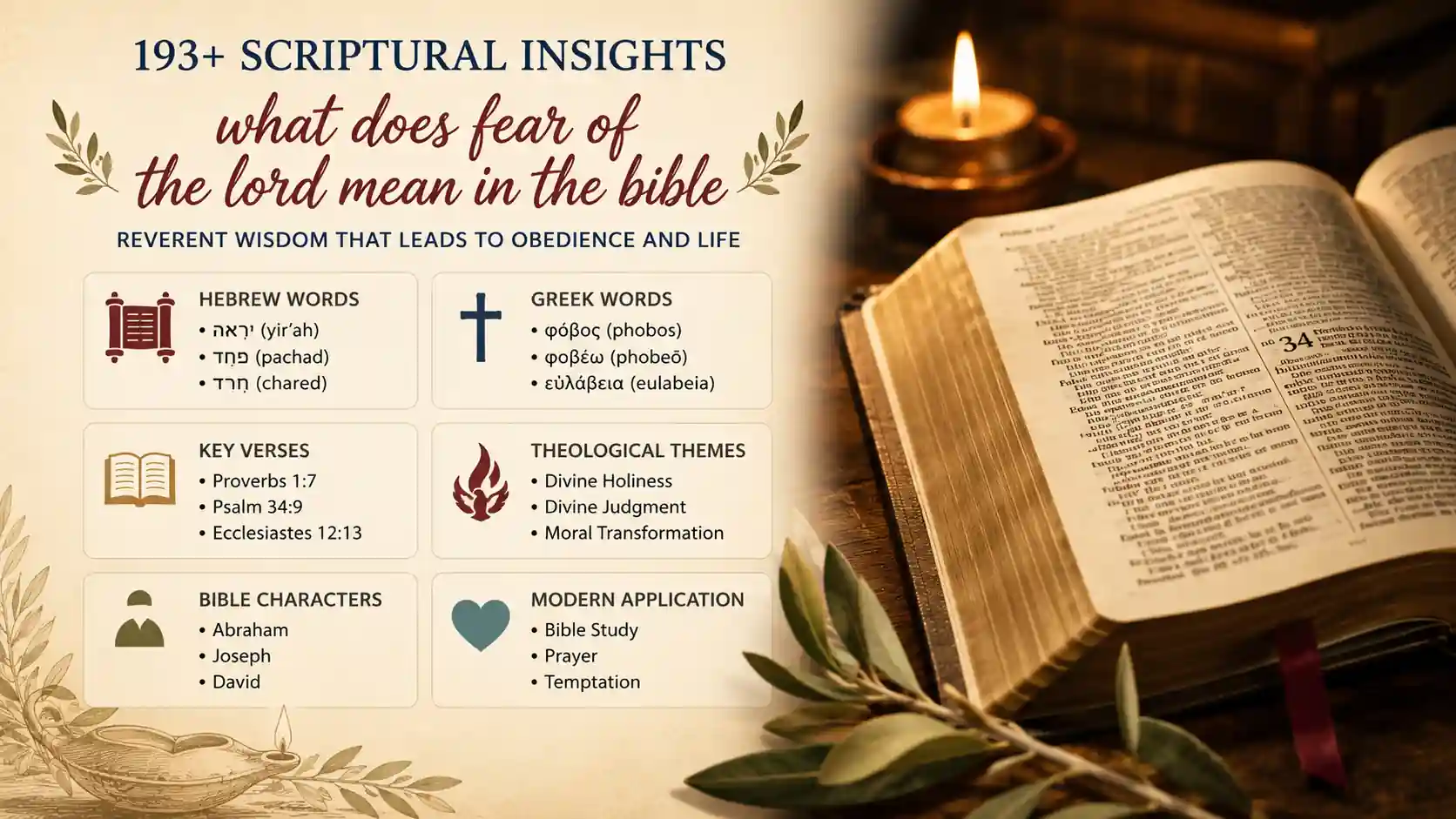
What does fear of the Lord mean in the Bible? Scripture presents it as a reverent response to God’s holiness, authority, justice, and mercy. It includes genuine trembling before divine judgment, yet it is far richer than frightened withdrawal.
When you fear the Lord, you recognize Him as God, trust His word, reject evil, and order your life beneath His authority. This holy fear draws faithful people toward God in worship and obedience. It becomes the beginning of wisdom, a safeguard against sin, and a source of confident hope.
Key Scripture References About Fear
| Verse | Passage Snippet | Context |
|---|---|---|
| Genesis 22:12 | “Now I know that thou fearest God” | Abraham obeys God concerning Isaac |
| Exodus 20:20 | “That his fear may be before your faces” | Sinai teaches Israel not to sin |
| Deuteronomy 10:12 | “Fear the LORD thy God” | Moses summarizes covenant faithfulness |
| Job 28:28 | “The fear of the Lord, that is wisdom” | True wisdom belongs to God |
| Psalm 34:9 | “Fear the LORD, ye his saints” | Worshipers trust God’s provision |
| Proverbs 1:7 | “Beginning of knowledge” | Foundational principle of Proverbs |
| Proverbs 8:13 | “To hate evil” | Holy fear produces moral opposition |
| Ecclesiastes 12:13 | “Fear God, and keep his commandments” | Final conclusion of the Teacher |
| Acts 9:31 | “Walking in the fear of the Lord” | Early churches mature and multiply |
| Revelation 14:7 | “Fear God, and give glory to him” | Worldwide summons before judgment |
Bible Translation Comparison of Fear
| Verse | KJV | NIV | ESV | NASB |
|---|---|---|---|---|
| Proverbs 1:7 | fear of the LORD | fear of the LORD | fear of the LORD | fear of the LORD |
| Proverbs 8:13 | hate evil | to hate evil | hatred of evil | to hate evil |
| Proverbs 9:10 | beginning of wisdom | beginning of wisdom | beginning of wisdom | beginning of wisdom |
| Proverbs 14:26 | strong confidence | secure fortress | strong confidence | strong confidence |
| Proverbs 14:27 | fountain of life | fountain of life | fountain of life | fountain of life |
| Psalm 19:9 | clean | pure | clean | clean |
| Psalm 111:10 | good understanding | good understanding | good understanding | good understanding |
| Ecclesiastes 12:13 | whole duty of man | duty of all mankind | whole duty of man | applies to every person |
| Acts 9:31 | fear of the Lord | fear of the Lord | fear of the Lord | fear of the Lord |
| 2 Corinthians 7:1 | fear of God | reverence for God | fear of God | fear of God |
People and Characters Associated with Fear
| Person | Role | Connection |
|---|---|---|
| Abraham | Patriarch | His obedience demonstrates fear of God |
| Joseph | Egyptian governor | Refuses injustice because he fears God |
| Moses | Covenant mediator | Teaches Israel to fear and obey |
| Hebrew midwives | Protectors of infants | Fear God above Pharaoh’s command |
| Job | Righteous sufferer | Fears God and turns from evil |
| David | King and psalmist | Invites others to learn holy fear |
| Solomon | Wisdom teacher | Connects fear with knowledge and obedience |
| Obadiah | Ahab’s steward | Fears the Lord from his youth |
| Nehemiah | Governor | Rejects exploitation because of godly fear |
| Cornelius | Roman centurion | Described as devout and God-fearing |
Original Hebrew and Greek Words for Fear
| Original Word | Transliteration | Strong’s # | Literal Meaning |
|---|---|---|---|
| יִרְאָה | yirʾah | H3374 | fear, reverence, awe |
| יָרֵא | yareʾ | H3372 | to fear, honor, revere |
| פַּחַד | pachad | H6343 | dread, terror, trembling |
| חָרֵד | chared | H2730 | trembling, anxious, reverent |
| מוֹרָא | moraʾ | H4172 | fear, awe, object of reverence |
| φόβος | phobos | G5401 | fear, reverence, respect |
| φοβέω | phobeō | G5399 | to fear, revere, respect |
| εὐλάβεια | eulabeia | G2124 | reverence, godly caution |
| εὐλαβής | eulabēs | G2126 | devout, reverent, careful |
| δέος | deos | G1168 | awe, profound reverence |
Related Biblical Concepts of Fear
| Concept | Connection | Supporting Verse |
|---|---|---|
| Wisdom | Holy fear begins wise thinking | Proverbs 9:10 |
| Knowledge | God must be known on His terms | Proverbs 1:7 |
| Obedience | Reverence accepts God’s commands | Deuteronomy 10:12 |
| Hatred of evil | Fear changes moral loyalties | Proverbs 8:13 |
| Repentance | Sinners turn from destructive paths | Proverbs 16:6 |
| Worship | Awe produces humble service | Psalm 2:11 |
| Holiness | Believers cleanse sinful practices | 2 Corinthians 7:1 |
| Trust | Reverence creates confidence in God | Proverbs 14:26 |
| Covenant love | Fear accompanies love and loyalty | Deuteronomy 10:12 |
| Final judgment | God alone judges every life | Ecclesiastes 12:14 |
Historical and Cultural Context of Fear
| Aspect | Detail | Biblical Source |
|---|---|---|
| Sinai revelation | Fire and thunder displayed divine holiness | Exodus 19:16-19 |
| Covenant assembly | Israel learned fear by hearing God’s words | Deuteronomy 4:10 |
| Royal authority | God outranked every earthly ruler | Exodus 1:17 |
| Family instruction | Children were taught covenant reverence | Deuteronomy 6:1-2 |
| Public Torah reading | Entire communities heard and learned | Deuteronomy 31:10-13 |
| Temple worship | Reverence shaped approach to God’s sanctuary | Leviticus 19:30 |
| Wisdom schools | Fear governed moral instruction | Proverbs 1:7 |
| Prophetic preaching | Fear exposed idolatry and injustice | Jeremiah 5:22-24 |
| Exile and restoration | Returned communities renewed obedience | Nehemiah 5:9 |
| Early church life | Reverence accompanied growth and comfort | Acts 9:31 |
Theological Themes within Fear
| Theme | Explanation | Scripture |
|---|---|---|
| Divine holiness | God is morally perfect and wholly distinct | Isaiah 6:1-5 |
| Divine sovereignty | Every creature lives under God’s rule | Jeremiah 10:7 |
| Divine judgment | God evaluates hidden deeds | Ecclesiastes 12:14 |
| Divine mercy | Forgiveness inspires deeper reverence | Psalm 130:4 |
| Covenant loyalty | Fear expresses allegiance to the Lord | Deuteronomy 6:13 |
| Moral transformation | Reverence leads believers away from evil | Job 1:1 |
| Spiritual security | Those who fear God find refuge | Proverbs 14:26 |
| Fatherly discipline | God trains His children in holiness | Hebrews 12:9-11 |
| Christ’s lordship | Jesus deserves obedient reverence | Colossians 3:22-24 |
| Final worship | Redeemed nations honor God’s name | Revelation 15:4 |
Modern Application of Fear for Believers
| Area | Practice | Scripture |
|---|---|---|
| Bible study | Receive Scripture with humility | Isaiah 66:2 |
| Prayer | Approach God boldly yet reverently | Hebrews 12:28 |
| Temptation | Remember God sees every choice | Proverbs 5:21 |
| Work | Serve sincerely as for Christ | Colossians 3:22 |
| Speech | Reject careless and destructive words | Proverbs 10:19 |
| Finances | Choose integrity over dishonest gain | Nehemiah 5:15 |
| Leadership | Exercise authority without exploitation | 2 Samuel 23:3 |
| Family | Teach children God’s words and works | Deuteronomy 6:2 |
| Worship | Combine rejoicing with trembling | Psalm 2:11 |
| Witness | Explain your hope with reverence | 1 Peter 3:15 |
יִרְאָה YirʾAh Joins Awe with Obedient Loyalty
The Hebrew noun יִרְאָה, yirʾah, can describe terror, but the phrase “fear of the Lord” commonly carries the sense of reverence, awe, and covenant faithfulness. Its meaning comes from the character of the One being feared. The Lord is holy, sovereign, truthful, and able to judge.
Biblical fear therefore engages your whole life. You acknowledge God’s rightful authority, take His commands seriously, and refuse to treat Him casually. Proverbs 8:13 gives this fear moral content by declaring that fearing the Lord means hating evil, pride, arrogance, and corrupt speech.
What Does Fear of the Lord Mean in the Bible at Sinai?
Exodus 20:20 contains an apparent tension. Moses tells Israel, “Fear not,” then says that God has come so “his fear may be before” them. The first fear is panic that drives people away. The second is enduring reverence that restrains sin and keeps the covenant community attentive to God.
Sinai shows that holy fear is not vague admiration. Israel heard God’s voice, witnessed fire and trembling, and received covenant commandments. Yet Deuteronomy repeatedly joins fear with love, service, obedience, and wholehearted devotion. God sought faithful children, not people trapped in hopeless dread.
φόβος Phobos in the Church and the New Covenant
The Greek noun φόβος, phobos, may indicate terror, but it can also describe profound reverence and respect. Acts 9:31 says the churches walked “in the fear of the Lord” and in the comfort of the Holy Spirit. Fear and comfort were not enemies. Together they encouraged holiness, stability, and growth.
The New Testament does not erase God’s majesty. Believers receive a kingdom that cannot be shaken, so Hebrews 12:28 calls them to worship with reverence and awe. Grace grants confident access to God, but it never makes Him ordinary. Christ’s saving work deepens grateful obedience rather than casual presumption.
Wisdom Literature Makes Holy Fear the Beginning
Proverbs calls the fear of the Lord the beginning of knowledge and wisdom. “Beginning” means more than an introductory lesson you eventually leave behind. It is the governing foundation of wise life. Unless you acknowledge God, your judgments about goodness, justice, success, and human purpose remain distorted.
Job 28:28 and Ecclesiastes 12:13 reach the same conclusion from different directions. Human beings cannot master wisdom through observation alone, and earthly pursuits cannot provide final meaning. Wisdom begins when you receive your place as God’s creature, depart from evil, and keep His commands.
Questions About the Fear of the Lord
Does יִרְאָה, yirʾah, mean terror or reverence?
It can mean either, but “fear of the Lord” usually combines awe, submission, moral seriousness, and reverent trust.
Why does Exodus 20:20 say both “fear not” and “his fear may be before you”?
Moses rejects paralyzing panic while commending a lasting reverence that helps Israel resist sin.
How can perfect love cast out fear while Christians still fear God?
First John 4:18 removes fear of condemnation, not the grateful awe and obedient respect owed to your holy Father.
Why is the fear of the Lord called the beginning of wisdom?
Recognizing God’s authority gives your knowledge its proper moral foundation, direction, and purpose.
How can you practice φόβος, phobos, without becoming anxious about God?
Trust His mercy in Christ while treating His presence, commands, discipline, and judgment with sincere reverence.