
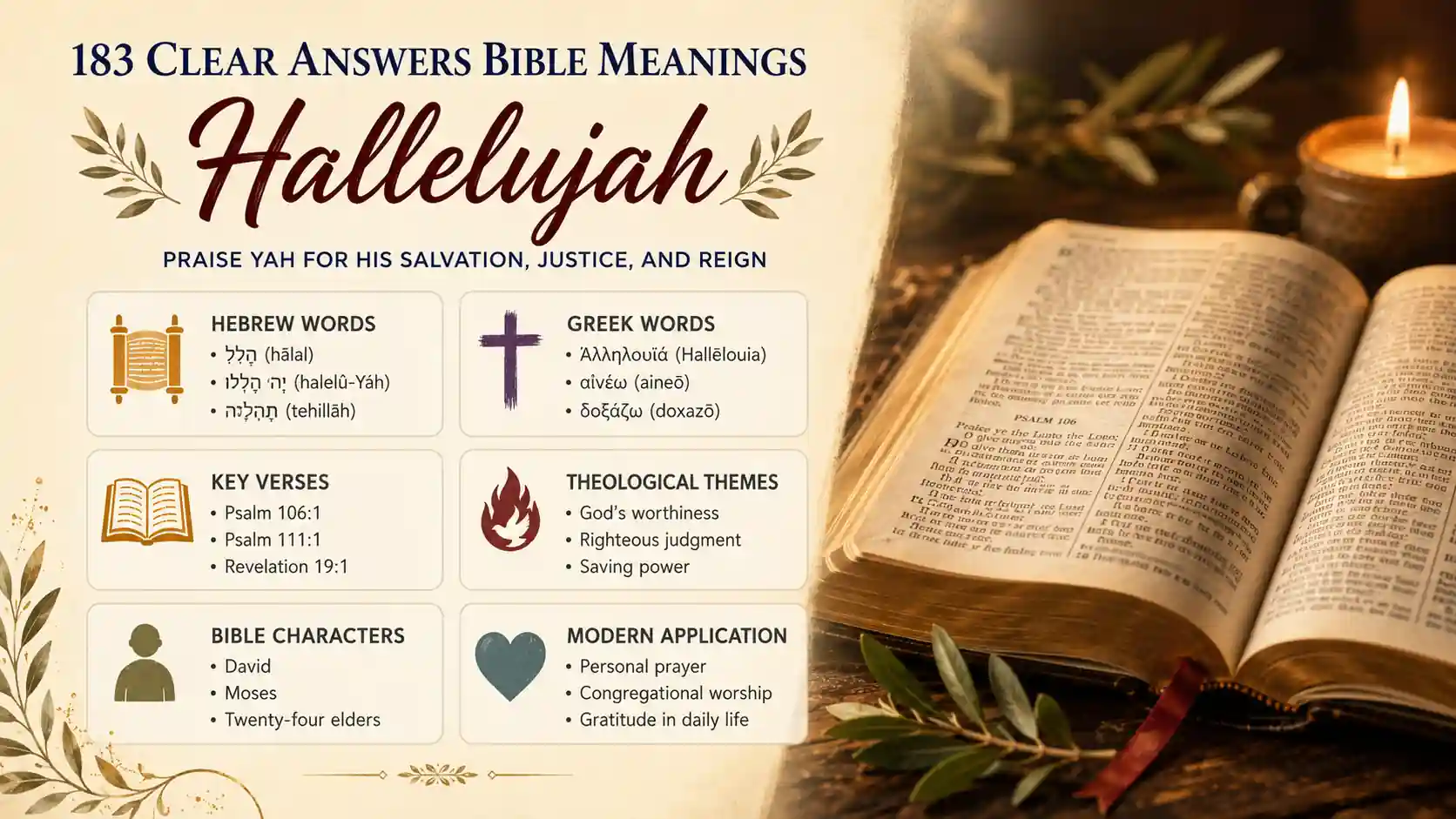
What does hallelujah mean in the Bible? The word is a joyful command meaning “Praise Yah,” or “Praise the LORD.” It joins the Hebrew verb הָלַל, hālal, with the shortened divine name יָהּ, Yāh. Rather than expressing an undefined feeling of happiness, hallelujah summons worshipers to honor Israel’s covenant God for who he is and what he has done.
In Scripture, this praise rises from congregations, psalmists, heavenly beings, elders, and a redeemed multitude. Your study will show that hallelujah celebrates God’s creation, salvation, justice, kingship, faithfulness, and everlasting reign.
Hallelujah Key Scripture References
| Verse | Passage Snippet | Context |
|---|---|---|
| Psalm 104:35 | “Praise the LORD” | Creation psalm ends with worship |
| Psalm 105:45 | “Praise the LORD” | Israel remembers covenant deliverance |
| Psalm 106:1 | “Give thanks to the LORD” | Praise introduces national confession |
| Psalm 111:1 | “I will praise the LORD” | Wholehearted praise among the upright |
| Psalm 112:1 | “Blessed is the man” | God-fearing life follows hallelujah |
| Psalm 113:1 | “Praise, O servants” | The servants of God are summoned |
| Psalm 146:1 | “Praise the LORD, O my soul” | Personal trust replaces human confidence |
| Psalm 147:1 | “It is good to sing praises” | Restored Jerusalem praises its healer |
| Psalm 148:1 | “Praise the LORD from heaven” | All creation receives the command |
| Revelation 19:6 | “The Almighty reigns” | Heaven celebrates God’s final kingship |
Hallelujah Bible Translation Comparison
| Verse | KJV | NIV | ESV | NASB |
|---|---|---|---|---|
| Psalm 106:1 | Praise ye the LORD | Praise the LORD | Praise the LORD | Praise the LORD |
| Psalm 111:1 | Praise ye the LORD | Praise the LORD | Praise the LORD | Praise the LORD |
| Psalm 112:1 | Praise ye the LORD | Praise the LORD | Praise the LORD | Praise the LORD |
| Psalm 113:1 | Praise ye the LORD | Praise the LORD | Praise the LORD | Praise the LORD |
| Psalm 135:1 | Praise ye the LORD | Praise the LORD | Praise the LORD | Praise the LORD |
| Psalm 146:1 | Praise ye the LORD | Praise the LORD | Praise the LORD | Praise the LORD |
| Psalm 150:1 | Praise ye the LORD | Praise the LORD | Praise the LORD | Praise the LORD |
| Revelation 19:1 | Alleluia | Hallelujah | Hallelujah | Hallelujah |
| Revelation 19:4 | Alleluia | Hallelujah | Hallelujah | Hallelujah |
| Revelation 19:6 | Alleluia | Hallelujah | Hallelujah | Hallelujah |
The KJV’s “Alleluia” in Revelation reflects the Greek spelling, while many modern translations use the familiar Hebrew-derived “Hallelujah.” Both forms communicate the same call to praise Yah.
People and Characters Associated with Hallelujah
| Person | Role | Connection |
|---|---|---|
| David | King and psalmist | Models praise throughout the Psalms |
| Moses | Covenant mediator | Leads praise after deliverance from Egypt |
| Asaph | Temple singer | Connects praise with God’s justice |
| Ezra | Priest and scribe | Leads restored worship in Jerusalem |
| Nehemiah | Governor | Organizes thanksgiving at the wall |
| Hezekiah | King of Judah | Restores temple praise and song |
| Levites | Worship ministers | Lead Israel in music and thanksgiving |
| Twenty-four elders | Heavenly worshipers | Answer “Amen, Hallelujah” |
| Four living creatures | Throne attendants | Worship God in Revelation 19 |
| Great multitude | Redeemed heavenly assembly | Proclaims fourfold hallelujah |
Original Hebrew and Greek Words Behind Hallelujah
| Original Word | Transliteration | Strong’s # | Literal Meaning |
|---|---|---|---|
| הָלַל | hālal | H1984 | Praise, boast, celebrate |
| יָהּ | Yāh | H3050 | Yah, shortened divine name |
| הַלְלוּ | halelû | H1984 | Praise, plural command |
| הַלְלוּ־יָהּ | halelû-Yāh | H1984 + H3050 | Praise Yah |
| תְּהִלָּה | tehillāh | H8416 | Praise, song of praise |
| יָדָה | yādâ | H3034 | Thank, confess, praise |
| בָּרַךְ | bārak | H1288 | Bless, kneel before |
| Ἁλληλουϊά | Hallēlouia | G239 | Praise Yah |
| αἰνέω | aineō | G134 | Praise, commend |
| δοξάζω | doxazō | G1392 | Glorify, honor |
The expression הַלְלוּ־יָהּ, halelû-Yāh, contains an imperative addressed to a group. It is not merely “I praise the Lord.” It calls the gathered community to praise him. The Greek Ἁλληλουϊά, Hallēlouia, is a transliteration of this Hebrew expression rather than a newly coined Greek word.
Biblical Concepts Related to Hallelujah
| Concept | Connection | Supporting Verse |
|---|---|---|
| Worship | Hallelujah directs honor to God | Psalm 150:1 |
| Thanksgiving | Praise recalls divine goodness | Psalm 106:1 |
| Covenant faithfulness | Yah keeps his promises | Psalm 105:8 |
| Creation | Heaven and earth praise their Maker | Psalm 148:1-5 |
| Salvation | Deliverance belongs to God | Revelation 19:1 |
| Divine justice | Heaven praises righteous judgment | Revelation 19:2 |
| Kingship | Hallelujah celebrates God’s reign | Revelation 19:6 |
| Providence | God feeds and sustains creatures | Psalm 147:9 |
| Reverent fear | Praise accompanies fear of God | Psalm 112:1 |
| Eternal hope | Praise continues forever | Psalm 146:2 |
Historical and Cultural Context of Hallelujah
| Aspect | Detail | Biblical Source |
|---|---|---|
| Hebrew worship | A congregational call to praise | Psalm 113:1 |
| Divine name | “Yah” shortens the name YHWH | Exodus 15:2 |
| Temple ministry | Levites served with instruments | 1 Chronicles 16:4-6 |
| Public assembly | Praise sounded among worshipers | Psalm 111:1 |
| Festival worship | Hallel psalms marked holy celebrations | Psalms 113-118 |
| Passover setting | Praise recalled the exodus | Psalm 114:1 |
| Pilgrimage | Worshipers approached Jerusalem singing | Psalm 122:1-4 |
| Exilic sorrow | Captives struggled to sing in Babylon | Psalm 137:1-4 |
| Restoration | Rebuilt worship included thanksgiving | Ezra 3:10-11 |
| Heavenly liturgy | Revelation presents universal worship | Revelation 19:1-6 |
Theological Themes within Hallelujah
| Theme | Explanation | Scripture |
|---|---|---|
| God’s worthiness | Praise begins with God’s character | Psalm 113:3 |
| God’s sovereignty | The Almighty reigns without rival | Revelation 19:6 |
| Righteous judgment | God judges evil truly and justly | Revelation 19:2 |
| Saving power | Salvation belongs to God alone | Revelation 19:1 |
| Covenant mercy | God’s steadfast love endures | Psalm 106:1 |
| Creation’s dependence | Every creature owes God praise | Psalm 148:5 |
| Human humility | Trust belongs in God, not princes | Psalm 146:3 |
| Corporate worship | Praise unites God’s people | Psalm 111:1 |
| Final victory | Evil will not rule forever | Revelation 19:3 |
| Messianic joy | The Lamb’s wedding is celebrated | Revelation 19:7 |
Modern Application of Hallelujah for Believers
| Area | Practice | Scripture |
|---|---|---|
| Personal prayer | Begin by praising God’s character | Psalm 146:1 |
| Congregational worship | Join others in audible praise | Psalm 111:1 |
| Scripture reading | Respond to truth with thanksgiving | Psalm 119:171 |
| Anxiety | Remember that God reigns | Revelation 19:6 |
| Disappointment | Praise without denying sorrow | Psalm 42:5 |
| Gratitude | Name specific acts of mercy | Psalm 105:1-5 |
| Creation care | Honor the Creator through stewardship | Psalm 148:7-10 |
| Justice | Trust God’s righteous verdicts | Revelation 19:2 |
| Witness | Declare God’s works among peoples | Psalm 105:1 |
| Endurance | Resolve to praise throughout life | Psalm 146:2 |
What Does Hallelujah Mean in the Bible’S Hebrew Psalms?
In Hebrew, hallelujah is written הַלְלוּ־יָהּ, halelû-Yāh. The first element comes from הָלַל, hālal, meaning to praise, celebrate, commend, or boast. In this construction, halelû is a plural command. You could express its force as “All of you, praise!”
The second element is יָהּ, Yāh, a shortened form of the covenant name often represented as YHWH. Exodus 15:2 contains this form in Israel’s song after crossing the sea. Hallelujah therefore identifies the object of praise. It does not command vague religious enthusiasm. It commands praise of Yah, the God who reveals himself and saves his people.
From the Egyptian Hallel to the Final Psalms
Psalms 113 through 118 are traditionally known as the Egyptian Hallel because they celebrate Israel’s deliverance from Egypt. Psalm 114 recalls the sea fleeing, the Jordan turning back, and the mountains trembling before the Lord. Praise is rooted in remembered redemption, not passing emotion.
The Psalter’s closing movement also resounds with hallelujah. Psalms 146 through 150 each begin and end with the command to praise the LORD. The sequence expands outward from the individual soul to Jerusalem, the heavens, all creation, and finally everything that has breath. Biblical praise becomes increasingly comprehensive because God’s worthiness has no boundary.
Why Revelation’S Hallelujah Includes Judgment
The New Testament uses Ἁλληλουϊά, Hallēlouia, four times, all in Revelation 19. Heaven praises God because salvation, glory, and power belong to him, but also because his judgments are true and just. Babylon, the symbolic persecuting world system, has fallen, and the blood of God’s servants has been avenged.
This setting can trouble readers who separate praise from judgment. Revelation does not celebrate cruelty or personal revenge. Heaven rejoices because oppression, corruption, idolatry, and violence will not endure forever. God’s judgment vindicates his holiness and rescues his creation from evil. Hallelujah is therefore both a song of deliverance and a declaration that God judges rightly.
Hallelujah and the Marriage Supper of the Lamb
The final hallelujah in Revelation 19:6 announces, “For the Lord our God the Almighty reigns.” The vision then turns toward the marriage supper of the Lamb. Judgment clears the way for communion, joy, holiness, and the public vindication of Christ’s redeemed people.
For your study, this shows that hallelujah looks backward and forward. It remembers God’s mighty acts, confesses his present rule, and anticipates his completed kingdom. When you say “Hallelujah,” you join a scriptural chorus that stretches from Israel’s worship to the final celebration of the Lamb.
Questions About Hallelujah in Scripture
Does הַלְלוּ־יָהּ, halelû-Yāh, mean “praise the Lord” or “praise Yah”?
Its most literal sense is “Praise Yah,” while “Praise the LORD” accurately identifies Yah as the covenant God.
Why does the KJV write “Alleluia” in Revelation 19?
“Alleluia” follows the Greek Ἁλληλουϊά, while “Hallelujah” preserves the better-known Hebrew form of the same expression.
Why does Revelation 19 say hallelujah after Babylon is judged?
Heaven praises God because his judgment ends oppression, vindicates his servants, and reveals that his verdicts are righteous.
Can you say hallelujah while grieving?
Yes, because biblical praise can confess God’s faithfulness amid sorrow without pretending that suffering is painless.
Is hallelujah addressed to God or to worshipers?
Grammatically, it commands worshipers to praise Yah, yet the praise produced by that command is directed to God.