
What does blessing mean in the Bible? Scripture presents blessing as God’s gracious favor expressed through life, covenant, fruitfulness, protection, spiritual inheritance, and fellowship with him. A blessing may be spoken, received, inherited, or embodied in faithful living. It is never merely religious language for comfort, wealth, or favorable circumstances.
Biblical blessing begins with God, reveals his generous character, and advances his redemptive purposes. As you study the theme, you discover that the blessed life is ultimately found in belonging to God, trusting his promises, and receiving salvation through Jesus Christ.
Blessing in Key Scripture References
| Verse | Passage Snippet | Context |
|---|---|---|
| Genesis 1:28 | “God blessed them” | Humanity receives fruitfulness and stewardship |
| Genesis 12:2 | “I will bless you” | Abraham is chosen to bless the nations |
| Genesis 27:28 | “God give thee” | Isaac pronounces covenant abundance over Jacob |
| Numbers 6:24 | “The LORD bless thee” | Priests place God’s name upon Israel |
| Deuteronomy 28:2 | “Blessings shall come” | Covenant obedience brings promised benefits |
| Psalm 1:1 | “Blessed is the man” | Wisdom contrasts righteous and wicked paths |
| Matthew 5:3 | “Blessed are the poor” | Jesus describes citizens of his kingdom |
| Ephesians 1:3 | “Every spiritual blessing” | Believers receive heavenly riches in Christ |
Blessing in Bible Translation Comparison
| Verse | KJV | NIV | ESV | NASB |
|---|---|---|---|---|
| Genesis 12:2 | “I will bless thee” | “I will bless you” | “I will bless you” | “I will bless you” |
| Numbers 6:24 | “The LORD bless thee” | “The LORD bless you” | “The LORD bless you” | “The LORD bless you” |
| Psalm 1:1 | “Blessed is the man” | “Blessed is the one” | “Blessed is the man” | “Blessed is the person” |
| Psalm 32:1 | “Blessed is he” | “Blessed is the one” | “Blessed is the one” | “How blessed is he” |
| Proverbs 10:22 | “maketh rich” | “brings wealth” | “makes rich” | “makes rich” |
| Matthew 5:3 | “Blessed are” | “Blessed are” | “Blessed are” | “Blessed are” |
| Luke 1:45 | “Blessed is she” | “Blessed is she” | “Blessed is she” | “Blessed is she” |
| James 1:12 | “Blessed is the man” | “Blessed is the one” | “Blessed is the man” | “Blessed is a man” |
People and Characters Associated with Blessing
| Person | Role | Connection |
|---|---|---|
| Adam and Eve | First humans | Blessed with fruitfulness and dominion |
| Noah | Covenant recipient | Blessed after the flood |
| Abraham | Patriarch | Blessed to become a blessing |
| Isaac | Promised son | Inherited and pronounced covenant blessing |
| Jacob | Father of Israel | Received blessing and blessed his sons |
| Melchizedek | Priest-king | Blessed Abraham in God’s name |
| Moses | Covenant mediator | Announced blessings and consequences |
| Mary | Mother of Jesus | Called blessed for believing God’s word |
| Jesus | Messiah | Brings Abraham’s blessing to the nations |
| Paul | Apostle | Explains spiritual blessing in Christ |
Blessing in Original Hebrew and Greek Words
| Original Word | Transliteration | Strong’s # | Literal Meaning |
|---|---|---|---|
| בָּרַךְ | bārak | H1288 | To bless, praise, kneel |
| בְּרָכָה | berākhāh | H1293 | Blessing, gift, benefit |
| אֶשֶׁר | esher | H835 | Happiness, blessedness |
| אַשְׁרֵי | ashrê | H835 | Blessed, fortunate, flourishing |
| טוֹב | tov | H2896 | Good, beneficial, pleasing |
| εὐλογέω | eulogeō | G2127 | To speak well of, bless |
| εὐλογία | eulogia | G2129 | Blessing, praise, benefit |
| μακάριος | makarios | G3107 | Blessed, favored, fortunate |
| μακαρισμός | makarismos | G3108 | Declaration of blessedness |
| ἐνευλογέω | eneulogeō | G1757 | To confer blessing upon |
The Hebrew noun בְּרָכָה, berākhāh, comes from בָּרַךְ, bārak, and can describe a spoken benediction, a divinely given benefit, or the resulting prosperity. The Greek εὐλογέω, eulogeō, carries the sense of speaking well of, praising, or conferring benefit, while μακάριος, makarios, describes a person whose condition is favored or truly fortunate before God.
Blessing and Related Biblical Concepts
| Concept | Connection | Supporting Verse |
|---|---|---|
| Covenant | Blessing accompanies God’s binding promises | Genesis 17:7 |
| Grace | Blessing flows from divine generosity | Ephesians 1:6 |
| Obedience | Faithful living receives God’s approval | Deuteronomy 28:1 |
| Faith | Abraham’s blessing comes through faith | Galatians 3:9 |
| Fruitfulness | God enables life and multiplication | Genesis 1:28 |
| Righteousness | Right relationship with God is blessed | Psalm 5:12 |
| Wisdom | God’s instruction leads to flourishing | Proverbs 3:13 |
| Inheritance | Believers receive promised spiritual riches | 1 Peter 3:9 |
| Peace | Blessing includes wholeness under God’s care | Numbers 6:26 |
| Praise | People bless God by honoring his name | Psalm 103:1 |
Blessing in Historical and Cultural Context
| Aspect | Detail | Biblical Source |
|---|---|---|
| Spoken words | Blessings were solemn, purposeful declarations | Genesis 27:27-29 |
| Patriarchal inheritance | Fathers blessed heirs before death | Genesis 49:1-28 |
| Covenant ceremony | Blessings confirmed loyalty to God | Deuteronomy 27-28 |
| Priestly ministry | Priests pronounced God’s name over Israel | Numbers 6:22-27 |
| Agricultural life | Rain and harvest signified divine provision | Deuteronomy 28:12 |
| Family continuity | Children were viewed as God’s gift | Psalm 127:3-5 |
| Hospitality | Hosts invoked peace and favor upon guests | Ruth 2:4 |
| Royal worship | Kings received prayers for divine favor | Psalm 72:15 |
| Jewish meals | God was blessed for his provision | Mark 6:41 |
| Early church | Blessing enemies marked Christian witness | Romans 12:14 |
In the ancient biblical world, a blessing was more than a polite wish. Spoken blessings identified heirs, invoked God’s favor, affirmed covenant promises, and sometimes shaped the future responsibilities of families and nations.
Yet biblical writers never treated the words as magical formulas. The effectiveness of blessing depended upon God, whose sovereign purpose could overturn human manipulation, as the histories of Isaac, Jacob, and Balaam demonstrate.
Blessing in Major Theological Themes
| Theme | Explanation | Scripture |
|---|---|---|
| Divine initiative | God blesses before humans can repay him | Genesis 1:28 |
| Covenant faithfulness | Blessing displays God’s loyalty to promises | Genesis 22:17 |
| Mission | The blessed become instruments of blessing | Genesis 12:3 |
| Reversal | God favors the humble and needy | Luke 6:20 |
| Union with Christ | Every spiritual blessing is found in Christ | Ephesians 1:3 |
| Redemption | Christ bears the curse for sinners | Galatians 3:13 |
| Holy Spirit | Abraham’s blessing includes the promised Spirit | Galatians 3:14 |
| Adoption | Believers receive the privileges of God’s children | Ephesians 1:5 |
| Perseverance | Endurance under trial is called blessed | James 1:12 |
| Eternal hope | Final blessing belongs to God’s redeemed people | Revelation 22:14 |
Blessing in Modern Application for Believers
| Area | Practice | Scripture |
|---|---|---|
| Prayer | Ask God to make you useful to others | Genesis 12:2 |
| Worship | Bless God through grateful praise | Psalm 103:1 |
| Speech | Use words that strengthen rather than wound | 1 Peter 3:9 |
| Enemies | Pray for those who mistreat you | Luke 6:28 |
| Generosity | Share what God has entrusted to you | 2 Corinthians 9:8 |
| Contentment | Recognize spiritual wealth in Christ | Ephesians 1:3 |
| Obedience | Receive and practice Christ’s teaching | Luke 11:28 |
| Suffering | Trust God when blessing is not visible | Matthew 5:10 |
| Work | Serve faithfully under God’s care | Colossians 3:23 |
| Community | Seek peace and mutual encouragement | Romans 14:19 |
These applications protect you from reducing blessing to personal advancement. God may provide health, resources, family, opportunity, or relief, and Scripture encourages you to receive such gifts with thanksgiving.
Still, the New Testament directs your attention toward deeper treasures. Forgiveness, adoption, the Holy Spirit, fellowship with Christ, a transformed character, endurance in suffering, and resurrection hope are blessings that changing circumstances cannot remove.
What Does Blessing Mean in the Bible’S Covenant Story?
Blessing appears near the beginning of Scripture. God blesses living creatures, humanity, Noah, and especially Abraham. In Genesis 12, Abraham’s blessing has a missionary purpose. God promises to bless him, make his name great, and extend blessing through him to all families of the earth.
This promise governs the biblical story. Israel receives covenant privileges so that God’s character may become known among the nations. The blessing is not meant to terminate upon one favored individual or ethnic group. It moves outward according to God’s promise and reaches its fulfillment through Abraham’s descendant, Jesus Christ.
בָּרַךְ BāRak and the Direction of Blessing
The verb בָּרַךְ, bārak, is unusual because Scripture uses it both for God blessing people and for people blessing God. When God blesses, he grants favor, life, ability, protection, or fruitfulness. When people bless God, they do not add anything he lacks. They praise him and declare his goodness.
This distinction helps you read expressions such as “Bless the LORD, O my soul.” The psalmist is calling himself to worship, not attempting to enrich God. Blessing therefore has a vertical rhythm. God graciously gives, and his people gratefully answer with praise, trust, and obedience.
Μακάριος Makarios and the Blessing of Jesus’ Kingdom
In the Beatitudes, Jesus repeatedly uses μακάριος, makarios. The term does not promise constant pleasant emotions. Jesus calls the grieving, meek, merciful, persecuted, and spiritually poor blessed because God’s kingdom belongs to them and his future comfort is certain.
This teaching overturns ordinary measurements of success. A person may possess comfort and public admiration yet remain spiritually impoverished. Another may suffer loss while being rich toward God. Your blessedness rests not in painless circumstances but in God’s saving reign and your relationship with the King.
Blessing, Curse, and Redemption Through Christ
Biblical blessing must also be understood beside the theme of curse. Sin brings alienation, disorder, judgment, and death. Under the Mosaic covenant, blessing represented life under God’s rule, while covenant rebellion exposed Israel to judgment. Human beings could not secure lasting blessing through flawless obedience.
Galatians announces the answer. Christ redeemed sinners from the law’s curse by bearing judgment at the cross. Through faith, Jews and Gentiles receive the blessing promised to Abraham and the gift of the Spirit. The deepest biblical blessing is therefore not material success but reconciliation with God through Christ.
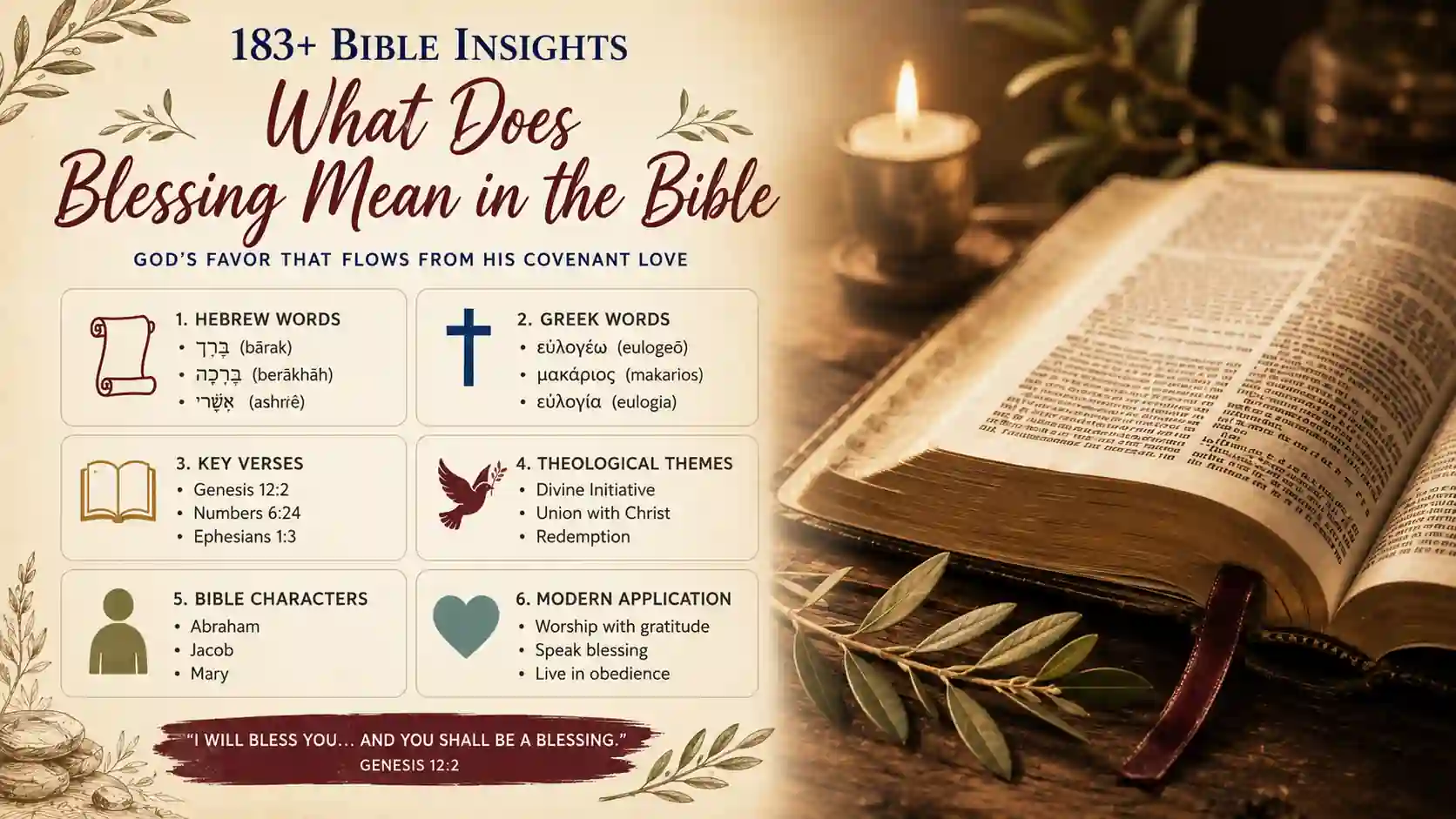
Questions About Blessing in the Bible
Does בָּרַךְ, bārak, always mean that God gives material prosperity?
No. It may include provision, but it also expresses praise, fruitfulness, covenant favor, protection, and divine purpose.
Why does Psalm 1 call a righteous person אַשְׁרֵי, ashrê?
The word describes the flourishing and enviable condition of someone who delights in God’s instruction.
Are the Beatitudes promises that faithful Christians will always feel happy?
No. Μακάριος, makarios, describes God-approved blessedness, even when disciples grieve, suffer, or face persecution.
How can believers bless God when God already possesses everything?
You bless God by praising his character, thanking him for his works, and publicly honoring his name.
Does Galatians 3 teach that Abraham’s blessing guarantees wealth?
No. Paul emphasizes justification by faith, redemption from the curse, inclusion among God’s people, and reception of the promised Spirit.