
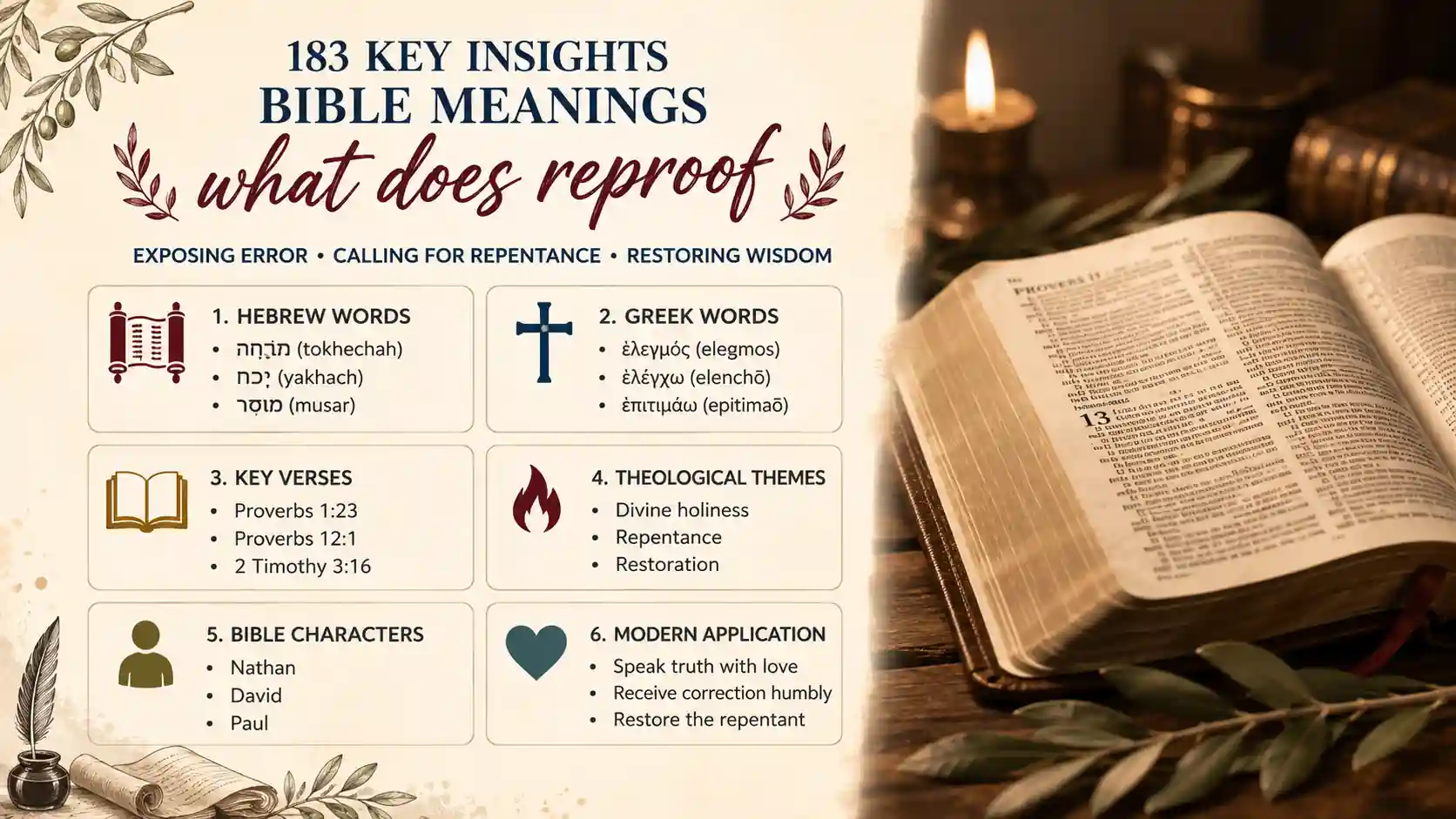
What does reproof mean in the Bible? Reproof is the exposure of error through truthful correction, with the purpose of leading a person toward wisdom, repentance, and restored obedience. Scripture presents it as more than criticism. Biblical reproof identifies what is wrong according to God’s standard and calls for a changed response.
In your study, you will find reproof in wisdom instruction, prophetic confrontation, church discipline, pastoral ministry, and the Holy Spirit’s work of conviction. Though it can be painful, godly reproof is an expression of holy love.
Key Scripture References About Reproof
| Verse | Passage Snippet | Context |
|---|---|---|
| Proverbs 1:23 | “Turn at my reproof” | Wisdom calls the simple to repent |
| Proverbs 3:11 | Do not despise the Lord’s discipline | A child receives correction from God |
| Proverbs 6:23 | Reproofs of discipline are life’s way | Parental teaching protects from sin |
| Proverbs 9:8 | Reprove a wise person | The wise grow through correction |
| Proverbs 10:17 | Whoever heeds instruction walks rightly | Reproof affects both self and others |
| Proverbs 12:1 | Hating reproof is senseless | Love of knowledge requires humility |
| Proverbs 15:31 | Listen to life-giving reproof | Correction places you among the wise |
| Proverbs 27:5 | Open rebuke is better than hidden love | Honest correction can express love |
| John 16:8 | The Spirit will convict the world | Divine reproof exposes sin and unbelief |
| 2 Timothy 3:16 | Scripture is profitable for reproof | God’s Word exposes doctrinal and moral error |
These passages show that reproof belongs to the path of wisdom, not merely to punishment. It warns, exposes, teaches, and invites a response.
Bible Translation Comparison of Reproof
| Verse | KJV | NIV | ESV | NASB |
|---|---|---|---|---|
| Proverbs 1:23 | Turn at my reproof | Repent at my rebuke | Turn at my reproof | Turn to my rebuke |
| Proverbs 3:11 | Despise not chastening | Do not despise discipline | Do not despise discipline | Do not reject discipline |
| Proverbs 6:23 | Reproofs of instruction | Correction and instruction | Reproofs of discipline | Rebukes for discipline |
| Proverbs 9:8 | Reprove not a scorner | Do not rebuke mockers | Do not reprove a scoffer | Do not rebuke a scoffer |
| Proverbs 10:17 | Refuseth reproof erreth | Ignores correction leads astray | Rejects reproof leads astray | Ignores a rebuke goes astray |
| Proverbs 12:1 | Hateth reproof is brutish | Hates correction is stupid | Hates reproof is stupid | Hates a rebuke is stupid |
| Proverbs 15:31 | Ear that heareth reproof | Heeds life-giving correction | Listens to life-giving reproof | Listens to life-giving rebuke |
| 2 Timothy 3:16 | Profitable for reproof | Useful for rebuking | Profitable for reproof | Beneficial for rebuke |
The comparison reveals no major theological disagreement. “Reproof,” “rebuke,” “correction,” and “conviction” highlight overlapping aspects of confronting error. In 2 Timothy 3:16, the NIV uses “rebuking,” while the KJV and ESV retain “reproof,” and the NASB uses “rebuke.”
People and Characters Associated with Reproof
| Person | Role | Connection |
|---|---|---|
| Moses | Covenant mediator | Reproved Israel for unbelief and rebellion |
| Nathan | Prophet | Exposed David’s sin through a judicial parable |
| David | King and psalmist | Accepted Nathan’s reproof and confessed |
| Solomon | Wisdom teacher | Repeatedly praised receiving correction |
| Elijah | Prophet | Confronted Ahab over idolatry and injustice |
| John the Baptist | Forerunner | Reproved Herod for unlawful conduct |
| Jesus | Messiah and teacher | Reproved hypocrisy, unbelief, and hardness |
| Peter | Apostle | Was corrected by Jesus and later by Paul |
| Paul | Apostle and pastor | Reproved public error and trained ministers |
| Timothy | Pastoral delegate | Commanded to reprove with patience and teaching |
Biblical reproof is not limited to one office. Parents, prophets, apostles, teachers, and fellow believers may speak corrective truth, but they remain accountable to God’s revealed standard.
Nathan’s confrontation of David is especially instructive. He exposed genuine guilt, yet his purpose was not humiliation for its own sake. David was brought to confession, and the prophet then announced God’s forgiveness while explaining that consequences remained.
Original Hebrew and Greek Words for Reproof
| Original Word | Transliteration | Strong’s # | Literal Meaning |
|---|---|---|---|
| תּוֹכֵחָה | tokhechah | H8433 | Reproof, correction, argument |
| יָכַח | yakhach | H3198 | Decide, prove, correct, rebuke |
| מוּסָר | musar | H4148 | Discipline, instruction, correction |
| גָּעַר | ga’ar | H1605 | Rebuke, restrain, threaten |
| נָזַף | nazaph | H2194 | Rebuke, express indignation |
| ἐλεγμός | elegmos | G1650 | Reproof, refutation |
| ἐλέγχω | elenchō | G1651 | Expose, convict, reprove |
| ἐπιτιμάω | epitimaō | G2008 | Rebuke, warn, command firmly |
| νουθετέω | noutheteō | G3560 | Admonish, put in mind |
| παιδεία | paideia | G3809 | Training, discipline, correction |
The principal Hebrew noun is תּוֹכֵחָה, tokhechah, Strong’s H8433. It can describe correction, rebuke, chastisement, or even an argument that demonstrates a case. It comes from יָכַח, yakhach, H3198, a verb connected with deciding a dispute, proving guilt, reasoning, and correcting.
In 2 Timothy 3:16, “reproof” translates ἐλεγμός, elegmos, G1650. The closely related verb ἐλέγχω, elenchō, G1651, means to expose, refute, convict, or show someone to be at fault. The word often carries the idea of bringing wrongdoing into the light with sufficient evidence.
Related Biblical Concepts of Reproof
| Concept | Connection | Supporting Verse |
|---|---|---|
| Wisdom | Wise people receive correction | Proverbs 9:8 |
| Repentance | Reproof calls for a changed direction | Proverbs 1:23 |
| Conviction | Sin is exposed before God | John 16:8 |
| Discipline | Correction trains God’s children | Hebrews 12:5 |
| Confession | Accepted reproof produces honesty | Psalm 32:5 |
| Restoration | Correction seeks to recover the sinner | Galatians 6:1 |
| Sanctification | Truth reshapes conduct and character | John 17:17 |
| Church discipline | Serious sin must not be ignored | Matthew 18:15 |
| Accountability | Believers watch over one another | Hebrews 3:13 |
| Love | Faithful wounds may protect a friend | Proverbs 27:5–6 |
Reproof and correction are closely related, but they are not identical in every context. Reproof exposes or establishes the fault. Correction then helps set the matter right. Instruction trains the person to continue walking rightly.
This pattern appears in 2 Timothy 3:16. Scripture teaches what is true, reproves what is false, corrects what has become crooked, and trains the believer in righteous living. The goal is readiness for every good work, not endless condemnation.
Historical and Cultural Context of Reproof
| Aspect | Detail | Biblical Source |
|---|---|---|
| Covenant law | God defined Israel’s moral boundaries | Deuteronomy 5 |
| City gate | Elders judged disputes publicly | Deuteronomy 21:19 |
| Wisdom school | Students learned through correction | Proverbs 1:2–7 |
| Household teaching | Parents corrected sons and daughters | Proverbs 6:20–23 |
| Royal court | Prophets confronted kings | 2 Samuel 12:1–14 |
| Prophetic lawsuit | Prophets presented God’s covenant case | Micah 6:1–8 |
| Synagogue reading | Scripture instructed gathered hearers | Luke 4:16–21 |
| Early church | Sin was addressed within community | Matthew 18:15–17 |
| Pastoral oversight | Elders protected sound teaching | Titus 1:9–13 |
| Public wrongdoing | Public sin could require public response | 1 Timothy 5:20 |
In ancient Israel, reproof often had covenantal and legal overtones. God had revealed his requirements, so prophetic rebuke was not personal irritation. Prophets presented the Lord’s charge against people who had violated known covenant obligations.
Wisdom literature places the same principle within homes, friendships, and education. A father’s correction, a sage’s warning, or a friend’s rebuke could preserve someone from moral disaster. Refusing reproof was therefore viewed as a rejection of wisdom itself.
Theological Themes within Biblical Reproof
| Theme | Explanation | Scripture |
|---|---|---|
| Divine holiness | Reproof exposes what contradicts God | Isaiah 6:5 |
| Scriptural authority | God’s Word judges belief and conduct | 2 Timothy 3:16 |
| Fatherly love | God disciplines those he receives | Hebrews 12:6 |
| Human sin | People naturally resist exposure | John 3:19–20 |
| Repentance | Reproof summons the sinner to turn | Revelation 3:19 |
| Grace | God warns before judgment falls | Proverbs 1:23–31 |
| Truth | Correction must rest on what is true | Ephesians 4:15 |
| Restoration | The fallen should be recovered gently | Galatians 6:1 |
| Church purity | Persistent sin harms the community | 1 Corinthians 5:6 |
| Perseverance | Mutual warning guards against hardness | Hebrews 3:12–13 |
Reproof reflects both God’s holiness and his mercy. Holiness means God cannot call evil good. Mercy means he does not leave his people unchallenged while they walk toward destruction.
Revelation 3:19 joins rebuke with love. Christ’s correction of the Laodicean church was severe, but it was also an invitation to renewed zeal and repentance. Biblical reproof may wound pride while serving the deeper work of grace.
Modern Application of Reproof for Believers
| Area | Practice | Scripture |
|---|---|---|
| Personal Bible study | Allow Scripture to challenge assumptions | 2 Timothy 3:16 |
| Prayer | Ask God to search your heart | Psalm 139:23–24 |
| Friendship | Speak truth with loyal love | Proverbs 27:5–6 |
| Marriage | Correct without contempt or retaliation | Ephesians 4:29 |
| Parenting | Join discipline with patient instruction | Ephesians 6:4 |
| Church life | Address sin privately when possible | Matthew 18:15 |
| Leadership | Correct impartially and carefully | 1 Timothy 5:20–21 |
| Teaching | Refute error from sound doctrine | Titus 1:9 |
| Self-examination | Receive correction without defensiveness | Proverbs 15:31–32 |
| Restoration | Respond gently to the repentant | Galatians 6:1 |
Before reproving someone, you should examine your facts, motives, manner, and biblical basis. Personal preference is not the same as divine command. Reproof becomes abusive when it is used to control, shame, exaggerate, or punish someone for disagreeing with you.
Receiving reproof also requires discernment. You need not accept every accusation as true, but you should listen humbly, test the matter by Scripture, and ask whether any part exposes a real fault. A wise response values truth more than wounded pride.
What Does Reproof Mean in the Bible’S Wisdom Literature?
Proverbs treats reproof as a gift that separates wisdom from folly. The decisive issue is not whether you ever make mistakes, but whether you permit truthful correction to reshape you. A wise person can be reproved and become wiser, while a scoffer attacks the messenger.
This explains the strong language of Proverbs 12:1, where hatred of correction is called senseless. Rejecting reproof closes the door to knowledge because growth requires the admission that your present understanding or behavior may be wrong.
תּוֹכֵחָה And the Covenant Purpose of Correction
The Hebrew תּוֹכֵחָה, tokhechah, can include rebuke, correction, chastisement, and reasoned accusation. Its legal dimension helps you understand why biblical reproof is more substantial than an emotional scolding. It identifies wrongdoing according to an established standard.
Within Israel’s covenant, that standard was God’s revealed law. Moses, the prophets, and wisdom teachers did not merely express private disapproval. They reminded the people of obligations already given by the Lord and warned of the consequences of persistent rebellion.
ἐλέγχω And the New Testament Work of Conviction
The Greek verb ἐλέγχω, elenchō, emphasizes exposing, proving, or bringing a fault to light. Jesus used this language when teaching about confronting a brother who sins. The aim was to “gain” the brother, showing that restoration stands at the heart of faithful correction.
The same word family can describe the Spirit’s conviction, pastoral rebuke, apostolic confrontation, and Christ’s discipline of his churches. The setting changes, but the truth-revealing function remains. Hidden or denied sin is brought into the light so that repentance becomes possible.
Reproof as Loving Restoration Rather than Condemnation
Godly reproof is not permission to be harsh. Paul instructed Timothy to reprove and exhort with complete patience and teaching. Correction must therefore be truthful, morally serious, and governed by a desire for the other person’s spiritual good.
Reproof also differs from condemnation. Condemnation simply pronounces guilt and judgment. Reproof exposes guilt while calling the hearer back to truth. When repentance occurs, the church should encourage restoration rather than keep the forgiven person under perpetual suspicion.
Frequently Asked Questions About Reproof
Is תּוֹכֵחָה, tokhechah, always verbal correction?
No. It often refers to spoken rebuke, but it can also include chastisement, legal argument, punishment, or corrective discipline.
Why does the NIV say “rebuking” in 2 Timothy 3:16 instead of “reproof”?
“Rebuking” communicates the corrective force of ἐλεγμός, elegmos, while “reproof” emphasizes exposing or refuting error.
Does ἐλέγχω, elenchō, mean conviction or rebuke?
It can express both, since the word describes exposing a fault so clearly that guilt is demonstrated and correction becomes necessary.
How should you respond when someone reproves you unfairly?
Listen calmly, test the accusation by Scripture and reliable facts, accept whatever is true, and reject false claims without retaliation.
When does biblical reproof become sinful harshness?
It becomes sinful when it abandons truth, patience, gentleness, impartiality, or the restorative purpose commanded in Scripture.